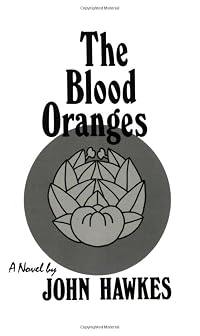
The Blood Oranges
by John Hawkes
On This Page
Description
No synopsis or comparison can convey the novel's lyric comedy or, indeed, its sinister power - sinister because of the strength of will Cyril exerts over his wife, his mistress, his wife's reluctant lover; lyric, since he is also a "sex-singer" in the land where music is the food of love.Tags
Recommendations











Member Reviews
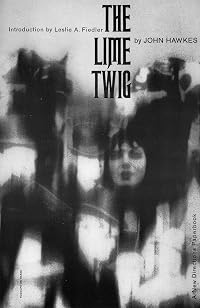
I came to this book fresh off The Lime Twig and so impressed with John Hawkes I had resolved to read everything by him. What I discovered was a completely different tone than I was expecting and it was around the section of the book when the arrogant narrator, Cyril, tried to fuck a mimosa tree when I thought maybe I made a horrible mistake diving blindly into this author's catalogue. Fortunately, the novel builds, and Hawkes effortlessly leads his characters along trajectories so inevitable and so perfect he's able to boil them alive without incident.
There is so much craft in this seemingly easy breezy story and I am still very impressed with Hawkes' ability to thread his narratives through such narrow eyes.
I highly recommend this book show more to anyone who wants the experience of reading dark psychic violence masquerading as soft core porn. show less
There is so much craft in this seemingly easy breezy story and I am still very impressed with Hawkes' ability to thread his narratives through such narrow eyes.
I highly recommend this book show more to anyone who wants the experience of reading dark psychic violence masquerading as soft core porn. show less
I came to this book fresh off The Lime Twig and so impressed with John Hawkes I had resolved to read everything by him. What I discovered was a completely different tone than I was expecting and it was around the section of the book when the arrogant narrator, Cyril, tried to fuck a mimosa tree when I thought maybe I made a horrible mistake diving blindly into this author's catalogue. Fortunately, the novel builds, and Hawkes effortlessly leads his characters along trajectories so inevitable and so perfect he's able to boil them alive without incident.
There is so much craft in this seemingly easy breezy story and I am still very impressed with Hawkes' ability to thread his narratives through such narrow eyes.
I highly recommend this book show more to anyone who wants the experience of reading dark psychic violence masquerading as soft core porn. show less
There is so much craft in this seemingly easy breezy story and I am still very impressed with Hawkes' ability to thread his narratives through such narrow eyes.
I highly recommend this book show more to anyone who wants the experience of reading dark psychic violence masquerading as soft core porn. show less
This book is quoted at the start of the 158 pound marriage, and it does have many similarities - they are both the story of two married couples, who are also both sleeping with the person of the opposite sex from the other couple. They both have a male narrator who thinks this is a great idea and is very relaxed, and the other man being more uncomfortable and antagonistic. They do both end miserably.
But they are very different reads. The 158 pound marriage is very prosaic, the characters have backstories, and specific things they want. This book is... it is a floating word cloud trying to capture strange feelings through bloated prose. The narrative flits around at different points in time, the story is woven from a surreal patchwork of show more scenes. It is very sensual, with hyperfocus on details.
I found myself fixating on what the author was trying to do. Was he really trying to show Cyril as an enlightened future? Or was he really expecting the reader to find Cyril entitled and repulsive, an unreliable narrator we should all hate? I mean, the book ends in tragedy, it's not a 'do this and everything will be great for you', but is the tragedy driven by Cyril casually taking what he wants, or by Hugh trapped in an unenlightened world view? Or is it truly not judging, just showing what happens when two different families meet and interact?
Both the women feel a bit like cyphers, mostly there for us to explore the men's emotions. The elder child gets very little screen time, but is painfully drawn, that angry suspicion of Cyril and how he is messing up her family.
I found it a slog to get through at points, the very detailed florid prose, the constantly having to reorientate myself in the timestream, the fact that the characters are quite unlikable to me. But it has some powerful and heady scenes. show less
But they are very different reads. The 158 pound marriage is very prosaic, the characters have backstories, and specific things they want. This book is... it is a floating word cloud trying to capture strange feelings through bloated prose. The narrative flits around at different points in time, the story is woven from a surreal patchwork of show more scenes. It is very sensual, with hyperfocus on details.
I found myself fixating on what the author was trying to do. Was he really trying to show Cyril as an enlightened future? Or was he really expecting the reader to find Cyril entitled and repulsive, an unreliable narrator we should all hate? I mean, the book ends in tragedy, it's not a 'do this and everything will be great for you', but is the tragedy driven by Cyril casually taking what he wants, or by Hugh trapped in an unenlightened world view? Or is it truly not judging, just showing what happens when two different families meet and interact?
Both the women feel a bit like cyphers, mostly there for us to explore the men's emotions. The elder child gets very little screen time, but is painfully drawn, that angry suspicion of Cyril and how he is messing up her family.
I found it a slog to get through at points, the very detailed florid prose, the constantly having to reorientate myself in the timestream, the fact that the characters are quite unlikable to me. But it has some powerful and heady scenes. show less
With Travesty and now this, Hawkes is rapidly becoming one of my favourite writers. The novel concerns two couples idling away a summer as they become involved with one another, leading to repercussions. The narrator, Cyril, is an enjoyable guide to events, at once a comic, satyr-like figure but also potentially destructive in his arrogance. Not a great deal of action takes place but what does has consequences and it's all narrated in fine detail from inside Cyril's consciousness. Although some may remark on it's being of its time in terms of its sexual content, I didn't find it lurid at all and mainly the stuff of comedy. As with Travesty, the writing is of the highest standard in its lyricism, though not without a comic element to show more it's high-flown language. show less
I finished this book over a week ago, mostly in an effort to write a review that would give it the justice it deserves, but I feel that time might have been spent it in vain. This is a strange, lyrical book – an idyll, really - that takes place on a Mediterranean island named “Illyria.” The name is obviously meant to evoke Shakespeare’s “Twelfth Night” and its paradisiacal setting, but Hawkes plants something haunting and evil here that never lets the reader get too comfortable.
The plot is as unencumbered with passé concerns like pacing or character development as its characters are fascinated by their own sexual lives. Fiona is married to Cyril, and Catherine is married to Hugh. The novel traces the whole range of their show more interactions, from mundane conversations, but mostly is concerned with their complicated sexual entanglements. Everything is told through flashbacks, and opens with Cyril trying to console Catherine for some reason the reader has yet to ascertain. Hawkes bounces back and forth in time, telling how the two couples met (Fiona and Cyril look on as Catherine and Hugh are rescued from a bus that has fallen into a nearby waterway) to the whittling away of endless hours on the beach with Hugh and Catherine’s children in the background.
Most of the action, such as it is, revolves around the eventual untangling of the formerly monogamous relationships of the two couples. Catherine initially stammers and hedges in her attraction toward Cyril, but Fiona is more open-minded and adventurous with Hugh. Hugh, on the other hand, tends to be slightly more cautious, and on several occasions voices his reservations to Cyril, only to be reassured that Fiona is perfectly okay with the arrangement. This is pretty much how things proceed, playing footsy in the sand, the sly unbuckling of a bikini strap in the white Greek sands. But Hugh eventually finds it to be too much, realizes that he’s gone too far, and proceeds to take matters into his own hands.
Aside from the children that Hugh and Catherine have, none of the characters are bothered by anything approaching responsibility or are interrupted by growth or self-afflatus. It seemed like a big exercise is omphaloskepsis. But for those interested in something truly off the beaten narrative path, this is worth looking at. While the singular obsession of the characters seemed unrealistic, there is at least a rhythmic lyricism to the prose that makes it a unique reading experience. show less
The plot is as unencumbered with passé concerns like pacing or character development as its characters are fascinated by their own sexual lives. Fiona is married to Cyril, and Catherine is married to Hugh. The novel traces the whole range of their show more interactions, from mundane conversations, but mostly is concerned with their complicated sexual entanglements. Everything is told through flashbacks, and opens with Cyril trying to console Catherine for some reason the reader has yet to ascertain. Hawkes bounces back and forth in time, telling how the two couples met (Fiona and Cyril look on as Catherine and Hugh are rescued from a bus that has fallen into a nearby waterway) to the whittling away of endless hours on the beach with Hugh and Catherine’s children in the background.
Most of the action, such as it is, revolves around the eventual untangling of the formerly monogamous relationships of the two couples. Catherine initially stammers and hedges in her attraction toward Cyril, but Fiona is more open-minded and adventurous with Hugh. Hugh, on the other hand, tends to be slightly more cautious, and on several occasions voices his reservations to Cyril, only to be reassured that Fiona is perfectly okay with the arrangement. This is pretty much how things proceed, playing footsy in the sand, the sly unbuckling of a bikini strap in the white Greek sands. But Hugh eventually finds it to be too much, realizes that he’s gone too far, and proceeds to take matters into his own hands.
Aside from the children that Hugh and Catherine have, none of the characters are bothered by anything approaching responsibility or are interrupted by growth or self-afflatus. It seemed like a big exercise is omphaloskepsis. But for those interested in something truly off the beaten narrative path, this is worth looking at. While the singular obsession of the characters seemed unrealistic, there is at least a rhythmic lyricism to the prose that makes it a unique reading experience. show less
My favorite Hawkes novel. A beautiful, passionate, and tortured love story explores relationships among two couples on a Greek island.
I read this is college and the only thing I remember is having to force myself top keep reading. Might have to try it again someday...
Members
- Recently Added By
Published Reviews
John Hawkes's The Blood Oranges fails because it is the work of a contemptible imagination.
added by jburlinson
Lists

Great American Novels
158 works; 42 members

Hidden Classics
73 works; 15 members

Significant works of postmodern fiction
86 works; 25 members

1970s
657 works; 23 members

Swinging Seventies
255 works; 18 members
Author Information

28+ Works 3,067 Members
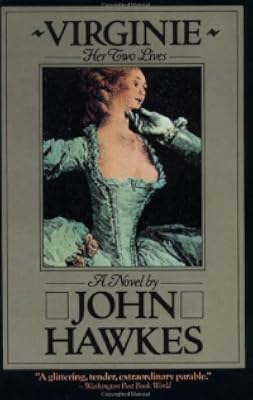
Author John Hawkes was born in Stamford, Connecticut on August 17, 1925. During World War II, he joined the American Field Service and was an ambulance driver in Italy and Germany from the summer of 1944 to the summer of 1945. He taught at Brown University for thirty years. He wrote eighteen novels, four plays, and a volume of poetry during his show more lifetime. His first novel, The Cannibal, was published in 1949. His other works include The Lime Twig, The Beetle Leg, and Virginie: Her Two Lives. His novel Adventures in the Alaskan Skin Trade won France's Prix Medicis Étranger in 1986. He died on May 15, 1998. (Bowker Author Biography) show less
Some Editions
Awards and Honors
Awards
Series
Belongs to Publisher Series
Gallimard, Folio (845)
Work Relationships
Is contained in
Has the adaptation
Common Knowledge
- Original publication date
- 1971
- Related movies
- The Blood Oranges (1997 | IMDb)
- Epigraph
- Is there then any terrestrial paradise where, amidst the whispering of the olive-leaves, people can be with whom they like and have what they like and take their ease in shadows and in coolness?
-Ford Madox Ford: The Good ... (show all)Soldier - First words
- Love weaves its own tapestry, spins its own golden thread, with its own sweet breath breathes into being its mysteries—bucolic, lusty, gentle as the eyes of daisies or thick with pain.
Classifications
Statistics
- Members
- 362
- Popularity
- 86,992
- Reviews
- 7
- Rating
- (3.60)
- Languages
- Dutch, English, French, Italian
- Media
- Paper, Ebook
- ISBNs
- 11
- ASINs
- 7