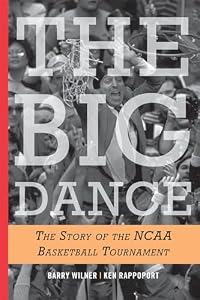
The Big Dance: The Story of the NCAA Basketball Tournament
by Barry Wilner
On This Page
Description
Covered by four networks, allowing every game to be televised, & ldquo;March Madness & rdquo; has become an American phenomenon. This is the story of the tournament, from its beginnings seventy-three years ago as an eight-team "bracket" to today's sixty-eight-team format & mdash;from "Cinderella" teams, to perennial powerhouses, to buzzer-beaters, upsets, and dynasties.Tags
Member Reviews
This review is based on a complimentary copy provided by the publisher through LibraryThing's Early Reviewers program. Thankfully. Quite frankly, this book is borderline terrible.
The only thing positive I can offer is that it does contain some interesting, if trivial, facts that I didn't know. That's about it.
As for the negatives, I can only echo and expand upon what's already been said. First and foremost, the writing is truly dreadful. As another reviewer noted, in two separate chapters (one on the UCLA dynasty the other on "great performances") the authors use almost the exact same language. It's incredibly lazy writing (and editing), and it makes for a repetitive and boring read. Let me give one example. In the chapter on the UCLA show more dynasty, the authors write: “Alcindor, who later changed his name to Kareem Abdul-Jabbar, was the most heralded freshman to ever play at UCLA—maybe anywhere in the history of college basketball. In an era when freshmen couldn’t play for the varsity, Alcindor was clearly the most notable sports name on campus even before he played in his first basketball game.” Two chapters later (in the section on Alcindor in the chapter on great performances) the authors write: “Alcindor, who later changed his name to Kareem Abdul-Jabbar, was the most heralded freshman to ever play at UCLA—and maybe anywhere in the history of college basketball. In an era when freshmen couldn’t play for the varsity, Alcindor was clearly the most notable sports name on campus when he arrived in Westwood.” That’s right, we have the addition of the word “and” and a change from “even before he played his first basketball game” to “when he arrived in Westwood.” This type of thing happens time and time again. In the UCLA chapter and the separate section on Bill Walton, the reader is subject to the exact same quote from John Wooden and is told in exactly the same words that Walton “played with inflamed knees that needed constant medical attention.”
In addition to the repetition, the authors have a penchant for inserting completely useless quotes; apparently, for the sole purpose of using a quote. The authors even resort to quoting college basketball guides. One example should suffice: “’It looked like a short, quick tournament for City College,’ the CCNY basketball guide said.” I still have no idea why recourse to the CCNY basketball guide for that quote is either necessary to make that point or somehow provides more authority or enhances the underlying fact (e.g., by using a particularly noteworthy or pithy turn of phrase).
Finally, as far as the writing goes, the authors contradict themselves within pages and confuse basketball issues that authors of a book about basketball should understand. For contradiction, on page 56, the authors write: “It may sound laughable today, but Kurland was praised in an article by Life magazine for being ‘balanced and coordinated in spite of his height.”” I took this to mean that what was “laughable” was the generalization that tall players are generally uncoordinated, yet five pages later the authors write that Lew Alcindor was “unusually coordinated for a big man.” Laughable. But for different reasons. The authors also confuse goaltending with basket interference (an excusable mistake if made by a casual fan, but inexcusable in a book about basketball). Readers are told that the goaltending rule was “obviously directed at [Bob] Kurland,” who played in the 1940s, and other tall players. That’s correct. However, five pages earlier, the reader is told that “another rules change came in response to [Bill] Russell: players would not be allowed to touch the ball on its downward arc toward the basket. This became known as ‘goaltending.’” This is an accurate description of goaltending, but Russell played a decade after Kurland, and the goaltending rule was already in place (although the authors don’t give a date for adoption of the goaltending rule, but readers can infer that if the rule was directed at Kurland it must have followed shortly thereafter). What the authors must intend here is a reference to basket interference.
I could go on and on with the copious examples of atrocious writing, but I’ll leave it at that. As for the other flaws, I’ll be brief. As others have observed, notwithstanding the subtitle, this book is not a history of the NCAA tournament in really any sense. There’s very little discussion of the origin of the tournament, its interplay with the NIT, how teams have been selected and seeded throughout its history, how sites are chosen, how and why the tournament has expanded, etc. The closest the authors come is the final ten pages of the book, much of which is in a text box on the NIT inserted into the chapter on the movement toward players leaving early (which has nothing to do with the NIT as far as I can tell). Instead, there are brief snippets about coaches, teams, and players (which often repeat information in other chapters). That’s fine, but it’s not what the subtitle indicates. As for structure, other than the fact that the book contains chapters and sections, there is none. Rather, the snippets are thrown together in what appears to be a completely random order.
To put it in a sentence: I love college basketball, but I had to try very hard to make myself finish this book. show less
The only thing positive I can offer is that it does contain some interesting, if trivial, facts that I didn't know. That's about it.
As for the negatives, I can only echo and expand upon what's already been said. First and foremost, the writing is truly dreadful. As another reviewer noted, in two separate chapters (one on the UCLA dynasty the other on "great performances") the authors use almost the exact same language. It's incredibly lazy writing (and editing), and it makes for a repetitive and boring read. Let me give one example. In the chapter on the UCLA show more dynasty, the authors write: “Alcindor, who later changed his name to Kareem Abdul-Jabbar, was the most heralded freshman to ever play at UCLA—maybe anywhere in the history of college basketball. In an era when freshmen couldn’t play for the varsity, Alcindor was clearly the most notable sports name on campus even before he played in his first basketball game.” Two chapters later (in the section on Alcindor in the chapter on great performances) the authors write: “Alcindor, who later changed his name to Kareem Abdul-Jabbar, was the most heralded freshman to ever play at UCLA—and maybe anywhere in the history of college basketball. In an era when freshmen couldn’t play for the varsity, Alcindor was clearly the most notable sports name on campus when he arrived in Westwood.” That’s right, we have the addition of the word “and” and a change from “even before he played his first basketball game” to “when he arrived in Westwood.” This type of thing happens time and time again. In the UCLA chapter and the separate section on Bill Walton, the reader is subject to the exact same quote from John Wooden and is told in exactly the same words that Walton “played with inflamed knees that needed constant medical attention.”
In addition to the repetition, the authors have a penchant for inserting completely useless quotes; apparently, for the sole purpose of using a quote. The authors even resort to quoting college basketball guides. One example should suffice: “’It looked like a short, quick tournament for City College,’ the CCNY basketball guide said.” I still have no idea why recourse to the CCNY basketball guide for that quote is either necessary to make that point or somehow provides more authority or enhances the underlying fact (e.g., by using a particularly noteworthy or pithy turn of phrase).
Finally, as far as the writing goes, the authors contradict themselves within pages and confuse basketball issues that authors of a book about basketball should understand. For contradiction, on page 56, the authors write: “It may sound laughable today, but Kurland was praised in an article by Life magazine for being ‘balanced and coordinated in spite of his height.”” I took this to mean that what was “laughable” was the generalization that tall players are generally uncoordinated, yet five pages later the authors write that Lew Alcindor was “unusually coordinated for a big man.” Laughable. But for different reasons. The authors also confuse goaltending with basket interference (an excusable mistake if made by a casual fan, but inexcusable in a book about basketball). Readers are told that the goaltending rule was “obviously directed at [Bob] Kurland,” who played in the 1940s, and other tall players. That’s correct. However, five pages earlier, the reader is told that “another rules change came in response to [Bill] Russell: players would not be allowed to touch the ball on its downward arc toward the basket. This became known as ‘goaltending.’” This is an accurate description of goaltending, but Russell played a decade after Kurland, and the goaltending rule was already in place (although the authors don’t give a date for adoption of the goaltending rule, but readers can infer that if the rule was directed at Kurland it must have followed shortly thereafter). What the authors must intend here is a reference to basket interference.
I could go on and on with the copious examples of atrocious writing, but I’ll leave it at that. As for the other flaws, I’ll be brief. As others have observed, notwithstanding the subtitle, this book is not a history of the NCAA tournament in really any sense. There’s very little discussion of the origin of the tournament, its interplay with the NIT, how teams have been selected and seeded throughout its history, how sites are chosen, how and why the tournament has expanded, etc. The closest the authors come is the final ten pages of the book, much of which is in a text box on the NIT inserted into the chapter on the movement toward players leaving early (which has nothing to do with the NIT as far as I can tell). Instead, there are brief snippets about coaches, teams, and players (which often repeat information in other chapters). That’s fine, but it’s not what the subtitle indicates. As for structure, other than the fact that the book contains chapters and sections, there is none. Rather, the snippets are thrown together in what appears to be a completely random order.
To put it in a sentence: I love college basketball, but I had to try very hard to make myself finish this book. show less
 This review was written for LibraryThing Early Reviewers.
To me this book felt like a conversation between two know-it-all college guys. For the most part it seems to be a contest of who could come up with the best story from the NCAA basketball tournament over the years since it was first started rather than a detailed history of the tournament. Certain events are retold, certain players are brought up time and again, even when irrelevant to the point or the story, as if he was the favorite player of the person telling the story. It is not chronological, geographical, told in sections based on teams, schools, or coaches, or even ranked from best to worst or most shocking moment in the tournament. The whole book is just a random compilation of facts, stories, and buzzer-beaters. For someone show more very interested in reliving the tournament, not in learning about it, this is a great book. For everyone else, you'd have to be very committed to make it all the way through. show less
This review was written for LibraryThing Early Reviewers.Hugely disappointing. The book should be called "Some Random Stuff About College Basketball, Mainly UCLA". By giving it the title "The Big Dance - the Story of the NCAA Basketball Tournament", the authors are promising something that they just don't deliver.
The book should give a year by year account of the NCAA Men's Basketball Tournament from 1939 to today, with a preliminary chapter or two about what happened before the tournament began and how it was originally conceived. Then each year should be encapsulated so that the reader gets an idea of what the major story-lines were; which teams were the biggest surprises and biggest disappointments, the best and worst games, the best individual performances, etc.
Instead we get this random show more hopping around with no clear story and no real purpose. I'm a huge fan of history and of college basketball. March Madness is just about the best time of year for a sports fan. This book should have been a slam dunk with me, but I couldn't even finish it. show less
The book should give a year by year account of the NCAA Men's Basketball Tournament from 1939 to today, with a preliminary chapter or two about what happened before the tournament began and how it was originally conceived. Then each year should be encapsulated so that the reader gets an idea of what the major story-lines were; which teams were the biggest surprises and biggest disappointments, the best and worst games, the best individual performances, etc.
Instead we get this random show more hopping around with no clear story and no real purpose. I'm a huge fan of history and of college basketball. March Madness is just about the best time of year for a sports fan. This book should have been a slam dunk with me, but I couldn't even finish it. show less
This review was written for LibraryThing Early Reviewers."March Madness". I have heard the phrase over the years, and associated it with either a clothing store sale or some other local sales event. To my surprise, after reading "The Big Dance" I know not that it is all about basketball and the NCAA Tournament. From page one to the end, I was fascinated with the history and selection practice of this springtime sports ritual.
Beginning in 1939 with the University of Oregon winning the first companionship an 8 team field, and the tourney actually losing money $2,531) to the billions made now, "The Big Dance" covers it all effortlessly and comprehensively.The authors, Bary Wilner and Ken Rappoport, did an excellent job of putting to paper many facts, stories, quotes and true life experiences on show more and off the court.
Ten of the NCAA playoffs greatest performances are included, along with stories about tourney blunders, classic confrontations, McGuire's miracles, and ten additional chapters.It is too difficult to pick the best reading from each chapter, for each chapter gave new insight, information and entertainment. Putting the book down was not an option, at times, as the information was presented in such a way that it was interesting to see what was in the next chapter.
I heartily recommend this book on basketball for all who live and love the game, but also for those such as me who knew nothing about "March Madness:"and the impact of basketball to television. Great reading, great gift idea. show less
Beginning in 1939 with the University of Oregon winning the first companionship an 8 team field, and the tourney actually losing money $2,531) to the billions made now, "The Big Dance" covers it all effortlessly and comprehensively.The authors, Bary Wilner and Ken Rappoport, did an excellent job of putting to paper many facts, stories, quotes and true life experiences on show more and off the court.
Ten of the NCAA playoffs greatest performances are included, along with stories about tourney blunders, classic confrontations, McGuire's miracles, and ten additional chapters.It is too difficult to pick the best reading from each chapter, for each chapter gave new insight, information and entertainment. Putting the book down was not an option, at times, as the information was presented in such a way that it was interesting to see what was in the next chapter.
I heartily recommend this book on basketball for all who live and love the game, but also for those such as me who knew nothing about "March Madness:"and the impact of basketball to television. Great reading, great gift idea. show less
This review was written for LibraryThing Early Reviewers.Part of my disappointment with this book is a misreading of the subtitle: I thought it was a history of the NCAA Basketball Tournament, a chronicle of how the tournament grew from eight teams playing in untelevised obscurity to a regional event with 16 and then 32 teams, to the all-encompassing national extravanganza with 68 teams and every game televised and everyone and their dog filling out a bracket.
I still want to read that book, but that's not what The Big Dance is. What it is is a series of vignettes about particular teams, or particular players, or particular coaches who have been notable in the NCAA Tournament through the years. There is no organizing principle as far as I can tell; it is not arranged chronologically or show more alphabetically or in any other particular way. The stand-alone nature of the vignettes means there is a fair amount of repetition among them; UCLA and John Wooden get more than their fair share of space even considering their accomplishments. The vignettes themselves are fine, if a bit thin. They read like newspaper accounts in a lot of ways, and that's not surprising when you realize that the two authors are both reporters for the Associated Press wire service.
This would be a good book to give a young or new fan who is just starting to get excited about college basketball. Although it is not written specifically for a YA audience, the level of writing is perfectly suitable to that age group. There is no profanity and no off-color innuendo here. Anyone who considers themselves at all knowledgeable about NCAA hoops probably won't find much new here, except perhaps in specific vignettes. Generally speaking, what you get is a surface introduction to the various teams, players, and eras, which might inspire you to look for more in-depth information elsewhere.
As for me, I'm still looking for a great history of the NCAA basketball tournament. I know there must be one out there somewhere ... show less
I still want to read that book, but that's not what The Big Dance is. What it is is a series of vignettes about particular teams, or particular players, or particular coaches who have been notable in the NCAA Tournament through the years. There is no organizing principle as far as I can tell; it is not arranged chronologically or show more alphabetically or in any other particular way. The stand-alone nature of the vignettes means there is a fair amount of repetition among them; UCLA and John Wooden get more than their fair share of space even considering their accomplishments. The vignettes themselves are fine, if a bit thin. They read like newspaper accounts in a lot of ways, and that's not surprising when you realize that the two authors are both reporters for the Associated Press wire service.
This would be a good book to give a young or new fan who is just starting to get excited about college basketball. Although it is not written specifically for a YA audience, the level of writing is perfectly suitable to that age group. There is no profanity and no off-color innuendo here. Anyone who considers themselves at all knowledgeable about NCAA hoops probably won't find much new here, except perhaps in specific vignettes. Generally speaking, what you get is a surface introduction to the various teams, players, and eras, which might inspire you to look for more in-depth information elsewhere.
As for me, I'm still looking for a great history of the NCAA basketball tournament. I know there must be one out there somewhere ... show less
This review was written for LibraryThing Early Reviewers.Being a big fan of March Madness and the college basketball system, I was excited to receive this book. That being said, it was very difficult to stay with this book. It is a compilation of facts that at times just lose the reader. The book as a whole needs to be better organized as it seems to jump from one fact to another. Some things are well documented and others are just random facts stated in a manner that does nothing to hold the reader's interest. I would not recommend this book.
This review was written for LibraryThing Early Reviewers."This is March. It's our favorite month." ~ Kellie Jolly, Tennessee Volunteers
Every March, the college basketball season wraps up with the NCAA tournament - also known as March Madness. This year 68 men's teams and 64 women's teams were chosen to play for the right to be national champions. Millions of people filled out brackets and predicted which teams would advance to the Sweet Sixteen, the Elite Eight, and the Final Four. These same fans watched the opening games of the tournament, cringing as two No. 2 seeds - the Missouri Tigers and the Duke Blue Devils - lost in the opening round of the tournament to No. 15 seeds Norfolk and Lehigh, who held onto their dreams of becoming the tournament's Cinderella stories.
Stories - for me, show more that's what makes the NCAA tournament special. While some might argue that the tournament is made up of games, carefully seeded match-ups, I follow the NCAA tournament for the stories. The powerhouse teams that advance through the bracket on the shoulders of giants. The Cinderella stories who have the support of everyone who loves an underdog. The players themselves - athletes who each come to the court with a history, a set of supporters, a set of challenges, and a dream. It is these stories that Barry Wilner and Ken Rappoport tell in their book, The Big Dance: The Story of the NCAA Basketball Tournament. The book does not flow in a continuous narrative, but rather is made up of chapters that highlight legendary stories of the tournament. The authors also weave in a number of interesting facts about the tournament that will make you the hit of your Final Four parties.
If you are looking for something to do to pass the time between rounds of the tournament, I recommend dipping into The Big Dance. show less
Every March, the college basketball season wraps up with the NCAA tournament - also known as March Madness. This year 68 men's teams and 64 women's teams were chosen to play for the right to be national champions. Millions of people filled out brackets and predicted which teams would advance to the Sweet Sixteen, the Elite Eight, and the Final Four. These same fans watched the opening games of the tournament, cringing as two No. 2 seeds - the Missouri Tigers and the Duke Blue Devils - lost in the opening round of the tournament to No. 15 seeds Norfolk and Lehigh, who held onto their dreams of becoming the tournament's Cinderella stories.
Stories - for me, show more that's what makes the NCAA tournament special. While some might argue that the tournament is made up of games, carefully seeded match-ups, I follow the NCAA tournament for the stories. The powerhouse teams that advance through the bracket on the shoulders of giants. The Cinderella stories who have the support of everyone who loves an underdog. The players themselves - athletes who each come to the court with a history, a set of supporters, a set of challenges, and a dream. It is these stories that Barry Wilner and Ken Rappoport tell in their book, The Big Dance: The Story of the NCAA Basketball Tournament. The book does not flow in a continuous narrative, but rather is made up of chapters that highlight legendary stories of the tournament. The authors also weave in a number of interesting facts about the tournament that will make you the hit of your Final Four parties.
If you are looking for something to do to pass the time between rounds of the tournament, I recommend dipping into The Big Dance. show less
This review was written for LibraryThing Early Reviewers.Members
- Recently Added By
Author Information
64 Works 314 Members
Barry Wilner is a professional sportswriter for the Associated Press. Other titles he has written for Enslow Publishers, Inc., include Football's Top 10 Running Backs and Football's Top 10 Quarterbacks.
Classifications
- Genres
- Sports and Leisure, Nonfiction, General Nonfiction, Hunting and Fishing, History
- DDC/MDS
- 796.323 — Arts & recreation Recreation, sports, and performing arts Athletic and outdoor sports and games Ball sports Ball and net sports Basketball
- LCC
- GV885.49 .N37 .W47 — Geography, Anthropology and Recreation Recreation. Leisure Recreation. Leisure Sports Ball games: Baseball, football, golf, etc.
- BISAC
Statistics
- Members
- 19
- Popularity
- 1,325,296
- Reviews
- 14
- Rating
- (2.36)
- Languages
- English
- Media
- Paper, Ebook
- ISBNs
- 2