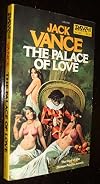
There is 1 current discussion about this work.
On This Page
Description
Five intergalactic criminal masterminds raid the tranquil world of Mount Pleasant, leaving behind only ruin and slaughter, and the orphaned child Kirth Gersen, who comes to manhood swearing to take bloody revenge. Now Gersen roams the galaxy, bringing vengeance to the Demon Princes one by one, in Jack Vance's classic series of hardboiled space opera. Among worlds populated by slave-takers and poisoners, Kirth Gersen is hunting the third Demon Prince, Viole Falushe, an Earthman who conceals show more his true identity while ruling a remote planet from his decadent Palace of Love. Posing as a journalist and accompanied by the mad poet Navarth, Gersen infiltrates the palace and uncovers a history of erotic obsession. Somewhere among the revelers lurks Falushe, whom Gersen schemes to identify, before delivering harsh justice. show lessTags
Recommendations











Member Reviews
ORIGINALLY POSTED AT Fantasy Literature.
Two down and three to go… In order to exact revenge on Viole Falushe, the third Demon Prince, Kirth Gersen must first discover who Mr. Falushe is, and then find and infiltrate his famous Palace of Love.
The actual plot, while just as brisk and fun as usual, isn't the most entertaining aspect of The Palace of Love. This volume is particularly charming because of Jack Vance's exquisite characters — three in particular:
1. Vogel Filschner was rejected by the prettiest girl in school when he was a pimply 14-year old geek. His retaliation feels just like what school psychologists are warning us about these days. He's a fascinating villain!
2. Navarath is a washed-up poet who lives on a houseboat. show more We're not sure if he's a genius, a fake, crazy, or just drunk. Whatever he is, he's amusing and Vance has lots of fun with Navarath, giving him an eccentric artist personality. He talks dramatically and emphatically, gestures extravagantly, seeks attention, drinks a lot, and broods. When he got on a spaceship for the first time he "simultaneously became afflicted with claustrophobia and agoraphobia, and lay on a settee with his feet bare and a cloth pulled over his head." He even constructs absurd (but somehow ingenious) poems, including one whose stanzas end with lines such as "But Tim R. Mortiss degurgled me" and "But Tim R. Mortiss peturgles me."
3. Zan Zu, the girl from Eridu, is a dreamy dirty adolescent misfit with no name. (Since Kirth asked for her name, Navarath introduced her as "Zan Zu from Eridu.") Vance can't help but use her entire title nearly every time she's mentioned (and I can't either), so Kirth thinks of her as Zan Zu, the girl from Eridu, and we regularly encounter the words "Zan Zu, the girl from Eridu" in the text. It just trips off the tongue so nicely and somehow made me smile every time I saw it. (I read somewhere that Jack Vance chose his characters' names this way — by saying them over and over to see how they sound.)
These are three of Vance's best supporting characters, all packed into about 150 pages. That's enough reason to read The Palace of Love.
www.fantasyliterature.com show less
Two down and three to go… In order to exact revenge on Viole Falushe, the third Demon Prince, Kirth Gersen must first discover who Mr. Falushe is, and then find and infiltrate his famous Palace of Love.
The actual plot, while just as brisk and fun as usual, isn't the most entertaining aspect of The Palace of Love. This volume is particularly charming because of Jack Vance's exquisite characters — three in particular:
1. Vogel Filschner was rejected by the prettiest girl in school when he was a pimply 14-year old geek. His retaliation feels just like what school psychologists are warning us about these days. He's a fascinating villain!
2. Navarath is a washed-up poet who lives on a houseboat. show more We're not sure if he's a genius, a fake, crazy, or just drunk. Whatever he is, he's amusing and Vance has lots of fun with Navarath, giving him an eccentric artist personality. He talks dramatically and emphatically, gestures extravagantly, seeks attention, drinks a lot, and broods. When he got on a spaceship for the first time he "simultaneously became afflicted with claustrophobia and agoraphobia, and lay on a settee with his feet bare and a cloth pulled over his head." He even constructs absurd (but somehow ingenious) poems, including one whose stanzas end with lines such as "But Tim R. Mortiss degurgled me" and "But Tim R. Mortiss peturgles me."
3. Zan Zu, the girl from Eridu, is a dreamy dirty adolescent misfit with no name. (Since Kirth asked for her name, Navarath introduced her as "Zan Zu from Eridu.") Vance can't help but use her entire title nearly every time she's mentioned (and I can't either), so Kirth thinks of her as Zan Zu, the girl from Eridu, and we regularly encounter the words "Zan Zu, the girl from Eridu" in the text. It just trips off the tongue so nicely and somehow made me smile every time I saw it. (I read somewhere that Jack Vance chose his characters' names this way — by saying them over and over to see how they sound.)
These are three of Vance's best supporting characters, all packed into about 150 pages. That's enough reason to read The Palace of Love.
www.fantasyliterature.com show less
The Palace of Love is the third of Vance’s Demon Princes series. It was first published by Berkley Books in 1967, three years after Berkley published the first two books of the series.
Please note that spoilers for the book’s plot follow.
The novel begins with Kirth Gersen spending time with Alusz Iphigenia Eperje-Tokay, the woman he rescued in The Killing Machine. Alusz cannot understand Gersen’s quest for vengeance and so the two part. Alas. It was not meant to be. (I still don’t find Alusz nearly as entertaining a love interest as the ill-fated Pallis Atwrode from The Star King.)
In his effort to track down Viole Falushe, third of the Demon Princes, Gersen follows a lead to Sarkoy, a world mentioned previously in the series show more where its inhabitants have made poison a way of life. There, Gersen learns something of Falushe’s past: he was born Vogel Filschner on Earth. Filschner was a vile creature even as a teen, and he kidnapped and sold into slavery an entire choral group of girls in a fruitless quest to possess the object of his affections, a girl named Jheral Tinzy. Unfortunately for the budding young psychopath, Tinzy didn’t attend choir practice the day of the kidnapping.
Gersen travels to Falushe’s hometown on Earth, since the criminal mastermind is still rumored to occasionally reappear here (regrettably we don’t see any of the quaint, bizarre customs for which Vance is famous in his descriptions of Europe in 3500 AD; I view this as a missed opportunity). It is here that Gersen makes the acquaintance of the mad poet Navarth, who maintains occasional contact with Faluche. In Navarth’s care is a young girl of unclear antecedents who resembles Jheral Tinzy to an uncanny degree. Gersen’s investigation on Earth and elsewhere is interesting, as are the financial arrangements he makes to invest and utilize his ill-gotten gains from the last novel. Gersen also prepares a cover story for himself as a journalist for a magazine he purchases outright. Such are the options when one has billions to spend in vigilantism!
After a series of botched attempts to encounter Faluche (once again, his precise identity is unclear), Gersen finally arranges to travel as a guest to Faluche’s Palace of Love on a distant world. There, Gersen finds an entire society that had dedicated itself to serving the criminal overlord. He also discovers that the fiend has created a series of clones of his childhood obsession (the original having committed suicide many years previously) in an attempt to find one version of Jheral Tinzy who will love him. Truly a perverse, tragic figure. And one that, of course, Gersen ends up killing in the end.
I didn’t find the second half of The Palace of Love to be particularly engaging; it meandered a bit and I was, to be honest, bored in parts. I also found many of the epigraphs to be especially (and unnecessarily) bizarre. Gersen's characterization, never particularly strong in the series, is limited in this middle work of the series. I found this to be the weakest of the first three Demon Princes novels, though I certainly don't think it's bad by any means, and it does include some delightful moments. I give The Palace of Love 3 out of 5 stars.
Review copyright 2010 J. Andrew Byers show less
Please note that spoilers for the book’s plot follow.
The novel begins with Kirth Gersen spending time with Alusz Iphigenia Eperje-Tokay, the woman he rescued in The Killing Machine. Alusz cannot understand Gersen’s quest for vengeance and so the two part. Alas. It was not meant to be. (I still don’t find Alusz nearly as entertaining a love interest as the ill-fated Pallis Atwrode from The Star King.)
In his effort to track down Viole Falushe, third of the Demon Princes, Gersen follows a lead to Sarkoy, a world mentioned previously in the series show more where its inhabitants have made poison a way of life. There, Gersen learns something of Falushe’s past: he was born Vogel Filschner on Earth. Filschner was a vile creature even as a teen, and he kidnapped and sold into slavery an entire choral group of girls in a fruitless quest to possess the object of his affections, a girl named Jheral Tinzy. Unfortunately for the budding young psychopath, Tinzy didn’t attend choir practice the day of the kidnapping.
Gersen travels to Falushe’s hometown on Earth, since the criminal mastermind is still rumored to occasionally reappear here (regrettably we don’t see any of the quaint, bizarre customs for which Vance is famous in his descriptions of Europe in 3500 AD; I view this as a missed opportunity). It is here that Gersen makes the acquaintance of the mad poet Navarth, who maintains occasional contact with Faluche. In Navarth’s care is a young girl of unclear antecedents who resembles Jheral Tinzy to an uncanny degree. Gersen’s investigation on Earth and elsewhere is interesting, as are the financial arrangements he makes to invest and utilize his ill-gotten gains from the last novel. Gersen also prepares a cover story for himself as a journalist for a magazine he purchases outright. Such are the options when one has billions to spend in vigilantism!
After a series of botched attempts to encounter Faluche (once again, his precise identity is unclear), Gersen finally arranges to travel as a guest to Faluche’s Palace of Love on a distant world. There, Gersen finds an entire society that had dedicated itself to serving the criminal overlord. He also discovers that the fiend has created a series of clones of his childhood obsession (the original having committed suicide many years previously) in an attempt to find one version of Jheral Tinzy who will love him. Truly a perverse, tragic figure. And one that, of course, Gersen ends up killing in the end.
I didn’t find the second half of The Palace of Love to be particularly engaging; it meandered a bit and I was, to be honest, bored in parts. I also found many of the epigraphs to be especially (and unnecessarily) bizarre. Gersen's characterization, never particularly strong in the series, is limited in this middle work of the series. I found this to be the weakest of the first three Demon Princes novels, though I certainly don't think it's bad by any means, and it does include some delightful moments. I give The Palace of Love 3 out of 5 stars.
Review copyright 2010 J. Andrew Byers show less
I found the first two of the Demon Princes novels to be very good, and The Face to be only marginally less enjoyable. This one, not so much so.
Our protagonist Gersen has become one dimensional and considerably less interesting. The plot feels contrived and yet fairly ho-hum at the same time. We never really get to know the creepy and mysterious bad guy, whose obsession with revenge has taken him to some very dark places (does that sound familiar?). I thought the best thing about the book was a couple of the supporting characters--the mad poet Navarth (who throws a great party) and the mysterious Drusilla.
Our protagonist Gersen has become one dimensional and considerably less interesting. The plot feels contrived and yet fairly ho-hum at the same time. We never really get to know the creepy and mysterious bad guy, whose obsession with revenge has taken him to some very dark places (does that sound familiar?). I thought the best thing about the book was a couple of the supporting characters--the mad poet Navarth (who throws a great party) and the mysterious Drusilla.
This may come as a surprise to some readers, but The Palace of Love is not about the Neverland Ranch! In fact it is the third installment of the Demon Princes series by Jack Vance. The premise is as simple as an old-time Western. Kirth Gersen is the survivor of the Mt. Pleasant massacre, an incident where five interstellar gangsters known as “The Demon Princes” murdered or enslaved an entire community. Gersen has dedicated his whole life to revenge. He’s bumped off Malagate the Woe, and Kokor Hekkus the Killing Machine, now he’s gunning for Viole Falushe.
http://sfreader.com/Home/BookReview/tabid/55/Default.aspx?book=1065
http://sfreader.com/Home/BookReview/tabid/55/Default.aspx?book=1065
More than anything, its Vance's writing that keeps me captivated. The soft flowing nature of his prose takes the reader into a fantasy SF world, rich with charm and adventurous plots. There are few writers like Vance. However, I suppose he's not for everyone. If your looking for Hard SF, I don't think you'll be satisfied. Still, Vance is classic SF. A good read for anyone who loves the classics.
Van http://mom.biblion.nl/ :
Jack Vance is een SF-grootmeester. Zijn stijl en thematiek zijn uniek en zijn lezersschare is groot. Hij mengt graag SF- en fantasy-elementen, en een geliefd thema is het reizen door het heelal om vreemde planeten te bezoeken. Dit komt goed naar voren in zijn beroemde Duivelsprinsen-serie, bestaande uit vijf, op zichzelf staande boeken. In het eerste deel - "De sterrekoning" - wordt bijna de gehele bevolking van Fraaibergen vermoord door de vijf Duivelsprinsen. Kirth Gersen wil wraak en in ieder deel achtervolgt hij een van de prinsen. In dit derde deel is dat de Prins van de Misdaad, die verblijft in het Paleis van de Liefde, ergens in de ruimte. De stijl is zeer verzorgd, bloemrijk en beeldend. De vreemde show more volkeren krijgen een eigen cultuur. Meulenhoff heeft deze serie in de jaren zeventig al uitgegeven, waarbij dit deel in de omnibus "De Duivelsprinsen" (a.i. 86-49-191-1) zat. De serie wordt nu in een goedkope heruitgave in vijf deeltjes uitgebracht. Het lettertype is klein. Soortgelijke auteurs zijn Fritz Leider en Jim Ballard. - René van Rossenberg. show less
Jack Vance is een SF-grootmeester. Zijn stijl en thematiek zijn uniek en zijn lezersschare is groot. Hij mengt graag SF- en fantasy-elementen, en een geliefd thema is het reizen door het heelal om vreemde planeten te bezoeken. Dit komt goed naar voren in zijn beroemde Duivelsprinsen-serie, bestaande uit vijf, op zichzelf staande boeken. In het eerste deel - "De sterrekoning" - wordt bijna de gehele bevolking van Fraaibergen vermoord door de vijf Duivelsprinsen. Kirth Gersen wil wraak en in ieder deel achtervolgt hij een van de prinsen. In dit derde deel is dat de Prins van de Misdaad, die verblijft in het Paleis van de Liefde, ergens in de ruimte. De stijl is zeer verzorgd, bloemrijk en beeldend. De vreemde show more volkeren krijgen een eigen cultuur. Meulenhoff heeft deze serie in de jaren zeventig al uitgegeven, waarbij dit deel in de omnibus "De Duivelsprinsen" (a.i. 86-49-191-1) zat. De serie wordt nu in een goedkope heruitgave in vijf deeltjes uitgebracht. Het lettertype is klein. Soortgelijke auteurs zijn Fritz Leider en Jim Ballard. - René van Rossenberg. show less
Members
- Recently Added By
Lists

Top Five Books of 2019
387 works; 111 members

Books Read in 2023
5,638 works; 147 members
Talk Discussions
Current Discussions
No reason to be this sullen... in Good Show Sir! — bad science fiction and fantasy covers (October 2025)
Author Information

374+ Works 34,885 Members
John Holbrook Vance (August 28, 1916 - May 26, 2013) was an American mystery, fantasy and science fiction writer. Most of his work was published under the name Jack Vance. He also wrote 11 mystery novels as John Holbrook Vance and three as Ellery Queen, and once each used pseudonyms Alan Wade, Peter Held, John van See, and Jay Kavanse. Vance won show more the World Fantasy Award for Life Achievement in 1984. The Science Fiction Hall of Fame inducted him in 2001. Among his awards for particular works were: Hugo Awards, in 1963 for The Dragon Masters, in 1967 for The Last Castle, and in 2010 for his memoir This is Me, Jack Vance!; a Nebula Award in 1966, also for The Last Castle; the Jupiter Award in 1975; the World Fantasy Award in 1990 for Lyonesse: Madouc. He also won an Edgar (the mystery equivalent of the Nebula) for the best first mystery novel in 1961 for The Man in the Cage. He died at his home in Oakland, California, on May 26, 2013, aged 96. (Bowker Author Biography) show less
Some Editions
Series

Belongs to Publisher Series
Work Relationships
Common Knowledge
- Canonical title*
- Le palais de l'amour
- Original title
- The Palace of Love
- Alternate titles*
- De duivelsprins (1e druk) (1e druk)
- Original publication date
- 1967-10
- People/Characters
- Kirth Gersen; Viole Falushe (Vogel Filschner); Navarth; Zan Zu/Drusilla Wayles; Alusz Iphigenia Eperje-Tokay; Lerand Wible (show all 14); Edelrod; Jehan Addels; Hygen Grote; Dr. William Ledinger; Emma Tinzy; Roman Haenigsen; Helaunce; Retz
- Important places
- Planète Sarkovy; Palais de l'amour, planète Sogdian; Rolingshaven, Netherlands
- First words*
- SARKOVY : planète solitaire de Phi Ophiuchi.
- Last words*
- (Click to show. Warning: May contain spoilers.)Allons, je vous écoute.
- Original language*
- English US
- Disambiguation notice
- Early Dutch editions carry the title ''De Duivelsprins'', later editions have this corrected to ''Het Paleis van de Liefde''
*Some information comes from Common Knowledge in other languages. Click "Edit" for more information.
Classifications
Statistics
- Members
- 535
- Popularity
- 55,893
- Reviews
- 13
- Rating
- (3.68)
- Languages
- 5 — Dutch, English, French, German, Russian
- Media
- Paper, Audiobook, Ebook
- ISBNs
- 22
- ASINs
- 17