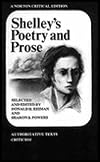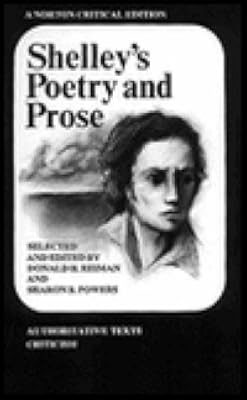
Shelley's Poetry and Prose [Norton Critical Edition, 1st ed.]
by Percy Bysshe Shelley, Sharon B. Powers (Editor), Donald H. Reiman (Editor)
On This Page
Description
Shelley's poetry has gone in and out of fashion since his death in 1822--first considered immature, excessive, and even incoherent but later judged by critics to be among the great poems of the English language. At its best, his poetry is unparalleled for its range of metrical experimentation, its moral rigor, and its lush, sensual imagery. He has been staunchly championed by poets from Byron to Wordsworth to Yeats.Tags
Recommendations











Member Reviews
This Norton Critical Edition combines several of Shelley’s poems, both long and short, three of Shelley’s essential essays (“On Love,” “On Life,” and “A Defence of Poetry”), and fifteen critical essays that aid in understanding. It was the perfect book to help me understand this Romantic poet.
I found I had to revise my picture of the romantic poet as one merely gushing emotion, despite Shelley’s habit of idealizing a series of sixteen-year-old girls like any lovelorn adolescent, with the difference that his language and technical poetic skill are far superior. Beyond that, I learned that he was well-informed on philosophy, science, and other topics. He was politically engaged.
As for the language, I was grateful for the show more notes, which elucidate his idiosyncratic vocabulary (“pinion” for “wing”), as well as his frequent references to mythology.
While some of his shorter lyrics (“such Ode to Freedom,” “To a Skylark,” and “Ode to the West Wind”) are excellent, I learned that Shelley’s strength was mastery of the long form, which makes him difficult to anthologize. The best of them, such as “Adonais” and the poem left unfinished at his death with the ironic title “Triumph of Life,” are impressive achievements. “Hellas,” on the other hand, was difficult for me. “Queen Mab,” perhaps not on the same level, contains a wonderful description of the universe, anticipating the photos sent back from the James Webb telescope and a memorable passage of how greed drives out truth.
Although a full appreciation of Shelley requires careful reading of entire poems, I was often struck by perfectly crafted couplets, such as the one that opens “Ode to Heaven”: “Palace-roof of cloudless nights/Paradise of golden lights.”
One of the challenges for me in coming to terms with Shelley, aside from his shabby treatment of the women he loved, is his congenital hatred of authority, culminating in his rejection of God. In “Prometheus Unbound,” he imagines that Jupiter (transparent for Yahweh) could be toppled from his throne, after which the Promethean spirit would spread to all mankind. No more sovereign, no more slave. Of course, we live in a world that has long since toppled God, but the human condition is no better for it.
To understand Shelley, I try to imagine where his picture of God comes from. It starts with his defiance of his father, compounded by his experiences in authoritarian, often cruel schools of the time, all justified by an appeal to a sovereign God at the top of the pyramid.
I also found it interesting that many of his visions of the world as it could be reminded me of Isaiah and other Hebrew prophets. For all his rejection of God, he had read his Bible well, and scriptural allusions abound.
Of the essays, I enjoyed Abrams on “Prometheus Unbound,” Chayes on “Ode to the West Wind,” and Matthews on Shelley’s Lyrics. Carlos Baker showed me that Shelley’s play, “The Cenci,” might be better than I thought it was when I read it. Finally, there is an annotated bibliography, which I always think is helpful.
If you don’t already own this, you should be aware that a second edition was published in 2002, incorporating the results of ongoing efforts to establish authoritative texts and a new selection of criticism. For that reason, I’ve withheld a fifth star from this edition. show less
I found I had to revise my picture of the romantic poet as one merely gushing emotion, despite Shelley’s habit of idealizing a series of sixteen-year-old girls like any lovelorn adolescent, with the difference that his language and technical poetic skill are far superior. Beyond that, I learned that he was well-informed on philosophy, science, and other topics. He was politically engaged.
As for the language, I was grateful for the show more notes, which elucidate his idiosyncratic vocabulary (“pinion” for “wing”), as well as his frequent references to mythology.
While some of his shorter lyrics (“such Ode to Freedom,” “To a Skylark,” and “Ode to the West Wind”) are excellent, I learned that Shelley’s strength was mastery of the long form, which makes him difficult to anthologize. The best of them, such as “Adonais” and the poem left unfinished at his death with the ironic title “Triumph of Life,” are impressive achievements. “Hellas,” on the other hand, was difficult for me. “Queen Mab,” perhaps not on the same level, contains a wonderful description of the universe, anticipating the photos sent back from the James Webb telescope and a memorable passage of how greed drives out truth.
Although a full appreciation of Shelley requires careful reading of entire poems, I was often struck by perfectly crafted couplets, such as the one that opens “Ode to Heaven”: “Palace-roof of cloudless nights/Paradise of golden lights.”
One of the challenges for me in coming to terms with Shelley, aside from his shabby treatment of the women he loved, is his congenital hatred of authority, culminating in his rejection of God. In “Prometheus Unbound,” he imagines that Jupiter (transparent for Yahweh) could be toppled from his throne, after which the Promethean spirit would spread to all mankind. No more sovereign, no more slave. Of course, we live in a world that has long since toppled God, but the human condition is no better for it.
To understand Shelley, I try to imagine where his picture of God comes from. It starts with his defiance of his father, compounded by his experiences in authoritarian, often cruel schools of the time, all justified by an appeal to a sovereign God at the top of the pyramid.
I also found it interesting that many of his visions of the world as it could be reminded me of Isaiah and other Hebrew prophets. For all his rejection of God, he had read his Bible well, and scriptural allusions abound.
Of the essays, I enjoyed Abrams on “Prometheus Unbound,” Chayes on “Ode to the West Wind,” and Matthews on Shelley’s Lyrics. Carlos Baker showed me that Shelley’s play, “The Cenci,” might be better than I thought it was when I read it. Finally, there is an annotated bibliography, which I always think is helpful.
If you don’t already own this, you should be aware that a second edition was published in 2002, incorporating the results of ongoing efforts to establish authoritative texts and a new selection of criticism. For that reason, I’ve withheld a fifth star from this edition. show less
Norton editions are always well worth reading.
Ratings
Members
- Recently Added By
Author Information

532+ Works 8,030 Members
Born in Field Place, near Horsham in Sussex, Shelley was educated at Syon House Academy and Eton, where he acquired the sobriquet "Mad Shelley" for his independent spirit. While at Eton he published Zastrozzi (1810), a Gothic novel. Expelled from Oxford because he refused to retract his atheistic beliefs, Shelley quarreled with his wealthy father show more and was banished from home. Shelley married impulsively and then abandoned his young wife to run off to Italy with the 16-year-old Mary Wollstonecraft Godwin (the daughter of the radical feminist and the anarchist philosopher, who was eventually to write Frankenstein). While in Italy, Shelley became close friends with Byron, and the two became objects of endless, notorious rumor. Shelley's personal character was revered by almost everyone who knew him. Extremely generous toward others, frugal with himself, he strove tirelessly for the betterment of humanity. Prometheus Unbound (1820), a lyrical drama in four acts, calls for the regeneration of society through love and for the destruction of all repressive institutions. The Cenci (1819), a verse drama based on real events, is one of the few plays from the romantic period still produced. Shelley's lyrics are marvelously varied and rich in sound and rhythm. Wordsworth regarded him as the best artist among living poets.Adonais (1821), written to honor the memory of John Keats, is one of the supreme elegies in English.The Triumph of Life, which was left incomplete at his death, has been hailed by T. S. Eliot as the nearest approach in English to Dante (see Vol. 2). The "Ode to the West Wind" and "To a Skylark" are anthologized everywhere. Shelley's early death by drowning ended his career just as it was coming into full flower. A revolutionary in his art and life, Shelley is considered by many to be an inspired polemicist and poetic genius. As one of his contemporaries wrote in Etonian (1821), "He is one of the many whom we cannot read without wonder, or without pain. . . ." (Bowker Author Biography) show less
All Editions
Series
Belongs to Publisher Series
Common Knowledge
- Canonical title
- Shelley's Poetry and Prose [Norton Critical Edition, 1st ed.]
- Original publication date
- 1977
- People/Characters
- Percy Bysshe Shelley
- First words
- In 1813 Shelley planned to have Thomas Hookham publishe two volumes of his poetry--Queen Mab and the volume of miscellaneous short poems that has become known as The Esdaile Notebook.
- Last words
- (Click to show. Warning: May contain spoilers.)Poet's are the unacknowledged legislators of the World.
- Disambiguation notice
- Do Not Combine: This is a "Norton Critical Edition", it is a unique work with significant added material, including essays and background materials. Do not combine with other editions of the work. Please maintain the p... (show all)hrase "Norton Critical Edition" in the Canonical Title and Publisher Series fields.
The first and second editions of the NCE have significantly different contents, please do not combine.
Classifications
Statistics
- Members
- 310
- Popularity
- 103,385
- Reviews
- 2
- Rating
- (4.39)
- Languages
- English, Norwegian
- Media
- Paper, Ebook
- ISBNs
- 4
- ASINs
- 4