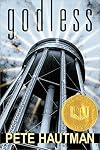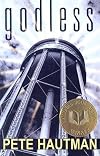
Godless
by Pete Hautman
On This Page
Description
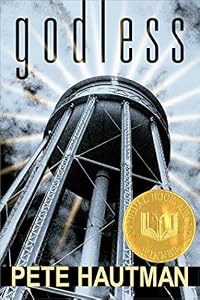
When sixteen-year-old Jason Bock and his friends create their own religion to worship the town's water tower, what started out as a joke begins to take on a power of its own.Tags
Recommendations






Member Recommendations

Member Reviews
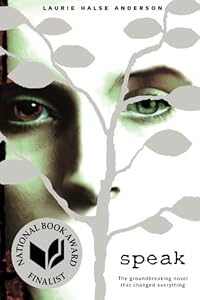
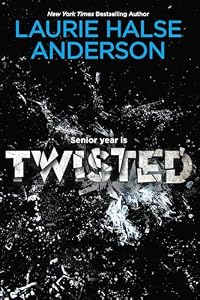
Hautman's book is in the same tradition as Chris Cutcher, Robert Cormier, Laurie Halse Anderson, and E.L. Konigsburg (amongst others). While the superficial subject of the book is religion and the creation thereof, it's really all about growing up and learning to navigate the world without losing oneself. It does this through the plot of Jason Bock's experiment with religion creation and the effect it has on his friends.
One of the nice aspects of the novel is that although it raises doubts about the validity of organized religion - especially modern religions such as Scientology or Mormonism - it does not ultimately suggest that everyone should become atheist or agnostic. Rather, though the main character is an agnostic throughout, show more other characters are religious without condemnation.
Even though the novel doesn't condemn religiousity, it does ask the reader to think critically about faith and religion through the creation of Chutengodianism by the main characters. If Jason created this religion as a joke, knowing full well that the water tower is not actually a god, then who is to say that other religions weren't created the same way? But even while the novel asks this question, it shows how the water tower is a god of sorts (it provides all the water for the community, which allows them to live, for example) and students of mythology will recognize that this line of thought is how other gods have been created - think of Apsu and Tiamat, Gaea and Ouranos, or Ra and Nu.
The novel's religious theme asks the reader to recognize that religions are man-made, fallible things. Yet they are powerful, too, as Shin's obsession with Chutengodianism causes him to place himself in danger. Even so, it does not deny that many people derive comfort from their faiths, nor that there is a place for religion in societies, no matter how they came about. It is a mixed-bag sort of ending, providing support for both theism and atheism.
Probably the take-away message of the book is to not take everything at face value. Just as religions are exposed as having shady origins (compared to how they're touted by the faithful), Jason learns that people, too, are not always as they seem on the surface. Henry Stagg, for example, is a science-fiction fan and someone Jason discovers he could be great friends with, despite having previously thought Henry to be no more than an ignorant thug type.
I can't say that this is a book I would recommend to just any teenager, because I know that many would scoff at the title and the plot and not read closely enough to recognise the life lessons it has inside. But I think it's as good as any other for those people struggling with what it means to believe in the modern era, and could be a comfort for them. show less
One of the nice aspects of the novel is that although it raises doubts about the validity of organized religion - especially modern religions such as Scientology or Mormonism - it does not ultimately suggest that everyone should become atheist or agnostic. Rather, though the main character is an agnostic throughout, show more other characters are religious without condemnation.
Even though the novel doesn't condemn religiousity, it does ask the reader to think critically about faith and religion through the creation of Chutengodianism by the main characters. If Jason created this religion as a joke, knowing full well that the water tower is not actually a god, then who is to say that other religions weren't created the same way? But even while the novel asks this question, it shows how the water tower is a god of sorts (it provides all the water for the community, which allows them to live, for example) and students of mythology will recognize that this line of thought is how other gods have been created - think of Apsu and Tiamat, Gaea and Ouranos, or Ra and Nu.
The novel's religious theme asks the reader to recognize that religions are man-made, fallible things. Yet they are powerful, too, as Shin's obsession with Chutengodianism causes him to place himself in danger. Even so, it does not deny that many people derive comfort from their faiths, nor that there is a place for religion in societies, no matter how they came about. It is a mixed-bag sort of ending, providing support for both theism and atheism.
Probably the take-away message of the book is to not take everything at face value. Just as religions are exposed as having shady origins (compared to how they're touted by the faithful), Jason learns that people, too, are not always as they seem on the surface. Henry Stagg, for example, is a science-fiction fan and someone Jason discovers he could be great friends with, despite having previously thought Henry to be no more than an ignorant thug type.
I can't say that this is a book I would recommend to just any teenager, because I know that many would scoff at the title and the plot and not read closely enough to recognise the life lessons it has inside. But I think it's as good as any other for those people struggling with what it means to believe in the modern era, and could be a comfort for them. show less
Simon & Schuster’s monthly offerings of free books may be a bit difficult to read from a technical point of view, but it’s always exciting to browse their list of available titles. This month (September 2020) is marked by their selection of banned and controversial YA books. Among these, Godless stands out with its exciting premise: some teenagers start a religion of their own, worshiping the town’s water tower. Hijinks ensue.
It all starts with Justin Bock sprawled out on the ground, looking at the belly of the tallest structure in town, the ten-legged metal giant that has been generously supplying the citizens with water for as long as anyone can remember. Jason meditates on the possibility of replacing the stale phrases of the show more adults around him with something different and meaningful, something he will have a hand in creating. He shares his thoughts with his nerdy best friend Shin and so the religion of the Ten-Legged One is born.
It doesn’t take long for them to find acolytes and the newly founded religion soon takes up the focal position in their lives. But as the Ten-Legged One gives, so too does he take. Each kid interprets the deity in their own way, according to their needs and wants. As each worshiper comes within reach of their own religious experience, the summer turns into a time in their lives they’ll never forget.
A short, incisive read, Godless is one of those books that are excellent for instigating class discussions and challenging young minds to see things from other perspectives instead of taking them for granted. The author has included some teaching materials on his website.
The style makes it compulsively readable, and the humour is relatable. Jason’s habit of pretending he’s a comic book hero to pass the time and escape from unpleasant tasks is particularly endearing.
It’s not hard to see what makes this book controversial: our hero openly questions figures of authority and points out the inconsistencies in the religious and other teachings of said figures of authority. The adults obviously don’t like it, and neither do some adult readers, apparently.
I would have loved to see more of Shin as a character, and more of the gang’s adventures in general, but as it is, the book is definitely a great read, with a valuable message: it’s okay to be different and to question what you’re born into, and it’s okay to wander off the beaten track and find your own way. show less
It all starts with Justin Bock sprawled out on the ground, looking at the belly of the tallest structure in town, the ten-legged metal giant that has been generously supplying the citizens with water for as long as anyone can remember. Jason meditates on the possibility of replacing the stale phrases of the show more adults around him with something different and meaningful, something he will have a hand in creating. He shares his thoughts with his nerdy best friend Shin and so the religion of the Ten-Legged One is born.
It doesn’t take long for them to find acolytes and the newly founded religion soon takes up the focal position in their lives. But as the Ten-Legged One gives, so too does he take. Each kid interprets the deity in their own way, according to their needs and wants. As each worshiper comes within reach of their own religious experience, the summer turns into a time in their lives they’ll never forget.
A short, incisive read, Godless is one of those books that are excellent for instigating class discussions and challenging young minds to see things from other perspectives instead of taking them for granted. The author has included some teaching materials on his website.
The style makes it compulsively readable, and the humour is relatable. Jason’s habit of pretending he’s a comic book hero to pass the time and escape from unpleasant tasks is particularly endearing.
It’s not hard to see what makes this book controversial: our hero openly questions figures of authority and points out the inconsistencies in the religious and other teachings of said figures of authority. The adults obviously don’t like it, and neither do some adult readers, apparently.
I would have loved to see more of Shin as a character, and more of the gang’s adventures in general, but as it is, the book is definitely a great read, with a valuable message: it’s okay to be different and to question what you’re born into, and it’s okay to wander off the beaten track and find your own way. show less
Ever questioned the religion your parents raised you in? Jason Bock is a teen who is tired of his religion and one day on a whim decides to invent his own. He chooses the town's water tower as his "god" and names it "The Ten-Legged One." He recruits a couple of friends, a girl he has a crush on, and a guy who once beat him up. It's all a harmless joke until the religion starts to take on a life of its own, in a heart-pounding scene that takes place on top of the tower. It's a story that makes you think about the way religions affect people, but it also made me laugh out loud quite a lot. Jason Bock is one wisecracking guy I would have liked to meet in high school.
Reviewed by Me for TeensReadToo.com
There is a reason that GODLESS won the National Book Award for Young People's Literature, and I don't believe it's because author Pete Hautman wrote a book he intended to be satire, as other reviews have suggested. To me, GODLESS is the epitome of everything that is both bad and good about organized religion--it is, in effect, an entreaty to the leaders of religions around the world to look at how blind faith funds their coffers.
Yes, maybe I'm reading more into the book than the author intended. If so, I can only hope that he appreciates the fact that I've obviously thought about the words he wrote long after they were published, and that he'd be happy about that fact. Now, though, on to the show more story...
Fifteen-year old Jason Bock is an agnostic ("I'll believe in God when I see Him") bordering on being an atheist ("There is no God"). His mother is obsessed over his health, coming up weekly with a new ailment that he just has to be suffering from. His father, though, is more concerned with his son's soul. That's why Jason, regardless of his personal beliefs, finds himself attending weekly Sunday Mass at the Church of the Good Shepherd, and even occasionally joins in at Thursday night TPO (Teen Power Outreach) meetings. The fact that he's ordered to attend the meetings more frequently when he's in trouble doesn't escape his notice.
Until one day, agnostic slash atheist Jason wonders what would happen if he started his own religion. Along with his best friend, Shin, fellow TPO attendee Magda, preacher's son Dan, and town rebel Henry, Jason creates the Chutengodians, a religion who worships the Ten-Legged One. That the Ten-Legged One is the town's water tower doesn't seem to deter them.
I know what you're thinking--who in their right mind would worship a water tower, even if they are teenagers? The answer, of course, is pretty simple. Why do people worship the Father, the Son, and the Holy Ghost? Why are there Buddhists, Muslims, Scientologists, Mormons, Protestants, or Latter Day Saints? Why does anyone worship anything? They do it because someone came up with their own ideas, made up some rules, implemented some commandments, created posts of leadership, and recruited parishioners.
Jason does the same, with some of the same consequences other organized religions have faced over the centuries--infighting, backstabbing, persecution, and doubts. When one Chutengodian almost ends up dead in an accident, and another seems determined to take his own life, and the others doubt the wisdom of associating with the creator of their religion, things start to fall apart. Sounds to me a lot like what happens in most "normal" organized religions found throughout the world today.
GODLESS is, without a doubt, one of the most thought-provoking books I've ever read. I highly recommend it to anyone searching for their own truths, regarding not only religion but finding your sense of self. You won't be disappointed--I know I wasn't. show less
There is a reason that GODLESS won the National Book Award for Young People's Literature, and I don't believe it's because author Pete Hautman wrote a book he intended to be satire, as other reviews have suggested. To me, GODLESS is the epitome of everything that is both bad and good about organized religion--it is, in effect, an entreaty to the leaders of religions around the world to look at how blind faith funds their coffers.
Yes, maybe I'm reading more into the book than the author intended. If so, I can only hope that he appreciates the fact that I've obviously thought about the words he wrote long after they were published, and that he'd be happy about that fact. Now, though, on to the show more story...
Fifteen-year old Jason Bock is an agnostic ("I'll believe in God when I see Him") bordering on being an atheist ("There is no God"). His mother is obsessed over his health, coming up weekly with a new ailment that he just has to be suffering from. His father, though, is more concerned with his son's soul. That's why Jason, regardless of his personal beliefs, finds himself attending weekly Sunday Mass at the Church of the Good Shepherd, and even occasionally joins in at Thursday night TPO (Teen Power Outreach) meetings. The fact that he's ordered to attend the meetings more frequently when he's in trouble doesn't escape his notice.
Until one day, agnostic slash atheist Jason wonders what would happen if he started his own religion. Along with his best friend, Shin, fellow TPO attendee Magda, preacher's son Dan, and town rebel Henry, Jason creates the Chutengodians, a religion who worships the Ten-Legged One. That the Ten-Legged One is the town's water tower doesn't seem to deter them.
I know what you're thinking--who in their right mind would worship a water tower, even if they are teenagers? The answer, of course, is pretty simple. Why do people worship the Father, the Son, and the Holy Ghost? Why are there Buddhists, Muslims, Scientologists, Mormons, Protestants, or Latter Day Saints? Why does anyone worship anything? They do it because someone came up with their own ideas, made up some rules, implemented some commandments, created posts of leadership, and recruited parishioners.
Jason does the same, with some of the same consequences other organized religions have faced over the centuries--infighting, backstabbing, persecution, and doubts. When one Chutengodian almost ends up dead in an accident, and another seems determined to take his own life, and the others doubt the wisdom of associating with the creator of their religion, things start to fall apart. Sounds to me a lot like what happens in most "normal" organized religions found throughout the world today.
GODLESS is, without a doubt, one of the most thought-provoking books I've ever read. I highly recommend it to anyone searching for their own truths, regarding not only religion but finding your sense of self. You won't be disappointed--I know I wasn't. show less
I read this book in a day because it was easy to read and weirdly compelling. Jason learns some about himself after inventing a fake religion and triggering his friend's mental illness. As an atheist, there were some lines I liked, for example when Jason questions why believing that a water tower is God is more silly than believing in the Catholic God. But then I also kind of like where Shin asks how you can understand something you don't believe in? I guess some stuff you just gotta "get" and I really don't get religion. I also really liked the mythos of the ocean gods that Shin wrote that began each chapter. Someone should make that into a movie.
This is one of those books which, as an adult, I can really appreciate... but which I'm fairly sure I would have quickly grown bored with when I was actually a teen, who this book is (theoretically) meant for. There's a review on the book that, to me, says a lot: "Anyone who ha questioned his or her religion, especially as a teenager, will respond to Jason's struggles with belief." The review is from Booklist, and now that I've read the book and come back to that quote on the back... well, yeah, I agree, but the fact that that quote puts the questioning in the past is important. Adults are going to see what the author has done here and be able to appreciate it, but teenagers actively involved in questioning their faith probably aren't show more going to be interested, or else I have a feeling they'll find it beneath them and move on to something else (this is, more than likely, how I would have felt when I was a teen who wasn't sure how to feel about religion).
So, in the end, I'm not surprised that this is an award-winning YA book, or that I've heard other adults rave about it. There's a lot to admire here. Is it a book I'd pass on to young readers, though? Probably not, though I might pass it on to adults who read YA. show less
So, in the end, I'm not surprised that this is an award-winning YA book, or that I've heard other adults rave about it. There's a lot to admire here. Is it a book I'd pass on to young readers, though? Probably not, though I might pass it on to adults who read YA. show less
The imaginative concept of this book caught my eye and I have to say it fulfilled its promise. The characters rang true for the most part, with nobody really being either all good or all bad, including the protagonist. It got a little preachy at times, but I guess that's to be expected considering the subject matter.
Members
- Recently Added By
Lists

Unshelved Book Clubs
579 works; 5 members
Author Information

112+ Works 6,086 Members
Pete Hautman has written many novels for adults, including Doohickey, as well as the teen novels Hole in the Sky, Stone Cold, and Mr. Was, which was nominated for an Edgar Award by the Mystery Writers of America. He divides his time between the Twin Cities of Minnesota and the shores of Lake Pepin in southwestern Wisconsin
Awards and Honors
Awards
Distinctions
Common Knowledge
- People/Characters
- Peter Stephen "Shin" Schinner; Henry Stagg; Jason Bock; Allan Anderson; Dan Grant; Rev. Andrew Grant (show all 8); Father Haynes; Magda Price
- First words
- Getting punched hard in the face is a singular experience.
- Last words
- (Click to show. Warning: May contain spoilers.)Until then, my god is made of steel and rust.
Classifications
- Genres
- Fiction and Literature, Teen, Young Adult
- DDC/MDS
- 823.914 — Literature & rhetoric English & Old English literatures English fiction 1900- 1901-1999 1945-1999
- LCC
- PZ7 .H2887 .G — Language and Literature Fiction and juvenile belles lettres Fiction and juvenile belles lettres Juvenile belles lettres
- BISAC
Statistics
- Members
- 903
- Popularity
- 29,550
- Reviews
- 37
- Rating
- (3.74)
- Languages
- English
- Media
- Paper, Ebook
- ISBNs
- 9
- ASINs
- 2