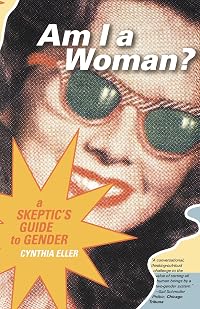
Am I a Woman?: A Skeptic's Guide to Gender
by Cynthia Eller
On This Page
Description
In this smart, intimate, and conversational book, Cynthia Eller delves into the twin thickets of gender theory and everyday experience to ask how we decide who is a woman-and why we find the answer important. Is a woman defined by her anatomy? Does she perceive the world differently than men? Is it her behavior that somehow marks her as inescapably female? Or is it a matter of how others evaluate her? Eller's answers demonstrate that the question is far more complicated, and its effects more show more pernicious, than it might at first appear. show lessTags
Recommendations












Member Reviews
Not much of a book on gender theory. Here's what "Am I a Woman?" is about: the author doesn't live up to the stereotypes of female behavior, which makes her feel somewhat uncomfortable. She then spends about 140 pages discussing the subject, going into topics such as the difference between sex and gender, nature vs. nurture, etc.
Of course, any woman will fail to live up to the stereotypes of female behavior. That's because they're stereotypes. Therefore, most of this book falls into the category of discussing sexism. It does very little to discuss the actual concept of gender, and how the gender binary is in fact its own type of prejudicial system that leaves behind many folks who are uncomfortable not with living up to stereotypes of show more femininity, but living to up stereotypes of "woman" and "man."
I guess this book is a product of the times; 15 years ago seems like ages when it comes to the (albeit insufficient and rather meagre) strides made by the trans community in the meantime. This book does almost nothing to subvert the gender binary or to explore the issues faced by trans folks, who LITERALLY do not fit into the categories of male/female, rather it only brings up a couple of trans folks as examples of how nature/nurture might lead into the whole sexism thing. I realize that cis people still pretty much run conversations about everything, and 15 years ago it was even more so, but cis people really need to STOP leading these conversations. So what if I don't like to buy shoes? Nobody is trying to murder me because of that fact. There is literally nothing new to add to this conversation that hasn't been covered since the 1990s.
What bothered me most about this book was the author's use of the R-word, and what bothered me second most about this book was the author's conclusion. When summing up what exactly it is that makes a woman female, she states that it is purely in the eyes of others. In her own words: "For me, identifying femaleness with the judgement of others -- you're a woman if others say you are -- meets all these criteria." (The criteria: "doesn't make women feel inadequate about their femininity, builds bridges between feminism and other liberation movements, is easy to understand, and that accords with our commonsense notions of which people are women and which men.")
Tell that definition to trans folks who are discriminated against, can't use the restroom, and are outright murdered because other people play gender police. The judgement of others has never been a fair, just or progressive idea. How about this: you're a woman if YOU say you are. Full stop. show less
Of course, any woman will fail to live up to the stereotypes of female behavior. That's because they're stereotypes. Therefore, most of this book falls into the category of discussing sexism. It does very little to discuss the actual concept of gender, and how the gender binary is in fact its own type of prejudicial system that leaves behind many folks who are uncomfortable not with living up to stereotypes of show more femininity, but living to up stereotypes of "woman" and "man."
I guess this book is a product of the times; 15 years ago seems like ages when it comes to the (albeit insufficient and rather meagre) strides made by the trans community in the meantime. This book does almost nothing to subvert the gender binary or to explore the issues faced by trans folks, who LITERALLY do not fit into the categories of male/female, rather it only brings up a couple of trans folks as examples of how nature/nurture might lead into the whole sexism thing. I realize that cis people still pretty much run conversations about everything, and 15 years ago it was even more so, but cis people really need to STOP leading these conversations. So what if I don't like to buy shoes? Nobody is trying to murder me because of that fact. There is literally nothing new to add to this conversation that hasn't been covered since the 1990s.
What bothered me most about this book was the author's use of the R-word, and what bothered me second most about this book was the author's conclusion. When summing up what exactly it is that makes a woman female, she states that it is purely in the eyes of others. In her own words: "For me, identifying femaleness with the judgement of others -- you're a woman if others say you are -- meets all these criteria." (The criteria: "doesn't make women feel inadequate about their femininity, builds bridges between feminism and other liberation movements, is easy to understand, and that accords with our commonsense notions of which people are women and which men.")
Tell that definition to trans folks who are discriminated against, can't use the restroom, and are outright murdered because other people play gender police. The judgement of others has never been a fair, just or progressive idea. How about this: you're a woman if YOU say you are. Full stop. show less
Ratings
Members
- Recently Added By
Lists

Beacon Press
39 works; 1 member
Author Information

11+ Works 376 Members
Cynthia Eller is Professor of Women's Studies and Religious Studies at Montclair State University. She is the author of The Myth of Matriarchal Prehistory: Why an Invented Past Will Not Give Women a Future; Am I a Woman? A Skeptic's Guide to Gender; and Living in the Lap of the Goddess: The Feminist Spirituality Movement in America.
Classifications
- Genres
- Nonfiction, Sexuality and Gender Studies, General Nonfiction, Sociology, Literature Studies and Criticism
- DDC/MDS
- 305.4201 — Society, government, & culture Social sciences, sociology & anthropology Social group - Age, Gender, Ethnicity Women Social role and status of women Standard subdivisions
- LCC
- HQ1190 .E424 — Social sciences The family. Marriage, Women and Sexuality The Family. Marriage. Women Women. Feminism
- BISAC
Statistics
- Members
- 29
- Popularity
- 955,788
- Reviews
- 1
- Rating
- (3.33)
- Languages
- English
- Media
- Paper
- ISBNs
- 2
- UPCs
- 1