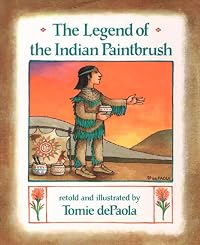
The Legend of the Indian Paintbrush
by Tomie dePaola
On This Page
Description
Little Gopher follows his destiny, as revealed in a Dream-Vision, of becoming an artist for his people and eventually is able to bring the colors of the sunset down to the earth.Tags
Recommendations

Member Reviews
“The legend of the Indian paintbrush” is a folk tale retold through a children’s book. The book tells the story of a young Indian boy who isn’t a warrior but found his meaning and place in life. The two biggest things in this story appeals to me and I would hope the students who are similar to me, it would appeal to them too. My family comes from Native Americans or Indian heritage however how little it may be. This connection drew me to it and I was happy to learn more about my heritage. One thing that excited me from a big picture point of view was the fact that they were depicting Indians in a different way than the typical cowboys and Indians, or Pocahontas type of story. This folk tale dove into how the Native Americans show more viewed the world and it was interesting to see it from their point of view. It was also refreshing to read a story about Indians because from what I have seen there aren’t as many Native American children books. The second thing that I felt was powerful was the message of the story. The message being even if you are not the biggest kid, not the strongest, or the fastest you can still do great things just by being you. Which is what the main character did and he brought joy and art to their world. So the world thanked him by giving the people new colorful flowers, and his tribe later gives him a name more fitting of what he had done for his people. show less
Different from all of the other boys in his tribe, Little Gopher was destined to be a maker and an artist, rather than a warrior—something confirmed by his tribe's shaman, and by his own Dream-Vision. Working away at his painting, he struggled to capture the colors of the sunset, as foretold he would do in his vision, until one evening he finally had his reward, gifted with magical brushes filled with gorgeous paint—brushes that allowed him to truly create the masterpiece of his dreams. It was only on the next day however, that the truly miraculous nature of this gift was revealed, as those brushes were transformed into gorgeous flowers on the hillside, leading Little Gopher to receive his new name: show more He-Who-Brought-the-Sunset-to-the-Earth...
In his 1983 picture book, The Legend of the Bluebonnet: An Old Tale of Texas, author/illustrator Tomie dePaola retold the traditional Comanche folktale concerning the origins of the bluebonnet flower—the state flower of Texas. Published a number of years later, in 1988, The Legend of the Indian Paintbrush explains the origin of the state flower of Wyoming. According to his author's note at the end of the book, the source for this story was a collection of articles by a Texan author, Ruth D. Isely, entitled Texas Wild Flowers: Stories and Legends (the Indian Paintbrush also being commonly found in that state), which was published by the Austin Independent School District, in 1965. Unfortunately, this volume doesn't appear to have ever been published commercially, and looks difficult to find, so it would be a challenge to determine what sources Isely used, assuming she listed any. I found myself a little bit disappointed that no specific cultural origin for this story was given, unlike the Bluebonnet tale, which was apparently Comanche. Saying it is a "Plains Indian" tale doesn't really help. Leaving that aside, although I didn't find it quite as poignant and appealing as dePaola's earlier work of flower folklore, I did enjoy this one, and would recommend it to young flower and/or folklore lovers, young would-be artists, and anyone seeking stories about Wyoming's state flower. Reading this and preceding book has made me wonder if I can find picture books about all fifty state flowers... I do love a themed reading project, after all. show less
In his 1983 picture book, The Legend of the Bluebonnet: An Old Tale of Texas, author/illustrator Tomie dePaola retold the traditional Comanche folktale concerning the origins of the bluebonnet flower—the state flower of Texas. Published a number of years later, in 1988, The Legend of the Indian Paintbrush explains the origin of the state flower of Wyoming. According to his author's note at the end of the book, the source for this story was a collection of articles by a Texan author, Ruth D. Isely, entitled Texas Wild Flowers: Stories and Legends (the Indian Paintbrush also being commonly found in that state), which was published by the Austin Independent School District, in 1965. Unfortunately, this volume doesn't appear to have ever been published commercially, and looks difficult to find, so it would be a challenge to determine what sources Isely used, assuming she listed any. I found myself a little bit disappointed that no specific cultural origin for this story was given, unlike the Bluebonnet tale, which was apparently Comanche. Saying it is a "Plains Indian" tale doesn't really help. Leaving that aside, although I didn't find it quite as poignant and appealing as dePaola's earlier work of flower folklore, I did enjoy this one, and would recommend it to young flower and/or folklore lovers, young would-be artists, and anyone seeking stories about Wyoming's state flower. Reading this and preceding book has made me wonder if I can find picture books about all fifty state flowers... I do love a themed reading project, after all. show less
Summary:
"The Legend of the Indian Paintbrush" by Tomie dePaola is a piece of Native American culture that tells the story of how the flower, the Indian Paintbrush, came into existence based on the folklore and stories of the Native American people. The story follows a young Native American boy, named Little Gopher, who has a talent of painting instead of the typical warrior skills that other young boys have. Through a Dream-Vision he is told that his purpose will be to paint the stories of his people.
Personal Reaction:
This book is the colorful book that introduces children to Native American culture and folklore. It also sends the message that not all people are destined to do the same thing. While the path may be different from others, show more we have the capability to do great things all the same. I can personally relate to this book because I am also part Native American and I like learning about Native American culture.
Extension Ideas:
1.) This book serves as a way to introduce Native American culture. Since we are Oklahoma, this may serve as a way to introduce children to local Native American tribes and find out more about their ancestors, possibly even determining if the children themselves have Native American ancestors.
2.) This book also serves as a way to learn more about local plant life. show less
"The Legend of the Indian Paintbrush" by Tomie dePaola is a piece of Native American culture that tells the story of how the flower, the Indian Paintbrush, came into existence based on the folklore and stories of the Native American people. The story follows a young Native American boy, named Little Gopher, who has a talent of painting instead of the typical warrior skills that other young boys have. Through a Dream-Vision he is told that his purpose will be to paint the stories of his people.
Personal Reaction:
This book is the colorful book that introduces children to Native American culture and folklore. It also sends the message that not all people are destined to do the same thing. While the path may be different from others, show more we have the capability to do great things all the same. I can personally relate to this book because I am also part Native American and I like learning about Native American culture.
Extension Ideas:
1.) This book serves as a way to introduce Native American culture. Since we are Oklahoma, this may serve as a way to introduce children to local Native American tribes and find out more about their ancestors, possibly even determining if the children themselves have Native American ancestors.
2.) This book also serves as a way to learn more about local plant life. show less
I liked this book for several reasons. The book is a retelling of an old Native American folk tale. I liked that the colors used in the illustrations of the book change depending on what is happening in the story. For example, when the story begins out the colors used are dull beige and brown. When Little Gopher receives his prophecy in the Dream Vision that he should become a painter, the colors in the sky are bright and colorful – full of reds and oranges. When Little Gopher paints the same bright colors reappear. I also enjoyed that the sentence structure was simple enough for young readers but still detailed and full of imagery. For example, the prophets told Little Gopher “you will paint a picture that is as pure as the colors show more in the evening sky”. Another description of the colors was “the deepest purples of the rocks, the reddest berries, the brightest flowers”. This helps readers visualize the colors and help enhance the story. I also enjoyed the hopeful message that the folk tale sends to young readers. Little Gopher was not as strong as the other boys and could not be a warrior, but he still found something he was great at and helped the people in his tribe. The folk tale’s message is to encourage children to use their individual talents to make their world a better place. show less
Summary:The story begins with a Native American child who longs to be like the other warrior children, but seems to smaller and always be lagging behind. Through the help of the Shaman and the boys dream vision he is able to find comfort in his own ability to be a painter, and to be able to record the tribes hunts, deeds of the warriors, and shamans so they will live throughout history. The boy is challenged to paint a picture of the sunset, although he struggles, he never gives up. He efforts are rewarded by all the colors needed to paint the sunset.
Person Reaction: This book is completely heart warming. The illustrations are gorgeous, and the over-all story just feels to authentic. I think it is incredible that the boy was not made to show more feel less of himself for being different. Instead, he was encouraged by those around him to continue to fulfill his talent of being a painter. It was accepted to go against the grain, which is not very common. The story is definitely about staying true to yourself, even when the temptation is there to be someone you are not. It is also a story of perseverance. The boy did not give up on painting the perfect sunset, and because of this was rewarded with all of the colors of the sunset. The was the paintbrushes then turned into flowers that would go onto bloom every spring is a wonderful touch as it shows the mark the boy is already leaving on the world, and for his tribe.
Extension Ideas:
1. I could ask the children what some of their talents are and ask them how they could use those talents to help those around them.
2. The class could work together to paint a giant sunset. This would show them teamwork as well as all of the beautiful colors that are in a sunset.
3. It would be neat to see if we could somehow recreate the look of the skin canvas for a painting activity. show less
Person Reaction: This book is completely heart warming. The illustrations are gorgeous, and the over-all story just feels to authentic. I think it is incredible that the boy was not made to show more feel less of himself for being different. Instead, he was encouraged by those around him to continue to fulfill his talent of being a painter. It was accepted to go against the grain, which is not very common. The story is definitely about staying true to yourself, even when the temptation is there to be someone you are not. It is also a story of perseverance. The boy did not give up on painting the perfect sunset, and because of this was rewarded with all of the colors of the sunset. The was the paintbrushes then turned into flowers that would go onto bloom every spring is a wonderful touch as it shows the mark the boy is already leaving on the world, and for his tribe.
Extension Ideas:
1. I could ask the children what some of their talents are and ask them how they could use those talents to help those around them.
2. The class could work together to paint a giant sunset. This would show them teamwork as well as all of the beautiful colors that are in a sunset.
3. It would be neat to see if we could somehow recreate the look of the skin canvas for a painting activity. show less
Gifted author/illustrator Tomie dePaola retells a Native American story concerning the Indian paintbrush plant's name. The story is well-told, and the illustrations are beautiful.
This was a well-written origin story that was well-developed and easy to follow. It really built up the protagonists character and was insightful to his culture. I liked that it developed the character from being a young boy to a young man, developing him in life. It discusses the influence of his ancestors as they guided him to paint his dream paintings, thus leading him to create the most beautiful sunset. I thought this was a very beautiful story for this reason as it detailed a recurring belief.
Members
- Recently Added By
Published Reviews
ThingScore 50
In this adaptation of the legend of the Indian Paintbrush flower… The story follows Little Gopher, a Native boy (no tribe indicated)… [whose] paint colors appear dull and dark. One night he hears a voice that tells him to go where he watches the evening sun, and on the ground he will find what he needs. There he is surrounded by brushes filled with paint, each one a color of the sunset. show more The brushes take root and are known today as Indian Paintbrush flowers. The illustrations do not reflect Plains material culture. show less
added by CourtyardSchool
The retelling is pleasantly cadenced, even though it tells us more about the artist's need for serf-expression within any society than about Plains Indians. And dePaola's somber tones burst forth into satisfyingly brilliant sunsets.
added by private library
This tale is related with deceptive simplicity by dePaola; he enhances the plainness of the story with his primitive illustrations, and, like Little Gopher, he finds inspiration in the colors of the sunset.
added by private library
Lists

Favorite Childhood Books
1,646 works; 518 members

Reading Rainbow
193 works; 10 members

Recommended Reading List
219 works; 1 member

Written and Illustrated By
805 works; 1 member
Author Information

243+ Works 98,394 Members
Tomie dePaola was born in Meriden, Connecticut on September 15, 1934. He received a B.F.A. from Pratt Institute in 1956, a M.F.A. from California College of Arts and Crafts in 1969, and a doctoral equivalency from Lone Mountain College in 1970. He has written and/or illustrated more than 270 books including 26 Fairmount Avenue, Strega Nona, Meet show more the Barkers, Nana Upstairs and Nana Downstairs, and Oliver Button Is a Sissy. He has received numerous awards for his work including the Caldecott Honor Award, the Newbery Honor Award and the New Hampshire Governor's Arts Award of Living Treasure. His murals and paintings can be seen in many churches and monasteries throughout New England. He has designed greeting cards, magazine and record album covers, and theater sets. His work is shown in galleries and museums. Tomie dePaola died on March 30, 2020 because of complications he had from surgery after a fall. (Bowker Author Biography) show less
Some Editions
Awards and Honors
Awards
Distinctions
Common Knowledge
- Canonical title
- The Legend of the Indian Paintbrush
- Original publication date
- 1988
- People/Characters
- Little Gopher
- Important places
- Great Plains, USA
- Related movies
- The Legend of the Indian Paintbrush (1991 | IMDb)
- Dedication
- For my dear friends, Pat Henry and her husband, Bill, who shared their part of Wyoming with me and didn't make me ride a horse.
- First words
- Many years ago when the People traveled the Plains and lived in a circle of teepees, there was a boy who was smaller than the rest of the children in the tribe.
- Last words
- (Click to show. Warning: May contain spoilers.)And the People no longer called him Little Gopher, but He-Who-Brought-the-Sunset-to-the-Earth.
- Disambiguation notice
- Relationship Note: Inspired by 'Texas Wildflowers, Stories and Legends' by Ruth D. Isely.
Classifications
- Genres
- Children's Books, Picture Books
- DDC/MDS
- 398.208997078 — Society, government, & culture Customs, etiquette & folklore Folklore & Folktales Folk literature Groups of people Folklore by ethnic group Native Americans
- LCC
- E78 .G73 .D4 — History of the United States America Indians of North America
- BISAC
Statistics
- Members
- 5,428
- Popularity
- 2,473
- Reviews
- 88
- Rating
- (4.09)
- Languages
- English, Spanish
- Media
- Paper, Audiobook, Ebook
- ISBNs
- 22
- ASINs
- 7