Children in Reindeer Woods
by Kristín Ómarsdóttir
On This Page
Description
Eleven-year-old Billie lives at a temporary home for children called Children in Reindeer Woods, which she discovers one afternoon, to her surprise, is in the middle of a war zone. When a small group of paratroopers kill everyone who lives there with her, and then turn on each other, Billie is forced to learn to live with the violent, innocent, and troubled Rafael, who decides to abandon the soldiers life and become a farmer, no matter what it takes.Tags
Recommendations









Member Recommendations
whymaggiemay Same feelings of loss and confusion
Member Reviews
This was a harrowing read for me, even though the tone is flat and simple. In the first scene an 11 year old girl watches a soldier murder everyone she knows; after the carnage, the soldier suddenly decides to desert his post and to take the place of those he murdered, because he's tired of the war and wants to be a farmer. He coerces the surviving girl to play the part of his daughter, and as the novel progresses their relationship evolves in surprising ways.
The story reminded me a great deal of [b:An Untouched House|40194572|An Untouched House|Willem Frederik Hermans|https://i.gr-assets.com/images/S/compressed.photo.goodreads.com/books/1527020055l/40194572._SX50_.jpg|1797555] by [a:Willem Frederik Hermans|184683|Willem Frederik show more Hermans|https://images.gr-assets.com/authors/1251877831p2/184683.jpg], for the way it shows how incessant violence warps and shatters any kind of natural human feeling. Unlike Hilbig's novel, though, this story focuses on a child's perceptions of war, which made the story all the more disturbing to me.
The writing is very flat. It mimics the passing musings of a child playing with her dolls, or worrying about what to wear on any given day, or what the rules of decorum are for a proper 11 year old girl...only the events witnessed by this child are horrific.
There is a level of abstraction to the story that took some getting used to. It's a fictional war held in a fictional valley. Somehow this abstraction didn't distance me from the human happenings, though. Instead, it felt like an appropriate tone to remind me of how war brings with it the relentless, relentlessly casual, and nearly abstract murder of others. The detached tone felt right, in that people in war will detach from horrific events as a way to cope. show less
The story reminded me a great deal of [b:An Untouched House|40194572|An Untouched House|Willem Frederik Hermans|https://i.gr-assets.com/images/S/compressed.photo.goodreads.com/books/1527020055l/40194572._SX50_.jpg|1797555] by [a:Willem Frederik Hermans|184683|Willem Frederik show more Hermans|https://images.gr-assets.com/authors/1251877831p2/184683.jpg], for the way it shows how incessant violence warps and shatters any kind of natural human feeling. Unlike Hilbig's novel, though, this story focuses on a child's perceptions of war, which made the story all the more disturbing to me.
The writing is very flat. It mimics the passing musings of a child playing with her dolls, or worrying about what to wear on any given day, or what the rules of decorum are for a proper 11 year old girl...only the events witnessed by this child are horrific.
There is a level of abstraction to the story that took some getting used to. It's a fictional war held in a fictional valley. Somehow this abstraction didn't distance me from the human happenings, though. Instead, it felt like an appropriate tone to remind me of how war brings with it the relentless, relentlessly casual, and nearly abstract murder of others. The detached tone felt right, in that people in war will detach from horrific events as a way to cope. show less
The opening scene of this novel left me reeling, and I remained rather stunned throughout the book. In a few short, staccato pages, Ómarsdóttir creates a world where the absurdity and casual brutality of war is played out against a backdrop of bucolic beauty and rural quiet. The surprising ways in which the author contrasts war and peace, violence and innocence, are highlighted by the sparse, matter of fact language. Readers are kept in a state of tension broken by absurd moments that seem funny until the next page.
Read the entire review in Belletrista.
Read the entire review in Belletrista.
Set in what seems to be the contemporary, Children in Reindeer Woods, captures your attention from the very beginning. In an idyllic and isolated rural area of an unknown country, there is a small farm called Reindeer Woods that houses a few urban children during the summer. It is also in a war zone. In a few short riveting pages, several soldiers arrive and kill the residents, before one soldier shoots the others and buries all the bodies. Eleven-year-old Billie, hiding under the bushes, witnesses enough activity to know what is going on, and she become the lone survivor. It is the uncertainty of her fate, and the strange relationship between her and the solitary soldier (who has decided he would rather take up farming than soldiering) show more that propels the reader through this fascinating book. The narration provides a lot of the story from Billie's viewpoint, though it's not strictly told in her voice. While the soldier goes about 'settling in" to the farm, Billie is compelled to help. She is frightened, but strangely compliant and curious, sometimes even bold, as she adjusts to her new situation.
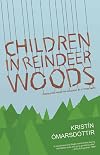
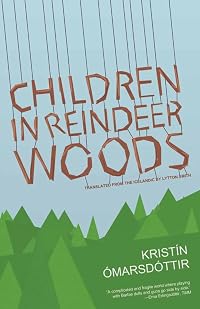
The book drifts into the surreal from time to time, but it's almost to be expected in the odd situation that Billie finds herself in. There's a puppet motif that runs through the book (which you can also see echoed in the book's cover art). We see this most obviously in Billie's insistence that her father is a puppet controlled by creatures from outer space (as best I can tell her father is a lawyer or possibly a politician), but also in her playing with her various Barbie dolls, and it doesn't seem a stretch to add 'soldiering' to the puppet list, for are not solders merely puppets in a war? The motif is presented in small ways also, in certain 'hanging' imagery: a paratrooper, a hung chicken, Billie getting hung up by her belt on the roof's edge when she tried to slide off the roof.
All which makes [Children in Reindeer Woods] a compelling, intriguing story of—as the book's description states—the "absurdies of war." The ending is somewhat open-ended, in what I often think is European fashion. It leaves one a little lost, without definitive conclusions, which, in this case, seems poignantly appropriate. An excellent book.
The beginning of [Children in Reindeer Woods] can be read in Issue 17 of Belletrista HERE show less
The book drifts into the surreal from time to time, but it's almost to be expected in the odd situation that Billie finds herself in. There's a puppet motif that runs through the book (which you can also see echoed in the book's cover art). We see this most obviously in Billie's insistence that her father is a puppet controlled by creatures from outer space (as best I can tell her father is a lawyer or possibly a politician), but also in her playing with her various Barbie dolls, and it doesn't seem a stretch to add 'soldiering' to the puppet list, for are not solders merely puppets in a war? The motif is presented in small ways also, in certain 'hanging' imagery: a paratrooper, a hung chicken, Billie getting hung up by her belt on the roof's edge when she tried to slide off the roof.
All which makes [Children in Reindeer Woods] a compelling, intriguing story of—as the book's description states—the "absurdies of war." The ending is somewhat open-ended, in what I often think is European fashion. It leaves one a little lost, without definitive conclusions, which, in this case, seems poignantly appropriate. An excellent book.
The beginning of [Children in Reindeer Woods] can be read in Issue 17 of Belletrista HERE show less
I try to avoid stereotypes—positive or negative—especially cultural stereotypes. There are valid reasons sometimes why these stereotypes were assigned, but there are quite a few that were meant only to harm. That being said, I've tried to ignore that stigma of oddness placed on Icelanders. Sure an Internet search on famous Icelanders and Icelandic attractions may lead you to believe they're all a little strange, but surely they all cannot be, right?
Children in Reindeer Woods is odd. There may be some translation issues here, but largely I get the feeling that Ómarsdóttir is, how we say it... peculiar. That's cool, I'm down with odd. Bjork, Twin Peaks, Regina Spektor (she used to be weirder)--yeah, I like odd. I'm cultural except show more when I'm not. Like when I turn my head to the side, scrunch my face and say “I just don't get it.” As I type this, thinking about Children in Reindeer Woods, I have my head turned to the side, my face is scrunched and I'm thinking “I just didn't get it.” I understand some of what Ómarsdóttir may have been trying to accomplish, but much of it seemed like trying to be strange for the sake of being strange. Then again, maybe it was all issue with the translation.
I don't drink. I never have, not once, so my analogy may be ridiculous. But Reindeer Woods reminded me of stories I've heard about alcohol. It sounded really fun. I looked forward to it and the second I had a copy in my hands, I dove into it. It had its moments when it was good, but largely I was immediately overcome with a thought of “I have to finish this?” I wanted to be cool so I kept plugging away. Despite the headache I finished it. And you know what? I don't know what the hell happened. Sure, I remember a detail here, a detail there, but largely it's all a blur.
Reindeer Woods isn't bad, its just confusing (in its English form). It doesn't do anything miraculous or leave you feeling anything but boredom. It's like that movie... looking up name of movie... Northfork, that's it! Visually beautiful, well acted, but confusing. You have to respect the vision of the artists who come up with these pieces, and know it probably means a lot to them, but that doesn't make it enjoyable.
Sorry Iceland, but you're a strange little island. show less
Children in Reindeer Woods is odd. There may be some translation issues here, but largely I get the feeling that Ómarsdóttir is, how we say it... peculiar. That's cool, I'm down with odd. Bjork, Twin Peaks, Regina Spektor (she used to be weirder)--yeah, I like odd. I'm cultural except show more when I'm not. Like when I turn my head to the side, scrunch my face and say “I just don't get it.” As I type this, thinking about Children in Reindeer Woods, I have my head turned to the side, my face is scrunched and I'm thinking “I just didn't get it.” I understand some of what Ómarsdóttir may have been trying to accomplish, but much of it seemed like trying to be strange for the sake of being strange. Then again, maybe it was all issue with the translation.
I don't drink. I never have, not once, so my analogy may be ridiculous. But Reindeer Woods reminded me of stories I've heard about alcohol. It sounded really fun. I looked forward to it and the second I had a copy in my hands, I dove into it. It had its moments when it was good, but largely I was immediately overcome with a thought of “I have to finish this?” I wanted to be cool so I kept plugging away. Despite the headache I finished it. And you know what? I don't know what the hell happened. Sure, I remember a detail here, a detail there, but largely it's all a blur.
Reindeer Woods isn't bad, its just confusing (in its English form). It doesn't do anything miraculous or leave you feeling anything but boredom. It's like that movie... looking up name of movie... Northfork, that's it! Visually beautiful, well acted, but confusing. You have to respect the vision of the artists who come up with these pieces, and know it probably means a lot to them, but that doesn't make it enjoyable.
Sorry Iceland, but you're a strange little island. show less
I wanted to like this book better than I did, both because I was taken by the title and because I read two intriguing reviews of it. There were parts of it I really enjoyed, but I wasn't completely drawn into the story or its location, and the ending completely turned around what I was thinking about one aspect of the book and left me puzzled.
The novel tells the story of an 11-year-old girl, Billie, who is sent to what appears to be some sort of small summer camp in a remote, idyllic, and bucolic farming valley, which nevertheless is in a war zone. One day the war intrudes, and Billie is left alone in the farmhouse with a young soldier, Rafael, who no longer wants to be a soldier but who can't entirely give up his soldierly ways even show more though he has taken on the role of the farmer, and in some ways the protector of Billie. On the surface, Billie seems largely unperturbed by this change, just as she hasn't seemed to miss her mother and father, although she thinks about them frequently. Her father is described as a puppet whose individual limbs are controlled by beings from another planet, and who is writing a book of laws of the earth/humans for those people on another planet, while her mother works as a doctor and organizes the household. Billie also thinks about a former ballet dancer, Marius, who used to work at the farm, and who had been in love with someone named Maria. As the novel progresses, various people drop by the remote farm, and the reader sees some evolution in Rafael's attitudes in how he deals with these intrusions. Billie, too, evolves a little as summer drifts into fall.
The best parts of this book for me were some of the details: Billie's play with her Barbie dolls reflects the violence of the world outside the farm, the chickens at the farm act like chickens and the cow acts like a cow, Billie reflects on the invisibility of children or on how her mother taught her to act with other people. But for me, the story and plot, such as it is, were confused by the remoteness of the farm (which still appears to be in a contemporary European country), by the characters of Billie and Rafael, neither of who feels completely "real" to me, and by the puppetry imagery which I took to be metaphoric and psychological, but which may not be.
The cover describes the book as "a lyrical and continually surprising take on the absurdity of war and the mysteries of childhood." Although some horrifying things occur in the book, the war in many ways feels far away (at least for someone who has read other books about war) and the farm life seems much more real, and the depiction of Billie's behavior seems remote as well. Just as the beings from another planet appear to control Billie's father, so the telling of this story seems distanced from the lives of Billie and Rafael and the chickens and the cow. show less
The novel tells the story of an 11-year-old girl, Billie, who is sent to what appears to be some sort of small summer camp in a remote, idyllic, and bucolic farming valley, which nevertheless is in a war zone. One day the war intrudes, and Billie is left alone in the farmhouse with a young soldier, Rafael, who no longer wants to be a soldier but who can't entirely give up his soldierly ways even show more though he has taken on the role of the farmer, and in some ways the protector of Billie. On the surface, Billie seems largely unperturbed by this change, just as she hasn't seemed to miss her mother and father, although she thinks about them frequently. Her father is described as a puppet whose individual limbs are controlled by beings from another planet, and who is writing a book of laws of the earth/humans for those people on another planet, while her mother works as a doctor and organizes the household. Billie also thinks about a former ballet dancer, Marius, who used to work at the farm, and who had been in love with someone named Maria. As the novel progresses, various people drop by the remote farm, and the reader sees some evolution in Rafael's attitudes in how he deals with these intrusions. Billie, too, evolves a little as summer drifts into fall.
The best parts of this book for me were some of the details: Billie's play with her Barbie dolls reflects the violence of the world outside the farm, the chickens at the farm act like chickens and the cow acts like a cow, Billie reflects on the invisibility of children or on how her mother taught her to act with other people. But for me, the story and plot, such as it is, were confused by the remoteness of the farm (which still appears to be in a contemporary European country), by the characters of Billie and Rafael, neither of who feels completely "real" to me, and by the puppetry imagery which I took to be metaphoric and psychological, but which may not be.
The cover describes the book as "a lyrical and continually surprising take on the absurdity of war and the mysteries of childhood." Although some horrifying things occur in the book, the war in many ways feels far away (at least for someone who has read other books about war) and the farm life seems much more real, and the depiction of Billie's behavior seems remote as well. Just as the beings from another planet appear to control Billie's father, so the telling of this story seems distanced from the lives of Billie and Rafael and the chickens and the cow. show less
The opening scene of Children in Reindeer Woods is one of sadly unsurprising violence – three soldiers arrive at a house and shoot and kill the inhabitants. One girl, Billie, survives but the other adults and children are killed. The next act of violence though is unexpected – one of the soldiers shoots the other two and buries all the bodies at the farm. Rafael, the murderer, decides to take up the life of a farmer and take care of Billie. Billie and Rafael gradually become accustomed to one another and are occasionally interrupted by various visitors to the farm. There’s always some underlying tension since we never quite know what Rafael’s going to do but the story as related by Billie is rather opaquely told. The prose flows show more smoothly and I read large chunks at time but was never fully engaged. Billie relates the story of her parents and describes her father as a puppet controlled by people on another planet. However, this is likely her imagination and though the setting is vague (there’s a war but nothing specific) most of the events are realistic.
The best part of the book is the uneasy relationship between Billie and Rafael which gradually changes and has some bumps and violence along the way. Rafael swings between pride and excitement at doing the farm chores and a murdering mode when guests come. When he seems to be drifting away from Billie – back to life as a soldier or to another woman – she can be clingy and annoyed. Billie can also be cold and calculating and is strangely unaffected by the violence. There’s also some ambiguity in the relationship – Billie is left wondering what really happened to some of the people who stop by. The intrusions from the outside world are slightly suspenseful from wondering what Rafael will do but the soldier who stops by goes on for too long and the nun’s behavior is unbelievable. Frequent references are made to Billie’s puppet father but I didn’t find this part compelling. I suppose there could be some symbolic role of the puppet – Billie and Rafael being controlled by outside forces, it’s just one of multiple stories that Billie and Rafael tell themselves to explain the world and their actions – and there’s something of a twist at the end, but that plot part wasn’t the best. More of interesting book than one that I really got into. show less
The best part of the book is the uneasy relationship between Billie and Rafael which gradually changes and has some bumps and violence along the way. Rafael swings between pride and excitement at doing the farm chores and a murdering mode when guests come. When he seems to be drifting away from Billie – back to life as a soldier or to another woman – she can be clingy and annoyed. Billie can also be cold and calculating and is strangely unaffected by the violence. There’s also some ambiguity in the relationship – Billie is left wondering what really happened to some of the people who stop by. The intrusions from the outside world are slightly suspenseful from wondering what Rafael will do but the soldier who stops by goes on for too long and the nun’s behavior is unbelievable. Frequent references are made to Billie’s puppet father but I didn’t find this part compelling. I suppose there could be some symbolic role of the puppet – Billie and Rafael being controlled by outside forces, it’s just one of multiple stories that Billie and Rafael tell themselves to explain the world and their actions – and there’s something of a twist at the end, but that plot part wasn’t the best. More of interesting book than one that I really got into. show less
This modern day fable has a dramatic, frightening opening and is then followed by a strange tale of a soldier who is tired of war, and an 11 year old girl who is wise beyond her years yet still a child, and how they help one another. It is a disturbing and thought provoking story by an Icelandic author whose work I haven't read before. I will be looking for more!
Members
- Recently Added By
Published Reviews
ThingScore 100
This is thefirst of Icelandic author Ómarsdóttir’s novels to appear in English, and it shouldn’t be the last. Somewhere in the reader’s mind, Catch-22 echoes faintly.
added by 1morechapter
Author Information
17+ Works 131 Members
Some Editions
Awards and Honors
Distinctions
Common Knowledge
- Original title
- Hér
- Original publication date
- 2004
Classifications
- Genres
- General Fiction, Fiction and Literature
- DDC/MDS
- 839.6934 — Literature & rhetoric German & related literatures Other Germanic literatures Old Norse, Old Icelandic, Icelandic, Faroese literatures Modern West Scandinavian; Modern Icelandic Modern Icelandic fiction 1900-1999
- LCC
- PT7511 .K65 .H4713 — Language and Literature German, Dutch and Scandinavian literatures Modern Icelandic literature Individual authors or works 19th-20th centuries
- BISAC
Statistics
- Members
- 63
- Popularity
- 492,314
- Reviews
- 9
- Rating
- (3.89)
- Languages
- English, Swedish
- Media
- Paper
- ISBNs
- 2
- ASINs
- 1