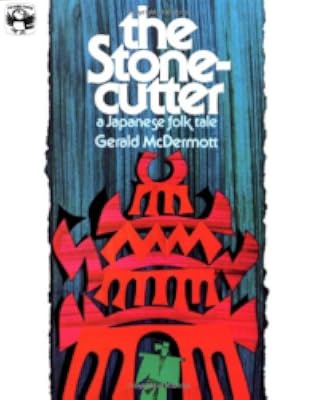
The Stonecutter: A Japanese Folk Tale (Picture Puffins)
by Gerald McDermott
On This Page
Description
Relates the consequences of a stonecutter's foolish longing for power.Tags
Recommendations






Member Reviews
I was a little surprised at how excellent this book was. I initially read it because I was curious if the story would have been reverent to Japanese culture and I found that the story was not only reverent but also full of wisdom. The story begins with a hard working stonecutter who who cuts stone from a mountain. The stone cutter wants more power and wishes to become a prince. Since the stone cutter was such a hard worker the spirit of the mountain heard him and granted his wish. After he became a prince, the stone cutter realized that the sun was more powerful than a prince, so the mountain spirit made him the sun. Then, he realized that a cloud was more powerful than the sun, so the mountain spirit made him into a cloud. He then show more thought that the mountain was the most powerful of all things so the mountain spirit made him into the mountain. But when he was the mountain a lowly stonecutter began to chisel him at his feet and he then realized that he was the most powerful person of all, right from the very beginning. I really liked how this story evolved and came back to stonecutting as being the most powerful of all things. The theme of finding power is universal to all of us and sometimes we need to reflect on where we are at and understand how powerful we truly are. show less
Chalk was very intriguing book to “read.” I put read in quotes because the book had no actual words. The entire story was all pictures, which I liked because the books illustrations were realistic and very visually pleasing. The book also allowed for my imagination to do the narrating of the story based on what the pictures looked like. For example, it was a rainy day and the children found chalk and then the child drew the sun and it became a sunny day. This allowed me as the reader to infer that the chalk was magical and as they continued to draw, the drawings kept coming to life. I liked the story because of the unique idea of magical chalk. It would be very cool if this chalk existed because anything that was drawn came to life, show more for example a girl in the story drew butterflies on the pavement and then on the next page the butterflies started flying off of the pavement. This idea of magical chalk, where everything you draw comes to life, also allows the author to get across the message of the story that you should be careful what you wish for. One child drew a dinosaur and then the dinosaur came to life and tried to attack the children and another child had to save the day by drawing a rain cloud that washed away the dinosaur drawing saving the day. show less
This story is about a stonecutter who is happy and then sees a prince and envies him. He asks the spirit of the mountain to make him a prince and the spirit does so. He is happy until he notices that the sun has more power, he is transformed into the sun, then a cloud, and lastly trying to get even more power he wants to be turned into a mountain. Which he does and then he feels the sting of a stone cutter. I thought this book had very good illustrations, they were very abstract and geometric. I also liked the moral of the story, it was clear that the stone cutter grew too powerful and greedy. I think this would be a good folk tale to demonstrate the genre with children
McDermott, Gerald. (1975) The Stonecutter: A Japanese Folk Tale. New York: The Viking Press, Inc.
This story s about a stonecutter that was very satisfied with his life as a stonecutter until he sees a prince and become envious of him. He makes a wish and the spirit who lived in the mountains heard him and granted him this wish. He doesn't gain any satisfaction from becoming a prince so he wishes to become the sun, then a rain cloud and each time he wishes for something the mountain spirit grants him the wish. He finally realizes that he wants to become the mountain because he sees that there is nothing more powerful and so the spirit grants him this final wish. He is finally satisfied until he feels a sharp pain and sees another show more stonecutter chipping away at his feet and he becomes afraid.
What makes this story unique are the illustrations that accompany it. They are very colorful and the artist used a form of watercolor called gouache to create the illustrations in the form of collages. The story is simple enough but it teaches a good lesson about being satisfied with what you have. show less
This story s about a stonecutter that was very satisfied with his life as a stonecutter until he sees a prince and become envious of him. He makes a wish and the spirit who lived in the mountains heard him and granted him this wish. He doesn't gain any satisfaction from becoming a prince so he wishes to become the sun, then a rain cloud and each time he wishes for something the mountain spirit grants him the wish. He finally realizes that he wants to become the mountain because he sees that there is nothing more powerful and so the spirit grants him this final wish. He is finally satisfied until he feels a sharp pain and sees another show more stonecutter chipping away at his feet and he becomes afraid.
What makes this story unique are the illustrations that accompany it. They are very colorful and the artist used a form of watercolor called gouache to create the illustrations in the form of collages. The story is simple enough but it teaches a good lesson about being satisfied with what you have. show less
The colors and shapes are fantastic.
A Jewish version of this story, The Stonecutter Who Wanted to be Rich, has a happier end with one more transformation (back to the stonecutter). See also Abraham's Search for God, in which Abraham wants to worship the most powerful being in the world, only to realize that there is none, and several Asian folktales in which an animal king wants his daughter to marry the most powerful being, only to realize that his species is as powerful as any entity.
A Jewish version of this story, The Stonecutter Who Wanted to be Rich, has a happier end with one more transformation (back to the stonecutter). See also Abraham's Search for God, in which Abraham wants to worship the most powerful being in the world, only to realize that there is none, and several Asian folktales in which an animal king wants his daughter to marry the most powerful being, only to realize that his species is as powerful as any entity.
A lowly stonecutter wishes to be more than he is. As he becomes more powerful first a prince then the sun, then a cloud and finally a mountain. Only to find a lowly stonecutter still had power over him.
Genre: Folk Tale
Media: Gouache, Collage
Age Appropriateness: Primary/Intermediate
This book is a Japanese Folk Tale about the Stone-Cutter. One day while he was working the Prince passed by and he was very jealous of the people that surrounded him and his robes. He asked the spirits to change him into a prince. He was only happy for so long, then he asked to be something else and then something else and so forth. He was never happy until he was turned into the strongest thing, a mountain. This book is a good example of a folk tale, because it is a Japanese Folk Tale. It has been passed down through generations and the reader can identify good and bad actions in the characters. There is also a moral. The plot line is very important to this show more story. I would give it a 3 on the star chart. It is not the best at keeping the reader involved, but it does make sense. show less
Media: Gouache, Collage
Age Appropriateness: Primary/Intermediate
This book is a Japanese Folk Tale about the Stone-Cutter. One day while he was working the Prince passed by and he was very jealous of the people that surrounded him and his robes. He asked the spirits to change him into a prince. He was only happy for so long, then he asked to be something else and then something else and so forth. He was never happy until he was turned into the strongest thing, a mountain. This book is a good example of a folk tale, because it is a Japanese Folk Tale. It has been passed down through generations and the reader can identify good and bad actions in the characters. There is also a moral. The plot line is very important to this show more story. I would give it a 3 on the star chart. It is not the best at keeping the reader involved, but it does make sense. show less
Members
- Recently Added By
Author Information

35+ Works 12,505 Members
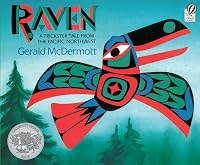
Gerald McDermott was born January 31, 1941 in Detroit, Michigan. He began studying art when he was admitted to a class at one of the nation's finest museums, the Detroit Institute of Arts, when he was just four years old. He continued pursuing his passion for art at Cass Tech, a public high school for the gifted. Upon graduation, he was awarded a show more National Scholastic scholarship to New York's Pratt Institute. He took a leave of absence during his junior year to become the first graphic designer for Channel 13, New York's educational television station, the year it went on the air. He also designed and directed his first animated film, The Stonecutter. He then toured Europe, visiting and exchanging ideas with filmmakers in England, France, and Yugoslavia. He returned to Pratt to finish his degree in 1964 and began producing and directing a series of animated films on folklore. It was then that he met Joseph Campbell, who served as the consultant on four of McDermott's films. McDermott then began to adapt his films into picture books. His first book, Anansi the Spider: A Tale from the Ashanti, was named a Caldecott Honor Book. His other books include Arrow to the Sun: A Tale from the Pueblo that won the 1975 Caldecott Medal, Raven: A Trickster Tale from the Pacific Northwest, another Caldecott Honor Book, and Musicians of the Sun. He died on December 26, 2012 at the age of 71. (Bowker Author Biography) show less
Awards and Honors
Awards
Common Knowledge
- People/Characters
- Stonecutter; Mountain Spirit
- Dedication
- For my mother
- First words
- Tasaku was a lowly stonecutter. Each day the sound of his hammer and chisel rang out as he chipped away at the foot of the mountain.
- Last words
- (Click to show. Warning: May contain spoilers.)But Tasaku felt the sharp sting of a chisel. It was a lowly stonecutter, chipping away at his feet. Deep inside, he trembled.
Classifications
Statistics
- Members
- 196
- Popularity
- 167,243
- Reviews
- 9
- Rating
- (3.94)
- Languages
- English
- Media
- Paper, Ebook
- ISBNs
- 10