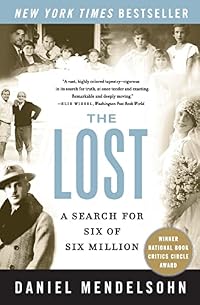
The Lost: A Search for Six of Six Million
by Daniel Mendelsohn
On This Page
Description
For five years, Daniel Mendelsohn traveled the globe searching for an answer to the question he had first asked as a boy decades earlier: What really happened to his great-uncle's family during the Holocaust? Here, Mendelsohn weaves together his discoveries about the past, family secrets and Judaism itself. He visits nearly a dozen countries on four continents in pursuit of the truth, eventually interviewing the town's twelve living survivors. Along the way, he detects things that challenge show more family myths and inspire new questions about long-held beliefs. Interwoven throughout the present-day developments are flashbacks to Mendelsohn's youth spent with his immigrant relatives, and more generally to Jewish life, philosophy and tradition over the years. Not only does he come to know his six deceased relatives on this unforgettable journey, but he discovers so much more about himself, his religion, his immediate family and their shared history as well.--From publisher description. show lessTags
Recommendations




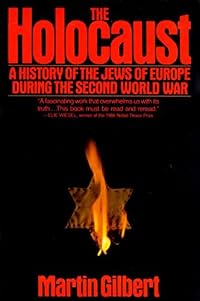
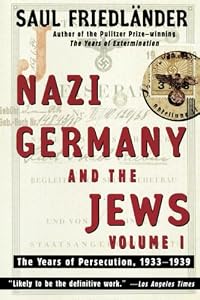
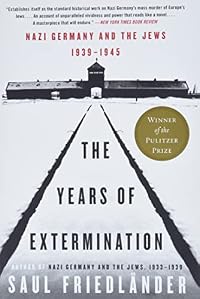
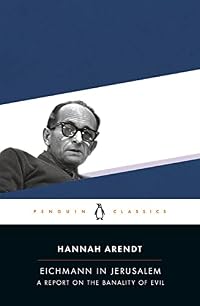

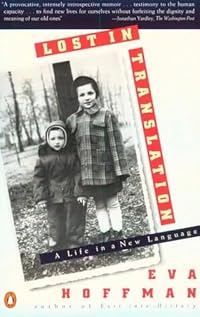

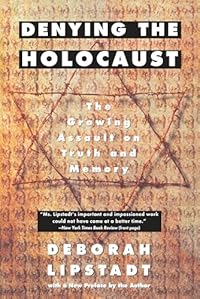

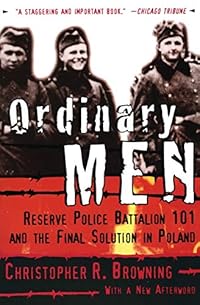
Member Recommendations
Member Reviews
Daniel is very close to his mother's father, old-worldly, meticulous and the family story-teller. Daniel learns much from him but, of course, doesn't fully appreciate or understand this treasure until he is older. After his grandfather dies, Daniel researches basic family genealogy. Daniel wonders why such a good story-teller didn’t tell stories about his older brother, Shmiel, his wife and their 4 daughters.
Daniel decides to find and write Shmiel’s story. Over many years he performed multi-faceted research, studied family photos and letters, visited, and spoke with and interviewed family members as well as strangers from Bolechow who knew a little something about Shmiel, Esther or their daughters, or who had ‘witnessed’ or show more ‘heard about’ an occurrence to Shmiel, Esther or their daughters. Daniel pieced together not just their pre-mature, abrupt, horrific murders by the Nazis and Ukrainians but the beauty of their friendships and daily lives. Mendelsohn’s thoughts and feelings coalesced into a greater understanding of his grandfather’s hidden anguish and guilt, and the unwillingness to speak of Shmiel, the brother he couldn’t save.
Using analysis of the weekly Parshiot read in synagogue on Shabbat to counterbalance his family’s painful story is brilliant. Especially meaningful to Daniel are the Torah segments about divisiveness between brothers; perhaps because Daniel had broken his brother, Matthew’s arm when young. And perhaps because he realized the guilt his grandfather suffered.
I both enjoyed and was saddened by everything Daniel shared but did feel the book ran on too long. show less
Daniel decides to find and write Shmiel’s story. Over many years he performed multi-faceted research, studied family photos and letters, visited, and spoke with and interviewed family members as well as strangers from Bolechow who knew a little something about Shmiel, Esther or their daughters, or who had ‘witnessed’ or show more ‘heard about’ an occurrence to Shmiel, Esther or their daughters. Daniel pieced together not just their pre-mature, abrupt, horrific murders by the Nazis and Ukrainians but the beauty of their friendships and daily lives. Mendelsohn’s thoughts and feelings coalesced into a greater understanding of his grandfather’s hidden anguish and guilt, and the unwillingness to speak of Shmiel, the brother he couldn’t save.
Using analysis of the weekly Parshiot read in synagogue on Shabbat to counterbalance his family’s painful story is brilliant. Especially meaningful to Daniel are the Torah segments about divisiveness between brothers; perhaps because Daniel had broken his brother, Matthew’s arm when young. And perhaps because he realized the guilt his grandfather suffered.
I both enjoyed and was saddened by everything Daniel shared but did feel the book ran on too long. show less
My interest in family history came from listening to my paternal grandmother's stories, which were often sparked by one of the objects that belonged to one of the relatives – a plate, a piece of jewelry, a photo album, a scrapbook, a diary. Daniel Mendelsohn's interest in his family's history seems to have developed in much the same way. His maternal grandfather told stories of the Jäger relatives who had emigrated from Bolechow, at the time a Polish town, to the U.S. His grandfather treasured the pictures and letters that were the only reminders left of his oldest brother, Shmiel, and Shmiel's wife and four daughters. While the rest of the family made new lives in the U.S., Shmiel decided to stay in Bolechow, where he was a “big show more fish in a little pond”. Shmiel and his family perished in the Holocaust along with almost all of Bolechow's Jewish residents.
Years of research allowed Mendelsohn to fill in many details on his family tree. As he filled in more and more details about other family members, Mendelsohn began to feel that he needed to learn more about his great-uncle Shmiel to complete the family tree. In order to find what could still be known about Shmiel's family and their fate, Mendelsohn needed to talk with the surviving remnant of Bolechow's Jews who were old enough to remember the Jäger family from before the war. Accompanied most of the way by his photographer brother Matt, Mendelsohn traveled to Australia, Israel, Sweden, Denmark, and Ukraine to meet people who had been there and to find out what they knew and what stories they had heard.
I was particularly struck by this passage:
It's different to write the story of people who survived, because there's someone to interview, and they can tell you these amazing stories. As I said these words, I thought of Mrs. Begley, who had once looked coldly at me and said, 'If you didn't have an amazing story, you didn't survive.'
My problem, I went on..., is that I want to write the story of people who didn't survive. People who had no story, anymore.
That passage sums up how this book differs from other books I've read about the Holocaust. It's not a survival account. It's about six individuals who didn't survive.
This is an inspirational book despite the grim subject matter. Mendelsohn frames his journey with meditation and commentary on weekly Torah readings (parashat) from Genesis. Along the way, he develops a stronger bond with his brother, forms new friendships, and discovers long-lost relatives. The journey is as meaningful as the destination. Highly recommended for readers with an interest in family history, Jewish genealogy, the Holocaust, and the history of Ukraine (formerly eastern Poland), particularly the town of Bolechow/Bolekhiv. show less
Years of research allowed Mendelsohn to fill in many details on his family tree. As he filled in more and more details about other family members, Mendelsohn began to feel that he needed to learn more about his great-uncle Shmiel to complete the family tree. In order to find what could still be known about Shmiel's family and their fate, Mendelsohn needed to talk with the surviving remnant of Bolechow's Jews who were old enough to remember the Jäger family from before the war. Accompanied most of the way by his photographer brother Matt, Mendelsohn traveled to Australia, Israel, Sweden, Denmark, and Ukraine to meet people who had been there and to find out what they knew and what stories they had heard.
I was particularly struck by this passage:
It's different to write the story of people who survived, because there's someone to interview, and they can tell you these amazing stories. As I said these words, I thought of Mrs. Begley, who had once looked coldly at me and said, 'If you didn't have an amazing story, you didn't survive.'
My problem, I went on..., is that I want to write the story of people who didn't survive. People who had no story, anymore.
That passage sums up how this book differs from other books I've read about the Holocaust. It's not a survival account. It's about six individuals who didn't survive.
This is an inspirational book despite the grim subject matter. Mendelsohn frames his journey with meditation and commentary on weekly Torah readings (parashat) from Genesis. Along the way, he develops a stronger bond with his brother, forms new friendships, and discovers long-lost relatives. The journey is as meaningful as the destination. Highly recommended for readers with an interest in family history, Jewish genealogy, the Holocaust, and the history of Ukraine (formerly eastern Poland), particularly the town of Bolechow/Bolekhiv. show less
I've been meaning to read this book for a decade now, ever since it came out and my European history professor from college emailed me. "I highly recommend this book," he said, "if you think you can get through it. Don't push yourself; the book can wait. But it is THAT GOOD." He wasn't insinuating that I didn't have the ability to read the book, that the vocabulary would be too much for me to grasp or that I wouldn't be able to make it through six hundred pages. Instead, he was concerned about my emotional ability to handle the content.
At that time, I was in the middle of conducting my own search - a search for twelve, all who perished in the Shoah (Holocaust), my grandmother's entire family. Only my grandmother "survived," although she show more hates being called a "survivor" because, as she says, she wasn't there. She had been sent away by her twice-widowed mother to England, a part of the Kindertransport, where she would stay until the end of the war, mostly (and, perhaps, blissfully) unaware of what was happening to her family, until the end, when it became brutally clear that she was the only one left. (She did manage to find a few cousins who survived and later moved to Israel, and another cousin who survived and decided to stay in Germany, and one of her uncles, her father's much older brother, whom she met once, emigrated to America before the war happened. But, essentially, the rest of her family was completely wiped from the face of the earth.)
So, yes, my former college professor was right to caution me, in his ever-exuberant way. He was the one, after all, who helped me with my search in college and afterward. So for years the book sat upon my shelf, and I always said "this year, I'm going to read it." But I never did. There was too much going on; I was too depressed to find out about another Jewish family, unrelated to mine and yet had suffered a similar fate; I was done with Shoah memoirs for a while, maybe forever (that'll never happen, no matter how many times I tell myself that "this one is the last one"); I wanted to read something that wasn't a tragedy.
And then, suddenly, it was the right time. It's been several years since I found any new information about my family; the trail has long gone cold, and although I do a half-hearted search every so often to see if anything new has popped up, I don't put my whole self into it anymore. They're all dead. I will never know them. And the nightmares that inevitably come when I think about them a great deal are...unpleasant, shall we say.
And this book did produce nightmares; don't get me wrong. But it was rather cathartic, in a way, to read this book, to cry and rage and feel all of the feelings.
Mendelsohn's grandfather left Bolechow, Poland before the war (and subsequent near-annihilation of Polish Jewry). He had one brother, Schmiel, who had also emigrated to America but had, unlike Mendelsohn's grandfather, returned to Bolechow. There he married and had four daughters, while he brought the family's butcher shop back to prominence. None of Schmiel's family survived the war.
Growing up, Mendelsohn heard varied stories of "the lost," of Schmiel and his family. But the stories were different and almost impossible to track down, at that time. As the author grew older, the need to know what happened to Schmiel and his family grew, until he found himself crossing the globe in search of answers, from America to Australia to Poland to Denmark to Sweden. Along the way, he finds much more than he ever expected to find, as well as coming to the realization that finding all of the details about what happened is impossible, especially with so few survivors who are still living.
Mehndelsohn's writing style is different. He tends to be rather "poetic," I suppose I would say, and he is damned fond of run-on sentences. He also expresses, early in the book, a love for how the Greeks (and how his grandfather) told stories - long and winding, with lots of asides in between that, eventually, make sense, but it might be a long way down the road. There were times that I had to read paragraphs several times (often the "paragraph" was just one long run-on sentence) in order for them to make sense. But the story is worth it, and I urge you to persevere.
If you need absolute closure, where you know everything about the major players introduced in the book, once again, this probably isn't for you. It always amazes me when I talk to people about the Shoah, how most think that we have a date and a time and a method of execution for every family member. Some even believe that we had bodies to bury! No, there are still numerous unexcavated mass graves in Poland, the Ukraine, etc, etc. And many bodies were burned, so they are only ashes now. As you can see from my own list of family members who died in the Shoah (below), I only have years. Only for one (my great-grandfather, who was the only NOT killed because of his ethnicity, although he was also Jewish) do I know, in so many words, exactly what happened to him. And the same holds true for Mendelsohn - he knows some details, and he can make some educated guesses, but in the end, what happened is so hazy. As numerous survivors told him, if we KNEW what exactly had happened, we wouldn't be here to talk to you, because we would be dead too.
Another thing that Mendelsohn talks about is the near absolute destruction of Polish (and European) Jewry. I remember talking to someone while I was in college and she was like, "well Hitler didn't win, the Jews are still around!" And yes, we are still around. But we are, for the most part, not "around" in places where, a hundred years ago, there were thriving, close-knit communities in Europe. We are in Israel, America, Australia, etc. Mendelsohn spoke to a few "last Jew of [insert town]," where one lone man or woman is the last living Jew in that area. The Nazis (and their local collaborators, who were numerous) managed to wipe out 90% of Polish Jews. Just imagine that. 90%. And the 10% of survivors? Well, most of them didn't want to return to the area where they had once lived, with their families murdered and their murderers often being the very neighbors that they had once smiled at in the streets and, perhaps, even been friends with, once upon a time. One of the most moving "scenes" for me, I think, was when Mendelsohn visits Prague and the "New Jewish Cemetery," which was a vast tract of land purchased before the Shoah, next to the "Old Jewish Cemetery." The Old Jewish Cemetery is packed with graves, so much so that it motivated the city's Jewish population to buy land to expand it (hence being the "New" Cemetery). That New Jewish Cemetery is virtually barren. There are very few graves there. Why? Because most of the Jews who had expected to be buried there were buried in unmarked mass graves or shipped off to concentration and extermination camps. And their descendants, if they survived, are mostly not in Prague any longer, and will have no need of a cemetery in a foreign land.
As Mendelsohn wrote, "It makes you realize that the Holocaust wasn't something that simply happened, but is an event that's still happening." The repercussions from the Shoah are like so many rings in a pond after you've thrown in a stone. Six million were killed, yes. But many more millions were never born because their would-be parents were murdered. Imagine the art, the books, the literature, the scientific breakthroughs that are missing now from the world. The recipes, the family stories, the picture albums of long dead relatives - all gone, or nearly so. My grandmother, for example, for decades, has been having me try to find a recipe for a dish her mother used to make. I've found a few online, but they don't taste exactly like what she remembers. That recipe is gone. And the family stories, the lullabyes that would have been passed along to my grandmother's children (and perhaps to me), the inside jokes...those are gone, too. I feel that missing piece in the world whenever I think about it, about them.
So yes, for those of us who are descendants of survivors, the wound can still burn. For the survivors themselves? The wound is still raw and bleeding for many of them. I look at my grandmother, who was sent away so young that she barely remembers her half-brothers and half-sister. She has one memory of her father, who was killed when she was barely four. There are "personality traits" that she has - her diagnosed OCD, her absolute need for order and lists, the emotional distance that she has with nearly everyone in her life - that I wonder would be there if she had grown up, happy and carefree, with her siblings and both living parents (or even her mother), instead of at the mercy of strangers (who, she will freely admit, were nothing but kind to her, and whom she kept in regular contact until their deaths; and she kept in touch with their children, as well, until their deaths) where the world that she knew, as she felt, could be taken away from her in an instant. And there is her almost hatred for the French and the Poles (never trust a Pole, I remember her saying to me when I was a small child, they'll stab you in the back AND front), which feels strange, I must admit, considering that she doesn't share the same hatred for Germans (I'm German, she'll proclaim when I question her idiosyncrasy, I can't hate myself. [Her father was German and her mother was Polish, although my grandmother was born and raised in Germany. She did, however, make a few trips to visit her much-older half-siblings, all of whom still lived in Poland except for the youngest, David, who was still a teenager when his mother married my great-grandfather, and moved to Germany.]) Mendelsohn addresses this in the book, too; it seems that it's not just one of my grandmother's "quirks," but something that is not uncommon with survivors.
Mendelsohn does, in the end, manage to track down where Schmiel and one of his daughters dies, and where they were hidden before their deaths. Finding that particular site for him was incredibly emotional. I cannot imagine what it would be like to stand, in my case, at the gates of Auschwitz or Treblinka and know, THIS is the place where they died. Just reading about his emotional breakdown, where he kneels and starts sobbing, made me cry like a baby. I've always been somewhat indifferent about visiting Auschwitz and/or Treblinka. I must admit that my grandmother's warnings about the Poles still ring in the back of my mind, although I know it is completely unfair to judge an entire people by the actions of some (you would think that my grandmother, being Jewish, wouldn't be so quick to judge an entire race...). The whole place feels frightening to me, I have to say. But after reading this book...maybe, someday, I'll want to go there.
I'd highly recommend this book, but do be prepared for an emotional rollercoaster.
May their memories be a blessing:
My great-grandfather, political prisoner (Communist), murdered in 1933
My great-grandmother, deported from France in 1942 (where she fled, probably feeling that she would be safer there than in Germany), presumably gassed immediately upon arrival at Auschwitz due to age/health
My great-uncle David, deported from France in 1942 (who fled from Germany to France with his mother), presumably gassed or otherwise killed in Auschwitz, exact year unknown (perhaps 1942, perhaps later)
My great-uncle Josef, as well as his son and daughter, deported to Warsaw Ghetto in 1942, presumably all deported to Treblinka (if they survived the Ghetto and deportation), where they would have been gassed upon arrival, in 1942
My great-uncle Wolf (or Rolf), last known location in 1939 of Lodz (Poland), fate unknown
My great-aunt Malke, husband Yitzhak, and their four children, deported to Warsaw Ghetto in 1942, presumably all deported to Treblinka (if they survived the Ghetto and deportation), where they would have been gassed upon arrival, in 1942 show less
At that time, I was in the middle of conducting my own search - a search for twelve, all who perished in the Shoah (Holocaust), my grandmother's entire family. Only my grandmother "survived," although she show more hates being called a "survivor" because, as she says, she wasn't there. She had been sent away by her twice-widowed mother to England, a part of the Kindertransport, where she would stay until the end of the war, mostly (and, perhaps, blissfully) unaware of what was happening to her family, until the end, when it became brutally clear that she was the only one left. (She did manage to find a few cousins who survived and later moved to Israel, and another cousin who survived and decided to stay in Germany, and one of her uncles, her father's much older brother, whom she met once, emigrated to America before the war happened. But, essentially, the rest of her family was completely wiped from the face of the earth.)
So, yes, my former college professor was right to caution me, in his ever-exuberant way. He was the one, after all, who helped me with my search in college and afterward. So for years the book sat upon my shelf, and I always said "this year, I'm going to read it." But I never did. There was too much going on; I was too depressed to find out about another Jewish family, unrelated to mine and yet had suffered a similar fate; I was done with Shoah memoirs for a while, maybe forever (that'll never happen, no matter how many times I tell myself that "this one is the last one"); I wanted to read something that wasn't a tragedy.
And then, suddenly, it was the right time. It's been several years since I found any new information about my family; the trail has long gone cold, and although I do a half-hearted search every so often to see if anything new has popped up, I don't put my whole self into it anymore. They're all dead. I will never know them. And the nightmares that inevitably come when I think about them a great deal are...unpleasant, shall we say.
And this book did produce nightmares; don't get me wrong. But it was rather cathartic, in a way, to read this book, to cry and rage and feel all of the feelings.
Mendelsohn's grandfather left Bolechow, Poland before the war (and subsequent near-annihilation of Polish Jewry). He had one brother, Schmiel, who had also emigrated to America but had, unlike Mendelsohn's grandfather, returned to Bolechow. There he married and had four daughters, while he brought the family's butcher shop back to prominence. None of Schmiel's family survived the war.
Growing up, Mendelsohn heard varied stories of "the lost," of Schmiel and his family. But the stories were different and almost impossible to track down, at that time. As the author grew older, the need to know what happened to Schmiel and his family grew, until he found himself crossing the globe in search of answers, from America to Australia to Poland to Denmark to Sweden. Along the way, he finds much more than he ever expected to find, as well as coming to the realization that finding all of the details about what happened is impossible, especially with so few survivors who are still living.
Mehndelsohn's writing style is different. He tends to be rather "poetic," I suppose I would say, and he is damned fond of run-on sentences. He also expresses, early in the book, a love for how the Greeks (and how his grandfather) told stories - long and winding, with lots of asides in between that, eventually, make sense, but it might be a long way down the road. There were times that I had to read paragraphs several times (often the "paragraph" was just one long run-on sentence) in order for them to make sense. But the story is worth it, and I urge you to persevere.
If you need absolute closure, where you know everything about the major players introduced in the book, once again, this probably isn't for you. It always amazes me when I talk to people about the Shoah, how most think that we have a date and a time and a method of execution for every family member. Some even believe that we had bodies to bury! No, there are still numerous unexcavated mass graves in Poland, the Ukraine, etc, etc. And many bodies were burned, so they are only ashes now. As you can see from my own list of family members who died in the Shoah (below), I only have years. Only for one (my great-grandfather, who was the only NOT killed because of his ethnicity, although he was also Jewish) do I know, in so many words, exactly what happened to him. And the same holds true for Mendelsohn - he knows some details, and he can make some educated guesses, but in the end, what happened is so hazy. As numerous survivors told him, if we KNEW what exactly had happened, we wouldn't be here to talk to you, because we would be dead too.
Another thing that Mendelsohn talks about is the near absolute destruction of Polish (and European) Jewry. I remember talking to someone while I was in college and she was like, "well Hitler didn't win, the Jews are still around!" And yes, we are still around. But we are, for the most part, not "around" in places where, a hundred years ago, there were thriving, close-knit communities in Europe. We are in Israel, America, Australia, etc. Mendelsohn spoke to a few "last Jew of [insert town]," where one lone man or woman is the last living Jew in that area. The Nazis (and their local collaborators, who were numerous) managed to wipe out 90% of Polish Jews. Just imagine that. 90%. And the 10% of survivors? Well, most of them didn't want to return to the area where they had once lived, with their families murdered and their murderers often being the very neighbors that they had once smiled at in the streets and, perhaps, even been friends with, once upon a time. One of the most moving "scenes" for me, I think, was when Mendelsohn visits Prague and the "New Jewish Cemetery," which was a vast tract of land purchased before the Shoah, next to the "Old Jewish Cemetery." The Old Jewish Cemetery is packed with graves, so much so that it motivated the city's Jewish population to buy land to expand it (hence being the "New" Cemetery). That New Jewish Cemetery is virtually barren. There are very few graves there. Why? Because most of the Jews who had expected to be buried there were buried in unmarked mass graves or shipped off to concentration and extermination camps. And their descendants, if they survived, are mostly not in Prague any longer, and will have no need of a cemetery in a foreign land.
As Mendelsohn wrote, "It makes you realize that the Holocaust wasn't something that simply happened, but is an event that's still happening." The repercussions from the Shoah are like so many rings in a pond after you've thrown in a stone. Six million were killed, yes. But many more millions were never born because their would-be parents were murdered. Imagine the art, the books, the literature, the scientific breakthroughs that are missing now from the world. The recipes, the family stories, the picture albums of long dead relatives - all gone, or nearly so. My grandmother, for example, for decades, has been having me try to find a recipe for a dish her mother used to make. I've found a few online, but they don't taste exactly like what she remembers. That recipe is gone. And the family stories, the lullabyes that would have been passed along to my grandmother's children (and perhaps to me), the inside jokes...those are gone, too. I feel that missing piece in the world whenever I think about it, about them.
So yes, for those of us who are descendants of survivors, the wound can still burn. For the survivors themselves? The wound is still raw and bleeding for many of them. I look at my grandmother, who was sent away so young that she barely remembers her half-brothers and half-sister. She has one memory of her father, who was killed when she was barely four. There are "personality traits" that she has - her diagnosed OCD, her absolute need for order and lists, the emotional distance that she has with nearly everyone in her life - that I wonder would be there if she had grown up, happy and carefree, with her siblings and both living parents (or even her mother), instead of at the mercy of strangers (who, she will freely admit, were nothing but kind to her, and whom she kept in regular contact until their deaths; and she kept in touch with their children, as well, until their deaths) where the world that she knew, as she felt, could be taken away from her in an instant. And there is her almost hatred for the French and the Poles (never trust a Pole, I remember her saying to me when I was a small child, they'll stab you in the back AND front), which feels strange, I must admit, considering that she doesn't share the same hatred for Germans (I'm German, she'll proclaim when I question her idiosyncrasy, I can't hate myself. [Her father was German and her mother was Polish, although my grandmother was born and raised in Germany. She did, however, make a few trips to visit her much-older half-siblings, all of whom still lived in Poland except for the youngest, David, who was still a teenager when his mother married my great-grandfather, and moved to Germany.]) Mendelsohn addresses this in the book, too; it seems that it's not just one of my grandmother's "quirks," but something that is not uncommon with survivors.
I'd highly recommend this book, but do be prepared for an emotional rollercoaster.
May their memories be a blessing:
My great-grandfather, political prisoner (Communist), murdered in 1933
My great-grandmother, deported from France in 1942 (where she fled, probably feeling that she would be safer there than in Germany), presumably gassed immediately upon arrival at Auschwitz due to age/health
My great-uncle David, deported from France in 1942 (who fled from Germany to France with his mother), presumably gassed or otherwise killed in Auschwitz, exact year unknown (perhaps 1942, perhaps later)
My great-uncle Josef, as well as his son and daughter, deported to Warsaw Ghetto in 1942, presumably all deported to Treblinka (if they survived the Ghetto and deportation), where they would have been gassed upon arrival, in 1942
My great-uncle Wolf (or Rolf), last known location in 1939 of Lodz (Poland), fate unknown
My great-aunt Malke, husband Yitzhak, and their four children, deported to Warsaw Ghetto in 1942, presumably all deported to Treblinka (if they survived the Ghetto and deportation), where they would have been gassed upon arrival, in 1942 show less
There may just be a vertical hierarchy in our popular understanding of the Holocaust. At the top, however uneasy, are the Survivors: it is through their testimony that we know to never forget. Their is also a measure of merit in having outwitted or simply survived the minatory machinations of the Nazis. below them are the victims, particularly present when the doltish ask "why they went like sheep, why they didn’t fight back, why they didn’t heed the signs in the 1930s?" Below that mound of evidence is nefarious mass of perpetrators, willing executioners, ordinary men, the devil incarnate and the betrayers.
If only life was that fucking simple.
Mr. Mendelson constructs a marvelous investigation sixty years after the fact. His show more training as a classicist lends a unique angle to his research. The idea of using Dido as an apt metaphor is astonishing: victim and exile, she prospers from her wits only to kill herself. If ever an example antiicpated the Survivor, this is it. show less
If only life was that fucking simple.
Mr. Mendelson constructs a marvelous investigation sixty years after the fact. His show more training as a classicist lends a unique angle to his research. The idea of using Dido as an apt metaphor is astonishing: victim and exile, she prospers from her wits only to kill herself. If ever an example antiicpated the Survivor, this is it. show less
"The Lost" goes on my "20 best books I have ever read" list. I will have to displace something else to put it there, but its depth and power demand a place.
Daniel Mendelsohn tells the story of his search for information regarding the fate of his great-uncle, and that uncle's wife and 4 daughters. The family knew that all 6 had perished in The Holocaust, but they had no details. They were not only lost to the family, but their humanity and their stories, were also "lost."
Mendelsohn sets out to find the facts about their deaths, and this books recounts that search. But it does very much more than that.
Constructed as a memoir, a detective story, a meditation on life and on the Torah, full of pain and life-altering coincidence, this book is show more a marvel. The writer's voice is compelling, and concrete, yet he deals in and with shadows, rumors, whispered confidences, secrets, lies and confusion.
Sorrow, loss, identity, grief and joy all comingle in this masterwork. Who are we? Who is our family? Where do we come from? How does our living and our dying impact our descendants? How can we recover those we have lost?
I could not put this book down. Page by page, chapter by chapter, Mendelsohn peels back layers of history and time, memory and forgetfulness, until at last we know what happened to the six. And in the process of following Mendelsohn's search, we ourselves are changed. show less
Daniel Mendelsohn tells the story of his search for information regarding the fate of his great-uncle, and that uncle's wife and 4 daughters. The family knew that all 6 had perished in The Holocaust, but they had no details. They were not only lost to the family, but their humanity and their stories, were also "lost."
Mendelsohn sets out to find the facts about their deaths, and this books recounts that search. But it does very much more than that.
Constructed as a memoir, a detective story, a meditation on life and on the Torah, full of pain and life-altering coincidence, this book is show more a marvel. The writer's voice is compelling, and concrete, yet he deals in and with shadows, rumors, whispered confidences, secrets, lies and confusion.
Sorrow, loss, identity, grief and joy all comingle in this masterwork. Who are we? Who is our family? Where do we come from? How does our living and our dying impact our descendants? How can we recover those we have lost?
I could not put this book down. Page by page, chapter by chapter, Mendelsohn peels back layers of history and time, memory and forgetfulness, until at last we know what happened to the six. And in the process of following Mendelsohn's search, we ourselves are changed. show less
The author's very personal journey to find the stories of 6 members of his family who were killed in Poland during the Holocaust has much to offer about the bigger picture as well. He tells the story much like his grandfather told stories, looping forward and back, away from what you thought was the main action and then back again. We learn about life in a small Polish town before the war and the hell that visited there during the war. But we also learn about the first section of the Torah and interpretations of it through the ages. It might seem irrelevant, but the cycles of destruction and rebirth of human society are very relevant to discussions of the Holocaust.
At times, the book meanders or repeats itself in ways that are less show more charming, but overall it keeps things moving even with a tough premise - it's hard to find specific answers when so many people who could tell the stories are dead (if not in the war, than in the 60 years between then and when Mendelsohn started seriously researching). For me, that was probably the most poignant part - that we often don't pursue asking questions until the people who could answer them are no longer with us. show less
At times, the book meanders or repeats itself in ways that are less show more charming, but overall it keeps things moving even with a tough premise - it's hard to find specific answers when so many people who could tell the stories are dead (if not in the war, than in the 60 years between then and when Mendelsohn started seriously researching). For me, that was probably the most poignant part - that we often don't pursue asking questions until the people who could answer them are no longer with us. show less
The Lost is an outstanding book that goes well beyond a family history. The extensive portrait of the extended Mendelsohn-Jäger clan living in Long Island and Florida can be at times a bit frightening to someone more used to nuclear families. This is a tale of large families (Daniel Mendelsohn himself has four siblings, one (Matt) contributing the photos of the book) living intimately together, with aunts, uncles and other relatives staying in for extended periods of time.
Woody Allen's portrait of a Holocaust obsessed New York Jew fits Mendelsohn to a T. Since his childhood, Daniel Mendelsohn had developed an odd obsession with genealogy, discovering the personal histories of his relatives impacted by the Holocaust. Linked to this is show more a creepy obsession of spending time in the company of old people, already as a teenager but also while traveling in Europe where he eschews visiting a city's highlights in order to score another interview with an often less than willing Holocaust survivor. His sightseeing is often marred by insufficient preparation. A simple Wikipedia search would have revealed that Theodor Herzl was buried in the Döbling cemetery not the Zentralfriedhof in Vienna. Vienna's Zentralfriedhof is lodged between the industrial zone, the airport and an oil refinery. No wonder that upstanding citizens such as Theodor Herzl did not want to be buried there. The Zentralfriedhof is almost situated in Vienna's equivalent of New Jersey. For marketing purposes, Vienna's administration reburied some of its heroes (such as Franz Schubert and Ludwig van Beethoven) in the Zentralfriedhof and even set up empty memorials for others (Mozart). Sometimes, the lack of a systematic approach is vexing. Serendipity often comes to the rescue.
The search quickly turns into a hunt, a mystery of a true crime. What had truly happened to Mendelsohn's grand-uncle and his daughters in 1941 and 1942? Mendelsohn unveils layer upon layer, giving faces and stories to name and places - a task better not left to the professionals: regarding his relatives, the database of Yad Vashem was filled with errors, partly due to the Galician-Polish-Ukrainian multi-linguistic environment. While the re-discovery of his relatives' life and death as well as the stories of the Holocaust survivors is a worthy endeavor in itself, Mendelsohn enriches it with a meditation and analysis of the first books of Moses. Jewish history as a tale of suffering starts early with God evicting and punishing the first humans and later wiping out most of humanity and nature in the flood. Sodom and Gomorrah only continues the story of a jealous and vengeful God. Even the God-fearing and righteous will suffer. Mendelsohn's research reveals quite a number of skeletons in the family closet. Reality is complex and non-fiction offers the best tales. Like an excellently choreographed firework, Mendelsohn's hunt pays off magnificiently, with tiny build-ups aggregating into big reveals. Given Goethe's Faust's famous agonizing over the correct translation of the first lines of Genesis, I found the discussion of its Hebrew translation issues (and its surprisingly frequent non-conventional approaches) very interesting. Another topic I have so much to learn about.
Where Mendelsohn's book could have benefited from was a more general introduction to the Eastern European area, recently labeled "Blood lands". Unfortunately for its inhabitants from Poland to Hungary to Austria to the Adria, the clashes through the centuries between the East and the West proved to be very bloody. Wiping out villages and cities used to be an all too familiar occurrence. Like Mendelsohn, I have often wondered why, for instance, the inhabitants of Hainburg, Austria, did not flee prior to the Turkish invasion of 1683. The Turks wiped out nearly all of the 8.000 inhabitants. Joseph Haydn's grand-father was one of the few survivors. While The Lost ultimately is a personal search for the history of his relatives and the Holocaust, a wider discussion of the violent nature of mankind would have been quite in order. The Holodomor, Stalin's starvation of millions of Ukrainians occurred just on the other side of the border from Bolechow. Since time immemorial, Eastern Europe has seen a lot of suffering (emigration has always been the best strategy). Homo homini lupus. Mendelsohn shies away from its full discussion and implication. This is especially bothersome in his mentioning of Abu Grhaib's "abuses said to have taken place". Call it torture and it is so amply documented that its denial or questioning is just sad. Together with mentioning Evian only as a mineral water, the continued whitewashing of US involvement in blocking Jewish emigration is not helpful in educating the next generation of Americans. Apart from this all too common blind spots, this is a spectacular achievement that is a fast-paced, revealing read. Highly recommended. show less
Woody Allen's portrait of a Holocaust obsessed New York Jew fits Mendelsohn to a T. Since his childhood, Daniel Mendelsohn had developed an odd obsession with genealogy, discovering the personal histories of his relatives impacted by the Holocaust. Linked to this is show more a creepy obsession of spending time in the company of old people, already as a teenager but also while traveling in Europe where he eschews visiting a city's highlights in order to score another interview with an often less than willing Holocaust survivor. His sightseeing is often marred by insufficient preparation. A simple Wikipedia search would have revealed that Theodor Herzl was buried in the Döbling cemetery not the Zentralfriedhof in Vienna. Vienna's Zentralfriedhof is lodged between the industrial zone, the airport and an oil refinery. No wonder that upstanding citizens such as Theodor Herzl did not want to be buried there. The Zentralfriedhof is almost situated in Vienna's equivalent of New Jersey. For marketing purposes, Vienna's administration reburied some of its heroes (such as Franz Schubert and Ludwig van Beethoven) in the Zentralfriedhof and even set up empty memorials for others (Mozart). Sometimes, the lack of a systematic approach is vexing. Serendipity often comes to the rescue.
The search quickly turns into a hunt, a mystery of a true crime. What had truly happened to Mendelsohn's grand-uncle and his daughters in 1941 and 1942? Mendelsohn unveils layer upon layer, giving faces and stories to name and places - a task better not left to the professionals: regarding his relatives, the database of Yad Vashem was filled with errors, partly due to the Galician-Polish-Ukrainian multi-linguistic environment. While the re-discovery of his relatives' life and death as well as the stories of the Holocaust survivors is a worthy endeavor in itself, Mendelsohn enriches it with a meditation and analysis of the first books of Moses. Jewish history as a tale of suffering starts early with God evicting and punishing the first humans and later wiping out most of humanity and nature in the flood. Sodom and Gomorrah only continues the story of a jealous and vengeful God. Even the God-fearing and righteous will suffer. Mendelsohn's research reveals quite a number of skeletons in the family closet. Reality is complex and non-fiction offers the best tales. Like an excellently choreographed firework, Mendelsohn's hunt pays off magnificiently, with tiny build-ups aggregating into big reveals. Given Goethe's Faust's famous agonizing over the correct translation of the first lines of Genesis, I found the discussion of its Hebrew translation issues (and its surprisingly frequent non-conventional approaches) very interesting. Another topic I have so much to learn about.
Where Mendelsohn's book could have benefited from was a more general introduction to the Eastern European area, recently labeled "Blood lands". Unfortunately for its inhabitants from Poland to Hungary to Austria to the Adria, the clashes through the centuries between the East and the West proved to be very bloody. Wiping out villages and cities used to be an all too familiar occurrence. Like Mendelsohn, I have often wondered why, for instance, the inhabitants of Hainburg, Austria, did not flee prior to the Turkish invasion of 1683. The Turks wiped out nearly all of the 8.000 inhabitants. Joseph Haydn's grand-father was one of the few survivors. While The Lost ultimately is a personal search for the history of his relatives and the Holocaust, a wider discussion of the violent nature of mankind would have been quite in order. The Holodomor, Stalin's starvation of millions of Ukrainians occurred just on the other side of the border from Bolechow. Since time immemorial, Eastern Europe has seen a lot of suffering (emigration has always been the best strategy). Homo homini lupus. Mendelsohn shies away from its full discussion and implication. This is especially bothersome in his mentioning of Abu Grhaib's "abuses said to have taken place". Call it torture and it is so amply documented that its denial or questioning is just sad. Together with mentioning Evian only as a mineral water, the continued whitewashing of US involvement in blocking Jewish emigration is not helpful in educating the next generation of Americans. Apart from this all too common blind spots, this is a spectacular achievement that is a fast-paced, revealing read. Highly recommended. show less
Members
- Recently Added By
Published Reviews
ThingScore 75
Mendelsohn verdient grote waardering voor zijn intensieve speurtocht en zijn pogen leven en lijden van 6 van de 6 miljoen concreet vorm te geven, maar jammer is het dat hij in zijn weergave van ontmoetingen en gesprekken de eigen persoon te veel op de voorgrond plaatst, te vaak tussen de lezer en het eigenlijke verhaal in gaat staan en zich hierbij verliest in talloze en overbodige details. show more Deze kritiek laat de waarde van dit boek als een aangrijpend menselijk document echter onverlet. show less
added by sneuper
Lists

Holocaust
100 works; 13 members

Best Biographies, Autobiographies and Memoirs
464 works; 156 members

The Burned Letter Book List
56 works; 1 member

Llibres que he llegit el 2025
81 works; 2 members
Author Information

20+ Works 3,630 Members
Daniel Mendelsohn is an award-winning author. He received a B.A. in Classics from the University of Virginia and received his M.A. and Ph.D. in Classics from Princeton University. Upon completing his Ph.D. in 1994, Mendelsohn began a career in journalism. In 2005 Mendelsohn was the recipient of a Guggenheim Fellowship for a translation of Cavafy's show more "Unfinished" poems, with commentary. His other honors include the National Book Critics Circle Award for Excellence in Book Reviewing (2000) and the George Jean Nathan Prize for Drama Criticism (2002). Mendelsohn's academic speciality is Greek (especially Euripidean) tragedy. In 2015 his title The Lost: A Search for Six of Six Million made the New Zealand Best Seller List. (Bowker Author Biography) show less
All Editions
Some Editions
Awards and Honors
Awards
Distinctions
Series
Belongs to Publisher Series
Bloom [Neri Pozza] (11)
Common Knowledge
- Canonical title
- The Lost: A Search for Six of Six Million
- Original title
- The Lost: A Search for Six of Six Million
- Original publication date
- 2006
- Important places
- Tel Aviv, Israel; New York, New York, USA; Bolekhiv, Ukraine
- Important events
- Holocaust
- Epigraph
- When we have passed a certain age, the soul of the child we were and the souls of the dead from whom we have sprung come to lavish on us their riches and their spells. . . . -- Marcel Proust, "In Search of Lost Time" (The ... (show all)Captive)
- Dedication
- To Frances Begley and Sarah Pettit
sunt lacrimae rerum - First words
- Some time ago, when I was six or seven or eight years old, it would occasionally happen that I'd walk into a room and certain people would begin to cry.
- Last words
- (Click to show. Warning: May contain spoilers.)But as Alex maneuvered the blue Passat out of the complicated little streets that an epoch ago had given the inhabitants of that place, very few of whom are left now, none of whom will be alive when I am Jack Greene's age, the nickname that nobody knows or cares about anymore, Bolechower crawlers! - as Alex navigated those twisty streets, we all started talking at once, telling the remarkable story of what we had found and where we had walked, and by the time I remembered to turn around and take that one last look, we had traveled too far, and Bolechow had slipped out of sight.
- Blurbers
- Wiesel, Elie
- Original language*
- Anglais (Etats-Unis) (Etats-Unis)
*Some information comes from Common Knowledge in other languages. Click "Edit" for more information.
Classifications
- Genres
- Biography & Memoir, General Nonfiction, History, Nonfiction
- DDC/MDS
- 973.049240092 — History & geography History of North America United States United States Ethnic And National Groups Other Groups Jewish Americans
- LCC
- E184.37 .M48 .L67 — History of the United States United States Elements in the population Afro-Americans
- BISAC
Statistics
- Members
- 1,959
- Popularity
- 10,742
- Reviews
- 46
- Rating
- (4.15)
- Languages
- 9 — Danish, Dutch, English, French, German, Italian, Norwegian (Bokmål), Portuguese, Spanish
- Media
- Paper, Audiobook, Ebook
- ISBNs
- 42
- UPCs
- 2
- ASINs
- 18