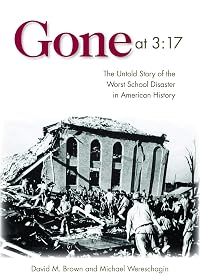
Gone at 3:17: The Untold Story of the Worst School Disaster in American History
by David Brown
On This Page
Description
How a town lost its futureAt 3:17 p.m. on March 18, 1937, a natural gas leak beneath the London Junior-Senior High School in the oil boomtown of New London, Texas, created a lethal mixture of gas and oxygen in the school's basement. The odorless, colorless gas went undetected until the flip of an electrical switch triggered a colossal blast. The two-story school, one of the nation's most modern, disintegrated, burying everyone under a vast pile of rubble and debris. More than 300 students show more and teachers were killed, and hundreds more were injured.
As the seventy-fifth anniversary of the catastrophe approaches, it remains the deadliest school disaster in U.S. history. Few, however, know of this historic tragedy, and no book, until now, has chronicled the explosion, its cause, its victims, and the aftermath.
Gone at 3:17 is a true story of what can happen when school officials make bad decisions. To save money on heating the school building, the trustees had authorized workers to tap into a pipeline carrying "waste" natural gas produced by a gasoline refinery. The explosion led to laws that now require gas companies to add the familiar pungent odor. The knowledge that the tragedy could have been prevented added immeasurably to the heartbreak experienced by the survivors and the victims' families. The town would never be the same.
Using interviews, testimony from survivors, and archival newspaper files, Gone at 3:17 puts readers inside the shop class to witness the spark that ignited the gas. Many of those interviewed during twenty years of research are no longer living, but their acts of heroism and stories of survival live on in this meticulously documented and extensively illustrated book.
. show less
Tags
Recommendations












Member Reviews
When I saw that Gone at 3:17 was co-authored by two writers and that both were newspaper journalists, I feared that my expectations for the book might not be met. Heretofore, I've found that co-authored works often suffer from stylistic confusion, and as a former English major in university, of course I considered journalism majors to be of an inferior breed, just as hard science majors looked down upon us humanities majors. (Remember the chorus of Kris Kristofferson's Jesus Was a Capricorn: “'Cause everybody's gotta have somebody to look down on”?) Anyway, my fears proved groundless because Brown and Wereschagin have written a remarkable book that is not only factually accurate (appealing to my appreciation of historical reality) show more but is also enticingly composed (appealing to my enjoyment of a readable, captivating narrative).
Why does natural gas have such a distinctive, annoying rotten-egg odor? A chemical called mercaptan is added to it; otherwise, it is invisible and odorless. Why make it smell so offensive? Over three hundred Texas death certificates, all bearing the same date and location of death, are why. The same inspiration underlies the creation of this book, which the authors have “dedicated to preserving the memory of the events of March 18, 1937” when the building housing the middle and high school classes of New London, Rusk County, Texas erupted in an earth-shattering explosion of its gas-filled basement.
Why is the book important? I offer myself as an example. I was born and grew up in a Texas town only a 2 ¼ hour drive from New London. I graduated from a Texas university that lies roughly a three hour drive away. Nevertheless, until I accidentally encountered Gone at 3:17, I had never heard of the incredible disaster that had unfolded only four counties to the south of my own. As Brown and Wereschagin note, the passage of time and the natural deaths of the aging survivors and witnesses of the catastrophic destruction of a brand new school building filled with students as young as fifth graders and their teachers is fading from public memory—and it really should not.
Why read this particular book? There are, of course, other accounts of this tragedy, and one can very simply look up its facts on line. The authors of Gone at 3:17 have written an account that includes but goes beyond the material facts. Through their prose, the reader is vicariously transported to the time and the town, feeling the warmth of the springtime Sun, smelling the airborne perfume of newly blooming flowers, seeing youngsters en route to school, hearing some of their chatter. The reader also understands why the town even came into being and sees the transformation of agricultural fields into a derrick-crowded, roughneck-populated oil boom region. (And waste gas produced by the refining of this oil played a crucial role in the massive death toll.) In short, through their descriptive narrative the authors transport readers into the events, which become far more memorable than facts that are simply read.
I levy only a few quite small criticisms against Gone at 3:17. The first is that, thankfully on only a very few occasions, the authors create some unsuccessful similes that, when contrasted with the otherwise excellent writing, strike me as unforgivably sophomoric. For example, on page 165 we read, “There were a few bright moments, like nuggets of gold or diamonds turning up in a washtub of muddy water.” On page 173, we encounter a reference to a “flashing beacon of an ambulance floating across the darkness like the raw red eye of a storybook phantom....” Fortunately, such inappropriate comparisons are not at all frequent.
A bit of jarring phraseology (perhaps a malapropism or a typo?) occurs on page 122. Quoting another source, the authors relate, “Most of the school had, literally, vanished, leaving a rubble-littered cradle to show where it had been.” A “cradle”? Might the original word have been “crater”? If so, then this observation is contradicted by a quotation from the Dallas Times-Herald on page 168: “[W]hile the building was shattered from the ground up, leaving no trace of the concrete basement floor, there was no hole in the ground.”
As long as I'm picking nits, page 118 shows an erroneous use of the subjunctive mood in the sentence “If the Kentucky Derby were taking place, McLemore was there.” This is the sole instance of an obviously ungrammatical sentence in the book, but one wonders where the proofreader was when the book was read before going to print.
I was also disappointed by one omission in the book. Although 16 unnumbered pages are given over to pertinent historical photographs, there is no photo of the impressive cenotaph that stands in New London today to memorialize the victims of the 1937 catastrophe although it is described in the text. Fortunately, numerous images are easily found by an Internet search, but I am surprised by their omission from the book.
Despite the nits I have just picked and my few perhaps picky criticisms, I found this to be a most effectively written book about a topic that should not vanish from public memory. It deserves an unqualified recommendation and is well worth the time expended in its reading. show less
Why does natural gas have such a distinctive, annoying rotten-egg odor? A chemical called mercaptan is added to it; otherwise, it is invisible and odorless. Why make it smell so offensive? Over three hundred Texas death certificates, all bearing the same date and location of death, are why. The same inspiration underlies the creation of this book, which the authors have “dedicated to preserving the memory of the events of March 18, 1937” when the building housing the middle and high school classes of New London, Rusk County, Texas erupted in an earth-shattering explosion of its gas-filled basement.
Why is the book important? I offer myself as an example. I was born and grew up in a Texas town only a 2 ¼ hour drive from New London. I graduated from a Texas university that lies roughly a three hour drive away. Nevertheless, until I accidentally encountered Gone at 3:17, I had never heard of the incredible disaster that had unfolded only four counties to the south of my own. As Brown and Wereschagin note, the passage of time and the natural deaths of the aging survivors and witnesses of the catastrophic destruction of a brand new school building filled with students as young as fifth graders and their teachers is fading from public memory—and it really should not.
Why read this particular book? There are, of course, other accounts of this tragedy, and one can very simply look up its facts on line. The authors of Gone at 3:17 have written an account that includes but goes beyond the material facts. Through their prose, the reader is vicariously transported to the time and the town, feeling the warmth of the springtime Sun, smelling the airborne perfume of newly blooming flowers, seeing youngsters en route to school, hearing some of their chatter. The reader also understands why the town even came into being and sees the transformation of agricultural fields into a derrick-crowded, roughneck-populated oil boom region. (And waste gas produced by the refining of this oil played a crucial role in the massive death toll.) In short, through their descriptive narrative the authors transport readers into the events, which become far more memorable than facts that are simply read.
I levy only a few quite small criticisms against Gone at 3:17. The first is that, thankfully on only a very few occasions, the authors create some unsuccessful similes that, when contrasted with the otherwise excellent writing, strike me as unforgivably sophomoric. For example, on page 165 we read, “There were a few bright moments, like nuggets of gold or diamonds turning up in a washtub of muddy water.” On page 173, we encounter a reference to a “flashing beacon of an ambulance floating across the darkness like the raw red eye of a storybook phantom....” Fortunately, such inappropriate comparisons are not at all frequent.
A bit of jarring phraseology (perhaps a malapropism or a typo?) occurs on page 122. Quoting another source, the authors relate, “Most of the school had, literally, vanished, leaving a rubble-littered cradle to show where it had been.” A “cradle”? Might the original word have been “crater”? If so, then this observation is contradicted by a quotation from the Dallas Times-Herald on page 168: “[W]hile the building was shattered from the ground up, leaving no trace of the concrete basement floor, there was no hole in the ground.”
As long as I'm picking nits, page 118 shows an erroneous use of the subjunctive mood in the sentence “If the Kentucky Derby were taking place, McLemore was there.” This is the sole instance of an obviously ungrammatical sentence in the book, but one wonders where the proofreader was when the book was read before going to print.
I was also disappointed by one omission in the book. Although 16 unnumbered pages are given over to pertinent historical photographs, there is no photo of the impressive cenotaph that stands in New London today to memorialize the victims of the 1937 catastrophe although it is described in the text. Fortunately, numerous images are easily found by an Internet search, but I am surprised by their omission from the book.
Despite the nits I have just picked and my few perhaps picky criticisms, I found this to be a most effectively written book about a topic that should not vanish from public memory. It deserves an unqualified recommendation and is well worth the time expended in its reading. show less
This is one of the saddest non-fiction books I have ever read. It is also an exemplary demonstration of the power of clear and precise reporting. It is a superb document detailing not just the events of March 18, 1937 and its aftermath, but the emotions and ramifications of those events. At 3:17 p.m. on that Thursday afternoon, in the small town of New London, Texas, a pool of undetected natural gas which had gathered in the basement of the town's school exploded, creating a blast that was felt for miles and that wiped out many of the town's children. Over 300 children and teachers died, and hundreds more were injured, in the disaster. No one in the town and surrounding area was untouched by the tragedy. The world resonated with cries show more of grief, messages of support and sympathy coming from such disparate people as Eleanor Roosevelt and Adolf Hitler. Yet today, the explosion and its devastating effect on a small town is almost forgotten. Fewer than two months later, the airship Hindenburg exploded, killing 36, and while it is remembered as an iconic event even by people who were not alive when it happened, the disaster in New London, with a death toll nearly 10 times greater, is known and remembered by only a comparative few. David M. Brown and Michael Wereschagin, both veteran journalists, have done a masterful job of recreating not just the details of the tragedy but of the emotions that ranged across that time and place. This is a rewarding book, and one that compels reading. I won't soon forget it. show less
An excellent narrative of the explosion that leveled a school in New London, Texas taking so many young lives.
Ratings
Members
- Recently Added By
Lists

Accidents, Disasters, and Tragedies
175 works; 7 members
Author Information
9 Works 137 Members
Common Knowledge
- Canonical DDC/MDS
- 373.764185
- Canonical LCC
- LD7501.N4662
Classifications
- Genres
- History, Nonfiction, General Nonfiction, Biography & Memoir
- DDC/MDS
- 373.764185 — Society, government, & culture Education Secondary education North America South Central U.S. Texas
- LCC
- LD7501 .N4662 — Education Individual institutions – United States United States Secondary and elementary schools
- BISAC
Statistics
- Members
- 55
- Popularity
- 565,019
- Reviews
- 3
- Rating
- (4.61)
- Languages
- English
- Media
- Paper, Ebook
- ISBNs
- 2
- ASINs
- 1