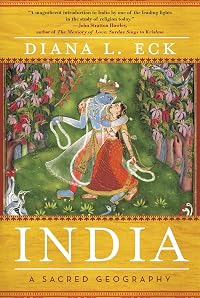
India: A Sacred Geography
by Diana L. Eck
On This Page
Description
"India" explores the sacred places of India, taking the reader on an extraordinary trip through the beliefs and history of this rich and profound place.Tags
Recommendations











Member Reviews
I approached this book with a skeptical mind mind, and some small measure of curiosity. I was soon hooked onto the book, and it was very clear that Diana Eck approached the subject with a lot of respect and, I would even say, love.
The book is very well written, and in my opinion, quite accessible to anyone interested in Hinduism. I really like the way that she constructed the myths around each God, and avataar, and linked the geography of India to the myths.
This is an innovative approach to the treatment of Hinduism, and I would recommend this book to anyone interested in learning about India and Hinduism.
The book is very well written, and in my opinion, quite accessible to anyone interested in Hinduism. I really like the way that she constructed the myths around each God, and avataar, and linked the geography of India to the myths.
This is an innovative approach to the treatment of Hinduism, and I would recommend this book to anyone interested in learning about India and Hinduism.
Ratings
Members
- Recently Added By
Author Information

21+ Works 1,600 Members
Diana Eck is Professor of Comparative Religion and Indian Studies at Harvard University and is Master of Lowell House and Director of The Pluralism Project.
Common Knowledge
- Canonical title*
- 朝聖者的印度:由虔信者足跡交織而成的神性大地
- Original title
- India: A Sacred Geography
- Quotations
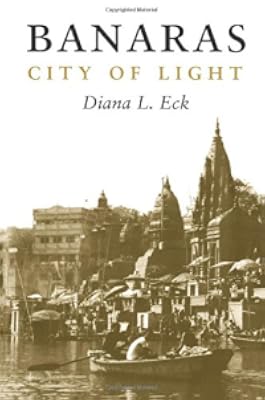
- I began thinking about this book in the city of Benares on the River Ganga in north India more than twenty-five years ago. I was then writing a book about that great city, a place I presumed to be the most important sacred ci... (show all)ty of India. Over the centuries, many visitors to Benares or Varanasi, have compared this city in sanctity and preeminence to Mecca, Jerusalem, and Rome, as the holiest center of Hindu pilgrimage. For example, in the 1860s a British civil servant, Norman McLeod, wrote effusively, “Benares is to the Hindoos what Mecca is to the Mohammedans, and what Jerusalem was to the Jews of old. It is the holy city of Hindostan. I've never seen anything approaching to it as a visible embodiment of religion; nor does anything like it exist on earth.” The singling out of the center towards which an entire religious community turns in collective memory or in prayer made sense to McLeod, as it does for many who have been schooled in the habits of thought shaped by Western monotheistic consciousness. Even in India, there have been many who would agree on the central and supreme significance of Benares, which Hindus also like to call Kashi, the Luminous, the City of Light. This is a powerful an ancient city, its dense maze of alleyways as dark as its riverfront is radiant. Its morning bathing rights facing the rising sun and its smoking cremation grounds right there along the riverfront are the heartbeat of a city that never fails to leave a lasting imprint on the visitor or pilgrim.
I lived off and on for years in Benares. Even as I investigated the legends and temples of this city, however, I began gradually to understand what most Hindus who visit the city already know––that the Benares does not stand alone as the great center of pilgrimage for Hindus, but is part of an extensive network of pilgrimage places stretching throughout the length and breath of India. The very names of temples, the ghats, and the bathing tanks of the city are derived from this broader landscape, just as the names of Kashi and it's great Shiva temple of Vishvanatha are to be found in pilgrimage places all over India. I began to realize that the entire land of India is a great network of pilgrimage places––referential, inter-referential, ancient and modern, complex and ever-changing. As a whole, it constitutes what would have to be called a "sacred geography," as vast and complex as the whole of the subcontinent. In this wider network of pilgrimage, nothing, not even the great city of Benares, stands alone, but rather everything is part of a living, storied, and intricately connected landscape.
*Some information comes from Common Knowledge in other languages. Click "Edit" for more information.
Classifications
- Genres
- Nonfiction, Religion & Spirituality
- DDC/MDS
- 294.50954 — Religion Other religions Dharmic religions Hinduism Hinduism by place
- LCC
- BL2001.3 .E25 — Philosophy, Psychology and Religion Religions. Mythology. Rationalism Religions. Mythology. Rationalism History and principles of religions Asian. Oriental By region or country India
- BISAC
Statistics
- Members
- 162
- Popularity
- 201,373
- Reviews
- 1
- Rating
- (4.14)
- Languages
- Chinese, traditional, English
- Media
- Paper, Ebook
- ISBNs
- 4
- ASINs
- 1