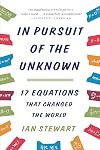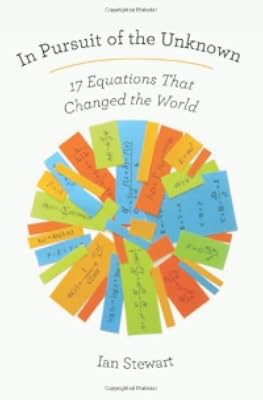
In Pursuit of the Unknown: 17 Equations That Changed the World
by Ian Stewart
On This Page
Description
Acclaimed writer and mathematician Ian Stewart examines the seventeen equations that have revolutionized our thinking and changed the course of history.Tags
Recommendations





Member Reviews
Really interesting. I thought that it would mostly be about the mathematics of the formulas, but a lot is actually of the physics and applications of them. Not exactly what I expected but still really interesting. It is also partly a history book, in terms of how and when the equations were developed and applied.
Some things that I especially liked: how Pythagora's theorem was used in surveying (it is easier to measure angels than distances), how much work multiplication of large numbers by hand is, and how logarithms help (I guess I knew this, but had forgotten), the importance and application of topology. In the Quantum Weirdness the author has a good argument against there being multiverses. The chapter on Information Theory is good - show more it is something I studied at university, and the description in the chapter is quite good.
I am deducting half a star because of the last chapter (on Black-Scholes Equation). This is also something I have read a lot about before, and there are two things that bother me with it: the financial crisis of 2008 had several caused. One was to use the equation even though the simplifying assumptions were no longer true. However, other big causes were the incentives the banks had to make housing loans to people that couldn't afford them, and the expectation that the banks would get bailed out (these other two reasons are not covered). Also, it would have been nice with some intuition on why the Black-Scholes formula works. The best explanation I have read about that is in [b:The Complete Guide to Capital Markets for Quantitative Professionals|330112|The Complete Guide to Capital Markets for Quantitative Professionals|Alex Kuznetsov|https://i.gr-assets.com/images/S/compressed.photo.goodreads.com/books/1348821609l/330112._SX50_.jpg|320688] on pages 272 - 280.
In summary, 4.5 stars - very interesting! show less
Some things that I especially liked: how Pythagora's theorem was used in surveying (it is easier to measure angels than distances), how much work multiplication of large numbers by hand is, and how logarithms help (I guess I knew this, but had forgotten), the importance and application of topology. In the Quantum Weirdness the author has a good argument against there being multiverses. The chapter on Information Theory is good - show more it is something I studied at university, and the description in the chapter is quite good.
I am deducting half a star because of the last chapter (on Black-Scholes Equation). This is also something I have read a lot about before, and there are two things that bother me with it: the financial crisis of 2008 had several caused. One was to use the equation even though the simplifying assumptions were no longer true. However, other big causes were the incentives the banks had to make housing loans to people that couldn't afford them, and the expectation that the banks would get bailed out (these other two reasons are not covered). Also, it would have been nice with some intuition on why the Black-Scholes formula works. The best explanation I have read about that is in [b:The Complete Guide to Capital Markets for Quantitative Professionals|330112|The Complete Guide to Capital Markets for Quantitative Professionals|Alex Kuznetsov|https://i.gr-assets.com/images/S/compressed.photo.goodreads.com/books/1348821609l/330112._SX50_.jpg|320688] on pages 272 - 280.
In summary, 4.5 stars - very interesting! show less
No-nonsense highlighting of equations, as opposed to avoiding them in the manner of many other mathematics books for general readers, and applied math as opposed to pure math -- discussions of how the equations are used in the physical and other sciences, in engineering, and in technology. (And in economics, in the case of the *mis*used Black-Scholes equation for financial derivatives. The last chapter is partly a devastating indictment of the world financial industry.) A typically high-quality and enjoyable book from Stewart.
[3.75 / 5] There's a great deal of discussion on whether this book is good or not. I believe this is because unlike other books promoting mathematics, this one *does* assume that you have some **working knowledge** on mathematics. However, I found it very illuminating regarding the history of maths, and how they are much more than just a series of meaningless, useless symbols.
I found the last chapter to be very boring and skipped about half of it. The rest is a very good read on how math lives, how it's created and how (despite the opinions of many know-it-all schoolers) it is used in daily life.
I found the last chapter to be very boring and skipped about half of it. The rest is a very good read on how math lives, how it's created and how (despite the opinions of many know-it-all schoolers) it is used in daily life.
Le equazioni del titolo italiano di questo libro sono solo i simboli dei temi scientifici di cui Stewart intende parlare. Alcune non sono neppure equazioni quanto definizioni, la maggior parte nascono dalla fisica e non dalla matematica. Tutte però hanno in comune la volontà degli umani di andare a caccia dell'ignoto, come recita il titolo originale. Rispetto ad altri suoi libri qui Stewart indulge molto poco ai giochi di parole, il che se avete presente cosa scrive di solito è un vantaggio. Nota molto negativa per la traduzione di Giorgio P. Panini, che spesso prende cantonate mica da ridere, e per il revisore del testo. Se ci sono delle frasi che non stanno in piedi in italiano vuol dire che nessuno ha riletto, e se per questo non show more c'è stato nessun controllo nemmeno quando il libro è stato ristampato in economica. Non sono proprio cose che mi sarei aspettato da Einaudi. show less
Some chapters, especially in the middle, about topology and imaginary numbers, are written so unclearly that I learned nothing from them. However, those on thermodynamics and information theory are excellent. An unbalanced book that is nevertheless worth reading.
Here Ian Stewart covers 17 equations that transformed our understanding of the world, normally either by their application in science, or because they are directly scientific in nature. Told in chronological order, starting with Pythagorus, the historical features and cultural significance of each equation are comprehensively described. Much of this is interesting, even entertaining, though it does appear too much on occasion.
What is critical here, though, is the explanation of the equations themselves. I was really hoping to fully understand each one. There was little chance of this, though. Sometimes Stewart provides extremely basic and clear explanations of mathematical concepts, such as what the two above a number means. Although show more anyone reading this should know this already, I never minded this. But there are many instances where he also describes another mathematical tool, such as matrices, and gives no explanation at all for what it is or how it works. This is the crux of the issue with the book - it combines some very deft explanations of mathematical or scientific concepts with other sections that are either too rushed or too full of jargon. I found this annoying and wished he'd spent more time trying to explain everything as clearly as he was occasionally clearly capable of.
Overall, to give a flavour of the influence of maths on science, and where key mathematical ideas sit in history, this was a useful book, but for each specific chapter I was left feeling I have seen clearer explanations elsewhere by other writers when more time was given to making them clear to the reader. show less
What is critical here, though, is the explanation of the equations themselves. I was really hoping to fully understand each one. There was little chance of this, though. Sometimes Stewart provides extremely basic and clear explanations of mathematical concepts, such as what the two above a number means. Although show more anyone reading this should know this already, I never minded this. But there are many instances where he also describes another mathematical tool, such as matrices, and gives no explanation at all for what it is or how it works. This is the crux of the issue with the book - it combines some very deft explanations of mathematical or scientific concepts with other sections that are either too rushed or too full of jargon. I found this annoying and wished he'd spent more time trying to explain everything as clearly as he was occasionally clearly capable of.
Overall, to give a flavour of the influence of maths on science, and where key mathematical ideas sit in history, this was a useful book, but for each specific chapter I was left feeling I have seen clearer explanations elsewhere by other writers when more time was given to making them clear to the reader. show less
A bit simple but pleasant book, which could have dug a lot deeper to give insight but still worth an airplane read.
Members
- Recently Added By
Lists

HS Mathematics class library
79 works; 6 members

The r/AskScience Reading List
159 works; 3 members

Books Read in 2023
5,638 works; 147 members
Author Information

89+ Works 20,241 Members
Ian Stewart is a professor emeritus of mathematics at the University of Warwick. The author of numerous books on math, he has written for New Scientist, Discover, and Scientific American, among other publications in the United Kingdom and the United States. He lives in Coventry, England.
Awards and Honors
Awards
Common Knowledge
- Original publication date
- 2012
Classifications
Statistics
- Members
- 707
- Popularity
- 40,445
- Reviews
- 11
- Rating
- (3.61)
- Languages
- 7 — English, French, German, Italian, Polish, Portuguese, Spanish
- Media
- Paper, Ebook
- ISBNs
- 22
- ASINs
- 13