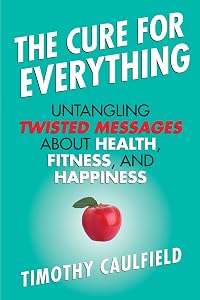
The Cure for Everything: Untangling Twisted Messages about Health, Fitness, and Happiness
by Timothy Caulfield
On This Page
Description
In this era of health-science research, rarely a day goes by without a public pronouncement of some exciting health-enhancing discovery: a new diet, a new fitness routine, a new drug or alternative therapy, the miracles achieved by genetic mapping. And we are told--by the media, health-care experts, even government--that we should use this information to live a healthier life. But what information can we trust? Are yoga and stretching the surefire path toward healthy aging? Can consuming show more enormous quantities of certain "natural" remedies ward off disease? Should we all eat nothing but carbs, or fats, or pineapples, and regularly cleanse our colons or have our meridians aligned? Should we all have our genome mapped to solve our health problems?In The Cure for Everything, health policy expert and fitness enthusiast Timothy Caulfield wades through the tides of health crazes, misleading data, and well-meaning gurus in a quest to sort out real, reliable health advice. He takes us along as he navigates the maze of facts, findings, and fears associated with emerging health technologies, drugs, and disease-prevention strategies and presents an impressively researched, accessible take on the production and spread of information in the health sciences.
Seamlessly switching between his sweatsuit and his lab coat, Caulfield doesn't just pore over the research and interview the professionals; he gets his t-shirt sweaty and his meridians aligned, testing out the scientific validity of some of the health and fitness crazes of our day. Bravely using himself as a guinea pig, he goes on a strict diet, a rigorous exercise routine, swallows bottles of "natural" remedies, and has needles inserted all over his body. He illuminates some solid paths to better health, along with the dead-end detours.
Science is everywhere, but what passes through most people's field of vision is often wrong, hyped, or twisted by an ideological or commercial agenda. And without good scientific data, bad decisions are made--by doctors and governments, by you and me. Caulfield demonstrates, alas, that there are no quick fixes or simple steps to flat abs; that you will never be able to eat all you want; that no "natural" supplements will lead to better health; that knowing your genetic map will not save you from almost anything. The Cure for Everything ends with five simple, scientifically sound--and, yet, difficult--steps to take in order to lead a longer, healthier life.
. show less
Tags
Recommendations





Member Reviews
The theme of this book is to look through all of the hype surrounding healthy lifestyles and see what science actually recommends. I saw it as sort of a mixture of Gina Kolata's books Ultimate Fitness and Rethinking Thin, at least as far as topic is concerned.
Caulfield first tackles the subject of fitness - what it means, and how to "get fit." To do this he speaks with personal trainers and reflects on his exercise experience as a sprinter and biker. I was hoping to see more of a critical look, or at least a bit of insight, into the papers he cites as scientific basis for his fitness thesis. I've read a lot of books about exercise, and many of the studies are faulty in many ways. It's difficult to determine what kind of exercise works show more for people, and many of the studies use small sample sizes of relatively fit men based on relatively strict metrics. Without explaining the studies to the reader, the reader is left to trust Caulfield implicitly, and my skeptical mind isn't convinced.
Caulfield's thesis is that to get fit requires interval training mixed with a bit of resistance training. I agree that the consensus with weight training is to use heavy weights (not the "high rep low weight" mantra you hear all over the place) to build muscle. However, interval training is sort of a specific cardiovascular routine, and I think that prescribing it for all people regardless of their beginning fitness level or what their goals are is kind of foolish. For one thing, a completely sedentary individual should not look to start a life of fitness by doing 400 meter sprint intervals on a track; it makes more sense to start with short walks and maybe, if the individual is interested in running, make their way to a more tailored routine. For me, training for a marathon will include some interval training, but also long runs, base runs, hill runs, and tempo runs. Swimmers, bikers, skiiers, rowers and the like may have completely different goals. One thing you learn as a scientist is that there is never a one-size-fits-all solution, which is what Caulfield seems to believe.
Compared with the second part of the book, however, I thought the first was amazing. In the next chapter, Caulfield explores the science behind dieting. The first thing that absolutely annoyed me about this chapter was the implicit assumption that thin equals healthy. Nowhere in the book does the author look into debunking that false relationship. Recent research is showing that being healthy and thin are not related, and having a healthy lifestyle (which does not necessarily include being "thin") is more important than weight.
Second the author uses spotty evo-psych arguments that humans are hard wired into desiring flat abs... which sort of ignores the actual science of evolution and how that works.
Caulfield meets with a team of experts in the field of losing weight and goes on a calorie restricting diet. He loses weight, and is extremely excited with how simple it is, and exclaims that diets absolutely work, except that he feels hungry and miserable all the time. But it's worth it, because he lost 26 pounds! Of course, by the end of the book, the author does note that 95% of people gain back the weight, including himself, but that doesn't mean that diets don't work. Wait, what? If something doesn't work 95% of the time, how can you say that it's a success?
The third and last part of the book was about medication, both alternative and conventional. I would say that this section of the book was probably the most informed but least interesting. Science does bear out that homeopathy is not any more effective than a placebo. However, the author dismisses chiropractic techniques without looking into them (I honestly don't know if it works, but I would at least expect the author to look into it) and suggests that acupuncture might work. He then discusses the long and horrible saga of the pharmaceutical industry (without getting to in detail, which is best left for a different book) to note that even the "scientific" way that we currently use in North America to find relief and cures is not exactly scientific.
Ultimately, I would suggest skipping this book and reading Gina Kolata instead. She actually goes into the science with you, the reader, instead of asking you to take her on faith. And she doesn't come to conclusions such as "I lost 26 pounds, so diets work even though I'm miserable and am gaining back the weight as we speak!" show less
Caulfield first tackles the subject of fitness - what it means, and how to "get fit." To do this he speaks with personal trainers and reflects on his exercise experience as a sprinter and biker. I was hoping to see more of a critical look, or at least a bit of insight, into the papers he cites as scientific basis for his fitness thesis. I've read a lot of books about exercise, and many of the studies are faulty in many ways. It's difficult to determine what kind of exercise works show more for people, and many of the studies use small sample sizes of relatively fit men based on relatively strict metrics. Without explaining the studies to the reader, the reader is left to trust Caulfield implicitly, and my skeptical mind isn't convinced.
Caulfield's thesis is that to get fit requires interval training mixed with a bit of resistance training. I agree that the consensus with weight training is to use heavy weights (not the "high rep low weight" mantra you hear all over the place) to build muscle. However, interval training is sort of a specific cardiovascular routine, and I think that prescribing it for all people regardless of their beginning fitness level or what their goals are is kind of foolish. For one thing, a completely sedentary individual should not look to start a life of fitness by doing 400 meter sprint intervals on a track; it makes more sense to start with short walks and maybe, if the individual is interested in running, make their way to a more tailored routine. For me, training for a marathon will include some interval training, but also long runs, base runs, hill runs, and tempo runs. Swimmers, bikers, skiiers, rowers and the like may have completely different goals. One thing you learn as a scientist is that there is never a one-size-fits-all solution, which is what Caulfield seems to believe.
Compared with the second part of the book, however, I thought the first was amazing. In the next chapter, Caulfield explores the science behind dieting. The first thing that absolutely annoyed me about this chapter was the implicit assumption that thin equals healthy. Nowhere in the book does the author look into debunking that false relationship. Recent research is showing that being healthy and thin are not related, and having a healthy lifestyle (which does not necessarily include being "thin") is more important than weight.
Second the author uses spotty evo-psych arguments that humans are hard wired into desiring flat abs... which sort of ignores the actual science of evolution and how that works.
Caulfield meets with a team of experts in the field of losing weight and goes on a calorie restricting diet. He loses weight, and is extremely excited with how simple it is, and exclaims that diets absolutely work, except that he feels hungry and miserable all the time. But it's worth it, because he lost 26 pounds! Of course, by the end of the book, the author does note that 95% of people gain back the weight, including himself, but that doesn't mean that diets don't work. Wait, what? If something doesn't work 95% of the time, how can you say that it's a success?
The third and last part of the book was about medication, both alternative and conventional. I would say that this section of the book was probably the most informed but least interesting. Science does bear out that homeopathy is not any more effective than a placebo. However, the author dismisses chiropractic techniques without looking into them (I honestly don't know if it works, but I would at least expect the author to look into it) and suggests that acupuncture might work. He then discusses the long and horrible saga of the pharmaceutical industry (without getting to in detail, which is best left for a different book) to note that even the "scientific" way that we currently use in North America to find relief and cures is not exactly scientific.
Ultimately, I would suggest skipping this book and reading Gina Kolata instead. She actually goes into the science with you, the reader, instead of asking you to take her on faith. And she doesn't come to conclusions such as "I lost 26 pounds, so diets work even though I'm miserable and am gaining back the weight as we speak!" show less
I love how well he cuts through the bs. Definitely gave me food for thought, and made me feel a little foolish about questionable fitness purchases I've made over the years.
I feel the need to show respect for this book since the author spent a year of his life researching and living the narrative that he puts forth. For many it will be more of the same. For others it will be a new, revealing way of life and still others will find it a lot of bunk. The beauty of it is that it takes only a few minutes to find out which group you fall into. Then you can decide whether or not to take it all in. The author strives for scientific significance with a relatively lengthy list of references which reinforces the fact that much of what he says has been said over and over again by many other authors. The most relevant portion of the book from my point of view is the chapter that is titled “Remedies” in which he show more gives the “scientific” basis for alternative treatments delivered by naturopaths, homeopaths, etc.. Reading and believing this chapter would undoubtedly benefit many who are easily led astray by various medical and pseudo-medical claims. In closing, here’s hoping the author manages to keep the weight off. show less
Researcher Timothy Caulfield talks with experts in medicine, pharmaceuticals, health, and fitness, and even tries out many of the health fads himself, in order to test their scientific validity, dispel the myths, and illuminate the path to better health. However, he doesn't (in the index) cite PCRM or vegetarian or vegan diets (messages not twisted), AND HE DOES CITE VEGAN MD formerly FROM HARVARD Dr. Mark Berman on "optimistic bias" (tendency to overrate one's invulnerability to risks). NOTE that he BEGINS with a common strategy, rousing the emotions of the reader (or audience) by totally dismissing something he presents as being totally beyond the pale, then he cites the word 'science' (or the idea of 'science') without using any show more scientific knowledge ('infuriated me'). A possibly useful book, but again, one must read critically through the author's language as one reads and lives and thinks critically through all of life, particularly purportedly health-related 'messaging'. However, I'd like to feel more confidence in the author's objectivity as I read through a book. show less
Researcher Timothy Caulfield talks with experts in medicine, pharmaceuticals, health, and fitness, and even tries out many of the health fads himself, in order to test their scientific validity, dispel the myths, and illuminate the path to better health. However, he doesn't (in the index) cite PCRM or vegetarian or vegan diets (messages not twisted), AND HE DOES CITE VEGAN MD formerly FROM HARVARD Dr. Mark Berman on "optimistic bias" (tendency to overrate one's invulnerability to risks). NOTE that he BEGINS with a common strategy, rousing the emotions of the reader (or audience) by totally dismissing something he presents as being totally beyond the pale, then he cites the word 'science' (or the idea of 'science') without using any show more scientific knowledge ('infuriated me'). A possibly useful book, but again, one must read critically through the author's language as one reads and lives and thinks critically through all of life, particularly purportedly health-related 'messaging'. However, I'd like to feel more confidence in the author's objectivity as I read through a book. show less
Researcher Timothy Caulfield talks with experts in medicine, pharmaceuticals, health, and fitness, and even tries out many of the health fads himself, in order to test their scientific validity, dispel the myths, and illuminate the path to better health. However, he doesn't (in the index) cite PCRM or vegetarian or vegan diets (messages not twisted), AND HE DOES CITE VEGAN MD formerly FROM HARVARD Dr. Mark Berman on "optimistic bias" (tendency to overrate one's invulnerability to risks). NOTE that he BEGINS with a common strategy, rousing the emotions of the reader (or audience) by totally dismissing something he presents as being totally beyond the pale, then he cites the word 'science' (or the idea of 'science') without using any show more scientific knowledge ('infuriated me'). A possibly useful book, but again, one must read critically through the author's language as one reads and lives and thinks critically through all of life, particularly purportedly health-related 'messaging'. However, I'd like to feel more confidence in the author's objectivity as I read through a book. show less
This read like a collection of magazine articles, some more interesting than others. In my mind, anyway, homeopathy is a dead horse, and the chapter about it added nothing to the discussion. On the other hand, the chapter on diet, while also not chock full of new information, was engaging. Worth a look.
Members
- Recently Added By
Lists

Beacon Press
39 works; 1 member
Author Information

14 Works 334 Members
Timothy Caulfield is a Canada Research Chair in Health Law and Policy, a Professor in the Faculty of Law and the School of Public Health, and Research Director of the Health Law Institute at the University of Alberta. He contributes frequently to the popular press and is the author of The Cure for Everything: Untangling the Twisted Messages about show more Health. Fitness, and Happiness, and The Science of Celebrity or Is Gwyneth Paltrow Wrong About Everything? as well as the host of the popular Netflix show A User's Guide to Cheating Death. show less
Classifications
- Genres
- Nonfiction, General Nonfiction, Health & Wellness, Science & Nature
- DDC/MDS
- 613 — Applied science & technology Medicine & health Personal health and Fitness
- LCC
- RA776 .C38 — Medicine Public aspects of medicine Public aspects of medicine Public health. Hygiene. Preventive medicine Personal health and hygiene
- BISAC
Statistics
- Members
- 110
- Popularity
- 290,969
- Reviews
- 12
- Rating
- (3.64)
- Languages
- English
- Media
- Paper, Ebook
- ISBNs
- 6
- ASINs
- 2