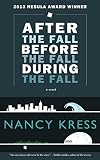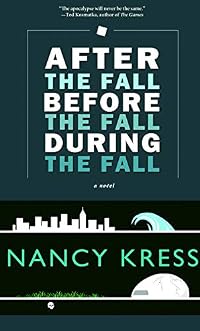
After the Fall, Before the Fall, During the Fall
by Nancy Kress
On This Page
Description
2012 Nebula Award Winner2012 Locus Award Winner
2013 Hugo Nominee
2013 Sturgeon Award Nominee
In the year 2035, all that is left of humanity lives in the Shell.
No one knows why the Tesslies attacked in 2014, devastated the environment, and nearly destroyed humanity. Or why the aliens imprisoned twenty-six survivors in a sterile enclosure built on the barren remains of the Earth.
Fifteen-year-old Pete, one of only six children born in the Shell, is determined to lead humanity to a new show more beginning. But Pete struggles to control his anger as, one by one, the survivors sicken and die. Although the Earth appears to be slowly healing, the Shell's inhabitants may not live long enough to see it. The only chance for humanity lies within brief time portals. Peter and the survivors hatch a desperate plan: to increase their numbers by abducting children from the past.
In the year 2013, a brilliant CIA consultant sees a pattern in seemingly unrelated kidnappings. As Julie Kahn's predictive algorithms reveal that the world is in imminent danger, she discovers that she may also play a role in its possible rebirth. Julie and Pete are rapidly converging in time—a chance encounter between them may be the Earth's only hope.
. show less
Tags
Recommendations








Member Reviews
Powerful end-of-the-world science fiction that is well written, elegantly structured and delivered on personal, human scale that increases its impact.
Nancy Kress' novella packs a big punch into a small package by combining powerful ideas with a clever story-telling structure and telling the story through the eyes of people you don't typically find at the heart of a so-this-is-the-end-of-the-world? story.
The makes-my-brain-stutter title, 'After The Fall, Before The Fall, During The Fall' isn't just decorative. It reflects the three converging timelines the story is told on.
We start 'After The Fall' in 2035, with twenty-seven human survivors, split between the ageing adults and the often weak or disabled young, living in a dome they show more didn't build and can't leave, on a devastated barren Earth and hoping to be the future of humanity.
We go back to 'Before The Fall' and watch a quant mine the data that tells her the world is heading for disaster and knowing that not only will no-one listen but that sharing the data will make her a target.
We converge on 'During The Fall' through an elaborate hard-for-the-reader-to-predict-but-fun-to-watch path. Then, right at the end, when we think we know just how bad everything is and how blind we were and how screwed we are, we get something new.
Nancy Kress makes this multiple timeline technique work well, using it to increase the tension and the sense of doom while leaving just enough wriggle room for hope that you don't give up.
The book was published in 2012. Reading it in 2020, it seems even more grimly plausible than it must have done then. I think it's a great example of Cli Fi (Climate Fiction). show less
Nancy Kress' novella packs a big punch into a small package by combining powerful ideas with a clever story-telling structure and telling the story through the eyes of people you don't typically find at the heart of a so-this-is-the-end-of-the-world? story.
The makes-my-brain-stutter title, 'After The Fall, Before The Fall, During The Fall' isn't just decorative. It reflects the three converging timelines the story is told on.
We start 'After The Fall' in 2035, with twenty-seven human survivors, split between the ageing adults and the often weak or disabled young, living in a dome they show more didn't build and can't leave, on a devastated barren Earth and hoping to be the future of humanity.
We go back to 'Before The Fall' and watch a quant mine the data that tells her the world is heading for disaster and knowing that not only will no-one listen but that sharing the data will make her a target.
We converge on 'During The Fall' through an elaborate hard-for-the-reader-to-predict-but-fun-to-watch path. Then, right at the end, when we think we know just how bad everything is and how blind we were and how screwed we are, we get something new.
Nancy Kress makes this multiple timeline technique work well, using it to increase the tension and the sense of doom while leaving just enough wriggle room for hope that you don't give up.
The book was published in 2012. Reading it in 2020, it seems even more grimly plausible than it must have done then. I think it's a great example of Cli Fi (Climate Fiction). show less
This one is seriously good; stayed up past my bedtime to finish it, which makes it at least four stars for me. Got it as part of a bundle of dark SF or I wouldn't have ever picked it up as I'm pretty much up to here with post apocalyptic stories. This one is creative in concept and story though a tad preachy. Still a great read.
In recent years, I’ve hesitated to pick up a hard science fiction novel. The quantum physics one must be familiar with to enjoy the novel is so far beyond me that I feel I need a physics course or two as a prerequisite. It’s hard to appreciate a novel when you haven’t the faintest idea what’s going on.
Trust Nancy Kress to write a hard science fiction novella that is so clear, so precise and so well-written that the reader is never left behind. It is no surprise that After the Fall, Before the Fall, During the Fall has been nominated for a Nebula Award this year. It has finely drawn characters (especially Pete, from the future, and Julie, from the present), and is based (at least in the sections set “during the fall”) on show more solid scientific principals with a touch of imagination — just enough to power the plot.
The novella opens with Pete just beginning what we learn is a Grab: he is transported to the past for only ten minutes, during which he must grab whatever he can and bring it into the future with him. The top priority is young children, unaffected by the radiation that has poisoned his generation and rendered it mostly infertile. Pete, a young teenager, arrives near the ocean, but his delight in the scene is erased when he realizes all that has been destroyed by the Tesslies. The Tesslies, we learn, are entities about which nothing is known except that they reduced humankind to a mere handful of people eking out an existence in the Shell, a habitat the Tesslies provided for them. Pete is able to grab a toddler and a baby and bring them back with him.
In the next few pages, we switch to an omniscient point of view, narrowing in on a plateau in Brazil where bacteria is mutating at the base of the roots of coffee plants. We learn in subsequent chapters that this mutation essentially converts the bacteria to alcohol, destroying the roots, destroying plant life — and the same mutation is inexplicably happening at the same time in disparate corners of the globe.
Then we’re in the present, where Julie is working with the FBI on the kidnapping of the toddler and baby. The mother’s husband was killed in the kidnapping — not by Pete, but by the machinery that allows him to travel in time and space, through which adults may not pass. She is, understandably, hysterical, though her hysteria takes a form that makes it impossible to communicate with her. Julie has been working on a series of kidnappings, mathematically predicting where and when the next one will take place, and this brings her work closer to solving the puzzle.
As the book proceeds, we learn much more about Pete and the small community in which he lives, and the manner in which the adults are trying to preserve the good and obliterate the bad in their young charges. More than that, they are trying to rebuild the human race from a very small population. The group is scientifically oriented; the children do not even understand the religious references and hymns that the oldest member of the group often uses. They keep watch for changes in the world outside their Shell, waiting for the day when it is safe to venture out again. The one factor no one quite understands is the Tesslies. Are they aliens who invaded our world? Are they human creations? It isn’t even known if they are machines or biological organisms. We never do learn quite what their nature is, which is the only fault I find with the novella.
We also learn more about Julie, who, it turns out, is pregnant from an affair she had with the FBI agent with whom she was working. She leaves her full-time project with the FBI and prepares herself for the child she always wanted, but she continues to do independent consulting. More, she continues to work on the algorithms that she was preparing to predict the kidnappings. One of her projects, for a professor seeking to make a name for himself, reveals that big changes are coming to the world — and not for the good.
We learn more about those changes, too. They are not limited to bacterial mutation, but include enormous changes in the behavior of the Earth’s tectonic plates, increased volcanic activity, and other signs that the Earth is becoming hostile to its human infection.
Kress effectively guides the flow of all three of these narrative streams, ultimately bringing them to a confluence that is both frightening and uplifting. Kress’s skill shows in the intricacy of the plotting, the scientific knowledge, and the strong characterization. Although I’ve read only three of the Nebula-nominated novellas so far, I have to think that After the Fall has an excellent chance of claiming the rocket ship.
Originally published at http://www.fantasyliterature.com/reviews/after-the-fall/ show less
Trust Nancy Kress to write a hard science fiction novella that is so clear, so precise and so well-written that the reader is never left behind. It is no surprise that After the Fall, Before the Fall, During the Fall has been nominated for a Nebula Award this year. It has finely drawn characters (especially Pete, from the future, and Julie, from the present), and is based (at least in the sections set “during the fall”) on show more solid scientific principals with a touch of imagination — just enough to power the plot.
The novella opens with Pete just beginning what we learn is a Grab: he is transported to the past for only ten minutes, during which he must grab whatever he can and bring it into the future with him. The top priority is young children, unaffected by the radiation that has poisoned his generation and rendered it mostly infertile. Pete, a young teenager, arrives near the ocean, but his delight in the scene is erased when he realizes all that has been destroyed by the Tesslies. The Tesslies, we learn, are entities about which nothing is known except that they reduced humankind to a mere handful of people eking out an existence in the Shell, a habitat the Tesslies provided for them. Pete is able to grab a toddler and a baby and bring them back with him.
In the next few pages, we switch to an omniscient point of view, narrowing in on a plateau in Brazil where bacteria is mutating at the base of the roots of coffee plants. We learn in subsequent chapters that this mutation essentially converts the bacteria to alcohol, destroying the roots, destroying plant life — and the same mutation is inexplicably happening at the same time in disparate corners of the globe.
Then we’re in the present, where Julie is working with the FBI on the kidnapping of the toddler and baby. The mother’s husband was killed in the kidnapping — not by Pete, but by the machinery that allows him to travel in time and space, through which adults may not pass. She is, understandably, hysterical, though her hysteria takes a form that makes it impossible to communicate with her. Julie has been working on a series of kidnappings, mathematically predicting where and when the next one will take place, and this brings her work closer to solving the puzzle.
As the book proceeds, we learn much more about Pete and the small community in which he lives, and the manner in which the adults are trying to preserve the good and obliterate the bad in their young charges. More than that, they are trying to rebuild the human race from a very small population. The group is scientifically oriented; the children do not even understand the religious references and hymns that the oldest member of the group often uses. They keep watch for changes in the world outside their Shell, waiting for the day when it is safe to venture out again. The one factor no one quite understands is the Tesslies. Are they aliens who invaded our world? Are they human creations? It isn’t even known if they are machines or biological organisms. We never do learn quite what their nature is, which is the only fault I find with the novella.
We also learn more about Julie, who, it turns out, is pregnant from an affair she had with the FBI agent with whom she was working. She leaves her full-time project with the FBI and prepares herself for the child she always wanted, but she continues to do independent consulting. More, she continues to work on the algorithms that she was preparing to predict the kidnappings. One of her projects, for a professor seeking to make a name for himself, reveals that big changes are coming to the world — and not for the good.
We learn more about those changes, too. They are not limited to bacterial mutation, but include enormous changes in the behavior of the Earth’s tectonic plates, increased volcanic activity, and other signs that the Earth is becoming hostile to its human infection.
Kress effectively guides the flow of all three of these narrative streams, ultimately bringing them to a confluence that is both frightening and uplifting. Kress’s skill shows in the intricacy of the plotting, the scientific knowledge, and the strong characterization. Although I’ve read only three of the Nebula-nominated novellas so far, I have to think that After the Fall has an excellent chance of claiming the rocket ship.
Originally published at http://www.fantasyliterature.com/reviews/after-the-fall/ show less
After the Fall, Before the Fall, During the Fall by Nancy Kress is a strong post-apocalyptic story that mixes time travel, global disaster and mysterious aliens into a short book that certainly deserved it’s 2012 Nebula and Locus awards. In the year 2035 a small group of human survivors live in a prison-like shell from which some of them are able to time travel back to 2013 and grab items from before the earth was destroyed. The most important items are young children that will help to repopulate the world.
Meanwhile back in 2013, brilliant mathematician Julie Kahn is working with the FBI to solve a number of strange kidnappings. As she untangles the puzzle her predictive algorithms begin to reveal much more than just simple show more kidnapping is going on. The story advances into 2014 when global disaster strikes and the future of humanity is at risk.
I was totally captured by this story and although it is of a bleak and despairing nature, the author ended her story with a strong message of hope which I appreciated. This novella length story is a quick read and the author makes the world’s end very credible and scary. After the Fall, Before the Fall, During the Fall is a unique, well-paced and gripping tale. show less
Meanwhile back in 2013, brilliant mathematician Julie Kahn is working with the FBI to solve a number of strange kidnappings. As she untangles the puzzle her predictive algorithms begin to reveal much more than just simple show more kidnapping is going on. The story advances into 2014 when global disaster strikes and the future of humanity is at risk.
I was totally captured by this story and although it is of a bleak and despairing nature, the author ended her story with a strong message of hope which I appreciated. This novella length story is a quick read and the author makes the world’s end very credible and scary. After the Fall, Before the Fall, During the Fall is a unique, well-paced and gripping tale. show less
Interesting book, didn't spend a lot of time on the science which is ok. We spent a lot of time in the heads of two characters Julie before the fall and Peter after the fall. I was really dreading dreading the ending and how their two stories would intersect but the author tied things together nicely. In spite of the huge amount of peril the characters are in the author does manage a bit of hope at the end, though a bit abruptly.
This book carried its own momentum -- it was a quick, easy read. The premise of a device to travel back in time to rescue people before an apocalypse in order to preserve the human race is done in an interesting way -- the people going have no control over the device, when it leaves or goes or where it goes, and can only hop in when it's ready and grab who/what they can before they are sent back.
It was hard to put down, but I do have some criticisms. For one, the number of grabs seems like awfully small number statistics for Julie, the mathematician to have noticed a pattern and developed an algorithm. It didn't seem like there was enough connecting the kid grabs to the store grabs for her to have linked them together.
Also, the ending show more was probably deliberately ambiguous, but I still have a lot of unresolved questions about the Tesslies - the beings who collected the survivors and made the time travel device. I have a really hard time finding their choices to have any consistency, and can't come up with a story fro them that would motivate them.
Don't read if you need to be reassured that teenage boys aren't all terrible. show less
It was hard to put down, but I do have some criticisms. For one, the number of grabs seems like awfully small number statistics for Julie, the mathematician to have noticed a pattern and developed an algorithm. It didn't seem like there was enough connecting the kid grabs to the store grabs for her to have linked them together.
Also, the ending show more was probably deliberately ambiguous, but I still have a lot of unresolved questions about the Tesslies - the beings who collected the survivors and made the time travel device. I have a really hard time finding their choices to have any consistency, and can't come up with a story fro them that would motivate them.
Don't read if you need to be reassured that teenage boys aren't all terrible. show less
It’s easy to see why Nancy Kress’s After the Fall, Before the Fall, During the Fall has done well with science fiction’s premier awards. Winning the Nebula and the Locus for best novella and garnering a nomination for the Hugo, the story is equally intriguing and gripping. It’s too bad her story flops for failure to satisfy reader expectations.
Pete, one of the Six, lives in the completely enclosed and environmentally controlled “Shell” in the year 2035. They are descendents of the few remaining survivors on Earth of a catastrophic alien attack decades before. Kept alive by the grace of the aliens–the Tesslies–Pete and his fellow survivors jump back to the past to rescue individual children, hoping somehow to overcome show more their captors and restart life again on the planet.
Meanwhile, Julie Kahn is a mathematician and contractor for the FBI helping to hunt down a mysterious crime spree that follows the outcomes of her algorithm. Each event brings her closer to a conclusion she may not be ready to accept.
Skipping between three timelines, the story quickly builds to a crescendo. Kress uses the absence of information as a tool to build mystery and suspense, creating a palpable sense of the ominous. Given how short the book is–a novella, by definition–it was easy to blow through it in just one sitting.
At this point, the book blogger code of ethics demands that I warn you that spoilers follow…or at least, information that could lead you to spoilers.
Despite Kress’ excellent writing, I struggled with her resolution. Rather than explain anything, it has the effect of deus ex machina, except that we have no idea where the ex machina emerges from. The twist–oh, yes, there is a twist, but if you’re still reading this, don’t say I didn’t warn you–has no explanation in reality or science fiction. It just happens. We never learn how or from whence it came…it just happens. And the major plot device–a time machine, robots, aliens, tidal waives, volcanos–none of it makes sense in the context of what Kress has promised the reader.If Kress had made angels appear and bring a message from God, it would have made more sense than the strange plot device she used.
Ultimately, for that reason, I finished After the Fall, Before the Fall, During the Fall with a feeling of betrayal, disappointment, and like I had just had a heavy handed message about the environment stuffed down my throat. I might even have been ok with the message, if Kress had seemed like, just for a moment, she would justify it by some sort of explanation. As it was, though, her story amounts to no more than wishful thinking that might shift this book more into the fantasy genre than science fiction. It’s good writing, but in the balance is a disappointing story. show less
Pete, one of the Six, lives in the completely enclosed and environmentally controlled “Shell” in the year 2035. They are descendents of the few remaining survivors on Earth of a catastrophic alien attack decades before. Kept alive by the grace of the aliens–the Tesslies–Pete and his fellow survivors jump back to the past to rescue individual children, hoping somehow to overcome show more their captors and restart life again on the planet.
Meanwhile, Julie Kahn is a mathematician and contractor for the FBI helping to hunt down a mysterious crime spree that follows the outcomes of her algorithm. Each event brings her closer to a conclusion she may not be ready to accept.
Skipping between three timelines, the story quickly builds to a crescendo. Kress uses the absence of information as a tool to build mystery and suspense, creating a palpable sense of the ominous. Given how short the book is–a novella, by definition–it was easy to blow through it in just one sitting.
At this point, the book blogger code of ethics demands that I warn you that spoilers follow…or at least, information that could lead you to spoilers.
Despite Kress’ excellent writing, I struggled with her resolution. Rather than explain anything, it has the effect of deus ex machina, except that we have no idea where the ex machina emerges from. The twist–oh, yes, there is a twist, but if you’re still reading this, don’t say I didn’t warn you–has no explanation in reality or science fiction. It just happens. We never learn how or from whence it came…it just happens. And the major plot device–a time machine, robots, aliens, tidal waives, volcanos–none of it makes sense in the context of what Kress has promised the reader.If Kress had made angels appear and bring a message from God, it would have made more sense than the strange plot device she used.
Ultimately, for that reason, I finished After the Fall, Before the Fall, During the Fall with a feeling of betrayal, disappointment, and like I had just had a heavy handed message about the environment stuffed down my throat. I might even have been ok with the message, if Kress had seemed like, just for a moment, she would justify it by some sort of explanation. As it was, though, her story amounts to no more than wishful thinking that might shift this book more into the fantasy genre than science fiction. It’s good writing, but in the balance is a disappointing story. show less
Members
- Recently Added By
Lists

Recommended Apocalyptic Novels
53 works; 24 members

Favorite Science Fiction by Women Authors
737 works; 202 members
Nebula Award
111 works; 14 members
Author Information

188+ Works 12,922 Members
Nancy Kress is an author who won Best Novella at the Nebula Awards 2014 for her title Yesterday's Kin. (Bowker Author Biography)
Some Editions
Awards and Honors
Awards
Work Relationships
Is contained in
Common Knowledge
- Canonical title
- After the Fall, Before the Fall, During the Fall
- Original title
- After the Fall, Before the Fall, During the Fall
- Original publication date
- 2012-04
- People/Characters
- Pete; McAllister; Gordon Fairford; Julie Kahn
- First words
- November 2013
It wasn't dark, and it wasn't light. It wasn't anything except cold. I'm dead, Pete thought, but of course he wasn't. Every time he thought that, all the way back to his first time when McAl... (show all)lister had warned him: "The transition may seem to last forever." - Last words
- (Click to show. Warning: May contain spoilers.)A bird swooped overhead, and on the wind came the sweet smell of warm rain.
- Blurbers
- Robinson, Kim Stanley; Kosmatka, Ted; Goldstein, Lisa; Gregory, Daryl; Griffith, Nicola; McDevitt, Jack (show all 7); Kowal, Mary Robinette
Classifications
Statistics
- Members
- 438
- Popularity
- 69,792
- Reviews
- 35
- Rating
- (3.38)
- Languages
- English, French, Italian
- Media
- Paper, Ebook
- ISBNs
- 6
- ASINs
- 3