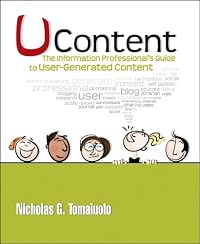
Ucontent: The Information Professional's Guide to User-Generated Content
by Nicholas G. Tomaiuolo
On This Page
Description
This text considers the reasons behind the wild popularity of UContent (user-generated content) and makes strong arguments for cultivating it while serving as an overview, a status report, a primer, and a prognostication. In addition to the author's own UContent experiences, the book includes examples, insights, tips, and illustrations designed to help process, administer, and enjoy the UContent phenomenon.Tags
Recommendations





Member Reviews
This detailed and well written book, provides a chapter by chapter breakdown on various user-generated content sites, such as Project Gutenberg, Wikis, Blogs, and more. The author provides first hand experience in a number of chapters of how he submitted an item, such as to Project Gutenberg or Wikipedia, allowing the reader to follow along as he navigates how the products work. He also provides background and history to the products, as well as interviews with people familiar with the material. For those that are like me, experienced with new technologies and navigating ucontent, then the book really doesn’t have a lot of new information, but the interviews are interesting. However, for those that are new to the area of user show more generated content, then this is the perfect book to follow along and discover something new. show less
 This review was written for LibraryThing Early Reviewers.
I requested this book through Library Thing’s Early Reviewer program, so I can only blame myself if the book wasn’t intended for me. It turns out that “Information Professional” really means librarian and those of us who are book lovers, blog writers and information junkies don’t make the cut. Here is a touch of condescension while the author defines his audience. To be fair, though, Tomaiuolo doesn’t exhibit any more professional self-importance than any other expert in any other field would exhibit—perhaps less, while making clear his audience is the professional librarian.
So was there anything here for me? You bet!
Tomaiuolo defines UContent as “the production of content by the general public [such as bloggers] rather show more than by paid professional and experts in the field”, and not generally considered a reliable source of information. But Tomaiuolo recognizes that there can be nuggets of information out there that can be used by “information professional.’
The material is presented in a logical manner. Each chapter considers a separate UContent source. Topics include blogs, Wikis (including the grand-daddy Wikipedia), podcasts, online product reviews, self-publishing, and citizen journalism. The author also considers information sources within Facebook, Yahoo!Pipes, Flickr and custom search engines. He explains tagging & folksonomies, as well as cybercartography.
Tomaiuolo discusses in some detail the source of information in each category of UContent. His research appears to be extremely thorough (there are copious endnotes in each chapter). He includes an interview in each chapter with a professional in a related field – a professor of journalism, a self-published author, and so on. He also includes well-established on-line sources that will provide updated information before another print edition of this book could be published.
Next, Tomaiuolo performs a surprisingly balanced assessment of each subject’s use, and its relevance for the information professional. He describes how libraries might contribute to the Content (for example, having blogs or being on Facebook) and also how librarians might find relevant information and use it in their own environment, both for their own use and use by the public.
Each chapter of UContent is a veritable goldmine of information. I enjoyed reading it through like narrative non-fiction, although it isn’t that. I consider myself fairly knowledgeable about using the Internet and finding information thereon, but Tomaiuolo taught me lots I didn’t know (what is/are folksonomies anyway, and why should I care?)
This book should become the bible of UContent reference for libraries. It is also a first-rate handbook for students doing research using the web. You’ll want to buy it and refer to it frequently. It's well worth the investment.
For the rest of us non-professionals, it’s a valuable overview of web content for any blogger or generator of other UContent, plus it’s interesting to read, and it’s full of useful data. For us, I rate it a solid 4 stars. show less
So was there anything here for me? You bet!
Tomaiuolo defines UContent as “the production of content by the general public [such as bloggers] rather show more than by paid professional and experts in the field”, and not generally considered a reliable source of information. But Tomaiuolo recognizes that there can be nuggets of information out there that can be used by “information professional.’
The material is presented in a logical manner. Each chapter considers a separate UContent source. Topics include blogs, Wikis (including the grand-daddy Wikipedia), podcasts, online product reviews, self-publishing, and citizen journalism. The author also considers information sources within Facebook, Yahoo!Pipes, Flickr and custom search engines. He explains tagging & folksonomies, as well as cybercartography.
Tomaiuolo discusses in some detail the source of information in each category of UContent. His research appears to be extremely thorough (there are copious endnotes in each chapter). He includes an interview in each chapter with a professional in a related field – a professor of journalism, a self-published author, and so on. He also includes well-established on-line sources that will provide updated information before another print edition of this book could be published.
Next, Tomaiuolo performs a surprisingly balanced assessment of each subject’s use, and its relevance for the information professional. He describes how libraries might contribute to the Content (for example, having blogs or being on Facebook) and also how librarians might find relevant information and use it in their own environment, both for their own use and use by the public.
Each chapter of UContent is a veritable goldmine of information. I enjoyed reading it through like narrative non-fiction, although it isn’t that. I consider myself fairly knowledgeable about using the Internet and finding information thereon, but Tomaiuolo taught me lots I didn’t know (what is/are folksonomies anyway, and why should I care?)
This book should become the bible of UContent reference for libraries. It is also a first-rate handbook for students doing research using the web. You’ll want to buy it and refer to it frequently. It's well worth the investment.
For the rest of us non-professionals, it’s a valuable overview of web content for any blogger or generator of other UContent, plus it’s interesting to read, and it’s full of useful data. For us, I rate it a solid 4 stars. show less
This review was written for LibraryThing Early Reviewers.I am really grateful to the author and Information Today for putting this up on Early Reviewers. I'm only halfway through with it so far, but I feel like I need to at least start a review. The author has patiently gone through a whole range of Web 2.0 applications (blogs, project gutenberg, wikipedia, podcasts etc.) and in each chapter offers resources to explore the application, interviews with some of the lead players, and his own chronicle of getting his feet wet with the application. I found his description of creating a file for project gutenberg to be particularly enlightening.
This is a book that will particularly spark the imaginations of librarians, but I hope it will find a much wider audience among others who are interested show more in Web 2.0 applications. When I'm done with the first read through, I plan on spending the summer exploring the links of the companion website. As a librarian who specializes in instruction, there is much here to fill up my sandbox! Well done. Highly recommended. show less
This is a book that will particularly spark the imaginations of librarians, but I hope it will find a much wider audience among others who are interested show more in Web 2.0 applications. When I'm done with the first read through, I plan on spending the summer exploring the links of the companion website. As a librarian who specializes in instruction, there is much here to fill up my sandbox! Well done. Highly recommended. show less
This review was written for LibraryThing Early Reviewers.Experienced reference and instruction librarian Nick Tomaiuolo's (aka the Web 2.0 Librarian) new book is a must-have for all librarians involved in digital content. UContent clearly describes various user-generated content (UGC) tools and how librarians can implement these in their library work and personal development.
UContent is targeted toward the beginner in UGC but tricks and tips will be welcomed by more advanced users. UContent isn't pretty. It's a bare-bones how-to do-it-yourself approach, but it works.
Since the content of the book can easily become outdated, Tomaiuolo has created an excellent website to accompany the book. The most important chapters are on blogs, audio and video services, social bookmarking, and show more Flickr.
Tomaiuolo provides an overview of the service as well as interviews with expert users or developers. Most importantly, he demonstrates how these services have been implemented by other librarians. This provides real-life demonstrations of the possibilities of UGC and acts as a jumping-off point for developing your own content. And, like any good librarian, he has a terrific bibliography for each chapter. UContent is sure to become a handy reference book for librarians as the enter the Web 2.0 world of UGC. show less
UContent is targeted toward the beginner in UGC but tricks and tips will be welcomed by more advanced users. UContent isn't pretty. It's a bare-bones how-to do-it-yourself approach, but it works.
Since the content of the book can easily become outdated, Tomaiuolo has created an excellent website to accompany the book. The most important chapters are on blogs, audio and video services, social bookmarking, and show more Flickr.
Tomaiuolo provides an overview of the service as well as interviews with expert users or developers. Most importantly, he demonstrates how these services have been implemented by other librarians. This provides real-life demonstrations of the possibilities of UGC and acts as a jumping-off point for developing your own content. And, like any good librarian, he has a terrific bibliography for each chapter. UContent is sure to become a handy reference book for librarians as the enter the Web 2.0 world of UGC. show less
This review was written for LibraryThing Early Reviewers.Provides a cursory introduction to a variety of prominent web sites and services that collect and distribute content contributed by volunteers. Also offers a snapshot in time regarding how selected librarians are using or contributing to various web services, such as YouTube, Wikipedia and Facebook. The author spends a lot of time describing how librarians can contribute to mainstream user-content oriented sites, but largely neglects to discuss how librarians can utilize user-generated content to enhance library web sites and services. This is a real disappointment and missed opportunity. Overall, the book suffers from a lack of refinement and synthesis. It often feels like reading somebody's notes for a book, rather than a finished show more book. The quality and level of synthesis would be appropriate on a blog, but I expect more out of a commercially published book. Many of the sources cited were published in 2008-2009, rendering the information rather dated. Perhaps more significant and useful are the book's companion website, which provides links to most of the resources listed, and the author's UContent blog, both of which are freely accessible.
Companion website: http://web.ccsu.edu/library/tomaiuolon/UContent/toc.htm
UContent blog: http://web20librarian.wordpress.com/ show less
Companion website: http://web.ccsu.edu/library/tomaiuolon/UContent/toc.htm
UContent blog: http://web20librarian.wordpress.com/ show less
This review was written for LibraryThing Early Reviewers.I was impressed by this book because it spanned experience levels so that whatever your familiarity with social media, you could learn from it. Often these books are horribly out of date -- after all the world of social moves far faster than book publishing. But this book did a great job of balancing current info with a curated view of the core fundamentals of social. As such it is a welcome resource!
This review was written for LibraryThing Early Reviewers.I wish this would have covered Twitter more thoroughly. It's briefly mentioned at best, and I think it's an important source of information for information professionals: both about our profession and as a way to find pop culture information (as in the case of Michael Jackson's death, as is mentioned in the book). Still a helpful and interesting tome overall.
This review was written for LibraryThing Early Reviewers.Members
- Recently Added By
Author Information

3 Works 108 Members

Nicholas Tomaiuolo is a LibraryThing Author, an author who lists their personal library on LibraryThing.
Classifications
- Genres
- Technology, Nonfiction
- DDC/MDS
- 006.7 — Computer science, information & general works Computer science, knowledge & systems Special computer methods (AI, barcoding, VR, web design, social media) Multimedia systems
- LCC
- ZA4482 .T66 — Bibliography, Library Science and Information Resources Information resources/materials Information resources (General) Information in specific formats or media
Statistics
- Members
- 22
- Popularity
- 1,186,031
- Reviews
- 9
- Rating
- (3.69)
- Languages
- English
- Media
- Paper, Ebook
- ISBNs
- 4