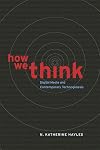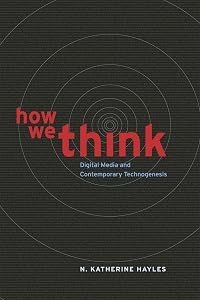
How We Think: Digital Media and Contemporary Technogenesis
by N. Katherine Hayles
109 Members (4.00)
On This Page
Description
"How do we think?" N. Katherine Hayles poses this question at the beginning of this bracing exploration of the idea that we think through, with, and alongside media. As the age of print passes and new technologies appear every day, this proposition has become far more complicated, particularly for the traditionally print-based disciplines in the humanities and qualitative social sciences. With a rift growing between digital scholarship and its print-based counterpart, Hayles argues for show more contemporary technogenesis-the belief that humans and technics are coevolving-and advocates for what she calls comparative media studies, a new approach to locating digital work within print traditions and vice versa. Hayles examines the evolution of the field from the traditional humanities and how the digital humanities are changing academic scholarship, research, teaching, and publication. She goes on to depict the neurological consequences of working in digital media, where skimming and scanning, or "hyper reading, " and analysis through machine algorithms are forms of reading as valid as close reading once was. Hayles contends that we must recognize all three types of reading and understand the limitations and possibilities of each. In addition to illustrating what a comparative media perspective entails, Hayles explores the technogenesis spiral in its full complexity. She considers the effects of early databases such as telegraph code books and confronts our changing perceptions of time and space in the digital age, illustrating this through three innovative digital productions-Steve Tomasula's electronic novel, TOC; Steven Hall's The Raw Shark Texts; and Mark Z. Danielewski's Only Revolutions. Deepening our understanding of the extraordinary transformative powers digital technologies have placed in the hands of humanists, How We Think presents a cogent rationale for tackling the challenges facing the humanities today. show lessTags
Recommendations






Member Reviews
Members
- Recently Added By
Lists

Big Data
52 works; 2 members
Author Information

N. Katherine Hayles is distinguished research professor of English at the University of California, Los Angeles, and James B. Duke Professor of Literature Emerita at Duke University. Her books include How We Became Posthuman: Virtual Bodies in Cybernetics, Literature, and Informatics (1999) and unthought: The Power of the Cognitive Nonconscious show more (2017). show less
All Editions
Some Editions
Series
Belongs to Publisher Series
Common Knowledge
- Canonical title*
- Lire et penser en milieux numérique. Attention, récits, technogenèse
- Original title
- How we think : digital media and contemporary technogenesis
- Original publication date
- 2012-04-11 (1e édition originale américaine, University of Chicago Press) (1e édition originale américaine, University of Chicago Press); 2016-07-01 (1e traduction et édition française|Savoirs littéraires et imaginaires scientifiques|Presses universitaires de Grenoble) (1e traduction et édition française | Savoirs littéraires et imaginaires scientifiques | Presses universitaires de Grenoble)
- First words*
- Préface. Humanités numériques et études de media comparés
Yves Citton
Comment pensons-nous – maintenant que des circuits électroniques s’immiscent toujours plus intimement dans nos façons de... (show all) nous situer dans le monde ? Comment l’ubiquité croissante des media numériques affecte-t-elle nos façons de lire, de connaître, de raconter1 ? En quoi nos anciennes catégories exigent-elles d’être amendées si nous voulons faire face à nos nouveaux défis ? En quoi méritent-elles d’être retenues si nous ne voulons pas sacrifier certains acquis précieux de notre passé antédigital ? Ce sont ces questions essentielles pour notre époque – fréquemment discutées, fortement contestées, mais rarement approfondies – que pose ce livre majeur de N. Katherine Hayles. [...]
Comment nous pensons
Médias numériques et technogenèse contemporaine
Comment pensons-nous ? Ce livre examine la proposition selon laquelle nous pensons par les médias, avec les médias et à côté... (show all) des médias. L’idée n’est pas neuve, bien sûr. [...] - Last words*
- (Click to show. Warning: May contain spoilers.)(Cartographier le temps, représenter les données)
- Original language*
- Anglais (Etats-Unis) (Etats-Unis)
*Some information comes from Common Knowledge in other languages. Click "Edit" for more information.
Classifications
- Genres
- Nonfiction, Technology, Literature Studies and Criticism, Philosophy, General Nonfiction
- DDC/MDS
- 302.23 — Society, government, & culture Social sciences, sociology & anthropology Mass Communication & Media Communication Media (Means of communication)
- LCC
- P96 .T42 .H39 — Language and Literature Philology. Linguistics Communication. Mass media
- BISAC
Statistics
- Members
- 109
- Popularity
- 297,071
- Rating
- (4.00)
- Languages
- English, French
- Media
- Paper, Ebook
- ISBNs
- 4
- ASINs
- 1