The Millstone
by Margaret Drabble
On This Page
Description
An award-winning novel about the perils of motherhood in a failing healthcare system and a woman's fight against the social stigma of the Sixties.Tags
Recommendations

















Member Recommendations


Member Reviews
That tagline Rosamund is clever, very independent - and pregnant, whilst accurate as a pitch of the book, turns out to be quite reductive. Rosamund is all those things but as a reader privy to her ongoing internal monologue as well as her external interactions, - in particular her preoccupation of appearing independent, and presenting her personality as she expects others to see her, - we uncover a character that we not only can root for but also relate to.
The light-hearted, flippant style (which seems common in post-war female English writers) of the first half belied the emotional depth and maturity that the book ended on, reflective of Rosamund's own personal growth. The last time I was tricked by such an emotional about-face was The show more Pumpkin Eater by Penelope Mortimer where I was rendered into a silently weepy mess on a plane. But unlike Mortimer's claustrophobic portrayal of what womanhood and motherhood entails, Drabble allows for a portrayal that was most freeing combined with a lot of wishful-thinking while just remaining on this side of realistic.
Things do go much smoother for Rosamund than imaginably possible, with consequences minimum, and support a-plenty. Some might complain about the unlikeliness of such convenient resolutions to all possible conflicts and the privileges afforded to Rosamund as an educated daughter of well-off parents, but I for one am just glad to have a non-tragic pregnant-and-unmarried-in-the-1960s story. show less
The light-hearted, flippant style (which seems common in post-war female English writers) of the first half belied the emotional depth and maturity that the book ended on, reflective of Rosamund's own personal growth. The last time I was tricked by such an emotional about-face was The show more Pumpkin Eater by Penelope Mortimer where I was rendered into a silently weepy mess on a plane. But unlike Mortimer's claustrophobic portrayal of what womanhood and motherhood entails, Drabble allows for a portrayal that was most freeing combined with a lot of wishful-thinking while just remaining on this side of realistic.
Things do go much smoother for Rosamund than imaginably possible, with consequences minimum, and support a-plenty. Some might complain about the unlikeliness of such convenient resolutions to all possible conflicts and the privileges afforded to Rosamund as an educated daughter of well-off parents, but I for one am just glad to have a non-tragic pregnant-and-unmarried-in-the-1960s story. show less
'I was trapped inside a human limit for the first time and i was going to have to learn how to live inside it'
By sally tarbox on 11 Nov. 2012
Format: Paperback
Masterly written novel, following 1960s academic, Rosamund Stacey. From her privileged background - amusing, bohemian friends; use of a nice flat while her parents are abroad; male admirers (but nothing more) - she is suddenly brought up short when she discovers she is pregnant after a one night stand with (gay?) George.
Suddenly she has to take on board a whole world to which she was oblivious: the badly dressed working class patients with whom she must now mix at the doctor's; the disapproval of her siblings. And whether to get back in touch with George and tell him of the show more fact.
Interesting from a historical perspective - did NHS matrons really refuse to let parents visit their infants for a couple of weeks after surgery in case it upset them?!
Rosamund doesn't seem to suffer the persecution that one equates with single-motherhood in this era; she acknowledges that this is due in no small part to her class background:
'Had I not been who I am and born and reared as I was, I would probably never have dared: I only thought I could get away with it, to put it briefly, because those ambulance men collected me from a good address, and not from a bedsitter in Tottenham...So, in a way, I was cashing in on the foibles of a society which I have always distrusted; by pretending to be above its structures, i was merely turning its anomalies to my own use.' show less
By sally tarbox on 11 Nov. 2012
Format: Paperback
Masterly written novel, following 1960s academic, Rosamund Stacey. From her privileged background - amusing, bohemian friends; use of a nice flat while her parents are abroad; male admirers (but nothing more) - she is suddenly brought up short when she discovers she is pregnant after a one night stand with (gay?) George.
Suddenly she has to take on board a whole world to which she was oblivious: the badly dressed working class patients with whom she must now mix at the doctor's; the disapproval of her siblings. And whether to get back in touch with George and tell him of the show more fact.
Interesting from a historical perspective - did NHS matrons really refuse to let parents visit their infants for a couple of weeks after surgery in case it upset them?!
Rosamund doesn't seem to suffer the persecution that one equates with single-motherhood in this era; she acknowledges that this is due in no small part to her class background:
'Had I not been who I am and born and reared as I was, I would probably never have dared: I only thought I could get away with it, to put it briefly, because those ambulance men collected me from a good address, and not from a bedsitter in Tottenham...So, in a way, I was cashing in on the foibles of a society which I have always distrusted; by pretending to be above its structures, i was merely turning its anomalies to my own use.' show less
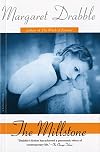
Why in the world Drabble chose to title this delightfully, humorously poignant book The Millstone is quite beyond me. Between the ominous title and the dreary Balthus painting on the cover, I was certain the book would be a perfect feminist downer. Turns out that it is a very thoughtful story about how an unmarried Renaissance literature scholar seeking her doctorate deals with her pregnancy and her child's infancy. Rosamund, after initial quandary and a humorously botched attempt at a gin induced miscarriage, decides to go ahead and become a mother.
Set in the early 1960s, Rosamund is torn between her own timidity towards men and the new wave of sexual promiscuity among her set, the intellectual middle class. She finds herself equally show more disquieted by how her membership in a more privileged class allows her to get away with having an illegitimate child. In fact, she is disquieted by much;what to do about the father of the child, how to balance her Fabian childhood with the realities of class difference; how to get nurses to pay attention to her demands. She is a woman who knows her worth and is not afraid to admit to it. She also pokes fun at her how hypocrisies and foibles. All in all, she is an witty and likable narrator for a likable, thoughtful account. show less
Set in the early 1960s, Rosamund is torn between her own timidity towards men and the new wave of sexual promiscuity among her set, the intellectual middle class. She finds herself equally show more disquieted by how her membership in a more privileged class allows her to get away with having an illegitimate child. In fact, she is disquieted by much;what to do about the father of the child, how to balance her Fabian childhood with the realities of class difference; how to get nurses to pay attention to her demands. She is a woman who knows her worth and is not afraid to admit to it. She also pokes fun at her how hypocrisies and foibles. All in all, she is an witty and likable narrator for a likable, thoughtful account. show less
It's 1960s London, and Rosamund, a young intellectual just beginning to make her mark in academia, loses her virginity and gets pregnant in one fell swoop. There's a few places Drabble could have gone with this story, and most interestingly she approaches it from the perspective of an intelligent, independent young woman who is damned if she's going to allow societal expectations to make a social pariah out of either her or her baby. Equally, she challenges the notion of needing a husband to raise a child, determined that it will be well within her grasp to financially support the two of them by herself.
I really enjoyed Drabble's writing. It reminded me of a bit of a mix of Anita Brookner and Barbara Pym - Brookner's type of setting and show more prose with Pym's wit, although with a little more spunk and modernity (for it's time) to the humour.
4 stars - a great start to the world of Drabble. show less
I really enjoyed Drabble's writing. It reminded me of a bit of a mix of Anita Brookner and Barbara Pym - Brookner's type of setting and show more prose with Pym's wit, although with a little more spunk and modernity (for it's time) to the humour.
4 stars - a great start to the world of Drabble. show less
Margaret Drabble's consistently high-calibre output of fiction, biography and scholarly writing over a career spanning more than fifty years is remarkable. Of special note are her iconic novels of the 1960s: in which, while still in her twenties, she established herself as one of the most literate and psychologically astute voices of her generation. The Millstone is her third novel, published in 1965 when the author was twenty-six. Rosamund Stacey, a young graduate student writing a thesis on the English Romantic poets, maintains a solitary and emotionally isolated existence in her parents' flat in London (her parents are living in Africa). Rigorously intellectual and self-aware, she’s plotted out her neat and tidy life every step of show more the way. Even the romantic involvements she’s permitted herself are planned and calculated for minimum fuss and muss: she goes on occasional outings to pubs and movies with two different men, neither of whom she finds particularly attractive and each of whom is under the impression she’s sleeping with the other—the result being that neither pressures her for a physical liaison or deeper commitment. But even Rosamund can’t control forever her own desire for human connection, and one night she meets a man in a bar, gets tipsy, brings him to her flat, and they have sex. It’s her one and only sexual encounter, and against the odds she discovers she’s pregnant. It’s at this point that her analytical approach to living breaks down and she begins questioning her motives and objectives. Reason dictates that she have an abortion and put the episode behind her. But almost without reaching the decision consciously, and without any help from her family and with very little from her friends, she foregoes this option and proceeds resolutely onward, making arrangements for the birth and for the presence in her life of someone who will depend on her for everything. Drabble’s assured narrative—first person from Rosamund’s perspective—is touching, thoroughly engrossing, psychologically penetrating, and sometimes very funny, as the middle-class intellectual in Rosamund struggles with feelings and passions that often take her by surprise, and is shocked again and again to discover how profoundly ignorant she is about life in the trenches. Drabble’s voice in this book is refined and mature and never lets the reader down. Her later novels are longer and more complex, but by any measure The Millstone remains a literary accomplishment of the first order. show less
For a book written as long ago as 1965 this story of an intelligent single woman who finds herself pregnant is surprisingly modern and sympathetic, with a refreshing lack of traditional moralising. Its heroine Rosamund has an academic background similar to Drabble's and is cushioned by being able to live rent free in her travelling parents' London flat.
In the first half of the book she drifts into a decision to keep the baby, and there is plenty of humour in the caricatured reactions of everyone she meets. She conveniently acquires a flatmate in Lydia, an aspiring novelist who is discovered to be writing about her which allows a slightly metafictional layer to be developed.
In the second half of the book the baby Octavia is born and show more Rosamund finds redemption in unexpected ways (none of which involve the various men she is involved with).
I found this book interesting and very enjoyable - particularly so soon after reading her latest one [b:The Dark Flood Rises|29875905|The Dark Flood Rises|Margaret Drabble|https://images.gr-assets.com/books/1482922339s/29875905.jpg|46835143] last month. show less
In the first half of the book she drifts into a decision to keep the baby, and there is plenty of humour in the caricatured reactions of everyone she meets. She conveniently acquires a flatmate in Lydia, an aspiring novelist who is discovered to be writing about her which allows a slightly metafictional layer to be developed.
In the second half of the book the baby Octavia is born and show more Rosamund finds redemption in unexpected ways (none of which involve the various men she is involved with).
I found this book interesting and very enjoyable - particularly so soon after reading her latest one [b:The Dark Flood Rises|29875905|The Dark Flood Rises|Margaret Drabble|https://images.gr-assets.com/books/1482922339s/29875905.jpg|46835143] last month. show less
London in the early 1960s is a place where casual sex is becoming acceptable, but having a child out of wedlock is not. Twenty-six year old scholar and doctoral student Rosamund Stacey is dating two men whose company she enjoys, but she’s really not interested in getting physical with either one. She more interested in Elizabethan poets and her academic career. Then a chance meeting with a likable radio announcer leads to an invitation to her flat, and after her first and only sexual encounter she finds herself pregnant. In keeping with her independent values and her “strange mixture of confidence and cowardice,” she decides to have the child and not tell the father about her pregnancy.
Told in the first person, Rosamund’s show more pregnancy and first year of motherhood is a tale of an intelligent young woman making her way in the world that’s worthy of Jane Austen. Like Austen’s heroines, Rosamund is comfortably middle class, but unlike them she is not surrounded by family. Her parents are in Africa teaching, and she is alone in their home in London with only friends and casual acquaintances around her. She is, by temperament and design, a loner, but after the birth of her daughter Octavia she finds herself overwhelmed by maternal love with all its tender devotion and obsessive worry. This tension is a fire that Drabble stokes right up to the final pages of the novel. Like Austen’s, Drabble’s domestic fiction sharply reflects the society, its foibles and inequalities, in which it is set. Rosamund is aware that her social position has allowed her to make the choice to have child and career that would not be possible for others with less means and social connections. show less
Told in the first person, Rosamund’s show more pregnancy and first year of motherhood is a tale of an intelligent young woman making her way in the world that’s worthy of Jane Austen. Like Austen’s heroines, Rosamund is comfortably middle class, but unlike them she is not surrounded by family. Her parents are in Africa teaching, and she is alone in their home in London with only friends and casual acquaintances around her. She is, by temperament and design, a loner, but after the birth of her daughter Octavia she finds herself overwhelmed by maternal love with all its tender devotion and obsessive worry. This tension is a fire that Drabble stokes right up to the final pages of the novel. Like Austen’s, Drabble’s domestic fiction sharply reflects the society, its foibles and inequalities, in which it is set. Rosamund is aware that her social position has allowed her to make the choice to have child and career that would not be possible for others with less means and social connections. show less
Members
- Recently Added By
Published Reviews
ThingScore 100
But to see this book as primarily about the sexual revolution, illegitimacy, and the swinging London of the 1960s, is to miss its point. The Millstone is about liberal guilt. It is perhaps one of the most philosophical books written on the subject, full of the sly profundity that is sometimes the special strength of spare, comic novels.
added by Nickelini
Lists

The Guardian's 1000 Novels Everyone Must Read
1,005 works; 546 members
20th Century Literature
1,161 works; 55 members

Best Books Set in London
157 works; 40 members

1960s, Best books published therein
254 works; 22 members

A Novel Cure
742 works; 23 members

Julie Parson’s Old Books
52 works; 4 members

BBC World Book Club
261 works; 5 members
Author Information

68+ Works 13,764 Members
Margaret Drabble was born on June 5, 1939 in Sheffield, England. She attended The Mount School in York and Newnham College, Cambridge University. After graduation, she joined the Royal Shakespeare Company at Stratford during which time she understudied for Vanessa Redgrave. She is a novelist, critic, and the editor of the fifth edition of The show more Oxford Companion to English Literature. Her works include A Summer Bird Cage; The Millstone, which won the John Llewelyn Rhys Prize in 1966; Jerusalem the Golden, which won James Tait Black Prize in 1967; and The Witch of Exmoor. She also received the E. M. Forster award and was awarded a Society of Authors Travelling Fellowship in the 1960s and the Commander of the Order of the British Empire in 1980. (Bowker Author Biography) show less
Some Editions
Awards and Honors
Awards
Notable Lists
Series
Belongs to Publisher Series
Work Relationships
Is abridged in
Common Knowledge
- Canonical title*
- L'enfant du minet
- Original title
- The Millstone
- Alternate titles
- Thank You All Very Much
- Original publication date
- 1965
- People/Characters
- Rosamund Stacey
- Important places
- Marylebone, London, England, UK
- First words
- My career has always been marked by a strange mixture of confidence and cowardice; almost, one might say, made by it.
- Quotations
- [Lydia is a writer, blocked. Asked why she doesn't write a book:]
`I can't', she wailed. `I try to. I begin them but I can't finish. How I
envy you, your work is always there, you know what's got to be done, it's
myself like a dirty great spider.' - Last words
- (Click to show. Warning: May contain spoilers.)'No,' said George, his hand upon the door. 'No, nothing.'
- Original language
- English
*Some information comes from Common Knowledge in other languages. Click "Edit" for more information.
Classifications
Statistics
- Members
- 994
- Popularity
- 26,177
- Reviews
- 26
- Rating
- (3.84)
- Languages
- 9 — Dutch, English, French, German, Hungarian, Italian, Norwegian (Bokmål), Spanish, Swedish
- Media
- Paper, Ebook
- ISBNs
- 38
- ASINs
- 19