House Held Up by Trees
by Ted Kooser
On This Page
Description
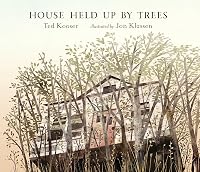
Built on a treeless yard by a family who cleared away all the sprouting trees on the property, a house is eventually abandoned and left to deteriorate on a lot that is gradually overrun by wild trees, in a poignant tale of loss, change, and nature's quiet triumph.Tags
Recommendations



Member Reviews
"Not far from here, I have seen a house held up by the hands of trees. This is its story." So reads the brief note on the title page of this lovely, contemplative picture-book from poet Ted Kooser, the United States Poet Laureate from 2004 through 2006. In simple but evocative language, Kooser relates the house's story, from the time it was first built, with its scrupulously kept lawn, through its years as the family home of a man and his two children, to its slow deterioration, after being abandoned by the man, when his children grow up and move away. Eventually, the encroaching trees reoccupy both lawn and house, growing around the slowing disintegrating structure and keeping it together, even as they uproot it.
There is a melancholy show more quality to House Held Up By Trees, a sense of the inexorable passage of time, and of the impermanence of people in the natural landscape. Although the family's lives do enter the picture - the father's care of the lawn, the brother and sister's time in the nearby woods - the narrative is focused house-ward, and the result is somewhat disquieting. Anyone who played near an old derelict building as a child - we had an old carriage house behind my own childhood home, that was slowly going to ruin - will recognize the simultaneous feelings of attraction and menace to be found here. The artwork, done by Jon Klassen, is just beautiful, emphasizing the centrality of the house to this story, as opposed to the marginal human figures. I'm not really sure, all told, who the appropriate audience for this one would be, and I have seen other reviewers question whether it is intended for children at all. It's hard to say. I think I would have been appreciated it as a girl, but then, the melancholy has always spoken to me... show less
There is a melancholy show more quality to House Held Up By Trees, a sense of the inexorable passage of time, and of the impermanence of people in the natural landscape. Although the family's lives do enter the picture - the father's care of the lawn, the brother and sister's time in the nearby woods - the narrative is focused house-ward, and the result is somewhat disquieting. Anyone who played near an old derelict building as a child - we had an old carriage house behind my own childhood home, that was slowly going to ruin - will recognize the simultaneous feelings of attraction and menace to be found here. The artwork, done by Jon Klassen, is just beautiful, emphasizing the centrality of the house to this story, as opposed to the marginal human figures. I'm not really sure, all told, who the appropriate audience for this one would be, and I have seen other reviewers question whether it is intended for children at all. It's hard to say. I think I would have been appreciated it as a girl, but then, the melancholy has always spoken to me... show less
When the house was new, not a single tree remained on its perfect lawn to give shade from the sun. The children in the house trailed the scent of wild trees to neighbouring lots, where thick bushes offered secret places to play. When the children grew up and moved away, their father, alone in the house, continued his battle against blowing seeds, plucking out sprouting trees - until one day he, too, moved away. Then, as the empty house began its decline, the trees began to take over.
6 books
6 books
Beautifully illustrated, this story from poet Ted Kooser is a two edged coin. From one point of view it's about nature surviving and reclaiming the land when man leaves. But it's also about a father unable to stop the passage of time and has to watch his children leave and finally being unable to hold onto the family home. Perhaps more for slightly older children. And adults who love Jon Klassen's art work - of which I imagine there are many.
Saw images from this book while browsing Jon Klassen art prints. It's an interesting author/illustrator pairing, but it works well; Klassen drops his humorous animals in favor of wistful countryside views, often from unusual angles. The story itself is about a boy and girl who move with their father to a house surrounded by a lawn that he is obsessed with maintaining, though they "loved to play among the trees" surrounding their property. The children grow up and move away, and eventually the father decides to leave his house and join them in the city; the house doesn't sell ("As it happened, nobody wanted to buy the house. Nobody could explain why, but it just didn't seem like a house where anybody wanted to live. That happens show more sometimes"). Seeds from the surrounding trees take root in the lawn and around the house; they grow up over the years, lifting the house off its foundation and up into the air. show less
I loved the text immoderately, which isn't surprising because I love Kooser immoderately (he is in fact one of the vanishingly small number of people who have made me cry in public). I'm not as fond of the illustrations by Klassen. There's a bit of flatness to them that doesn't quite work to my eye- the words are so lovely and so fraught that the combination is jarring. Still, a lovely, lovely book.
This was one of my favorite books that I have read in this class. First, I love the illustrations. They add so much to enhance the story and to create a mood. For example, when the father decides that he wants to move into the city to be closer to his children and the house has become too much work, the picture shows the house and surroundings in muted colors. The sky is a dark brown and orange and the house is by itself in what seems like miles and miles of land. I think this depicts how the father is feeling at this time. He is lonely at the house without his children but is worn down from trying to keep up with the work. He doesn't want to leave the house but he knows it will be better for him to do so. The colors and images of this show more page enhance this feelings. Next, I love this book because of how poetically it is written. When you first start reading it, you don't realize that it is written like a poem until you run across lines that are the same. For example, one page says "This went on year after year, and the children slowly grew up, as children will." Then later in the book it says "Nobody could explain why, but it just didn't seem like a house where anybody wanted to live. That happens sometimes." These two parts of the book really stuck out to me. They aren't repeating phrases but are phrases that seem to mimmic each other. They both seem to say, well thats just what happens in life and we have to deal with it. This happened a few times within the book and I think it added a strong parallel to everyday life. Finally, I liked the overall message of this story. It seems to parallel life and subtly talk about family, life, and death. Here is this man who wants so badly to stay in his house that he has worked so hard for. Yet, he knows that he has to say goodbye. He knows that he can't keep up with the work and it is just disappointing to keep seeing the house falling apart. He knows it will be healthier for him to move closer to his kids. In a way I think the author was trying to suggest that the house was a representation of his wife and him losing her. This book seemed to teach the reader that things happen, and we can just make the best of the situation. show less
Beautiful, reflective story about the passing of time. Will be appreciated more by adults than children, however my 7 year old read it and really enjoyed it. Gorgeous illustrations. I loved it!
Members
- Recently Added By
Lists

spooky children's library
7 works; 1 member
Author Information

46+ Works 3,759 Members
Ted Kooser, U.S. Poet Laureate (2004-2006), is a professor of English at the University of Nebraska-Lincoln
All Editions
Awards and Honors
Awards
Distinctions
Classifications
Statistics
- Members
- 261
- Popularity
- 123,826
- Reviews
- 23
- Rating
- (3.85)
- Languages
- English, German
- Media
- Paper, Ebook
- ISBNs
- 5