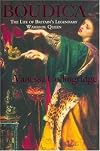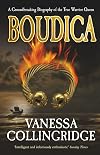
Boudica
by Vanessa Collingridge
On This Page
Description
An "intelligent and infectiously enthusiastic" biography of the Celtic queen and an analysis of her impact on British and feminist history ( The Sunday Times ). Boudica has been mythologized as the woman who dared to take on the Romans to avenge her daughters, her tribe, and her enslaved country. Her immortality rests on the fact that she almost drove the Romans out of Britain, and her legend has become the reference point for any British woman in power, from Elizabeth I to Margaret
show more Thatcher. As Boudica has become well known as an icon of female leadership and strength, the true story of her revolt against the Roman Empire has only become more distant until now. Combining new research and recent archaeological discoveries, Vanessa Collingridge has written a major new biography on this shadowy and often misunderstood figure of ancient history. Boudica provides a detailed history of the Celtomania that has adopted Boudica as its earliest hero, and the nationalist and feminist causes that have also tried to claim her as their own. While tracking the origins and impact of the various versions of the Boudica legend, Collingridge unearths a historical woman who is far subtler but every bit as fascinating as the myths associated with her name. "Deeply researched and powerfully explosive." - Saga Magazine "A compelling tale." - Daily Mail Tags
Recommendations











Member Reviews
The first I'd heard of Boudica (or Boadicea as it was spelled then) was in the Eagle Eye Mysteries in London edutainment game- one of the Eagles' friends wrote a song inspired by her. Popped up again when I signed up for the library's winter reading program, which had a time-traveling theme- read a book written about, in or set different time periods, which is problematic for me because I tend to stick to either fantasy worlds or science. Didn't feel like reading about actual Romans for the 'Ancient Rome' category, so opted to read about the infamous British queen's rebellion against them.
An interesting read. Collingridge first looks at the historical context and story of the actual Boudica (Rome and conquering the Gauls then Ocean show more then Britannia, etc.) then digs into the cultural evolution of the myth around Boudicca in the second half. The most fascinating part to me was actually a tangent- the fabrication of the Celtic identity by European Romantics in the late 1700s- early 1800s and the weird fusion of Druidism and the Britons. Use of Boudica as an avatar for whatever values the people of the time wanted to say was also interesting- would love to see comparisons of all the different depictions in plays.
I have way, way too many library books in my queue so I'm glad to get this done. Actually missed submitting any reads to the winter reading program, whoops. show less
An interesting read. Collingridge first looks at the historical context and story of the actual Boudica (Rome and conquering the Gauls then Ocean show more then Britannia, etc.) then digs into the cultural evolution of the myth around Boudicca in the second half. The most fascinating part to me was actually a tangent- the fabrication of the Celtic identity by European Romantics in the late 1700s- early 1800s and the weird fusion of Druidism and the Britons. Use of Boudica as an avatar for whatever values the people of the time wanted to say was also interesting- would love to see comparisons of all the different depictions in plays.
I have way, way too many library books in my queue so I'm glad to get this done. Actually missed submitting any reads to the winter reading program, whoops. show less
A bit of a mixed bag. This 400 pager is not really a biography of Boudica in the traditional sense of the term. Indeed, little in the way of hard fact is known about the actual events of her life - or rather of the last year or so of her life that we know about from Tacitus and Cassius Dio - so only really enough to fill barely a quarter of the book. The first half of the book covers previous Roman and British history at some length on the basis - understandable to a degree, but stretched here to breaking point at nearly 200 pages - that one needs to understand that earlier history in order to understand Boudica. The last quarter looks at Boudican symbolism in literature and in popular and political culture over the centuries and makes show more some interesting points, though rather labours the Britannia imagery and constant comparisons to famous females including Elizabeth I, Queen Victoria, Margaret Thatcher and even Princess Diana. Probably the most interesting aspect of the book is the coverage of archaeological finds, what has been extrapolated from them and how this relates or not to what Tacitus and Cassius Dio tell us. show less
Agree with most of the reviewers here. The writing is poor and overblown. There is not much evidence on which to base a discussion of Boudica. And the desperate attempt to find modern Boudicas (including Princess Diana?!?) is a bit much. I most enjoyed the sections on the general archaeology of Iron Age Britain, but suspect that more interesting and accurate discussion of that can be found elsewhere. All the stuff about druids is poorly researched; much of it has been discredited by contemporary scholars. Collingridge seems to take hearsay and (suspect) ancient mentions of druids as solid evidence. Some interesting spots, but I ended up skimming the last couple chapters because I was losing patience with the author.
The problem with writing a biography about Boudica is that there's virtually nothing in the way of evidence on which a full-length book can be based. After all, her reign, if in fact she did reign, lasted only a year, a mere blink in the span of ages. As a result, this book is also the story of the early Roman emperors, Cartimandua, and the other early British tribal leaders. On the one hand, this is an interesting approach since it provides a depth on the period and a context that helps the (limited) story of Boudica to make sense. But the book is ostensibly a book about Boudica, and in this, it misses the mark.
This book covers almost the same territory as Boudica: Iron Age Warrior Queen and contains several quotes from that author Richard Hingley. The major exception being that Collingridge goes further back in time to Rome and Caesar to study their attitudes toward women in society as a backdrop for her research. Both books look at the classical authors and modern archaeology to tell their tales. Both books conclude we know very little about the woman known as Boudica--including her name, which might have been a title or battle name (it means Victory). Both books spend about half their pages on history and about half on the legend that grew up around Boudica and her image down through the ages in literature, art, drama, and role in politics. show more However, Collingridge's book is meant as a popular biography. There are no footnotes, attributions are given in the text, and the narrative is in modern accessible language. She does provide a select biography and index. Personally I preferred the Hingley book, but I am doing research and liked the footnotes and attributions. Both books are thorough and well-written. (I think) the casual reader would enjoy either or both. show less
Other than a couple of references in the Roman histories of Cassius Dio and Tacitus, and a coin which may or may not depict her likeness, little is known—or will ever be known—of Boudica, Queen of the Iceni. Collingridge avoids acknowledging this, referring instead to “a string of exciting discoveries” (11) in archaeology, which turn out to have added nothing substantive to our knowledge of Boudica. The first third of the book mostly consists of an account of the Roman civilization, from the eighth century BC all the way through monarchy, republic and empire. Much of the rest deals with the author’s thoughts on Boudica as a symbol of empire for the Victorians; on druidism and “celtomania” in the nineteenth century; on the show more role of powerful women from Cleopatra and Agrippina through Elizabeth I and Queen Victoria to Margaret Thatcher, Princess Diana and Condoleeza Rice. I found this to be a highly irritating book: its use of breathless, emotive language is repetitive and confusing, its claims to solid scholarship completely unsubstantiated. show less
Well written and highly readable. The author did research the topic well but the focus of her book is the legend behind the woman and the impact this warrior queen had for the past 2000 years. The chapters about Boudicca herself start only after half the book.
Members
- Recently Added By
Author Information

4 Works 352 Members
Vanessa Collingridge is the co-anchor of Britain's news program Tonight and writes a column for The Daily Telegraph. She studied geography at Oxford University and is currently a fellow of the Royal Geographical Society
Common Knowledge
- Canonical title
- Boudica
- Alternate titles
- Boudica: A Groundbreaking Biography of the True Warrior Queen
- Original publication date
- 2005
- People/Characters
- Boudica; Gaius Julius Caesar
- Important places
- Ancient Rome; Bronze Age Britain; Roman Britannia
- Important events
- Roman occupation of Britain; Boudicca's Revolt (60 | 61); Gallic Wars (58 BC | 50 BC)
- Epigraph
- "Whoever were the first inhabitants of Britain, whether natives or immigrants, has never been answered: don't forget we are dealing with barbarians"
Tacitus, Agricola, xi. - First words
- The red layer was the colour of African earth.
--Introduction - Last words
- (Click to show. Warning: May contain spoilers.)It's only our interpretations of that history that change, just as they did in AD 60 when a client queen of the Romans rebelled against her foreign masters and rose up to become Britain's legendary warrior queen.
- Original language
- English UK
Classifications
- Genres
- History, Nonfiction, Biography & Memoir, General Nonfiction
- DDC/MDS
- 936.204092 — History & geography History of ancient world (to ca. 499) Europe north and west of Italian Peninsula to ca. 499 England to 410 and Wales to 410
- LCC
- DA145.3 .B6 .C65 — History of Europe, Asia, Africa and Oceania Great Britain History of Great Britain England History By period Early and medieval to 1485 Celts. Romans. Saxons. Danes. Normans
- BISAC
Statistics
- Members
- 208
- Popularity
- 157,782
- Reviews
- 10
- Rating
- (2.92)
- Languages
- English
- Media
- Paper, Ebook
- ISBNs
- 6
- ASINs
- 4