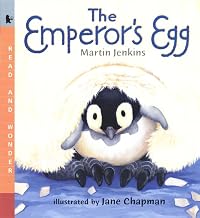
The Emperor's Egg
by Martin Jenkins
On This Page
Description
Describes the parental behavior of Emperor penguins, focusing on how the male keeps the egg warm until it hatches and how the parents care for the chick after it is born.Tags
Recommendations












Member Reviews
I love this informational text for many reasons! I liked how it was written in a form of a story. It takes the reader on an adventure from the time the egg was hatched to how a penguin grows up. I also liked how the book had text features like a diagram explaining and showing the difference in size of a baby penguin to a adult full grown penguin. The text also highlights and explains vocabulary words like that a baby penguin is called a chick. Pictures are very colorful and engaging for the reader especially on the page where it explains how and why the penguins slide down hills on their stomachs. The big idea is to explain to the reader the life of a penguin from when it hatches to when it becomes an adult.
The Emperor's egg is a fantastic non-fiction account of how emperor penguins car for their eggs until they hatch. The book begins with an illustrated dictionary type layout, but after introducing Antarctica and its climate, it moves into a narrative that while being non-fiction, has suspense, a problem, a solution, and a resolution.
The book is illustrated with paintings that are nothing to write home about but do a good job of providing extra information through illustration. The writing is by far the books strongest part, with a well told story that includes all the necessary information to explain the arduous process a penguin goes through to keep its egg warm. The story-telling is well-paced and includes several moments of suspense show more that provide perfect opportunities to have the children you are reading to make a prediction. By far the most engaging part of the book is when, after the male penguin has been sitting on the egg for over two months with no food, the female penguins slowly appears on the horizon and arrives with great penguin fanfare to meet and feed her new chick. M y kids actually cheered when they read that. I look forward to reading this book to kindergartners again. show less
The book is illustrated with paintings that are nothing to write home about but do a good job of providing extra information through illustration. The writing is by far the books strongest part, with a well told story that includes all the necessary information to explain the arduous process a penguin goes through to keep its egg warm. The story-telling is well-paced and includes several moments of suspense show more that provide perfect opportunities to have the children you are reading to make a prediction. By far the most engaging part of the book is when, after the male penguin has been sitting on the egg for over two months with no food, the female penguins slowly appears on the horizon and arrives with great penguin fanfare to meet and feed her new chick. M y kids actually cheered when they read that. I look forward to reading this book to kindergartners again. show less
This book was about emperor penguin culture. This book addressed how they care for their babies, eat, and work together. I used to book to introduce the letter P to my students. I knew the book was too long when I first looked at it, so I paraphrased for the read aloud. I felt that this book would have been a better product had the author not used so many words. There seemed to be a lot of vague information. In many places, there was text that anticipated for the next page. For example, one page would say “but wait... what's that shape over there? It can't be. Yes!”, which I thought was unnecessary. I foster predictions whenever possible during read alouds, so this was language found its way naturally into the experience. The words, show more however, might be useful to someone who isn't familiar with reading to young children. I personally did not feel that they needed to be there. Another negative aspect to reading this book to preschoolers was how the text was printed. When teaching children in PK, the concept of text serving the purpose of communicating information is a tough skill to teach. This book had some words in different font, different sizes, and sometimes printed in a wavy line. While I can see this being appropriate for a skilled reader, I found this to be distracting for my students. What I did like were the illustrations and the content. We had read a Science Spin with the children that explained how male emperor penguins took care of the eggs while the females spent the winter hunting and gaining weight. This was an interesting topic for the kids because it challenged typical gender roles. One child said “my mom feeds me dinner”, and one said “no, the mama sits on the egg to keep it warm, not the daddy”. This created an opportunity for me to explain to them that not all animals work the same way we do. My students found this to be very interesting. They especially loved learning about how the mother penguin throws up for the baby penguin (cue “ew!” and “gross!”). This read aloud led to a “waddling race” as a gross motor activity for which the children had to balance an Easter egg on the tops of their feet while waddling towards the next teammate. Outside of the story being too long to be read throughout for a read aloud, this book worked well in my classroom. The children had many questions and the pictures were very telling. They were able to predict as long as I eliminated a few of the phrases, which is a great exercise for preschoolers. While I would not hesitate to use this book again, I would be interested to see if there is another book out there with just as much content, but less “creativity” with how the text was printed. show less
The Emperor’s Egg tells the story of what the male Emperor penguins endure to ensure the safety of their unborn during the difficult winter months in the Antarctica.
I found this book to be absolutely precious, a perfect combination of the author’s written word along with the illustrator’s creative and breathtaking pictures. Together, the reader actually feels as though they are on the incredible journey with the father penguins.
Classroom extensions include having the students create their own penguin out of construction paper. Another extension would be to have the children locate Antarctica on the globe.
I found this book to be absolutely precious, a perfect combination of the author’s written word along with the illustrator’s creative and breathtaking pictures. Together, the reader actually feels as though they are on the incredible journey with the father penguins.
Classroom extensions include having the students create their own penguin out of construction paper. Another extension would be to have the children locate Antarctica on the globe.
I liked reading this informational book for two reasons. I first liked the book for its engaging writing. As an informational children's book, it worked hard to keep its audience interested. It did so by asking readers to imagine themselves in different situations. The author wrote "Can you imagine it? Standing around in the freezing cold with an egg on your feet for two whole months?" This allows readers to connect to the book. I also liked the book for its language. The author used descriptive language that was appropriate to this context like "mate," "chick," and "krill." Overall, this book worked hard to convey the message of how Emperor penguins lay eggs. Through descriptive language, engaging writing, and even the illustrations, show more the book walked children step-by-step through the egg-laying process. show less
This book is wonderfully illustrated and reads well. The only flaw I have with it is sometimes it's hard to tell if you should read from page to page or read it left to right across both. However I loved the storytelling while still being factual.
I enjoyed this book because it provided facts and information about penguins in a fun, entertaining way. This nonfiction book is very engaging and uses well developed text that makes the information easier for children to understand. The illustrations support the text and help the reader better visualize what is happening in the book. The plot is well paced and follows a chronological order. By stating what happens step by step the readers are able to fully understand the process penguins go through when they have a baby. In addition, the author adds in questions and statements that keeps the reader thinking and engaged by helping them connect to their lives. For example, when the text states the father penguin has to wait two months show more before he can eat food just to keep the egg warm. This allows the readers to visualize and connect their emotions to the book by having them relate to how they would feel if they did not eat for two months. The main message of this book is to inform the readers about the Emperor Penguins and help them understand where and how they live. show less
Members
- Recently Added By
Lists

Beautiful Feet Books
304 works; 7 members
Author Information

38+ Works 5,295 Members
All Editions
Awards and Honors
Awards
Series
Belongs to Publisher Series
Common Knowledge
- Canonical title
- The Emperor's Egg
- Important places
- Antarctica
Classifications
Statistics
- Members
- 2,048
- Popularity
- 10,238
- Reviews
- 35
- Rating
- (4.32)
- Languages
- English, German, Italian, Korean
- Media
- Paper, Audiobook, Ebook
- ISBNs
- 32
- UPCs
- 2
- ASINs
- 7