Crooked River
by Shelley Pearsall
On This Page
Description
When twelve-year old Rebecca Carter's father brings a Native American accused of murder into their 1812 Ohio settlement town, Rebecca, witnessing the town's reaction to the Indian, struggles with the idea that an innocent man may be convicted and sentenced to death.Tags
Recommendations





Member Reviews
Dreaming of seeing my own books in bookstores one day, I find myself consciously wondering sometimes, what makes me pick a book up from the shelf? What makes me look at the blurb on the back? And then what makes me buy? Unfortunately what makes me buy is all too often influenced by whether the book is cheap, and some of my most treasured finds have been remaindered hardbacks.
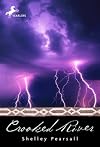
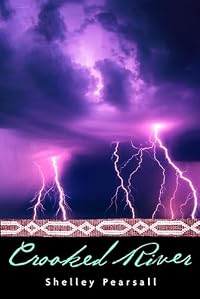
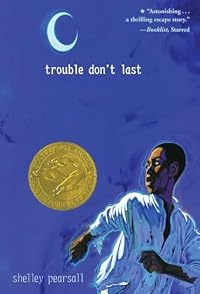
Crooked River was a hardback remainder with a beautiful cover. Purple clouds (I like purple) loom in a black-lit sky and jagged lightning stabs at a woven earth-toned patterned thread. That’s why I picked it up. The back blurb lists the awards received for Shelley Pearsall’s previous book, Trouble Don’t Last, convincing me she must be a good writer who tells show more a good tale. And the inside flap reveals the voice of Indian John in prose poetry, coupled with this introduction, “The year is 1812. A white trapper is murdered. And a young Chippewa Indian stands accused.” I was hooked.
The story is told in two voices, that of Indian John with flowing words likes streams of living meaning, and that of Rebecca Carver, a thirteen-year-old slowly learning just how wrong the world can be. Her halting steps, from obedient acceptance of everything she’s told, to human concern and thankfulness and thought, are beautifully told. Her words reflect the language of the time—the author says she mined old documents and diaries for authentic turns of phrase. The passages grow to reveal the mind of a genuine girl with a thirteen-year-old’s passion for truth and joy under the burden of a settler’s needs.
I learned how justice was conducted on the frontier, how judges travelled from town to town, how decisions were made and lives ended with the aid of a jury of somebody’s peers. I learned of human frailty, of good people believing falsehood and closing their ears to truth, and also of hope. I longed for the right ending to the book, though I couldn’t see how it would come. And then I read an ending that was righter than right and delighted me.
I hope I might read Trouble Don’t Last one day. But for now, Crooked River was a wonderful introduction to an author whose research astounds and convinces, and whose writing voices inspire. show less
Crooked River was a hardback remainder with a beautiful cover. Purple clouds (I like purple) loom in a black-lit sky and jagged lightning stabs at a woven earth-toned patterned thread. That’s why I picked it up. The back blurb lists the awards received for Shelley Pearsall’s previous book, Trouble Don’t Last, convincing me she must be a good writer who tells show more a good tale. And the inside flap reveals the voice of Indian John in prose poetry, coupled with this introduction, “The year is 1812. A white trapper is murdered. And a young Chippewa Indian stands accused.” I was hooked.
The story is told in two voices, that of Indian John with flowing words likes streams of living meaning, and that of Rebecca Carver, a thirteen-year-old slowly learning just how wrong the world can be. Her halting steps, from obedient acceptance of everything she’s told, to human concern and thankfulness and thought, are beautifully told. Her words reflect the language of the time—the author says she mined old documents and diaries for authentic turns of phrase. The passages grow to reveal the mind of a genuine girl with a thirteen-year-old’s passion for truth and joy under the burden of a settler’s needs.
I learned how justice was conducted on the frontier, how judges travelled from town to town, how decisions were made and lives ended with the aid of a jury of somebody’s peers. I learned of human frailty, of good people believing falsehood and closing their ears to truth, and also of hope. I longed for the right ending to the book, though I couldn’t see how it would come. And then I read an ending that was righter than right and delighted me.
I hope I might read Trouble Don’t Last one day. But for now, Crooked River was a wonderful introduction to an author whose research astounds and convinces, and whose writing voices inspire. show less
Life on the Ohio frontier is rough. Rebecca Carver and her sister have to run the household for their controlling Pa. After a trapper is found dead near Crooked River, Pa and some men round up some of the Chippewa Indian's who are accused of the murder. After killing one of the men, Indian John is brought in shackles to the Carver house and held in the attic until the trial. Indian John doesn't have much chance of a fair trial judging by the attitudes and treatment he gets. But Rebecca connects with the man and shows him some kindnesses.
Told through Rebecca and Amik's eyes, issues of discrimination and freedom are explored.
Told through Rebecca and Amik's eyes, issues of discrimination and freedom are explored.
Shelley Pearsall writes good historical fiction for children. Her main character's voice is true, and this story provokes thought about prejudice and standing up for truth and justice.
Crooked River is a very enjoyable, and thought provoking book to read. It is a historical fiction/ mystery novel that is best suited for 5th grade readers due to its mature contexts and reading level. The big message of the story is that despite color, ethnicity, age, gender, etc.—people are people. On reason that I enjoyed this book was because it is written from multiple perspectives. One side of the book is written from the perspective Indian John, the Indian trapped in the attic, and the other side is written from the perspective of Rebecca, a settler’s daughter who must live with the Indian in her attic. Because of this, readers are given the opportunity to make judgments themselves. Another reason I like this book is because show more of the social injustices that it brings to light beyond that of white v brown. The characters, Pa and his daughters, Rebecca and Laura. The characters ae often seen bickering while Pa talks down to the girls and disrespects their opinions and thoughts. This is evidence of social injustices carrying beyond the main focus of the story. show less
I liked this book. The young lady in the story learned to judge and trust on her own intuition. It took great courage to go against her father and his beliefs, but she did. The book is based on the true life trial of Native American, John O'Mic, in Cleveland, Ohio.
Rebecca is appalled when her Pa brings home an Indian and locks him up in the attic. She's terrified of Indians in general and her Pa says that this Indian is a murderer. But when she screws up her courage to bring the Indian some food, she begins to realize that maybe he's not as terrifying as she thought. Then a young lawyer comes to their cabin claiming to be friends with the Indian. He's going to defend "Indian John" at his trial. Rebecca knows that there is no chance Indian John will be found innocent, but maybe, just maybe, something spectacular will happen that could save his life.
I found it a little hard to get into this book because the action starts pretty much right away and you don't get a lot of background about the show more characters. Short chapters narrated by Rebecca alternate with poems that show "Indian John" (Amik)'s point of view. As the novel went on, I found myself rooting for the characters and Pearsall includes a fabulous author's note and selected bibliography. show less
I found it a little hard to get into this book because the action starts pretty much right away and you don't get a lot of background about the show more characters. Short chapters narrated by Rebecca alternate with poems that show "Indian John" (Amik)'s point of view. As the novel went on, I found myself rooting for the characters and Pearsall includes a fabulous author's note and selected bibliography. show less
A captivating tale of fear, ignorance, and bravery on the Ohio frontier in 1812. A white trapper is murdered and a young Chippewa Indian stands accused. Thirteen-year-old Rebecca must decide what and who is right, since a man's life hangs in the balance. This is based upon a true story. At the end of the book, there are several reader's theater scenes adapted from the book's chapters that can be used for programming.
Members
- Recently Added By
Lists

Best middle grade books
130 works; 24 members
Author Information

9 Works 2,631 Members
Awards and Honors
Awards
Notable Lists
Common Knowledge
- People/Characters
- Rebecca Carver; Peter Kelley
- Important places
- Ohio, USA
Classifications
- Genres
- Fiction and Literature, Kids, Children's Books
- DDC/MDS
- 813.54 — Literature & rhetoric American literature in English American fiction in English 1900-1999 1945-1999
- LCC
- PZ7 .P3166 .C — Language and Literature Fiction and juvenile belles lettres Fiction and juvenile belles lettres Juvenile belles lettres
- BISAC
Statistics
- Members
- 198
- Popularity
- 164,753
- Reviews
- 14
- Rating
- (3.39)
- Languages
- English
- Media
- Paper, Audiobook, Ebook
- ISBNs
- 8
- ASINs
- 1