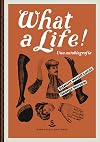
What a Life!
by E. V. Lucas, George Morrow (Author)
On This Page
Tags
Recommendations


















Member Reviews
I can't imagine why this book is so very little known when lesser books are famous and considered British comic classics. I learned of it only because a few pages were reproduced in the catalogue for an exhibition devoted to Bataille's journal 'Documents'; Queneau, I then found, had written an essay about it, and I've the impression that it's received more attention from French thinkers than from the British public. If you pride yourself upon being a John Bull type who considers 'French intellectual' a contemptuous term, stick that in your pipe and smoke it. (Mine's a Gauloise, thanks.)
Lucas and Morrow used images from a department-store catalogue to illustrate a cod autobiography. Whilst the book could be read in a few minutes it wants show more much longer than that to be looked at because, while there's a certain charm and some humour in the words, the appeal of the book lies largely in the illustrations in juxtaposition with the text. The catalogue pictures are used without regard to scale or style: On one page might be a line drawing of an archery target and at the top of the next a fashion plate next to a densely cross-hatched piece of furniture. Flat-irons are used to illustrate swans, a brooch stands in for a bird in flight, and one of the body parts strewn about by a train wreck is a box shaped like a heart. Rum bottles rest on a table that could never support their weight and figures who, given the relative scale, would be giants or midgets pop up often. The story itself seems to be inspired by the pictures, not vice versa--after all, who could resist mentioning a horse with a swollen neck simply in order to point out a strikingly inept drawing of a horse with what seems to be the grandaddy of all goitres?
Off-hand, I can't think of another British book whose overall feel is as surrealistic as this one's. A little treasure. show less
Lucas and Morrow used images from a department-store catalogue to illustrate a cod autobiography. Whilst the book could be read in a few minutes it wants show more much longer than that to be looked at because, while there's a certain charm and some humour in the words, the appeal of the book lies largely in the illustrations in juxtaposition with the text. The catalogue pictures are used without regard to scale or style: On one page might be a line drawing of an archery target and at the top of the next a fashion plate next to a densely cross-hatched piece of furniture. Flat-irons are used to illustrate swans, a brooch stands in for a bird in flight, and one of the body parts strewn about by a train wreck is a box shaped like a heart. Rum bottles rest on a table that could never support their weight and figures who, given the relative scale, would be giants or midgets pop up often. The story itself seems to be inspired by the pictures, not vice versa--after all, who could resist mentioning a horse with a swollen neck simply in order to point out a strikingly inept drawing of a horse with what seems to be the grandaddy of all goitres?
Off-hand, I can't think of another British book whose overall feel is as surrealistic as this one's. A little treasure. show less
The preface sets the tone for this illustrated surreal story: "As adventures are to the adventurous, so is romance to the romantic. One man searching the pages of Whitely's General Catalogue will find only facts and prices; another will find what we think we have found - a deeply moving human drama."
Originally published in 1911, E.V. Lucas & George Morrow took a catalogue and, using images cut out from it, assembled this humorous 'autobiography' of a Victorian gentleman. I cannot imagine that Monty Python, and in particular Terry Gilliam's similar cut-out imagery, are not influenced by this slim, quirky work.
The narrative includes not only the collage of catalogue images, but a story rich with comically posh named characters, boyhood show more life and chums, youthful infatuations, marriage, even a chapter with a country estate crime (while staying with Lord Bunderbourne at Jacobean mansion Closure Castle, there is a jewel heist).
Purchased on a whim based on a mention in a footnote of Floating Worlds: The Letters of Edward Gorey and Peter F. Neumeyer, this was a fantastic revelation - funny, odd, charming, clever. A pre-cursor not only to Monty Python, I can see why Neumeyer recommended this to Edward Gorey (and why he was surprised Gorey didn't already know it). If you like this type of humor, this is a must-have for your library. show less
Originally published in 1911, E.V. Lucas & George Morrow took a catalogue and, using images cut out from it, assembled this humorous 'autobiography' of a Victorian gentleman. I cannot imagine that Monty Python, and in particular Terry Gilliam's similar cut-out imagery, are not influenced by this slim, quirky work.
The narrative includes not only the collage of catalogue images, but a story rich with comically posh named characters, boyhood show more life and chums, youthful infatuations, marriage, even a chapter with a country estate crime (while staying with Lord Bunderbourne at Jacobean mansion Closure Castle, there is a jewel heist).
Purchased on a whim based on a mention in a footnote of Floating Worlds: The Letters of Edward Gorey and Peter F. Neumeyer, this was a fantastic revelation - funny, odd, charming, clever. A pre-cursor not only to Monty Python, I can see why Neumeyer recommended this to Edward Gorey (and why he was surprised Gorey didn't already know it). If you like this type of humor, this is a must-have for your library. show less
A humorous British novel based on illustrations from a department store catalog.
The authors weave a surrealistic and lightly satirical narrative around the catalog engravings, sketching the autobiography of an upper-class British gentleman. The story covers various episodes in the narrator's life, including his childhood, his involvement in a criminal investigation, his romantic affairs, world travels, marriage and home life. Much of the humor is derived from the interplay between image and text, as illustrations are used out of their original context or juxtaposed in surreal ways.
The use of collage to create a surrealistic narrative was rather original in 1911 when this book was created, but the book's novelty has been considerably show more diminished by the passage of time, as these techniques have been extensively explored by subsequent artists and writers. However, the book does retain a certain whimsical charm.
All in all, a mildly amusing historical curiosity for lovers of surreal British humor. show less
The authors weave a surrealistic and lightly satirical narrative around the catalog engravings, sketching the autobiography of an upper-class British gentleman. The story covers various episodes in the narrator's life, including his childhood, his involvement in a criminal investigation, his romantic affairs, world travels, marriage and home life. Much of the humor is derived from the interplay between image and text, as illustrations are used out of their original context or juxtaposed in surreal ways.
The use of collage to create a surrealistic narrative was rather original in 1911 when this book was created, but the book's novelty has been considerably show more diminished by the passage of time, as these techniques have been extensively explored by subsequent artists and writers. However, the book does retain a certain whimsical charm.
All in all, a mildly amusing historical curiosity for lovers of surreal British humor. show less
Ratings
Members
- Recently Added By
Lists

Michael Dirda's 100 Best Comic Novels
100 works; 1 member
Author Information

150+ Works 819 Members
All Editions
Common Knowledge
- Original publication date
- 1911
- First words
- I was born very near the end of the year.
- Last words
- (Click to show. Warning: May contain spoilers.)...and I therefore take my leave of my patient and too indulgent readers as Baron Dropmore, of Corfe.
Classifications
Statistics
- Members
- 51
- Popularity
- 595,017
- Reviews
- 3
- Rating
- (3.88)
- Languages
- English, Spanish
- Media
- Paper
- ISBNs
- 3