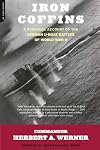
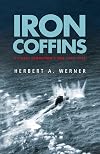
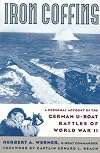
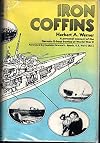
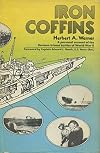
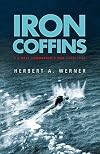
Iron Coffins
by Herbert A. Werner
On This Page
Description
Because I was one of the few U-boat commanders who fought through most of the war and who managed to survive, I felt it was my duty to my fallen comrades to set the record straight. Very much to the point, duty was the first and last word in the lexicon of the U-boat men; and, remarks to the contrary notwithstanding, we did our duty with a correct gallantry unsurpassed in any branch of service on either side. We were soldiers and patriots, no more and no less, and in our dedication to our show more lost cause we died in appalling numbers. But the great tragedy of the U-boat Force was not merely that so many good men perished; it was also that so many of our lives were squandered on inadequate equipment and by the unconscionable policies of U-boat Headquarters. - p. [xiii]. show lessTags
Recommendations






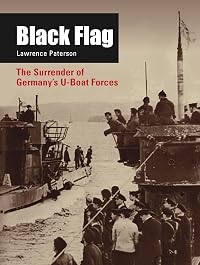
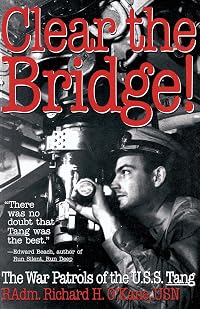

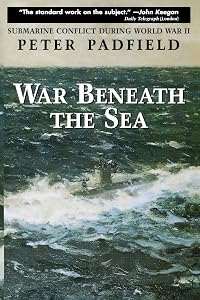






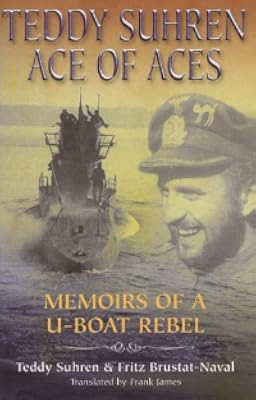















Member Recommendations
Member Reviews
Hard on the heels of Admiral Doenitz, we have Iron Coffins, by Oberleutnant zur See Herbert Werner. Although Werner captained two U-boats near the end of the war, most of his career was spent as First Watch Officer on other U-boats.
No translator is credited – I assume Werner wrote in English. There are only so many ways to describe being depth charged while jammed in a steel cylinder with a bunch of equally scared young men and Werner has to do a lot of that. He must have kept his own log book – although the book was written in 1969, Werner has details about radio signals sent and received, the number of depth charges dropped, and so on – or maybe he made it up.
What interested me more than the combat stories was actually show more Werner’s shore life. He is unabashed about having “a girl in every port”; a more-or-less steady girlfriend in Berlin, plus chance encounters in Brest and Paris and Bergen, plus sailor’s brothels. I suppose that’s more or less natural under the circumstances. His infrequent home leaves are traumatic; each time Germany is more damaged and more shabby and further on the way to Götterdämmerung.
He’s also unabashed about being a patriotic German. He was never a Nazi but grieved at the death of Hitler. He has reason to be not very fond of the Allies – his entire family and his steady girlfriend were killed in air raids and he was thrown into a French POW camp after the war – but doesn’t show it much.
What I’d like to see in one of these German WWII memoirs is an account of how everybody fell for Hitler in the first place. There are some generalities of the form “He gave hope to a defeated Germany” but I don’t know of anybody who describes just what it was like to be – for example – 16 years old in 1933. What was so great about the supposedly spellbinding oratory? What did it feel like to take part in a Nuremberg rally? The closest thing I have, oddly enough, is Mom’s continuing hero worship of FDR – nothing she can really put her finger on but a sense that this was a great man who was going to accomplish great things.
I’ll have to reread Das Boot for comparison. show less
No translator is credited – I assume Werner wrote in English. There are only so many ways to describe being depth charged while jammed in a steel cylinder with a bunch of equally scared young men and Werner has to do a lot of that. He must have kept his own log book – although the book was written in 1969, Werner has details about radio signals sent and received, the number of depth charges dropped, and so on – or maybe he made it up.
What interested me more than the combat stories was actually show more Werner’s shore life. He is unabashed about having “a girl in every port”; a more-or-less steady girlfriend in Berlin, plus chance encounters in Brest and Paris and Bergen, plus sailor’s brothels. I suppose that’s more or less natural under the circumstances. His infrequent home leaves are traumatic; each time Germany is more damaged and more shabby and further on the way to Götterdämmerung.
He’s also unabashed about being a patriotic German. He was never a Nazi but grieved at the death of Hitler. He has reason to be not very fond of the Allies – his entire family and his steady girlfriend were killed in air raids and he was thrown into a French POW camp after the war – but doesn’t show it much.
What I’d like to see in one of these German WWII memoirs is an account of how everybody fell for Hitler in the first place. There are some generalities of the form “He gave hope to a defeated Germany” but I don’t know of anybody who describes just what it was like to be – for example – 16 years old in 1933. What was so great about the supposedly spellbinding oratory? What did it feel like to take part in a Nuremberg rally? The closest thing I have, oddly enough, is Mom’s continuing hero worship of FDR – nothing she can really put her finger on but a sense that this was a great man who was going to accomplish great things.
I’ll have to reread Das Boot for comparison. show less
Some incredible stories here. Sometimes fiction movies cram years of incidents into the course of perhaps a single day. This book gave me that same feeling—but it is true! How could one person survive all of this? The author's resolute claims of being apolitical, as he fights for the Nazis, strike me as suspicious, and perhaps I should be equally suspicious of the rest of the book. But it feels real, generally. The book loses some momentum in the second half.
Als je enige interesse hebt in de u-boten dan is dit zeker een goed boek. Het is een soort van dagboek geschreven door een kapitein van verschillende u-boten dat zeer persoonlijk is en gaat onder meer ook over de liefjes die hij had, zijn gedachten, het leed dat hij zag,... en is niet zozeer toegespitst op de details van de oorlosvoering ter zee zelf. Tussendoor kunnen we wel het verloop van de oorlog volgen maar dit boek is er geen van cijfers en data. Als je dit boek leest lijk je in de film 'Das Boot' te zitten inclusief de spanning. Kortom een aanrader om te lezen.
One of my faves. Authentic, first hand, chock full of useful catch phrases to bandy about the house, such as, "Get those eels out of those tubes!" As with most German memoirs, it is exceedingly well written.
Interestingly, this Uboat captain, an ace, ended his career being depth charged to the surface by an American destroyer. Half a lifetime later, he's selling his sailboat I think in Florida, and the man who comes to buy it turns out to be the officer from the destroyer that captured him. How small is this world? I am badly paraphrasing this but you can find this episode related in Stud Terkel's "The Good War".
The uboat itself is on display in Chicago.
Interestingly, this Uboat captain, an ace, ended his career being depth charged to the surface by an American destroyer. Half a lifetime later, he's selling his sailboat I think in Florida, and the man who comes to buy it turns out to be the officer from the destroyer that captured him. How small is this world? I am badly paraphrasing this but you can find this episode related in Stud Terkel's "The Good War".
The uboat itself is on display in Chicago.
One of the first U-boat books I purchased. Werner writes about his experiences in subs during WWII. While few books write about war personal experiences without personal opinions, Werner tells about how he came up in the officer ranks to command a U-boat. Little by little with each cruise and assignment, he starts to realize the Third Reich is not the cure-all. By the end of the book (and end of the war), he is pretty much disillusioned with warfare. Very interesting perspective of submarine warfare from a "user's" standpoint. If someone thinks they would like to start reading about U-boats, this is an excellent starter book.
Simply brilliant.
If you think Bomber Command had it tough, the author's accounts of his U-Boat crews trying to survive after May 43 will make you pause.
Required reading for anyone with an interest in WWII, courage or leadership.
If you think Bomber Command had it tough, the author's accounts of his U-Boat crews trying to survive after May 43 will make you pause.
Required reading for anyone with an interest in WWII, courage or leadership.
Absolutely phenomenal, amazingly written and such a page turning story. Truly one of the best memoirs I have ever read. A no holds barred look at the U-Boat war from the happy times to the last desperate gasps. Highly recommended.
Members
- Recently Added By
Author Information

3 Works 615 Members
Common Knowledge
- Canonical title
- Iron Coffins
- People/Characters
- Submarines
- Important places
- Atlantic Ocean; North Atlantic Ocean
- Important events
- World War II (1939 | 1945); Battle of the Atlantic (1939 | 1945)
Classifications
- Genres
- History, Nonfiction, General Nonfiction, Biography & Memoir
- DDC/MDS
- 940.542 — History & geography History of Europe History of Europe 1918- Military history of World War II Campaigns and battles by theatre
- LCC
- D780 .W45 — History of Europe, Asia, Africa and Oceania History (General) World War II (1939-1945)
- BISAC
Statistics
- Members
- 609
- Popularity
- 48,190
- Reviews
- 15
- Rating
- (4.06)
- Languages
- 6 — English, Finnish, French, German, Spanish, Swedish
- Media
- Paper
- ISBNs
- 13
- ASINs
- 16