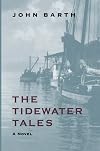
The Tidewater Tales
by John Barth
On This Page
Description
"Tell me a story!" Katherine Shorter Sherritt Sagamore orders her husband Peter Sagamore -- and so lets loose a flood of tales that floats them both past encounteres with their own lives and loves, entanglements with the CIA and toxic waste, and fantastically inventive brushes with some of the greatest characters of all time, including updated versions of Don Quixote, Odysseus, and Scheherazade.Tags
Recommendations















Member Reviews
Peter is a working class successful writer who has become blocked and so begs his well heeled wife (Katherine) who is 8 ½ months pregnant to set him a task. She does which is to tell stories as they sail around the Chesapeake Bay (a 200 mile long estuary on the Virginia and Maryland coastlines) in their boat called Story. During of which we discover how they fell in love in the 60’s but not met up until the 70’s and why they are having babies now as they hit 40. But this is only one of three other love stories in the novel. One is the love of landscape and the other is of sailing. Both of which are powerfully evoked throughout the novel. Their love story, landscape and sailing are then effectively linked to their families. Hers show more being local old money who have shaped the land since before the USA was founded and his being boat builders who have shaped access to the water since coming over in the 19th century.
Katherine’s family are open, generous friendly and sophisticated so accept and support the whims of Peter and Katherine to sail around the Bay. Likewise Peter shy and intense and Katherine open and bright are deep friends and in love so we like the characters and join in the physicality evoked by the writing. However these are but three of several strands in the novel, two others are a political thriller and an eco-mystery. The first explores the CIA-KGB spy games as the SALT talks dirty tricks play out in the local area. The second looks at the environmental damage being done by illegal dumping. Both story lines are linked firmly with Katharine’s ex husband and her charming but wastrel brother but not as you expect.
But all this are themes for the real focus of the novel which is about the art and mystery of writing and story telling. So over the 14 days of sailing we move in and out of the stories of Don Quixote, Huckleberry Finn, 1001 nights of Arabian Tales, Odyssey as they shape and are shaped by the love story landscape and sailing. We meet the narrators as characters finishing their own stories and shaping the novel as we do as reader-characters. This means that the narrative moves through a whole range of formats (plays, short essays, monologues, puns, wordplay etc) and genres (love story, social comedy, thriller, family saga, etc) with us and the unborn babies as narrator commentators along with the characters who know they are in a story. And we know their fates outside the story itself.
Don’t expect a quick read as its 655 pages and small print but do expect an intellectual tour de force and a page turner for what is mediation on writing that races along driven by the reader’s identification with Peter’s writers block, and their immediate parenthood while the multi-layer story entertains and stretches. Clearly a banquet that lingers in the memory when many beans on toast novels have been long forgotten so highly recommended. show less
Katherine’s family are open, generous friendly and sophisticated so accept and support the whims of Peter and Katherine to sail around the Bay. Likewise Peter shy and intense and Katherine open and bright are deep friends and in love so we like the characters and join in the physicality evoked by the writing. However these are but three of several strands in the novel, two others are a political thriller and an eco-mystery. The first explores the CIA-KGB spy games as the SALT talks dirty tricks play out in the local area. The second looks at the environmental damage being done by illegal dumping. Both story lines are linked firmly with Katharine’s ex husband and her charming but wastrel brother but not as you expect.
But all this are themes for the real focus of the novel which is about the art and mystery of writing and story telling. So over the 14 days of sailing we move in and out of the stories of Don Quixote, Huckleberry Finn, 1001 nights of Arabian Tales, Odyssey as they shape and are shaped by the love story landscape and sailing. We meet the narrators as characters finishing their own stories and shaping the novel as we do as reader-characters. This means that the narrative moves through a whole range of formats (plays, short essays, monologues, puns, wordplay etc) and genres (love story, social comedy, thriller, family saga, etc) with us and the unborn babies as narrator commentators along with the characters who know they are in a story. And we know their fates outside the story itself.
Don’t expect a quick read as its 655 pages and small print but do expect an intellectual tour de force and a page turner for what is mediation on writing that races along driven by the reader’s identification with Peter’s writers block, and their immediate parenthood while the multi-layer story entertains and stretches. Clearly a banquet that lingers in the memory when many beans on toast novels have been long forgotten so highly recommended. show less
This book is both good and bad. Foul mouthed and coarse not for family reading, but wordsmithing that really hits the heights in places. At over six hundred pages it is a tad long, but worth it for the chestnuts in the writing, but not a classic that one will keep referring to.
Ratings
Members
- Recently Added By
Author Information

39+ Works 12,265 Members
John Barth taught for many years in the writing program at Johns Hopkins University, and he lives in Chestertown, Maryland. (Publisher Provided) John Simmons Barth was born on May 27, 1930 in Cambridge, Maryland. He is considered to be one of the American writers who introduced a U.S. audience to experimental fiction. Barth began as a conventional show more novelist, exploring existential themes of suicide in The Floating Opera (1956) and the complexity of love in The End of the Road (1958). By the end of the 1950s, however, he was exploring less realistic techniques to keep the reader from being pulled into the story, and thus to make larger points. Those techniques include parody, which Barth first used in The Sot-Weed Factor (1960), to mock the style of the eighteenth-century picaresque novel, and Giles Goat-Boy (1966), which depicts the world as a giant university. In Chimera (1972), for which he won the National Book Award, Barth applied his method to retell classical myths. His later works include Letters (1979), in which Barth himself appears as a character, and Sabbatical (1982), the story of a woman college professor and her novelist husband, both of whom address the reader and author. Barth's other novels include The Tidewater Tales (1987) and The Last Voyage of Somebody the Sailor (1991). For most of his career as a writer, he has also been a professor of English, teaching at Pennsylvania State University, the State University of New York at Buffalo, and The Johns Hopkins University. (Bowker Author Biography) show less
Awards and Honors
Notable Lists
Common Knowledge
- Canonical title
- The Tidewater Tales
- Original title
- The Tidewater Tales
- Original publication date
- 1987
- Important places
- Chesapeake Bay, Virginia, USA; Berlin Zoological Garden, Berlin, Germany; Chesapeake Bay, Maryland, USA
- Original language
- English
Classifications
Statistics
- Members
- 359
- Popularity
- 88,282
- Reviews
- 2
- Rating
- (3.91)
- Languages
- English
- Media
- Paper
- ISBNs
- 7
- ASINs
- 3