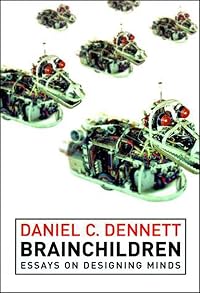
Brainchildren: Essays on Designing Minds
by Daniel C. Dennett
On This Page
Description
"Minds are complex artifacts, partly biological and partly social, and only a unified, multidisciplinary approach will yield a realistic theory of how minds came into existence and how they work. One of the foremost thinkers in this multidisciplinary field is Daniel Dennett. This book brings together his essays on philosophy of mind, artificial intelligence, and cognitive ethology that appeared in relatively inaccessible journals from 1984 to 1996"--Jacket.Tags
Recommendations












Member Reviews
Daniel Dennett is a "philosopher of mind" and has spent his career thinking deeply about human consciousness, artificial intelligence, and the question of just what this thing we call the mind is and how it works. This volume collects essays and articles of his that were originally published in various journals in the 1980s and 90s.
I picked up this book because I'd read some of Dennett's other work and found it very interesting (if sometimes a bit dense and slow going). I then let it sit unread on my shelves for the better part of two decades. Both of these things, I think, were mistakes.
Buying the book in the first place was a mistake not because it's bad -- it's not -- but because I really am not the intended audience for it. Some of show more these pieces are very accessible, but many or most of them were aimed primarily at his colleagues, so they tend to use a lot of specialized vocabulary and assume a lot of knowledge. I remembered enough from the previous Dennett books I'd read, and from a bit of other reading on these subjects, to muddle through, mostly, but some of it was frustratingly obscure to me. A lot of it also involved direct responses to the writings of others, and felt a little incomplete without the context in which they were published, or at least some familiarity with the work of the people he's referencing. (I did know a few of them -- such as Douglas Hofstadter and Thomas Nagel -- but only a few.) So, yeah, I'm definitely a bit too much of a layman to have gotten everything I should out of this, but I suspect that, for those who are more expert on these subjects, these snippets of decades-old academic conversations are likely to feel pretty dated. (Well, at least some of the artificial intelligence ones are, anyway. Although maybe not quite as much as one might expect.)
All of which isn't to say that I didn't get anything at all out of it. I quite enjoyed one or two of the more accessible articles, and even some of the ones I only half-understood were interesting, as far as I understood them. But I really should have stuck with his at least somewhat more popular-level books.
Rating: This is one of those things it's hard to know how to rate, as my experience of reading it and the author's competency at writing it are not at all the same thing. I guess I'll call it 3/5. show less
I picked up this book because I'd read some of Dennett's other work and found it very interesting (if sometimes a bit dense and slow going). I then let it sit unread on my shelves for the better part of two decades. Both of these things, I think, were mistakes.
Buying the book in the first place was a mistake not because it's bad -- it's not -- but because I really am not the intended audience for it. Some of show more these pieces are very accessible, but many or most of them were aimed primarily at his colleagues, so they tend to use a lot of specialized vocabulary and assume a lot of knowledge. I remembered enough from the previous Dennett books I'd read, and from a bit of other reading on these subjects, to muddle through, mostly, but some of it was frustratingly obscure to me. A lot of it also involved direct responses to the writings of others, and felt a little incomplete without the context in which they were published, or at least some familiarity with the work of the people he's referencing. (I did know a few of them -- such as Douglas Hofstadter and Thomas Nagel -- but only a few.) So, yeah, I'm definitely a bit too much of a layman to have gotten everything I should out of this, but I suspect that, for those who are more expert on these subjects, these snippets of decades-old academic conversations are likely to feel pretty dated. (Well, at least some of the artificial intelligence ones are, anyway. Although maybe not quite as much as one might expect.)
All of which isn't to say that I didn't get anything at all out of it. I quite enjoyed one or two of the more accessible articles, and even some of the ones I only half-understood were interesting, as far as I understood them. But I really should have stuck with his at least somewhat more popular-level books.
Rating: This is one of those things it's hard to know how to rate, as my experience of reading it and the author's competency at writing it are not at all the same thing. I guess I'll call it 3/5. show less
This was a real treat to read. A compilation of essays by Dennett about a good variety of topics, from neurosci to philosophy of language and everything in between.
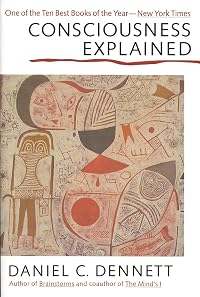
Be warned, it's a bit tough for the layman, so I'd recommend Consciousness Explained first. But if you can handle it, this book is a gem. Good science, good writing, and just good overall.
Be warned, it's a bit tough for the layman, so I'd recommend Consciousness Explained first. But if you can handle it, this book is a gem. Good science, good writing, and just good overall.
Ratings
Members
- Recently Added By
Author Information

43+ Works 17,431 Members
Daniel C. Dennett is a University Professor and Austin B. Fletcher Professor of Philosophy at Tufts University and the author of numerous books including Intuition Pumps and Other Tools for Thinking, Breaking the Spell, Darwin's Dangerous Idea, and Consciousness Explained.
Series
Belongs to Publisher Series
Common Knowledge
- Canonical title
- Brainchildren: Essays on Designing Minds
- Original publication date
- 1998
- Dedication
- For Harry and Betty Stanton
- First words
- Preface
The point of this collection is to bring together, for the convenience of students and other readers who
do not have ready access to a major university library, essays on the mind that I have published over ... (show all)the
last dozen years in a wide variety of relatively inaccessible publications.
1 Can Machines Think?
Much has been written about the Turing test in the last few years, some of it preposterously off the
mark. People typically mis-imagine the test by orders of magnitude. This essay is an antido... (show all)te, a prosthesis for the imagination, showing how huge the task posed by the Turing test is, and hence how unlikely it is that any computer will ever pass it. - Last words
- (Click to show. Warning: May contain spoilers.)The first, general result is appealing: we can already see that since any "system" for ethical decisionmaking
must be bounded arbitrarily by limitations that are far from content-neutral, no technological black-box oracle can give you a principled, objective, reliable answer to your ethical problems, no matter what anyone advertises. When the choice is between "flying by the seat of your own pants" on the one hand and paying to fly by the seat of somebody else's pants on the other, you are entitled to keep both the responsibility and the excitement to yourself. - Original language
- English
Classifications
Statistics
- Members
- 350
- Popularity
- 90,089
- Reviews
- 5
- Rating
- (3.83)
- Languages
- Dutch, English, Japanese
- Media
- Paper, Ebook
- ISBNs
- 5