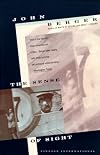
The Sense of Sight
by John Berger
On This Page
Description
With this provocative and infinitely moving collection of essays, a preeminent critic of our time responds to the profound questions posed by the visual world. For when Booker Prize-winning author John Berger writes about Cubism, he writes not only of Braque, Léger, Picasso, and Gris, but of that incredible moment early in this century when the world converged around a marvelous sense of promise. When he looks at the Modigliani, he sees a man's infinite love revealed in the elongated lines show more of the painted figure. Ranging from the Renaissance to the conflagration of Hiroshima; from the Bosphorus to Manhattan; from the woodcarvers of a French village to Goya, Dürer, and Van Gogh; and from private experiences of love and of loss, to the major political upheavals of our time, The Sense of Sight encourages us to see with the same breadth, courage, and moral engagement that its author does. show lessTags
Recommendations




























Member Reviews
To read Sense of Sight is to jump into a world of essays on various topics, each one taking you on a journey for the senses. You will discover Albrecht Durer is an interesting looking guy. Berger tells us he is the first painter to be obsessed with his own image. A ride on the Bosphorus can be somewhat romantic if you are patient and watchful. Manhattan, seen as a chaotic paradox and a land of severe contradictions, will astound you. [As an aside, while reading about Manhattan I was simultaneously reminded of Natalie Merchant's "Carnival" and Candace Bushnell's Sex and the City with their displays of weak and strong, poverty and wealth, intimacy and strangeness, darkness and light. One of my favorite quotes comes from Berger's essays on show more Manhattan, "Manhattan is haunted by the dead" (p 65). And to think the essay in question was written in the mid-1970s. What would Berger think of the dead after 9/11 attacks?]
But. I digress. Back to Sense of Sight. I wish Berger were standing before me. I would ask if it is true the body of the Duchess of Alba was exhumed and her skeleton compared to the Goya paintings (according to Google, it is very much true). Talk about the scrutiny of art! And speaking of Alba, Durer's conceit was on display in Sense of Sight whereas Maja dressed and indressed evokes a curiosity within us. Because Berger does not provide her image like he did for Durer, are we prompted or subliminally urged to look her up? If so, does that mean we have been artfully played into Berger's cunning trap of intrigue? He talks of Maja undressed and dressed in such great detail we might not need the investigation if we are to trust our imaginations. But we will want to all the same. In reading Sense of Sight the reader is treated to a mini biography of Claude Monet (did he really love the sea? why do I only think of ponds and lilies?), learn of a hotel that once serves as the interogation and death and torture headquarters during World War II, and come to the realization that poetry is anguish.
Sense of Sight made me think. I have always wondered when a painting is truly finished. What prompts an artist to put down the paint brush for the final time? And this - when a person is no longer with us, are they no longer real? If they become just a memory does what was once tangible become a figment of our imagination? show less
But. I digress. Back to Sense of Sight. I wish Berger were standing before me. I would ask if it is true the body of the Duchess of Alba was exhumed and her skeleton compared to the Goya paintings (according to Google, it is very much true). Talk about the scrutiny of art! And speaking of Alba, Durer's conceit was on display in Sense of Sight whereas Maja dressed and indressed evokes a curiosity within us. Because Berger does not provide her image like he did for Durer, are we prompted or subliminally urged to look her up? If so, does that mean we have been artfully played into Berger's cunning trap of intrigue? He talks of Maja undressed and dressed in such great detail we might not need the investigation if we are to trust our imaginations. But we will want to all the same. In reading Sense of Sight the reader is treated to a mini biography of Claude Monet (did he really love the sea? why do I only think of ponds and lilies?), learn of a hotel that once serves as the interogation and death and torture headquarters during World War II, and come to the realization that poetry is anguish.
Sense of Sight made me think. I have always wondered when a painting is truly finished. What prompts an artist to put down the paint brush for the final time? And this - when a person is no longer with us, are they no longer real? If they become just a memory does what was once tangible become a figment of our imagination? show less
Ratings
Members
- Recently Added By
Author Information

150+ Works 17,146 Members
John Peter Berger was born in London, England on November 5, 1926. After serving in the British Army from 1944 to 1946, he enrolled in the Chelsea School of Art. He began his career as a painter and exhibited work at a number of London galleries in the late 1940s. He then worked as an art critic for The New Statesman for a decade. He wrote fiction show more and nonfiction including several volumes of art criticism. His novels include A Painter of Our Time, From A to X, and G., which won both the James Tait Black Memorial Prize and the Booker Prize in 1972. His other works include an essay collection entitled Permanent Red, Into Their Labors, and a book and television series entitled Ways of Seeing. In the 1970s, he collaborated with the director Alain Tanner on three films. He wrote or co-wrote La Salamandre, The Middle of the World, and Jonah Who Will Be 25 in the Year 2000. He died on January 1, 2017 at the age of 90. (Bowker Author Biography) show less
Classifications
- Genres
- Nonfiction, Art & Design
- DDC/MDS
- 700 — Arts & recreation Arts Arts & Recreation
- LCC
- N7445.2 .B47 — Fine Arts Visual arts General works
- BISAC
Statistics
- Members
- 288
- Popularity
- 111,380
- Reviews
- 1
- Rating
- (4.05)
- Languages
- Chinese, English, German, Spanish
- Media
- Paper, Ebook
- ISBNs
- 7
- ASINs
- 3