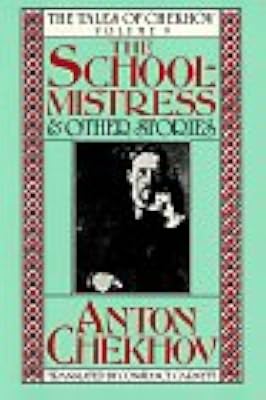
The Darling and other stories [Tales of Tchehov vol. I]
by Anton Chekhov
On This Page
Description
Olenka, the daughter of the retired collegiate assessor, Plemyanniakov, was sitting in her back porch, lost in thought. It was hot, the flies were persistent and teasing, and it was pleasant to reflect that it would soon be evening. Dark rainclouds were gathering from the east, and bringing from time to time a breath of moisture in the air. Kukin, who was the manager of an open-air theatre called the Tivoli, and who lived in the lodge, was standing in the middle of the garden looking at the sky.Tags
Recommendations




















Member Reviews
In a Nutshell: A collection of ten stories by Anton Chekhov. Might work better for the right reader. To me, this was more of an experimental pick and ended up an average read.
~~~~~~~~~~~~~~~~~~~~~~~~~~~~
I might have read a couple of Chekhov’s stories over the years in some or the other compilation, but I don't recollect any at present except 'Misery'. And I've never read any of his story collections. This seemed like a good time and book to begin exploring his writing.
It was not.
As this is a classic collection and many might know these stories, I’ll be brief. (Well, briefer than my usual reviews.)
➾ Ten stories, of which one is novella-length. I stopped reading the novella halfway as I was bored out of my head.
➾ This translation show more was first published in 1916. It seems like a good attempt, with the language being consistent across the set.
➾ Portrayal of women - Typical of the era and culture and male Russian authors. Sigh…
➾ Typical Russian writing tendency of calling one character by ten names! Longer sigh…
➾ Of the ten stories, I liked only one. The titular “The Darling” - From the ironic title to the vacuous yet endearing lead character to the intelligent juxtaposition of tragedy and comedy to the cryptic yet clear ending, this story reads even better between the lines than at surface level. - ⭐⭐⭐⭐
➾ The stories are all in the public domain so you can download them from various sites. I read an EPUB downloaded from the globalgreyebooks site, which has an amazing collection of public domain works available for free downloads. I loved how well this free book was formatted, much better than some Project Gutenberg copies. I’ll check out some other classics from this site in future.
➾ Still interested in giving this a go? You can get a copy of this book here:
https://www.globalgreyebooks.com/darling-and-other-stories-ebook.html
2.5 stars, rounding down as even the good stories were somewhat misogynistic in their depiction of women.
~~~~~~~~~~~~~~~~~~~~~~~~~~~~
Connect with me through:
My Blog || The StoryGraph || Instagram || X/Twitter || Facebook || show less
~~~~~~~~~~~~~~~~~~~~~~~~~~~~
I might have read a couple of Chekhov’s stories over the years in some or the other compilation, but I don't recollect any at present except 'Misery'. And I've never read any of his story collections. This seemed like a good time and book to begin exploring his writing.
It was not.
As this is a classic collection and many might know these stories, I’ll be brief. (Well, briefer than my usual reviews.)
➾ Ten stories, of which one is novella-length. I stopped reading the novella halfway as I was bored out of my head.
➾ This translation show more was first published in 1916. It seems like a good attempt, with the language being consistent across the set.
➾ Portrayal of women - Typical of the era and culture and male Russian authors. Sigh…
➾ Typical Russian writing tendency of calling one character by ten names! Longer sigh…
➾ Of the ten stories, I liked only one. The titular “The Darling” - From the ironic title to the vacuous yet endearing lead character to the intelligent juxtaposition of tragedy and comedy to the cryptic yet clear ending, this story reads even better between the lines than at surface level. - ⭐⭐⭐⭐
➾ The stories are all in the public domain so you can download them from various sites. I read an EPUB downloaded from the globalgreyebooks site, which has an amazing collection of public domain works available for free downloads. I loved how well this free book was formatted, much better than some Project Gutenberg copies. I’ll check out some other classics from this site in future.
➾ Still interested in giving this a go? You can get a copy of this book here:
https://www.globalgreyebooks.com/darling-and-other-stories-ebook.html
2.5 stars, rounding down as even the good stories were somewhat misogynistic in their depiction of women.
~~~~~~~~~~~~~~~~~~~~~~~~~~~~
Connect with me through:
My Blog || The StoryGraph || Instagram || X/Twitter || Facebook || show less
This was the first of a series of 13 volumes of Chekhov's tales. Many of them seemed to address the rise of woman during that time and the difficulty men still had in his interactions with them but Chekhov also addresses frivolous men who spend every last rouble and of men who philander and leave their dying wives to suffer alone. His sense of characters range from the redeemable to the nearly absurd. There is the painter who only paints landscapes and thinks we should all should merely work a couple of hours a day and the woman who marries a much older man for his money and spends the next ten years miserable. There is the story which the novel starts out with, The Darling (followed by a criticism of this story by Tolstoy) in which a show more woman takes on the distinct passions of every man she marries as vehemently as if they were always her own and seeming to possess truly none of her own. Chekhov seems to hypothesizing about women and the future in a few of these and, though there is sometimes a sense of ridicule, one also gets the impression that he sees the value in women too.
In any case, the definitive delivery of these stories is a sense of the people living in Russia in the late 1800s and we see all walks of life from the successful business man's son to the artist. Most of the people are living above the poverty line but the backgrounds are still quite diverse to be interesting.
Those expecting stories reminiscent of a dark and dreary Dostoevsky will be surprised. Chekhov's tales vary from the slice of life variety to the profound but they often have a sense of wit and intellectual mirth that makes them brighter stories. One can imagine Chekhov smiling in real life whereas one can only picture Dostoevsky gnashing his teeth. The stories are also very easy to read and understand, with the only major difficulty still being so many similar names and very different sounding nicknames attached to full formal names which make it slightly more challenging at times to follow the characters.
It's difficult to top the introduction from Richard Ford and how he explains Chekhov's writing. Here's a couple of quotes I liked from that:
"Indeed, one regularly finds humor in Chekhov, often in surprising though never really mistakable moments. As in Shakespeare as in Falkner as in Flannery O'Connor, the comic turn not only counterweighs and intensifies a serious story's gravity, it also humanizes our own fated intimacy with what's grave by permitting life's fullest, most actual context to be brought into view, even as it points us toward an approved method of acceptance: laughter."
"The entirety of Chekhov's stories, in fact, often seem-but for their formal, sturdy existence in language-not even artful (although that would be wrong) but rather to be assiduous in mapping out degree by precious degree an accurate ground level constellation of ordinary existence-each story representing a subtly distinguished movement in a single sustained gesture of life confirmed."
"With Chekhov, we share the frankness of life's inalienable thereness; we share the conviction of how much we would profit if more of human sensation cold be elevated into clear, expressive language; we share a view that life (particularly life with others) is a surface beneath which we must strive to construct a convincing subtext in order that more can be clung to less desperately..." show less
In any case, the definitive delivery of these stories is a sense of the people living in Russia in the late 1800s and we see all walks of life from the successful business man's son to the artist. Most of the people are living above the poverty line but the backgrounds are still quite diverse to be interesting.
Those expecting stories reminiscent of a dark and dreary Dostoevsky will be surprised. Chekhov's tales vary from the slice of life variety to the profound but they often have a sense of wit and intellectual mirth that makes them brighter stories. One can imagine Chekhov smiling in real life whereas one can only picture Dostoevsky gnashing his teeth. The stories are also very easy to read and understand, with the only major difficulty still being so many similar names and very different sounding nicknames attached to full formal names which make it slightly more challenging at times to follow the characters.
It's difficult to top the introduction from Richard Ford and how he explains Chekhov's writing. Here's a couple of quotes I liked from that:
"Indeed, one regularly finds humor in Chekhov, often in surprising though never really mistakable moments. As in Shakespeare as in Falkner as in Flannery O'Connor, the comic turn not only counterweighs and intensifies a serious story's gravity, it also humanizes our own fated intimacy with what's grave by permitting life's fullest, most actual context to be brought into view, even as it points us toward an approved method of acceptance: laughter."
"The entirety of Chekhov's stories, in fact, often seem-but for their formal, sturdy existence in language-not even artful (although that would be wrong) but rather to be assiduous in mapping out degree by precious degree an accurate ground level constellation of ordinary existence-each story representing a subtly distinguished movement in a single sustained gesture of life confirmed."
"With Chekhov, we share the frankness of life's inalienable thereness; we share the conviction of how much we would profit if more of human sensation cold be elevated into clear, expressive language; we share a view that life (particularly life with others) is a surface beneath which we must strive to construct a convincing subtext in order that more can be clung to less desperately..." show less
In a Nutshell: A collection of ten stories by Anton Chekhov. Might work better for the right reader. To me, this was more of an experimental pick and ended up an average read.
~~~~~~~~~~~~~~~~~~~~~~~~~~~~
I might have read a couple of Chekhov’s stories over the years in some or the other compilation, but I don't recollect any at present except 'Misery'. And I've never read any of his story collections. This seemed like a good time and book to begin exploring his writing.
It was not.
As this is a classic collection and many might know these stories, I’ll be brief. (Well, briefer than my usual reviews.)
➾ Ten stories, of which one is novella-length. I stopped reading the novella halfway as I was bored out of my head.
➾ This translation show more was first published in 1916. It seems like a good attempt, with the language being consistent across the set.
➾ Portrayal of women - Typical of the era and culture and male Russian authors. Sigh…
➾ Typical Russian writing tendency of calling one character by ten names! Longer sigh…
➾ Of the ten stories, I liked only one. The titular “The Darling” - From the ironic title to the vacuous yet endearing lead character to the intelligent juxtaposition of tragedy and comedy to the cryptic yet clear ending, this story reads even better between the lines than at surface level. - ⭐⭐⭐⭐
➾ The stories are all in the public domain so you can download them from various sites. I read an EPUB downloaded from the globalgreyebooks site, which has an amazing collection of public domain works available for free downloads. I loved how well this free book was formatted, much better than some Project Gutenberg copies. I’ll check out some other classics from this site in future.
➾ Still interested in giving this a go? You can get a copy of this book here:
https://www.globalgreyebooks.com/darling-and-other-stories-ebook.html
2.5 stars, rounding down as even the good stories were somewhat misogynistic in their depiction of women.
~~~~~~~~~~~~~~~~~~~~~~~~~~~~
Connect with me through:
My Blog || The StoryGraph || Instagram || X/Twitter || Facebook || show less
~~~~~~~~~~~~~~~~~~~~~~~~~~~~
I might have read a couple of Chekhov’s stories over the years in some or the other compilation, but I don't recollect any at present except 'Misery'. And I've never read any of his story collections. This seemed like a good time and book to begin exploring his writing.
It was not.
As this is a classic collection and many might know these stories, I’ll be brief. (Well, briefer than my usual reviews.)
➾ Ten stories, of which one is novella-length. I stopped reading the novella halfway as I was bored out of my head.
➾ This translation show more was first published in 1916. It seems like a good attempt, with the language being consistent across the set.
➾ Portrayal of women - Typical of the era and culture and male Russian authors. Sigh…
➾ Typical Russian writing tendency of calling one character by ten names! Longer sigh…
➾ Of the ten stories, I liked only one. The titular “The Darling” - From the ironic title to the vacuous yet endearing lead character to the intelligent juxtaposition of tragedy and comedy to the cryptic yet clear ending, this story reads even better between the lines than at surface level. - ⭐⭐⭐⭐
➾ The stories are all in the public domain so you can download them from various sites. I read an EPUB downloaded from the globalgreyebooks site, which has an amazing collection of public domain works available for free downloads. I loved how well this free book was formatted, much better than some Project Gutenberg copies. I’ll check out some other classics from this site in future.
➾ Still interested in giving this a go? You can get a copy of this book here:
https://www.globalgreyebooks.com/darling-and-other-stories-ebook.html
2.5 stars, rounding down as even the good stories were somewhat misogynistic in their depiction of women.
~~~~~~~~~~~~~~~~~~~~~~~~~~~~
Connect with me through:
My Blog || The StoryGraph || Instagram || X/Twitter || Facebook || show less
To these wonderful stories I come back again and again. (IV-11)
Ratings
Members
- Recently Added By
Author Information

2,642+ Works 44,747 Members
Anton Pavlovich Chekhov was born in the provincial town of Taganrog, Ukraine, in 1860. In the mid-1880s, Chekhov became a physician, and shortly thereafter he began to write short stories. Chekhov started writing plays a few years later, mainly short comic sketches he called vaudvilles. The first collection of his humorous writings, Motley show more Stories, appeared in 1886, and his first play, Ivanov, was produced in Moscow the next year. In 1896, the Alexandrinsky Theater in St. Petersburg performed his first full- length drama, The Seagull. Some of Chekhov's most successful plays include The Cherry Orchard, Uncle Vanya, and Three Sisters. Chekhov brought believable but complex personalizations to his characters, while exploring the conflict between the landed gentry and the oppressed peasant classes. Chekhov voiced a need for serious, even revolutionary, action, and the social stresses he described prefigured the Communist Revolution in Russia by twenty years. He is considered one of Russia's greatest playwrights. Chekhov contracted tuberculosis in 1884, and was certain he would die an early death. In 1901, he married Olga Knipper, an actress who had played leading roles in several of his plays. Chekhov died in 1904, spending his final years in Yalta. (Bowker Author Biography) show less
All Editions
Series
Belongs to Publisher Series
Tales of Chekhov (01)
Work Relationships
Common Knowledge
- Canonical title
- The Darling and other stories [Tales of Tchehov vol. I]
Classifications
- Genres
- Fiction and Literature, General Fiction, Horror
- DDC/MDS
- 891.73 — Literature & rhetoric Asian Literature East Indo-European and Celtic literatures Russian and East Slavic languages Russian fiction
- LCC
- PG3456 .A15 .G3 — Language and Literature Slavic languages and literatures. Baltic languages. Albanian language Slavic. Baltic. Albanian Russian literature Individual authors and works 1870-1917 Chekhov
- BISAC
Statistics
- Members
- 116
- Popularity
- 279,793
- Reviews
- 4
- Rating
- (3.75)
- Languages
- English
- Media
- Paper, Ebook
- ISBNs
- 19
- ASINs
- 6