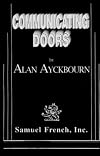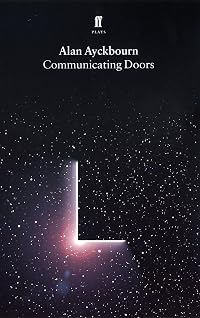
Communicating Doors
by Alan Ayckbourn
80 Members (3.30)
On This Page
Description
Set in a near dystopian future, a dominatrix flees for her life through a hotel communicating door only to find herself 20 years in the past as a result of which she is stalked by a psychopath in the present and the past. The opportunity to alter time for the better puts the lives of three women at stake. 'Communicating Doors' premiered in February 1994 at the Stephen Joseph Theatre in the Round, Scarborough.Tags
Recommendations























Member Reviews
Members
- Recently Added By
Author Information

140+ Works 2,324 Members
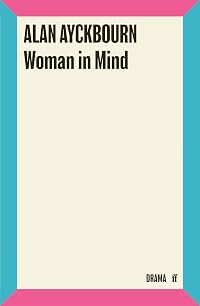
Many American tourists who flock to the annual Ayckbourn offering in London's West End, think of Alan Ayckbourn as Great Britain's Neil Simon. The analogy holds true to the extent that the relationship between Ayckbourn's and Simon's plays illustrates the difference between British and American theater and audiences. Both writers capture the show more social machinations of middle-class characters in daily situations that are made compelling simply by the addition of clever but conventional plots, dramatic intrigues, twists, and discoveries. However, where Simon's plays tend to evolve into a condition of broad pathos or comedy, luxuriating in bittersweet melodrama, Ayckbourn's offerings revel in ever increasing intricacy, sharply incisive verbal dueling, and a dark social resonance that sounds much greater depths than in Simon's drama. Ayckbourn's scripts embody boggling challenges for directors and actors as well as audiences. Intimate Exchanges (1985), for example, a sequence of plays for ten characters played by only two actors, involves numerous moments when an actor chooses to send the script off on one of two alternative directions. The Norman Conquests (1975) typifies Ayckbourn's determination to squeeze as much as possible out of a dramatic construct. The trilogy's first play, Table Manners, offers a typical Ayckbourn scenario with family traumas played against each other in the constrained setting of a dining room. In the second and third plays, Living Together and Round and Round the Garden, the audience is exposed to simultaneous layers of action that occur in two other venues, the living room and garden, when characters are not onstage in the dining room. Each play makes sense on its own, but the trilogy taken as a whole embodies a vision of this family that is larger than the sum of the individual parts. Aychbourn has also been known for rather experimental staging. The Way Upstream (1982), for example, is set on and around a boat and requires flooding the stage. Ayckbourn's later plays reflect a bleak vision of society. In Woman in Mind (1985) and Henceforward (1987), Aychbourn's characters have become increasingly complex, and he reveals himself as an intense social commentator. Other recent plays include It Could Be Any One of Us (1983), Man of the Moment (1990), and Body Language (1991). Since the 1970s, Ayckbourn has written at least one play a season; the premieres are always at a small local theater that he runs in the resort town of Scarborough. 020 (Bowker Author Biography) Alan Ayckbourn is the author of more than fifty plays, many of which are available from Faber. He lives in England. (Bowker Author Biography) show less
Classifications
Statistics
- Members
- 80
- Popularity
- 398,265
- Rating
- (3.30)
- Languages
- English
- Media
- Paper, Ebook
- ISBNs
- 6
- ASINs
- 1