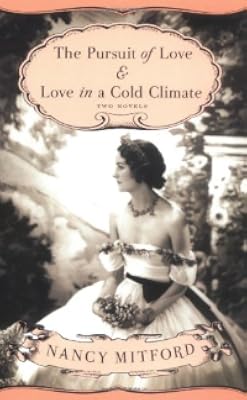
The Pursuit of Love and Love in a Cold Climate: Two Novels
by Nancy Mitford
Radlett and Montdore (Collections and Selections — 1-2)
On This Page
Description
The snobbery and false values of the English country nobility are satirized in these two love stories involving the well-established Radlett and Hampton families.Tags
Recommendations


























Member Recommendations


Member Reviews
Fate - and a bookswapping website - recently reminded me that I had yet to read Nancy Mitford's novels, despite working my way through her sisters' non-fiction titles, so I promptly traded one of my own books that I was unlikely to read again ... for another. I love Nancy Mitford's style and humour - that uniquely upper class combination of Jane Austen and P.G. Wodehouse - but found the actual stories, once past the familiar Mitford biographical details, dated and unbelievable. And not in a good way.
The Pursuit of Love is about the Radlett family, and in particular the beautiful Linda, modelled in part on Nancy herself and sister Diana (so claims Jessica Mitford in the foreword). The eccentric Radletts - wonderfully gruff Uncle show more Matthew, vague Aunt Sadie, and the children Louisa, Linda, Matt, Bob, Jassy, Vict, etc. - are described with indulgent amusement by narrator Fanny, their very sensible and ordinary cousin. The prewar years at the Radletts' country estate of Alconleigh are the funniest chapters, with the Hons meeting in the airing cupboard, and Uncle Matthew's 'child hunt' through the countryside. Uncle Matthew is one of my favourite characters, ever, with his 'damn sewers' and 'chubb fuddling'. He is a bad-tempered, unsociable, forthright old curmudgeon, but vastly entertaining all the same. I love his 'curse' on the people he hates:
'It was a favourite superstition of Uncle Matthew's that if you wrote somebody's name on a piece of paper and put it in a drawer, that person would die within a year.'
Linda, however, who soon takes over the story with her varied and always unsuitable love life, is a beautiful yet selfish and infuriating creature, the kind of woman who must always have a man in her life. She reels from bed to bed, marrying a boring banker, eloping with a communist, and shacking up with a French lothario who picks her up in the train station. I didn't find her eccentric or endearing, merely a cold-hearted cliche. Fanny the less than impartial narrator obviously loves her, but I found I couldn't care less.
And Polly Hampton, in Love in a Cold Climate, is Linda with a different name, who this time marries a disgusting old man to escape her overbearing mother. Boy Dougdale, played by Anthony Andrews in the screen adaptation of the novel, would never be allowed in modern fiction, being a Humbert Humbert type who grooms his own nieces. Then when Polly is cut out of her father's will, a distant relation from Canada, who makes Boy pale in comparison, arrives to claim her inheritance. Cedric Hampton is a raging homosexual, who arrives wearing a bright blue suit and blue goggles, charms Polly's poor father with his knowledge of antiques, flatters her vain mother, and generally takes over the whole story. I couldn't stand him either.
Nancy Mitford has a witty way with words, and a sharply observant eye for social and background details, but if her novels are exaggeratedly autobiographical throughout, like the anecdotes in the first chapters of Pursuit that I recognised from Jessica and Debo's books, then the inspiration behind Linda/Polly is slightly disturbing. Thankfully, Nancy must have thought the same, because both characters meet with a suitably fitting end. show less
The Pursuit of Love is about the Radlett family, and in particular the beautiful Linda, modelled in part on Nancy herself and sister Diana (so claims Jessica Mitford in the foreword). The eccentric Radletts - wonderfully gruff Uncle show more Matthew, vague Aunt Sadie, and the children Louisa, Linda, Matt, Bob, Jassy, Vict, etc. - are described with indulgent amusement by narrator Fanny, their very sensible and ordinary cousin. The prewar years at the Radletts' country estate of Alconleigh are the funniest chapters, with the Hons meeting in the airing cupboard, and Uncle Matthew's 'child hunt' through the countryside. Uncle Matthew is one of my favourite characters, ever, with his 'damn sewers' and 'chubb fuddling'. He is a bad-tempered, unsociable, forthright old curmudgeon, but vastly entertaining all the same. I love his 'curse' on the people he hates:
'It was a favourite superstition of Uncle Matthew's that if you wrote somebody's name on a piece of paper and put it in a drawer, that person would die within a year.'
Linda, however, who soon takes over the story with her varied and always unsuitable love life, is a beautiful yet selfish and infuriating creature, the kind of woman who must always have a man in her life. She reels from bed to bed, marrying a boring banker, eloping with a communist, and shacking up with a French lothario who picks her up in the train station. I didn't find her eccentric or endearing, merely a cold-hearted cliche. Fanny the less than impartial narrator obviously loves her, but I found I couldn't care less.
And Polly Hampton, in Love in a Cold Climate, is Linda with a different name, who this time marries a disgusting old man to escape her overbearing mother. Boy Dougdale, played by Anthony Andrews in the screen adaptation of the novel, would never be allowed in modern fiction, being a Humbert Humbert type who grooms his own nieces. Then when Polly is cut out of her father's will, a distant relation from Canada, who makes Boy pale in comparison, arrives to claim her inheritance. Cedric Hampton is a raging homosexual, who arrives wearing a bright blue suit and blue goggles, charms Polly's poor father with his knowledge of antiques, flatters her vain mother, and generally takes over the whole story. I couldn't stand him either.
Nancy Mitford has a witty way with words, and a sharply observant eye for social and background details, but if her novels are exaggeratedly autobiographical throughout, like the anecdotes in the first chapters of Pursuit that I recognised from Jessica and Debo's books, then the inspiration behind Linda/Polly is slightly disturbing. Thankfully, Nancy must have thought the same, because both characters meet with a suitably fitting end. show less
The six Mitford sisters were stylish young members of English high society during the 1920s & 30s. These two novellas provide an entertaining look at their world, as seen by their cousin, Fanny. Pursuit of Love is the most autobiographical of the two, as it centers on the Radletts, a large family of mostly daughters, who divide their time between London and a country house. The second-oldest daughter, Linda, is a contemporary of Fanny's, and they spend much of their childhood together. As Linda matures she finds herself "in pursuit of love," moving from one relationship to another ... in contrast to Fanny who rather easily finds love and forms a happy marriage.
Love in a Cold Climate tells of Fanny's other cousins, the much wealthier show more Montdores and their daughter, Polly. Polly came of age in India and returned to England to come out in society. She rejects the young men presented to her, and eventually her reasons become apparent, with painful consequences for the entire family.
Happily, these rather serious-sounding story lines are overshadowed by quirky, eccentric characters portrayed in a very humorous, over-the-top style. Take, for example, Polly's mother, Lady Montdore: "You know, Fanny," she went on, "it's all very well for funny little people like you to read books the whole time. You only have yourselves to consider, whereas Montdore and I are public servants, in a way, we have something to live up to, tradition and so on, duties to perform, you know. It's a very different matter. A great deal is expected of us, I think and hope not in vain. It's a hard life, make no mistake about that; hard and tiring, but occasionally we have our reward -- when people get a chance to show how they worship us." (p. 396)
While I enjoyed Nancy Mitford's skewering of her own family & society, I enjoyed even more the way these two novellas complemented each other. Many characters appear in both books, but in different settings, such that the reader develops a more complete picture of that character. This is particularly true of the narrator, Fanny, who moves with ease among the two very different families. The stories take place in the same time period, the Radletts and Mountdores know one another, and occasionally their worlds intersect, i.e.; for weddings and funerals. These books are best read together in order to appreciate this richness. show less
Love in a Cold Climate tells of Fanny's other cousins, the much wealthier show more Montdores and their daughter, Polly. Polly came of age in India and returned to England to come out in society. She rejects the young men presented to her, and eventually her reasons become apparent, with painful consequences for the entire family.
Happily, these rather serious-sounding story lines are overshadowed by quirky, eccentric characters portrayed in a very humorous, over-the-top style. Take, for example, Polly's mother, Lady Montdore: "You know, Fanny," she went on, "it's all very well for funny little people like you to read books the whole time. You only have yourselves to consider, whereas Montdore and I are public servants, in a way, we have something to live up to, tradition and so on, duties to perform, you know. It's a very different matter. A great deal is expected of us, I think and hope not in vain. It's a hard life, make no mistake about that; hard and tiring, but occasionally we have our reward -- when people get a chance to show how they worship us." (p. 396)
While I enjoyed Nancy Mitford's skewering of her own family & society, I enjoyed even more the way these two novellas complemented each other. Many characters appear in both books, but in different settings, such that the reader develops a more complete picture of that character. This is particularly true of the narrator, Fanny, who moves with ease among the two very different families. The stories take place in the same time period, the Radletts and Mountdores know one another, and occasionally their worlds intersect, i.e.; for weddings and funerals. These books are best read together in order to appreciate this richness. show less
"Well, you know, they did," says boorish peer Lady Montdore, when another character surmises that the Indian "Rajahs" must have worshiped her and Lord Montdore during the English couples' sojourn on the subcontinent,
And so go Nancy Mitford's wry yet sparkling satires The Pursuit of Love and Love in a Cold Climate: always affectionate, always amused fun-poking at the ridiculous self-importance and insularity of moneyed upper classes in Britain between the show more Wars. I've been using this lovely pink omnibus edition as a kind of amuse-bouche between the disfigured babies, socialist screeds, and delicate alienation of my other reading choices, and I must say it fulfills that function admirably. Lovers of Wodehouse, or Stella Gibbons's Cold Comfort Farm, will feel quite at home with the mix of lightly barbed observation, one-liners and situational humor that builds on itself until the reader is chuckling aloud. The characters, including narrator Fanny Wincham and her vast brood of Radlett cousins, their vague matriarch Sadie ("I shouldn't care for one of my girls to look like that," Aunt Sadie said, "You'd think she had something on her mind") and bombastic patriarch Matthew, who hunts his children with hounds, might seem outlandish were they not all very lightly fictionalized portraits of the members of Mitford's own family. The cousins are the particular life of the books, wild, uneducated girls bursting with energy and oddly-expressed creativity:
Needless to say, "Man's long agony in a lift-shaft" follows us around for the rest of the novel; Mitford is skilled at building up her comic elements and bringing them back into the narrative at just the right moment so that the reader feels enveloped in the loud, boisterous, inside-joking Radlett clan just like Fanny does. While the purported "plots" of these novels involve the happy and unhappy love-affairs of two different members of the Radlett circle, it's really the portraits of family, neighbors, and country-house life that are their chief joy; as Fanny says at one point about her cousins, she is thankful to be different from them, but they make her laugh so much and she loves them so much that she can't wish them much different. The same holds true, I think, for most of the characters depicted, and it makes Mitford's satire a relatively affectionate, gentle affair, much more so than that of, for example, Jane Austen, who often seems actually to hate certain of her characters. In Mitford, on the other hand, everyone is ridiculous but nobody is despicable. On Fanny's hypochondriac uncle Davey:
So the books sparkle and bubble along, it's true. They are delightful pieces of fluff. And yet, there is also the surprising fact of some of their subject matter: for the latter half of The Pursuit of Love centers around the Nazi invasion of France and bombing of England, and Love in a Cold Climate takes an oddly complaisant view toward borderline pedophilia, and between the two books, three characters do die either while very young or in the prime of their lives—important characters, ones who, in a normal comedy, would feature in weddings toward the end. In The Pursuit of Love, Mitford jokes that English politics in the 1920s were quite dull "before Hitler came along to liven them up." In short, as amazing as it is that a book like Irene Némirovsky's Suite Française, a serious, poetic novel about the war, could have been written contemporaneously with the events depicted, it strikes me as even stranger that a novel like The Pursuit of Love should sport a 1945 publication date. One would think that a light, satirical tone would be the last thing people would tend towards when thinking about the wartime trauma they had just been through.
One might assume, from her glibness, that Nancy MItford's life was not personally affected by the events she describes, but nothing could be further from the truth: a moderate socialist herself, her sister Jessica was a staunch Communist and two of her other sisters, Diana and Unity, were termed "more Nazi than the Nazis." Diana was married in the home of Goebbels, with Hitler in attendance, and Unity may have been Hitler's mistress; she was certainly in his inner circle. When Hitler announced plans to invade Britain, Unity shot herself in the head, later returning to England via Switzerland in order to recover. Meanwhile, Mitford's parents drew apart over the politics of the war, leading to an eventual separation. Given this personal history I am even more taken aback by Mitford's ability to treat the war as a backdrop for an amusing series of character portraits. I can only imagine it was, to some degree, a survival strategy: Mitford's Wikipedia page claims that she "somehow kept on good terms most of the time with her sisters, despite the extreme political views of Diana, Jessica and Unity, mainly by deploying her acerbic wit," which casts an illuminating light on the way in which Nancy chose to transfer her sisters into novelistic form.
All in all, I chuckled and snickered my way through these books, and highly recommend them for a light reading break. I'll leave you with another short taste of Mitford's prose:
"Well, you know, they did...They really worshipped us. It was quite touching. And, of course, we deserved it. We did a very great deal for them. I think I may say we put India on the map. Hardly any of one's friends in England had ever even heard of India before we went there, you know."
And so go Nancy Mitford's wry yet sparkling satires The Pursuit of Love and Love in a Cold Climate: always affectionate, always amused fun-poking at the ridiculous self-importance and insularity of moneyed upper classes in Britain between the show more Wars. I've been using this lovely pink omnibus edition as a kind of amuse-bouche between the disfigured babies, socialist screeds, and delicate alienation of my other reading choices, and I must say it fulfills that function admirably. Lovers of Wodehouse, or Stella Gibbons's Cold Comfort Farm, will feel quite at home with the mix of lightly barbed observation, one-liners and situational humor that builds on itself until the reader is chuckling aloud. The characters, including narrator Fanny Wincham and her vast brood of Radlett cousins, their vague matriarch Sadie ("I shouldn't care for one of my girls to look like that," Aunt Sadie said, "You'd think she had something on her mind") and bombastic patriarch Matthew, who hunts his children with hounds, might seem outlandish were they not all very lightly fictionalized portraits of the members of Mitford's own family. The cousins are the particular life of the books, wild, uneducated girls bursting with energy and oddly-expressed creativity:
There was always some joke being run to death at Alconleigh, and just now it was headlines from the Daily Express which the children had made into a chant and intoned to each other all day.
Jassy: "Man's long agony in a lift-shaft."
Victoria: "Slowly crushed to death in a lift."
Aunt Sadie became very cross about this, said they were really too old to be so heartless, that it wasn't a bit funny, only dull and disgusting and absolutely forbade them to sing it any more. After this they tapped it out to each other, on doors, under the dining-room table, clicking their tongues or blinking with their eyelids, and all the time in fits of naughty giggles.
Needless to say, "Man's long agony in a lift-shaft" follows us around for the rest of the novel; Mitford is skilled at building up her comic elements and bringing them back into the narrative at just the right moment so that the reader feels enveloped in the loud, boisterous, inside-joking Radlett clan just like Fanny does. While the purported "plots" of these novels involve the happy and unhappy love-affairs of two different members of the Radlett circle, it's really the portraits of family, neighbors, and country-house life that are their chief joy; as Fanny says at one point about her cousins, she is thankful to be different from them, but they make her laugh so much and she loves them so much that she can't wish them much different. The same holds true, I think, for most of the characters depicted, and it makes Mitford's satire a relatively affectionate, gentle affair, much more so than that of, for example, Jane Austen, who often seems actually to hate certain of her characters. In Mitford, on the other hand, everyone is ridiculous but nobody is despicable. On Fanny's hypochondriac uncle Davey:
I hope I am not giving the impression that Davey's whole life was centred around his health. He was fully occupied with his work, writing, and editing a literary review, but his health was his hobby, and, as such, more in evidence during his spare time, when I saw most of him. How he enjoyed it! He seemed to regard his body with the affectionate preoccupation of a farmer towards a pig—not a good doer, the small one of the litter, which must somehow be made to be a credit to the farm. He weighed it, sunned it, aired it, exercised it, and gave it special diets, new kinds of patent food and medicine, but all in vain. It never put on so much as a single ounce of weight, it never became a credit to the farm, but somehow it lived, enjoyed good things, enjoying its life, though falling victim to the ills that flesh is heir to, and other imaginary ills as well, through which it was nursed with unfailing care, with concentrated attention, by the good farmer and his wife.
So the books sparkle and bubble along, it's true. They are delightful pieces of fluff. And yet, there is also the surprising fact of some of their subject matter: for the latter half of The Pursuit of Love centers around the Nazi invasion of France and bombing of England, and Love in a Cold Climate takes an oddly complaisant view toward borderline pedophilia, and between the two books, three characters do die either while very young or in the prime of their lives—important characters, ones who, in a normal comedy, would feature in weddings toward the end. In The Pursuit of Love, Mitford jokes that English politics in the 1920s were quite dull "before Hitler came along to liven them up." In short, as amazing as it is that a book like Irene Némirovsky's Suite Française, a serious, poetic novel about the war, could have been written contemporaneously with the events depicted, it strikes me as even stranger that a novel like The Pursuit of Love should sport a 1945 publication date. One would think that a light, satirical tone would be the last thing people would tend towards when thinking about the wartime trauma they had just been through.
One might assume, from her glibness, that Nancy MItford's life was not personally affected by the events she describes, but nothing could be further from the truth: a moderate socialist herself, her sister Jessica was a staunch Communist and two of her other sisters, Diana and Unity, were termed "more Nazi than the Nazis." Diana was married in the home of Goebbels, with Hitler in attendance, and Unity may have been Hitler's mistress; she was certainly in his inner circle. When Hitler announced plans to invade Britain, Unity shot herself in the head, later returning to England via Switzerland in order to recover. Meanwhile, Mitford's parents drew apart over the politics of the war, leading to an eventual separation. Given this personal history I am even more taken aback by Mitford's ability to treat the war as a backdrop for an amusing series of character portraits. I can only imagine it was, to some degree, a survival strategy: Mitford's Wikipedia page claims that she "somehow kept on good terms most of the time with her sisters, despite the extreme political views of Diana, Jessica and Unity, mainly by deploying her acerbic wit," which casts an illuminating light on the way in which Nancy chose to transfer her sisters into novelistic form.
All in all, I chuckled and snickered my way through these books, and highly recommend them for a light reading break. I'll leave you with another short taste of Mitford's prose:
show less
"She's a tactless person, but she is perfectly right you know. Polly needs a life of her own, babies, occupations and interests—an establishment, in fact—and for all that she must have a husband."
"Or a lady of Llangollen," said Victoria.
"Time you went to bed, miss, now off you go, both of you."
"Not me, it's not nearly my bedtime yet."
"I said both of you, now begone."
They dragged themselves out of the room as slowly as they dared and went upstairs, stamping out "Man's long agony" on the bare boards of the nursery passage so that nobody in the whole house could fail to hear them.
"Those children read too much," said Aunt Sadie. "But I can't stop them. I honestly believe they'd rather read the label on a medicine bottle than nothing at all."
"Oh, but I love reading the labels on medicine bottles," said Davey. "They're madly enjoyable, you know."
The Pursuit of Love:
Within a couple of pages of starting this novel by Nancy Mitford, I ran into a description of a child-hunt, where the narrator's Uncle Matthew would hold an actual child hunt with huge braying hounds chasing two little girls across the country-side; no this isn't The Hunger Games and the little girls loved it and the neighbors thought Uncle Matthew was crazy. Thus starts this novel which was absolutely delightful! Lots of laugh-out-loud moments, but it was also a bit wistful, following along the narrator's cousin in her pursuit of love.
Love in a Cold Climate:
A companion novel to The Pursuit of Love, this novel has many of the same characters. It has the same narrator, and covers a period of time that overlap The show more Pursuit of Love. This time we follow the narrator's friend, the beautiful Polly (Leopoldina actually - her mother rather hoped she might marry royalty), and covers Polly growing up and her mother's efforts trying to marry her off. As with the previous novel, we get to see a lot of what pre-WWII London society was like. Another lovely novel that makes me a big Nancy Mitford fan. show less
Within a couple of pages of starting this novel by Nancy Mitford, I ran into a description of a child-hunt, where the narrator's Uncle Matthew would hold an actual child hunt with huge braying hounds chasing two little girls across the country-side; no this isn't The Hunger Games and the little girls loved it and the neighbors thought Uncle Matthew was crazy. Thus starts this novel which was absolutely delightful! Lots of laugh-out-loud moments, but it was also a bit wistful, following along the narrator's cousin in her pursuit of love.
Love in a Cold Climate:
A companion novel to The Pursuit of Love, this novel has many of the same characters. It has the same narrator, and covers a period of time that overlap The show more Pursuit of Love. This time we follow the narrator's friend, the beautiful Polly (Leopoldina actually - her mother rather hoped she might marry royalty), and covers Polly growing up and her mother's efforts trying to marry her off. As with the previous novel, we get to see a lot of what pre-WWII London society was like. Another lovely novel that makes me a big Nancy Mitford fan. show less
This classic follows the love life of the dramatic Linda Radlett through the eyes of her cousin Fanny. She falls for one man after another, each so different. It reminded me of I Capture the Castle, without the coming-of-age elements. It also had a bit of The Painted Veil thrown in, with Linda maturing through the novel, just as Kitty did in Veil. There is so much wit and it's delightful to read. I watched the (Amazon Prime) miniseries after reading it and was impressed by how closely it stayed to the playfulness and text of the book. I loved Fanny's observations and patience as she tells her cousin's story.
I did a reread after listening to a podcast about the recent adaption and thinking, that doesn't sound like the books I read. It has been ages since I read both and they were worth going back to. There are some very dated references and treatment of what she implies but never says are gay men in Love in a Cold Climate don't match anything from today but they are a product of the times and I try to read them as such. Her sharp observations of character are timeless and that is worth the read.
I had never heard of Nancy Mitford until I read The Sisters, a biography of her fascinating and scandalous family. I took a chance buying this hardcover edition of two of her novelettes. I guess I kind of half-expected that she got by on her name and social status rather than the quality of her writing. Happily, I couldn't have been more wrong. The Radlett family stories are hilarious (though they do get serious and even tragic at turns). I don't suppose they provide any deep insights into the human condition but who needs that when the author has such an exquisite sense of humor? These are truly the kind of books you hope there are an endless series of because you love the characters so much and don't want the fun to ever end.
Members
- Recently Added By
Lists

Read the book and saw the movie
1,170 works; 195 members

Rory Gilmore Book Club
193 works; 5 members

Books Read in 2020
4,379 works; 123 members

My Library's Recommended Adult Fiction
13 works; 2 members

Books We Love to Reread
688 works; 296 members

The Complete Rory Gilmore Reading List
506 works; 5 members

Best Satire
188 works; 29 members
Author Information

33+ Works 13,527 Members
Some Editions
Series

Belongs to Publisher Series
Work Relationships
Common Knowledge
- Canonical title
- The Pursuit of Love and Love in a Cold Climate: Two Novels
- Original title
- The Pursuit of Love and Love in a Cold Climate: Two Novels
- Original publication date
- 1980 (combined volume) (combined volume); 1945 (Pursuit of love) (Pursuit of love); 1949 (Love in a cold climate) (Love in a cold climate)
- People/Characters
- Alfred Wincham; Fanny Wincham
- Important places
- Sète, Occitanie, France (known as Cette until 1928)
- Related movies
- Love in a Cold Climate (2001 | IMDb); Love in a Cold Climate (1980 | IMDb); The Pursuit of Love (2021 | IMDb)
- Dedication
- To Gaston Palewski (Pursuit of Love)
To Lord Berners (Love in a Cold Climate) - First words
- There is a photograph in existence of Aunt Sadie and her six children round the tea-table at Alconleigh. (The Pursuit of Love)
I am obliged to begin this story with a brief account of the Hampton family, because it is necessary to emphasize the fact once and for all that the Hamptons were very grand as well as very rich. (Love in a Cold Climate) - Last words
- (Click to show. Warning: May contain spoilers.)'Oh, dulling,' said my mother, sadly. 'One always thinks that. Every, every time.' (The Pursuit of Love)
(Click to show. Warning: May contain spoilers.)'Yes, I know,' I said, 'The Boreleys think it's simply terrible.' (Love in a Cold Climate)
Classifications
Statistics
- Members
- 1,611
- Popularity
- 14,055
- Reviews
- 30
- Rating
- (4.08)
- Languages
- Chinese, English
- Media
- Paper, Ebook
- ISBNs
- 11
- ASINs
- 7