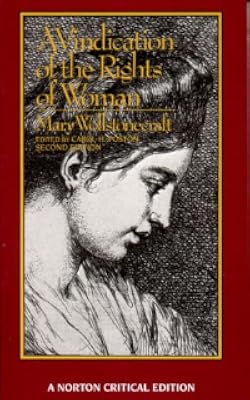
A Vindication of the Rights of Woman {Norton Critical Edition}
by Mary Wollstonecraft, Carol H. Poston (Editor)
On This Page
Description
This second edition offers the best in Wollstonecraft scholarship and criticism since 1976, providing the ideal means for studying the first feminist document in English.Tags
Recommendations













Member Reviews
Not exactly light reading, this first 'feminist' writing in history. Mary Wollstonecraft (1759-1797) wrote this long essay in 1792 in a style and terminology that is not always easily accessible to us, and that is logical, due to the more than 2 centuries that separate her from us. The line of argument is at times very forceful, it often deviates from the proposed route, and it involves quite a bit of repetition.
But of course Wollstonecraft's fiery combativeness is very recognizable. There is particular indignation at the inferior fate of women in her time, at the derogatory attitude of men towards women, and at the wrong attitude of women themselves who cultivate their own weakness. The writing testifies to an independent, critical show more mind with a sharp pen.
Her plea is primarily one for an at least equal education of women, so that they can judge and act for themselves through the use of reason. Reason and education are typical themes of the Enlightenment, of which Wollstonecraft is definitely an epigone. The reason for this writing was the developments in the French Revolution, which was then just in its first phase and which aroused enormous expectations worldwide; Wollstonecraft was certainly among the supporters of the radical changes in France, but she was particularly disappointed by a proposed educational reform in which it was not considered necessary to include women; and that was the direct occasion for her essay.
It has been written several times: Wollstonecraft does not argue for the absolute equality of men and women. She repeatedly emphasizes the differences between the sexes and in some passages she even suggests that male dominance may be willed by God and therefore inevitable. Does that detract from her feminism? I don't think so, because the common thread in this essay is clearly the plea for equality (in virtue), although it also contains arguments for political, social and economic independence.
Two things that really struck me besides the feminist theme. The constant (and justified) attacks against Jean-Jacques Rousseau who believed that women should not receive a proper education at all (I still don't understand the pedagogues' infatuation with Rousseau). And especially the very fierce attacks against monarchy and despotism. This Vindication and other writings by Wollstonecraft are known as striking expressions of republicanism. show less
But of course Wollstonecraft's fiery combativeness is very recognizable. There is particular indignation at the inferior fate of women in her time, at the derogatory attitude of men towards women, and at the wrong attitude of women themselves who cultivate their own weakness. The writing testifies to an independent, critical show more mind with a sharp pen.
Her plea is primarily one for an at least equal education of women, so that they can judge and act for themselves through the use of reason. Reason and education are typical themes of the Enlightenment, of which Wollstonecraft is definitely an epigone. The reason for this writing was the developments in the French Revolution, which was then just in its first phase and which aroused enormous expectations worldwide; Wollstonecraft was certainly among the supporters of the radical changes in France, but she was particularly disappointed by a proposed educational reform in which it was not considered necessary to include women; and that was the direct occasion for her essay.
It has been written several times: Wollstonecraft does not argue for the absolute equality of men and women. She repeatedly emphasizes the differences between the sexes and in some passages she even suggests that male dominance may be willed by God and therefore inevitable. Does that detract from her feminism? I don't think so, because the common thread in this essay is clearly the plea for equality (in virtue), although it also contains arguments for political, social and economic independence.
Two things that really struck me besides the feminist theme. The constant (and justified) attacks against Jean-Jacques Rousseau who believed that women should not receive a proper education at all (I still don't understand the pedagogues' infatuation with Rousseau). And especially the very fierce attacks against monarchy and despotism. This Vindication and other writings by Wollstonecraft are known as striking expressions of republicanism. show less
Okay, okay, admittedly I'm like, what (?) two weeks behind on this post! So much so, I thought about not actually writing it. I mean, aren't ya'll tired of reading about this antiquated text. BUT because I am attempting to at least ramble a wee bit about everything that I read this year, here goes my wee bit of rambling.
This is my second time around with Vindication. My first experience was a bit over ten years ago, when I was in my early twenties and I could define what "feminism" meant to me in a more concise black and white manner. (Experience has taught me that no belief system is either concise or black and white). Perhaps it will surprise you that I found the text far more interesting the first time around than reading it at my show more more mature age?
Some notes that I made at 21 ...
"Interesting that this debate is still going on...biology vs. sociology, thus attempting to find reason in books." in reference to the quote - 'that either nature has made a great difference between man and man, or that the civilization which has hitherto taken place in the world has been very partial.'
"Beauty vs. Brains..great comparison to fading leaves."
"What, women have no souls?"
"Really good at acknowledging her audience"
"Sarcasm!!"
"What are the values that are being taught...obeying turns into ignorance, not very well thought out."
"Passion will subside, the mind needs so much more"
What has changed since the me of the past? Well, to tell you the truth, I had to convince myself to continue reading multiple times (and yes, I even skimmed parts). It was just so damn repetitive. Why did I forget that? I know that many were put off by the god/christianity because it was a-plenty in the text, but I was forgiving. It just seemed more in the context of the time period. I mean wasn't EVERYONE religious back then?
Also, I still have to give Wollstonecraft props for what she did. Huge credit. I mean, man, she put herself out there. I don't think it is unforgivable that she still refers to women as second to man. It's baby steps people. What was she suppose to do back then? Let's face it, we have a bit more opportunity now a'days than we would in the late 1700's.
I'm definitely intrigued by Wollstonecraft's life and will (must) get my hands on a biography. show less
This is my second time around with Vindication. My first experience was a bit over ten years ago, when I was in my early twenties and I could define what "feminism" meant to me in a more concise black and white manner. (Experience has taught me that no belief system is either concise or black and white). Perhaps it will surprise you that I found the text far more interesting the first time around than reading it at my show more more mature age?
Some notes that I made at 21 ...
"Interesting that this debate is still going on...biology vs. sociology, thus attempting to find reason in books." in reference to the quote - 'that either nature has made a great difference between man and man, or that the civilization which has hitherto taken place in the world has been very partial.'
"Beauty vs. Brains..great comparison to fading leaves."
"What, women have no souls?"
"Really good at acknowledging her audience"
"Sarcasm!!"
"What are the values that are being taught...obeying turns into ignorance, not very well thought out."
"Passion will subside, the mind needs so much more"
What has changed since the me of the past? Well, to tell you the truth, I had to convince myself to continue reading multiple times (and yes, I even skimmed parts). It was just so damn repetitive. Why did I forget that? I know that many were put off by the god/christianity because it was a-plenty in the text, but I was forgiving. It just seemed more in the context of the time period. I mean wasn't EVERYONE religious back then?
Also, I still have to give Wollstonecraft props for what she did. Huge credit. I mean, man, she put herself out there. I don't think it is unforgivable that she still refers to women as second to man. It's baby steps people. What was she suppose to do back then? Let's face it, we have a bit more opportunity now a'days than we would in the late 1700's.
I'm definitely intrigued by Wollstonecraft's life and will (must) get my hands on a biography. show less
I do not know how anyone can give this book a less than 5 star rating. This is the first feminist monograph and it is eloquant and easy to read. This is a classic, a must read and must own for anyone who is interested in women's studes, education, and feminism. I loved this book. And at the end there is a little section where scholars debate the book. I highly recommend this to everyone. I absolute loved it.
very informative book you should read it
Purchased book on 14Mar26 at Half Price Books. Used and paperback in good condition.
Ratings
Members
- Recently Added By
Author Information

51+ Works 7,901 Members
Mary Wollstonecraft was born in London on April 27, 1759. She opened a school in Newington Green with her sister Eliza and a friend Fanny Blood in 1784. Her experiences lead her to attack traditional teaching methods and suggested new topics of study in Thoughts on the Education of Girls. In 1792, she published A Vindication of the Rights of show more Woman, in which she attacked the educational restrictions that kept women ignorant and dependant on men as well as describing marriage as legal prostitution. In Maria or the Wrongs of Woman, published unfinished in 1798, she asserted that women had strong sexual desires and that it was degrading and immoral to pretend otherwise. In 1793, Wollstonecraft became involved with American writer Gilbert Imlay and had a daughter named Fanny. After this relationship ended, she married William Godwin in March 1797 and had a daughter named Mary in August. Wollstonecraft died from complications following childbirth on September 10, 1797. Her daughter Mary later married Percy Bysshe Shelley and wrote Frankenstein. (Bowker Author Biography) show less
All Editions
Some Editions
Series
Belongs to Publisher Series
Work Relationships
Common Knowledge
- Canonical title
- A Vindication of the Rights of Woman {Norton Critical Edition}
- Disambiguation notice
- Do not combine this version with the original work. This version contains significant extra critical material.
Classifications
- Genres
- Nonfiction, Sexuality and Gender Studies, General Nonfiction, Philosophy, History, Literature Studies and Criticism
- DDC/MDS
- 305.40941 — Society, government, & culture Social sciences, sociology & anthropology Social group - Age, Gender, Ethnicity Women Standard subdivisions History, geographic treatment, biography Europe British Isles -- Ireland and Scotland
- LCC
- HQ1596 .W6 — Social sciences The family. Marriage, Women and Sexuality The Family. Marriage. Women Women. Feminism
- BISAC
Statistics
- Members
- 526
- Popularity
- 56,812
- Reviews
- 5
- Rating
- (3.69)
- Languages
- English
- Media
- Paper
- ISBNs
- 5
- ASINs
- 2