On This Page
Description
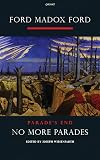
The second volume of Ford Madox Ford's Parade's End series, this fully annotated edition follows Christopher Tietjens, an officer and gentlemen, from the secure, orderly world of Edwardian England into the chaotic madness of World War I. Recounting a complex sexual intrigue involving Tietjens and his faithless wife Sylvia, this account is not only a panorama of WWI, but an exploration of time, history, and sexuality. The text also provides key contexts--such as Ford's biography, the show more historical moment, the novel's reception at the time of its original publication, and its relation to the author's other novels--giving readers a close-up view of this major literary technician at work. Transcripts of significant deletions and revisions to the work as well as a glossary of pertinent terms are also included. show lessTags
Recommendations

















Member Reviews
This is a really small stage, a single town in France in the middle of WW1. Ford lays out more explicitly the foundations of Tietjens's character - don't peach to the headmaster. Well, I spent a couple years as a young student in an English boarding school. He's right about that! There are just a few characters here. The whole thing is really a pressure cooker, the confinement inducing a build up of pressure.
Ford's technical mastery hits a new level here, beyond that of Some Do Not. In No More Parades, Ford has streams of consciousness of multiple people interleaved. He pulls it off!
Ford's technical mastery hits a new level here, beyond that of Some Do Not. In No More Parades, Ford has streams of consciousness of multiple people interleaved. He pulls it off!
When I am unconvinced by a much celebrated novel, my default mode is "try harder", hoping that I will connect if I stick with it. This approach often pays off. There have been exceptions, most notably, (and predictably), Henry James. My struggles reading Portrait of a Lady gave me some small insight into dyslexia (how is that a sentence?), aphasia (how does this conversation make any sense whatsoever?), and attention deficit disorder (am I going to have to read that paragraph yet again?).
To James, I reluctantly add Ford Madox Ford to my list of the dead ends encountered along my literary journey. Somewhere in Parade's End, there is a great story. I know this because Tom Stoppard created a great screenplay from it for BBC. He used show more Parade's End's themes, setting, and characters, enhancing the plot, and adding action. Most importantly, he somehow got this lumbering locomotive back on the rails. Ford, on the other hand, can't seem to get out of his own sputtering way. His liberal use of ellipses (. . . .), sometimes a dozen or more times on a single page, means that the reader must wade through hundreds and hundreds of garbled and unfinished sentences, even as Ford is tending, in countless additional ways, to derail his own story.
It could be that Ford is using style to mimetically burden the reader with the dysfunctional temper of his time, i.e. the derailment of virtually everything that one might trust and believe in, ultimately culminating in, and exemplified by, WWI. If true, then it asks too much of his readers and dooms Parade's End to, if not obscurity, then at least to rarely being read. show less
To James, I reluctantly add Ford Madox Ford to my list of the dead ends encountered along my literary journey. Somewhere in Parade's End, there is a great story. I know this because Tom Stoppard created a great screenplay from it for BBC. He used show more Parade's End's themes, setting, and characters, enhancing the plot, and adding action. Most importantly, he somehow got this lumbering locomotive back on the rails. Ford, on the other hand, can't seem to get out of his own sputtering way. His liberal use of ellipses (. . . .), sometimes a dozen or more times on a single page, means that the reader must wade through hundreds and hundreds of garbled and unfinished sentences, even as Ford is tending, in countless additional ways, to derail his own story.
It could be that Ford is using style to mimetically burden the reader with the dysfunctional temper of his time, i.e. the derailment of virtually everything that one might trust and believe in, ultimately culminating in, and exemplified by, WWI. If true, then it asks too much of his readers and dooms Parade's End to, if not obscurity, then at least to rarely being read. show less
The second volume of Parade's End follows Christopher Tietjens to war, where he works as a dispatching officer organizing men to go to the front (You can see that my military knowledge is not very great. I couldn't even begin to describe his job more precisely than that). This volume is laden with symbolism of death, decay, and despair that starkly contrasts with the (by comparison) almost pastoral tones of the first volume. This is hardly surprising given that it is set in war-torn France and focuses almost entirely on Tietjens's experiences in the shift from civilian life to a military officer. We watch his despair and lack of control as one of his men is unexpectedly killed in an air raid and dies in his arms. We see his voluntary show more abstention from the comforts of the hotel where the military surgeon has ordered him to stay.
It does a lot to help the reader understand the inner psychology of the primary character. But as someone with limited military knowledge, setting the entire novel against the backdrop of the war was a little confusing for me. There was a lot of outdated military vocabulary that I could not figure out or find definitions for, which made it a little harder for me to understand what was happening. This did not seem to be part of Ford's strategy of selective obfuscation; rather it's just a set of terminology that can no longer be understood without difficulty. So this knocked down the star rating on this volume--at least for me. Still highly worth reading. show less
It does a lot to help the reader understand the inner psychology of the primary character. But as someone with limited military knowledge, setting the entire novel against the backdrop of the war was a little confusing for me. There was a lot of outdated military vocabulary that I could not figure out or find definitions for, which made it a little harder for me to understand what was happening. This did not seem to be part of Ford's strategy of selective obfuscation; rather it's just a set of terminology that can no longer be understood without difficulty. So this knocked down the star rating on this volume--at least for me. Still highly worth reading. show less
Well, this is part 2 of the Parade's End quartet by Ford. Part 1 and I did not get along well, but since they were both in the same volume, i trudged forward with part 2. The writing style is still challenging, but like that subtitled foreign film that seems completely unwatchable those first few minutes, eventually, your mind starts to adapt and the struggle lessens........mind you, it lessens, it does not disappear. I am slowly getting the gist of this slower-moving treatise on the death of the social structures of the upper class as WWI plunges English society into the modern world. Still lots of specific, dated period references that often leave me somewhat lost, but i am not as lost as i was earlier. What keeps me going is that show more relatively little happens in the way of action, yet i am compelled to continue to find out if the main character, for which i feel the utmost sympathy for, will ever get any peace and joy out of life, or will he be forever chained to his 'duty' as he sees it from his perspective with his standards from a time gone by. Interesting character revelations from actionless conversation and piecing together the puzzle of the disjointed timeline that Ford seems to thrive on. OK......I maybe should take a break from Ford......I have just rambled on at length and have said virtually nothing......maybe it's contagious!!! (but you could not stop reading, could you!!!) Am i making myself clear??? show less
Audiobook edition narrated by Stephen Crossley, very good job.
This second book in the Parade's End series gives more insight into the character of Sylvia Tiejens.
This second book in the Parade's End series gives more insight into the character of Sylvia Tiejens.
Even better than the first book. Full review on my blog.
Side note, I do miss cross-posting here but cannot on principle after GR has gotten so heavy handed about deleting reviews.
Side note, I do miss cross-posting here but cannot on principle after GR has gotten so heavy handed about deleting reviews.
Ratings
Members
- Recently Added By
Lists

In and About the 1920s
181 works; 31 members
1,001 BYMRBYD Concensus
723 works; 27 members
Author Information

110+ Works 10,377 Members
Born Ford Hermann Madox Hueffer in England in 1873, Ford Madox Ford came from a family of artists and writers that included his grandfather, the pre-Raphaelite painter Ford Madox Brown, and his uncles Gabriel Dante Rossetti and William Michael Rossetti. Ford's early works were published under the name Ford Madox Hueffer, but in 1919 he legally show more changed his name to Ford Madox Ford due to legal complications that arose when he left his wife, Elsie Martindale, and their two daughters. He also used the pen names Daniel Chaucer and Fenil Haig. Ford's early works include The Brown Owl, a fairy tale, children's stories, romances, and The Fifth Queen, a historical trilogy about Katherine Howard, the fifth wife of Henry VIII. He also collaborated with Joseph Conrad, whom he first met in 1898, on three novels: The Nature of Crime, The Inheritors, and Romance. Ford is best known for his novels The Good Soldier, which he considered both his first serious effort at a novel and his best work, and Parade's End, a tetralogy set during World War I. Both of these books explore a theme that appears often in Ford's writing, that of a good man whose old-fashioned, gentlemanly code is in conflict with modern industrial society. Ford also published several volumes of autobiography and reminiscences, including Return to Yesterday and It Was the Nightengale, as well as numerous works of biography, history, poetry, essays, travel writing, and criticism of literature and art. Although Ford and Martindale never divorced, Ford had significant, long-term relationships with three other women, all of whom took his name; he had another daughter by one of them. He died in Deauville, France, in 1939. (Bowker Author Biography) show less
Awards and Honors
Series

Work Relationships
Common Knowledge
- Canonical title
- No More Parades
- Original title
- No More Parades
- Original publication date
- 1925
- Epigraph
- For two things my heart is grieved: A man
of war that suffereth from poverty and men
of intelligence that are counted as refuse.
PROVERBS - First words
- When you came in the space was desultory, rectangular, warm after the drip of the winter night, and transfused with a brown-orange dust that was light.
- Last words
- (Click to show. Warning: May contain spoilers.)To Tietjens this was like the sudden bursting out of the regimental quick-step, as after a funeral with military honours the band and drums march away, back to barracks.
Classifications
Statistics
- Members
- 149
- Popularity
- 219,655
- Reviews
- 6
- Rating
- (3.76)
- Languages
- English, German
- Media
- Paper, Audiobook, Ebook
- ISBNs
- 27
- ASINs
- 14