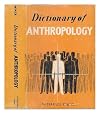
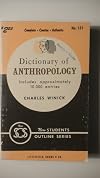
Dictionary of anthropology
by Charles Winick
On This Page
Description
The Dictionary of Anthropology is a comprehensive explication of basic terms and concepts of archaeology, cultural anthropology, linguistics, and physical anthropology. The terms have been selected from standard source and instructional materials, and include identifications of some major early contributors to anthropology. This is the only collection in any language of the specialized vocabularies of all the fields of anthropology. It is a handbook not only for anthropologists but for show more everyone interested in the study of man and of man's cultural and physical heritage. show lessTags
Recommendations































Member Reviews
The use of a specialist dictionary will speed the immersion in a subject. For example, it is not enough to know that "basalt" is dark, compact volcanic rock, but to appreciate how it was used by the ancient Egyptians for sculpture and obelisks. And that "Basque" is a language of a million inhabitants of Spain and France, with no common origin, many words formed by the addition of prefixes and suffixes, and "the verbs do not have an active voice". Well, maybe not the verbs!
Under "law", the definition is "A social norm sanctioned by the possibility of the application of force by appointed authorized persons". This is awkward, and vague -- "possibility", "appointed"? More useful, the four functions of law described by Hoebel are listed: show more defining relationships, allocating the power of coersion, handling cases of trouble, and adopting social relations to changing conditions of life. Then, the name-laws: Ammon's (cephalic index to height), Bartholomae's (Iranian sound-shifts), biogenetic (ontogeny recapitulates phylogeny), Cope's (specialization to survival), Dahl's (voicing Bantu consonants), Darmesteter's (Latin to French syllabic silencing), Deperet's (size as success), Dollo's (irreversibility), Ferrell's (earth rotation deflects motion), frontality (line of head, nose, spine, navel in pre-500 bc sculpture), Grassman's (silence of 1st aspirant in Greek), Grimm's (voiced stops become voiceless in German), Meinhof's (displacement of nasalized consonants in Bantu), palatal (Sanskrit correspondence to Greek), Peschel's (clothing to pigmentation), sumptuary (regulation of luxury display), Schwann's (muscle contraction), water (regulation), Williston's (parts of organism), Wolff's (organs enlarge or diminish with function).
Includes biographies of contributors to this "young field", in which so many find it necessary to "speak a special vocabulary among themselves". [vi] show less
Under "law", the definition is "A social norm sanctioned by the possibility of the application of force by appointed authorized persons". This is awkward, and vague -- "possibility", "appointed"? More useful, the four functions of law described by Hoebel are listed: show more defining relationships, allocating the power of coersion, handling cases of trouble, and adopting social relations to changing conditions of life. Then, the name-laws: Ammon's (cephalic index to height), Bartholomae's (Iranian sound-shifts), biogenetic (ontogeny recapitulates phylogeny), Cope's (specialization to survival), Dahl's (voicing Bantu consonants), Darmesteter's (Latin to French syllabic silencing), Deperet's (size as success), Dollo's (irreversibility), Ferrell's (earth rotation deflects motion), frontality (line of head, nose, spine, navel in pre-500 bc sculpture), Grassman's (silence of 1st aspirant in Greek), Grimm's (voiced stops become voiceless in German), Meinhof's (displacement of nasalized consonants in Bantu), palatal (Sanskrit correspondence to Greek), Peschel's (clothing to pigmentation), sumptuary (regulation of luxury display), Schwann's (muscle contraction), water (regulation), Williston's (parts of organism), Wolff's (organs enlarge or diminish with function).
Includes biographies of contributors to this "young field", in which so many find it necessary to "speak a special vocabulary among themselves". [vi] show less
Ratings
Members
- Recently Added By
Author Information
8 Works 91 Members
Classifications
Statistics
- Members
- 59
- Popularity
- 523,583
- Reviews
- 1
- Rating
- (3.50)
- Languages
- English
- Media
- Paper, Ebook
- ISBNs
- 4
- ASINs
- 6