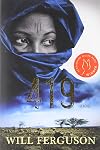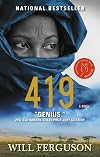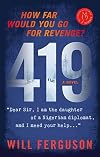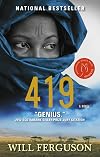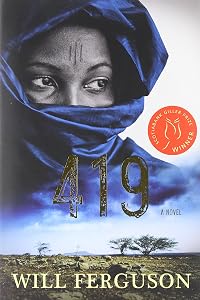
419
by Will Ferguson
On This Page
Description
A car tumbles through darkness down a snowy ravine. A woman without a name walks out of a dust storm in Africa. And in the seething heat of Lagos City, a criminal cartel scours the Internet, looking for victims. Lives intersect. Worlds collide. And it all begins with a single email: 'Dear Sir, I am the daughter of a Nigerian diplomat, and I need your help ... ' At once a chilling thriller about a lonely woman avenging her father's death and an epic portrait of morality and corruption across show more the globe, Will Ferguson's Giller Prize-winning novel plunges into the labyrinth of li. show lessTags
Recommendations















Member Reviews
Who knew that Will Ferguson could write seriously with such accomplishment? I had previously read his travel memoir Beyond Belfast and really enjoyed it. But I hadn't read any of his fiction and I wondered if he could really make the transition. However, a friend recommended 419 and then it was short-listed for the Giller prize so I thought I should check it out.
We've all received emails from Nigeria offering us a cut of millions of dollars if we would just let the money be deposited into our bank account. Most of us delete these emails without even reading them. However, some people must read them and respond because the Nigerian scam artists keep sending them out. That's the premise behind this book. Laura Curtis's father was one of show more those who responded. He ended up sending all his savings and mortgaging his house to Nigeria. When it became apparent to him that he had lost everything he drove his car off the road and over a precipice. He had recently upped his life insurance and made Laura the beneficiary but because he committed suicide the insurance company refused to pay. Bit by bit the family finds out the extent of the loss and how the scam was run.
Meanwhile in Nigeria an Ijaw boy from the Delta is hired by one of the oil companies. Nnamdi has learned how to fix engines from his father and he quickly ascends to fixing oil company machinery. However he is let go when the oil companies start losing executives and valuable assets to Nigerian bandits. Much further north a young woman wrapped in indigo robes and with facial scars and a baby in her womb starts walking south. When Nnamdi is hired on as a driver and mechanic for a tanker truck going north he finds this young woman scavenging for food. He decides, against the wishes of his co-driver, to give her a ride south. The woman is called Amina.
Eventually Laura, Nnamdi and Amina come together in Lagos. All of them are changed by the encounter.
The tension builds in this book almost right to the end. Laura is a true Canadian heroine, shy, self-effacing but determined. I can't imagine doing what she did but I haven't gone through what she had to go through. I cared about Laura and that is important to me in liking a book.
Highly recommended. show less
We've all received emails from Nigeria offering us a cut of millions of dollars if we would just let the money be deposited into our bank account. Most of us delete these emails without even reading them. However, some people must read them and respond because the Nigerian scam artists keep sending them out. That's the premise behind this book. Laura Curtis's father was one of show more those who responded. He ended up sending all his savings and mortgaging his house to Nigeria. When it became apparent to him that he had lost everything he drove his car off the road and over a precipice. He had recently upped his life insurance and made Laura the beneficiary but because he committed suicide the insurance company refused to pay. Bit by bit the family finds out the extent of the loss and how the scam was run.
Meanwhile in Nigeria an Ijaw boy from the Delta is hired by one of the oil companies. Nnamdi has learned how to fix engines from his father and he quickly ascends to fixing oil company machinery. However he is let go when the oil companies start losing executives and valuable assets to Nigerian bandits. Much further north a young woman wrapped in indigo robes and with facial scars and a baby in her womb starts walking south. When Nnamdi is hired on as a driver and mechanic for a tanker truck going north he finds this young woman scavenging for food. He decides, against the wishes of his co-driver, to give her a ride south. The woman is called Amina.
Eventually Laura, Nnamdi and Amina come together in Lagos. All of them are changed by the encounter.
The tension builds in this book almost right to the end. Laura is a true Canadian heroine, shy, self-effacing but determined. I can't imagine doing what she did but I haven't gone through what she had to go through. I cared about Laura and that is important to me in liking a book.
Highly recommended. show less
419 by Canadian author Will Ferguson is an intricate and compelling international crime story that gathers momentum as it goes along. The author is peeling back the layers behind a real-life internet scam that swindles the life savings from it’s victims.
Henry Curtis, retired teacher from Calgary, Alberta swerves his car into a snowy ravine, leaving behind a devastated family. It is revealed that Henry was a victim of a 419 Nigerian scam and that his death is being ruled a suicide. His daughter, Laura, sets out to track down the people she considers her father’s killers not realizing the extreme danger she is putting herself in. But there is much more to 419 than this one story, the author gives us a detailed picture of the country show more of Nigeria by introducing a number of other characters, telling their backstory and showing the desperation and poverty that is rife in this country.
I was riveted by this book and felt rewarded by the excellence of the story and the writing. Will Ferguson is better known as a travel writer and humorist, but he certainly put together an interesting and well researched thriller with this book. show less
Henry Curtis, retired teacher from Calgary, Alberta swerves his car into a snowy ravine, leaving behind a devastated family. It is revealed that Henry was a victim of a 419 Nigerian scam and that his death is being ruled a suicide. His daughter, Laura, sets out to track down the people she considers her father’s killers not realizing the extreme danger she is putting herself in. But there is much more to 419 than this one story, the author gives us a detailed picture of the country show more of Nigeria by introducing a number of other characters, telling their backstory and showing the desperation and poverty that is rife in this country.
I was riveted by this book and felt rewarded by the excellence of the story and the writing. Will Ferguson is better known as a travel writer and humorist, but he certainly put together an interesting and well researched thriller with this book. show less
Laura remembers being impatient with her father, when he discovered symbols of the four elements in a shopping mall's design.
Water, earth, air and fire: he had spotted representations of all of them.
She was carrying too many parcels, frustrated by needing to ask him to help with her burden, and only after his death does she recall this incident, wondering if he had been searching for some essential truth.
There is a mystery surrounding her father's death.
Readers are aware of the complicated circumstances before Laura is, because Will Ferguson's narrative affords access to a variety of voices, so readers know that there is more than one set of tire-tracks leading off the road.
The multiple perspectives and the intricate plotting keep the show more pages turning, but at the heart of it all, 419 revolves around the idea that what appears to be true at first glance is actually much more complicated.
And, so, the segments in 419 are not named for the elements, but for more complex representations of these vital substances: snow, sand, fuel, fire.
Each of these has connections to each of the narrative's threads (literally or figuratively), either in memory or in real-time events that unfold on the page.
The thematic layering works to maintain a cohesive narrative despite a format of short chapters which, increasingly, sprawl across continents and narrators as more complications are revealed. Unexpected connections and parallels between characters' experiences also work to smooth the edges as do overt demonstrations of the author's crafting.
The work is titled for the section of the Nigerian Criminal Code that "deals with obtaining money or goods under false pretenses. Any kind of fraud, really. It’s entered the lexicon over there."
Anyone with an email address has likely received an invitation to such ventures, e-mails requesting assistance with investing sums of money overseas or securing passage for innocents in dangerous situations. Most recipients think nothing of these letters, perhaps don't even see them if a mail program's spam filter is set up to block them.
"But don’t be fooled: 419 is a business. It brings in hundreds of millions of dollars a year. It’s bigger than Nigeria; it’s as old as sin. As old as desire. These 419ers, they prey on people’s dreams. Average loss in a 419 scam is somewhere to the tune of $250,000 – often more. The going rate for dreams, apparently."
But don't be fooled; the detective has a clear cut analysis of the situation, but in Will Ferguson's novel, it is more complicated than that.
Many of these 419ers spend long days working with bulk mailings that flood inboxes around the world but for Winston, a day working with these letters is not just a way to pay his bills but an art. He spends a great deal of time perfecting his contact with individuals who will be more likely to respond to particular requests, rewriting content so that it speaks to the targets' individual situations, deliberately wording and timing his efforts.
Winston's long, solitary work day is detail-oriented, often overlooked as insignificant, and lonely: not all that different from Laura's work as a freelance copyeditor. It is one of many parallels which subtly unifies the work. In one scene, Winston speaks of fishing with words, of netting and hooking and spearing the targets of 419s. In another scene, there is a father and son actually fishing. In one scene, a North American police officer mentions Lagos Lagoon and in the next a Nigerian character observes the lagoon.
But even that, 'Nigerian', is a scam from some perspectives.
"It was a net loosely thrown, a name on a map, one created by the British to paper over the gaping cracks in the joinery. A conjurer’s trick, where the many became one, a sleight of hand, like the tired magic of old men making coins disappear. 'There is no Nigeria.' This was the first lesson her uncle had wished to impart. 'There is Fulani and Hausa, Igbo and Tiv, Efik and Kanuri, Gwari and Yoruba. But Nigeria? That is only the pail we carry these in.'”
And those who have thrown the net are, from some perspectives, scammers.
"'We are tax collectors, Adam. We charge a tax on greed. We should be congratulated, not prosecuted, and yet it is we who are called the criminals. Criminals! They talk about Nigerian’s 'culture of corruption’. What of Europe’s ‘culture of greed’? What of America’s? What of these oyibos agreeing to schemes that are so clearly illegal, were they to be true?'"
The stories of residents in the land colonized as Nigeria comprise the bulk of 419, and Will Ferguson does not falsely simplify the differences between them, whether in speaking of the superficial or more inherently complex issues like social class.
(For instance, Amina is from the Sahel, with its savannah tastes and scents and clear air, a land of crumbling soil that turns to sand in her hand; her skin is the colour of "old clay, of dust, of sand", she bears scars that identify her kinship lines, and she is accustomed to eating lamb, groundnuts, beef, onions and greens. In contrast, Nnamdi has the "dark sheen of oil, as though it had soaked into his skin" from the sticky southern lands, the soil so dark and oily that it marks the soils of one's feet, and he eats mostly fish, plantains, sugar, cocoyams and cassava.)
Tax collectors and criminals, militia and bank employees, police officers and roadside gangs, parents and children, thieves and children, fathers and murderers: Will Ferguson's novel is set in an arena which is inherently compelling and readers can track the plot as narrative lines echo and converge.
Some characters pursue, others are the pursued; some change roles as the story progresses.
"But here, under this open sky? On these open plains? Where would you hide? Where could you hide? A single body cast a long presence out here. Hunters could track you simply by the shadow you trailed, even in moonlight. You would have to run very far to escape."
If you don't have tire-tracks or a desert to assist you, how do you track someone who does not want to be found? How does a single sender cast a shadow in an email?
How do you track the love of a man who has died with secrets that you don't understand? When one profits from a situation that also helps somebody, how much of the motivation is greed and how much kindness?
What happens when some hunt by shadows and others avoid even stepping on them because that would be to step on a soul? How do you define 'hunter' and 'hunted' in the context of a legacy of colonialism?
When you break down the elements of a human life, are the subject headings the same matters of importance that appear on a bank statement, a police incident report, or in an email exchange?
One simple statement reverberates throughout the narrative and the stories of several characters: "Loss demands repayment."
But the answer is rooted in elemental truths that complicate the question of currency.
Will Ferguson's novel reaches beyond the armful of shopping bags and the bulging spam filter; 419 scrapes back the layers to reveal what really matters.
This discussion originally appeared on BuriedInPrint along with more a more detailed consideration of specific elements of the work. show less
Water, earth, air and fire: he had spotted representations of all of them.
She was carrying too many parcels, frustrated by needing to ask him to help with her burden, and only after his death does she recall this incident, wondering if he had been searching for some essential truth.
There is a mystery surrounding her father's death.
Readers are aware of the complicated circumstances before Laura is, because Will Ferguson's narrative affords access to a variety of voices, so readers know that there is more than one set of tire-tracks leading off the road.
The multiple perspectives and the intricate plotting keep the show more pages turning, but at the heart of it all, 419 revolves around the idea that what appears to be true at first glance is actually much more complicated.
And, so, the segments in 419 are not named for the elements, but for more complex representations of these vital substances: snow, sand, fuel, fire.
Each of these has connections to each of the narrative's threads (literally or figuratively), either in memory or in real-time events that unfold on the page.
The thematic layering works to maintain a cohesive narrative despite a format of short chapters which, increasingly, sprawl across continents and narrators as more complications are revealed. Unexpected connections and parallels between characters' experiences also work to smooth the edges as do overt demonstrations of the author's crafting.
The work is titled for the section of the Nigerian Criminal Code that "deals with obtaining money or goods under false pretenses. Any kind of fraud, really. It’s entered the lexicon over there."
Anyone with an email address has likely received an invitation to such ventures, e-mails requesting assistance with investing sums of money overseas or securing passage for innocents in dangerous situations. Most recipients think nothing of these letters, perhaps don't even see them if a mail program's spam filter is set up to block them.
"But don’t be fooled: 419 is a business. It brings in hundreds of millions of dollars a year. It’s bigger than Nigeria; it’s as old as sin. As old as desire. These 419ers, they prey on people’s dreams. Average loss in a 419 scam is somewhere to the tune of $250,000 – often more. The going rate for dreams, apparently."
But don't be fooled; the detective has a clear cut analysis of the situation, but in Will Ferguson's novel, it is more complicated than that.
Many of these 419ers spend long days working with bulk mailings that flood inboxes around the world but for Winston, a day working with these letters is not just a way to pay his bills but an art. He spends a great deal of time perfecting his contact with individuals who will be more likely to respond to particular requests, rewriting content so that it speaks to the targets' individual situations, deliberately wording and timing his efforts.
Winston's long, solitary work day is detail-oriented, often overlooked as insignificant, and lonely: not all that different from Laura's work as a freelance copyeditor. It is one of many parallels which subtly unifies the work. In one scene, Winston speaks of fishing with words, of netting and hooking and spearing the targets of 419s. In another scene, there is a father and son actually fishing. In one scene, a North American police officer mentions Lagos Lagoon and in the next a Nigerian character observes the lagoon.
But even that, 'Nigerian', is a scam from some perspectives.
"It was a net loosely thrown, a name on a map, one created by the British to paper over the gaping cracks in the joinery. A conjurer’s trick, where the many became one, a sleight of hand, like the tired magic of old men making coins disappear. 'There is no Nigeria.' This was the first lesson her uncle had wished to impart. 'There is Fulani and Hausa, Igbo and Tiv, Efik and Kanuri, Gwari and Yoruba. But Nigeria? That is only the pail we carry these in.'”
And those who have thrown the net are, from some perspectives, scammers.
"'We are tax collectors, Adam. We charge a tax on greed. We should be congratulated, not prosecuted, and yet it is we who are called the criminals. Criminals! They talk about Nigerian’s 'culture of corruption’. What of Europe’s ‘culture of greed’? What of America’s? What of these oyibos agreeing to schemes that are so clearly illegal, were they to be true?'"
The stories of residents in the land colonized as Nigeria comprise the bulk of 419, and Will Ferguson does not falsely simplify the differences between them, whether in speaking of the superficial or more inherently complex issues like social class.
(For instance, Amina is from the Sahel, with its savannah tastes and scents and clear air, a land of crumbling soil that turns to sand in her hand; her skin is the colour of "old clay, of dust, of sand", she bears scars that identify her kinship lines, and she is accustomed to eating lamb, groundnuts, beef, onions and greens. In contrast, Nnamdi has the "dark sheen of oil, as though it had soaked into his skin" from the sticky southern lands, the soil so dark and oily that it marks the soils of one's feet, and he eats mostly fish, plantains, sugar, cocoyams and cassava.)
Tax collectors and criminals, militia and bank employees, police officers and roadside gangs, parents and children, thieves and children, fathers and murderers: Will Ferguson's novel is set in an arena which is inherently compelling and readers can track the plot as narrative lines echo and converge.
Some characters pursue, others are the pursued; some change roles as the story progresses.
"But here, under this open sky? On these open plains? Where would you hide? Where could you hide? A single body cast a long presence out here. Hunters could track you simply by the shadow you trailed, even in moonlight. You would have to run very far to escape."
If you don't have tire-tracks or a desert to assist you, how do you track someone who does not want to be found? How does a single sender cast a shadow in an email?
How do you track the love of a man who has died with secrets that you don't understand? When one profits from a situation that also helps somebody, how much of the motivation is greed and how much kindness?
What happens when some hunt by shadows and others avoid even stepping on them because that would be to step on a soul? How do you define 'hunter' and 'hunted' in the context of a legacy of colonialism?
When you break down the elements of a human life, are the subject headings the same matters of importance that appear on a bank statement, a police incident report, or in an email exchange?
One simple statement reverberates throughout the narrative and the stories of several characters: "Loss demands repayment."
But the answer is rooted in elemental truths that complicate the question of currency.
Will Ferguson's novel reaches beyond the armful of shopping bags and the bulging spam filter; 419 scrapes back the layers to reveal what really matters.
This discussion originally appeared on BuriedInPrint along with more a more detailed consideration of specific elements of the work. show less
I really enjoyed this departure from Ferguson's "regular" genre. It reminded me a bit of Dan Chaon's book, "Await Your Reply". Basically the idea of computer fraud and how psychological factors of the victims feed into them being swindled. The way it is written it really gives you insight into how this is part of culture in certain places and they blame people for being vulnerable. I found it fascinating and well written.
 This review was written for LibraryThing Early Reviewers.
I enjoyed the writing, the characters and the storylines of this book. 419 is so well researched and written with such heart that I wish I had liked it more. I found that I could not make the leap to believe in the fantastical ending--I wanted to but I could not. Still, I recommend it--I've never heard THIS story told before.
i am still amazed that people are actually sending money to Nigeria and believe all these crazy promises. i know they are poor in Nigeria but lets face it, not the big shots who evetually collect the morny will be left dead but the little people and their families.
this books breaks your heart when you see the family suffering after the canadian father send money to Nigeria and then again when you read about the people who started thr scam.
the daughter goes out for revenge but in the end there no winners, just loosers on both sides.
sad.
this books breaks your heart when you see the family suffering after the canadian father send money to Nigeria and then again when you read about the people who started thr scam.
the daughter goes out for revenge but in the end there no winners, just loosers on both sides.
sad.
This review was written for LibraryThing Early Reviewers."Four one nine is not a game, it is a contest of wills," Ironsi-Egobia continued. "It is Nigerian cunning versus oyibo greed, and in such a tussle, cunning always has the advantage. Why? Because greed clouds men's eyes, fogs their gaze. Cunning focuses it. We are tax collectors, Adam. We charge a tax on greed. We should be congratulated, not prosecuted, and yet it is we who are called the criminals. Criminals! They talk about Nigeria's 'culture of corruption.' What of Europe's 'culture of greed'? What of America's? What of these oyibos agreeing to schemes that are so clearly illegal, were they to be true? Moving millions of dollars out of a poverty-stricken nation, profiteering on Nigeria's hardships? Are the mugus not criminals too? show more Aspiring criminals, but criminals still. Are they not accomplices as much as they are victims? This is what the fools at the EFCC fail to see."
419, the winner of the 2012 Scotiabank Giller Prize, begins with a mysterious automobile accident in Calgary that claims the life of Henry Curtis, a retired schoolteacher. That is the first of a series of surprises that follow, as his wife, his son Wallace and his daughter Laura soon find out that Henry was the victim of a Nigerian e-mail scam that has claimed his and his wife's life savings and has left them nearly $200,000 in debt. The local Canadian police share details of the conversations Henry had with a supposed Nigerian bank executive, but the family is informed that this money is lost forever, and they should not attempt to reclaim it by contacting Canadian or Nigerian officials. Wallace verbally expresses his anger and frustration with vehemence, while Laura quietly plans what action she can take to gain revenge for her father's death.
Winston is a university educated young Nigerian who operates out of an Internet parlor in Lagos creating 419 e-mail scams alongside other yahoo boys (419 refers to the section in the Nigerian Criminal Code that concerns fraud). He works independently and is quite successful, and as a result he is selected by Ironsi-Egobia, a local strong man, to run his scams in private under his "protection".
Nnamdi is a bright village youth selected by Dutch oil company officials for training as a mechanic, and later becomes a Shell Man, who earns a hefty salary but is loathed by other young men nearby. He later collaborates with some of them, and undertakes an even more lucrative job whose risks are outweighed by its potential profits.
The lives of these three main characters converge in Lagos, a chaotic city where corruption is rampant and danger is always present. The story progressively picks up speed as it reaches its terrifying and unexpected conclusion.
419 is an action packed novel that takes big risks, yet largely fails to deliver on them, in the manner of a batter who takes a mighty swing at a baseball and hits a high drive that falls well short of the outfield fence and lands harmlessly in a fielder's glove. The story regularly strained credulity, and ultimately I lost interest in the lives of its characters. Although it does seem to paint a believable, though bleak, picture of modern Nigeria and provides information about the effects of 419 scams on Westerners and Nigerians, it ultimately was an unsatisfying read. show less
419, the winner of the 2012 Scotiabank Giller Prize, begins with a mysterious automobile accident in Calgary that claims the life of Henry Curtis, a retired schoolteacher. That is the first of a series of surprises that follow, as his wife, his son Wallace and his daughter Laura soon find out that Henry was the victim of a Nigerian e-mail scam that has claimed his and his wife's life savings and has left them nearly $200,000 in debt. The local Canadian police share details of the conversations Henry had with a supposed Nigerian bank executive, but the family is informed that this money is lost forever, and they should not attempt to reclaim it by contacting Canadian or Nigerian officials. Wallace verbally expresses his anger and frustration with vehemence, while Laura quietly plans what action she can take to gain revenge for her father's death.
Winston is a university educated young Nigerian who operates out of an Internet parlor in Lagos creating 419 e-mail scams alongside other yahoo boys (419 refers to the section in the Nigerian Criminal Code that concerns fraud). He works independently and is quite successful, and as a result he is selected by Ironsi-Egobia, a local strong man, to run his scams in private under his "protection".
Nnamdi is a bright village youth selected by Dutch oil company officials for training as a mechanic, and later becomes a Shell Man, who earns a hefty salary but is loathed by other young men nearby. He later collaborates with some of them, and undertakes an even more lucrative job whose risks are outweighed by its potential profits.
The lives of these three main characters converge in Lagos, a chaotic city where corruption is rampant and danger is always present. The story progressively picks up speed as it reaches its terrifying and unexpected conclusion.
419 is an action packed novel that takes big risks, yet largely fails to deliver on them, in the manner of a batter who takes a mighty swing at a baseball and hits a high drive that falls well short of the outfield fence and lands harmlessly in a fielder's glove. The story regularly strained credulity, and ultimately I lost interest in the lives of its characters. Although it does seem to paint a believable, though bleak, picture of modern Nigeria and provides information about the effects of 419 scams on Westerners and Nigerians, it ultimately was an unsatisfying read. show less
This review was written for LibraryThing Early Reviewers.Members
- Recently Added By
Published Reviews
ThingScore 50
So what to make of 419? Surely, talented authors should stretch their bounds. Ferguson can do many things, from travel writing to joke-telling to satire. What he can’t do is present believable earnestness. As an artist, 419 plays to all of his faults, and few of his talents. He has attempted to test himself by writing an international tragedy in the vein of Michael Ondaatje, but has imported show more many more of Ondaatje’s excesses than achievements. show less
added by kidzdoc
The novel is further enlivened by sharp dialogue and imagery. Looking out from her apartment window at Calgary’s crane-crowned winter skyline, Laura sees “a city that was constantly erasing and rewriting itself. A cold city, exhaling steam.” Later, Nnamdi remembers the day the men from the oil company suddenly emerged from the dense mangrove thickets to stake the villagers’ ancestral show more land: “More and more men boiled out of the [jungle] gap like ants.”
But too often, especially in the novel’s first half, the prose reveals a talented author working against the instincts and storytelling gifts that served him so well in his other works. Hopefully Ferguson finds equally compelling material to work with in his next novel, be it comic or otherwise, and this time trusts his gut a little more. show less
But too often, especially in the novel’s first half, the prose reveals a talented author working against the instincts and storytelling gifts that served him so well in his other works. Hopefully Ferguson finds equally compelling material to work with in his next novel, be it comic or otherwise, and this time trusts his gut a little more. show less
added by vancouverdeb
Until Ferguson’s characters move toward inevitable confrontations in Lagos, 419 suffers some drag. But from roughly page 187 on, you won’t sleep until you finish, and then rest won’t come easily. Riveting. Provocative.
added by vancouverdeb
Lists

The Best of Canadian Literature
235 works; 33 members
CBC Books - Canada's 100 (+ bonus 10): Which have you read?
110 works; 23 members

Giller Prize Winners
32 works; 6 members

CBC's Great Canadian Reading List
149 works; 5 members

Urban Fiction
74 works; 7 members

Books Read in 2015
3,299 works; 129 members

Books Set In Africa
81 works; 4 members

IMPAC Dublin Literary Award 2014 longlist
150 works; 3 members

Books Read in 2013
1,630 works; 51 members

Allie's 2015 Reading List
33 works; 1 member

Books read in 2015
213 works; 5 members
Author Information

25+ Works 4,919 Members
Some Editions
Awards and Honors
Awards
Distinctions
Notable Lists
Common Knowledge
- Original publication date
- 2012-03-27
- Important places
- Nigeria
- Dedication
- For Alex and Alistair
- First words
- A car, falling through darkness.
- Quotations
- "Four one nine is not a game, it is a contest of wills," Ironsi-Egobia continued. "It is Nigerian cunning versus oyibo greed, and in such a tussle, cunning always has the advantage. Why? Because greed clouds men's eyes... (show all), fogs their gaze. Cunning focuses it. We are tax collectors, Adam. We charge a tax on greed. We should be congratulated, not prosecuted, and yet it is we who are called the criminals. Criminals! They talk about Nigeria's 'culture of corruption.' What of Europe's 'culture of greed'? What of America's? What of these oyibos agreeing to schemes that are so clearly illegal, were they to be true? Moving millions of dollars out of a poverty-stricken nation, profiteering on Nigeria's hardships? Are the mugus not criminals too? Aspiring criminals, but criminals still. Are they not accomplices as much as they are victims? This is what the fools at the EFCC fail to see."
- Last words
- (Click to show. Warning: May contain spoilers.)He tried to speak, but no words came out, only bubbles , and something that sounded like love.
- Blurbers
- Lam,Vincent; Gibb, Camilla; Moore, Lisa
Classifications
Statistics
- Members
- 667
- Popularity
- 43,154
- Reviews
- 51
- Rating
- (3.68)
- Languages
- English
- Media
- Paper, Audiobook, Ebook
- ISBNs
- 16
- ASINs
- 11