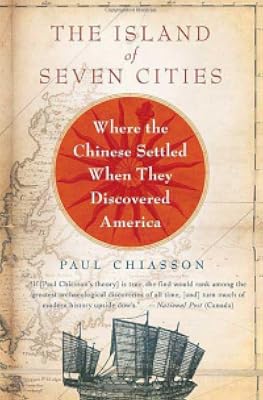
The Island of Seven Cities: Where the Chinese Settled When They Discovered America
by Paul Chiasson
On This Page
Description
In 2003, Paul Chiasson climbed a mountain he never explored on the island where he grew up. Cape Breton, one of the oldest points of exploration in the Americas, is littered with remnants of old settlements. The road he found that day was unique. Consistently wide and formerly bordered with stone walls, the road had been a major undertaking. For the next two years, he surveyed the history of Europeans in North America, and came to a stunning conclusion: The ruins he came upon did not belong show more to the Portuguese, French, or English and pre-dated John Cabot's "discovery" of the island in 1497. With aerial and site photographs, maps, drawings and his expertise in the history of architecture, Chiasson pieces together clues to one of the world's great mysteries. The Island of Seven Cities reveals the existence of a large Chinese colony that thrived on Canadian shores well before the European Age of Discovery and unveils the first tangible proof that the Chinese were in the New World before Columbus. show lessTags
Recommendations




































Member Reviews
The Island of Seven Cities: Where the Chinese Settled When They Discovered America by Paul Chiasson
For so many years, North Americans have been taught that Columbus was the discoverer of "The New World" when this could not be furthest from the truth. Vikings of the ninth century were crossing from Europe to Greenland and Iceland fairly regularly. The Vikings, in fact, established a colony on the northern end of Newfoundland. Chiasson presents his information that the Chinese actually settled on the northern end of Cape Breton Island, Nova Scotia, Canada.
Columbus had known about the Island of Seven Cities twenty years before he "found" the New World" so obviously somebody had been there long before him and his ilk. Chiasson believes that show more the earliest inhabitants of Cape Breton Island, besides the native Amerindian populations, were Chinese explorers. Gavin Menzies in his book, 1424, comes to the same conclusions about the Chinese; they established colonies in many different parts of the world.
I found this book very exciting and captivating. Chaisson tells this fascinating story with an eye to building suspense and intrigue along the way until he can successfully get the reader to agree that the Chinese cold be responsible for settling in Cape Breton Island.
Anybody looking for some historical detective reading along the sme lines as Menzies would appreciate this book. I found it captivating.
Happy Reading, show less
For so many years, North Americans have been taught that Columbus was the discoverer of "The New World" when this could not be furthest from the truth. Vikings of the ninth century were crossing from Europe to Greenland and Iceland fairly regularly. The Vikings, in fact, established a colony on the northern end of Newfoundland. Chiasson presents his information that the Chinese actually settled on the northern end of Cape Breton Island, Nova Scotia, Canada.
Columbus had known about the Island of Seven Cities twenty years before he "found" the New World" so obviously somebody had been there long before him and his ilk. Chiasson believes that show more the earliest inhabitants of Cape Breton Island, besides the native Amerindian populations, were Chinese explorers. Gavin Menzies in his book, 1424, comes to the same conclusions about the Chinese; they established colonies in many different parts of the world.
I found this book very exciting and captivating. Chaisson tells this fascinating story with an eye to building suspense and intrigue along the way until he can successfully get the reader to agree that the Chinese cold be responsible for settling in Cape Breton Island.
Anybody looking for some historical detective reading along the sme lines as Menzies would appreciate this book. I found it captivating.
Happy Reading, show less
This is a non-fiction that reads like a novel. The author took us on a personal journey of discovery where he played history detective on a ancient ruin the size of a shopping mall located on Cape Breton. Most of his research on the origin of the ruin was done at the Toronto Reference Library. Half of the book is on the early European explorations of the Maritime focusing on Cape Breton. This work contains all the intrigues of a treasure hunt. The book is surprisingly well written from someone that is not a professional writer or historian.
OK. Another mystic book that seems to totally ignore any facts that contradict the authors views. Still, and interesting tale.
Ratings
Members
- Recently Added By
Author Information

3 Works 242 Members
Paul Chiasson is the author of The Island of Seven Cities: Where the Chinese Settled When They Discovered America, a book that explores the possibility that early Chinese explorers settled in the Cape Dauphin area of Cape Breton years before Columbus made his famous voyage. He lives in Toronto.
Common Knowledge
- Original publication date
- 2006
- Important places
- Cape Breton Island, Nova Scotia, Canada
- Dedication
- TO MY FAMILY
Classifications
Statistics
- Members
- 234
- Popularity
- 139,043
- Reviews
- 3
- Rating
- (3.60)
- Languages
- English
- Media
- Paper, Ebook
- ISBNs
- 5
- ASINs
- 5