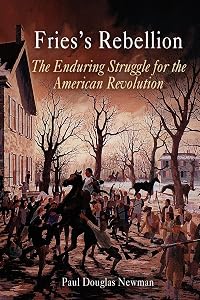
Fries's Rebellion: The Enduring Struggle for the American Revolution
by Paul Douglas Newman
On This Page
Description
In 1798, the federal government levied its first direct tax on American citizens, one that seemed to favor land speculators over farmers. In eastern Pennsylvania, the tax assessors were largely Quakers and Moravians who had abstained from Revolutionary participation and were recruited by the administration of John Adams to levy taxes against their patriot German Reformed and Lutheran neighbors.Led by local Revolutionary hero John Fries, the farmers drew on the rituals of crowd action and show more stopped the assessment. Following the Shays and Whiskey rebellions, Fries's Rebellion was the last in a trilogy of popular uprisings against federal authority in the early republic. But in contrast to the previous armed insurrections, the Fries rebels used nonviolent methods while simultaneously exercising their rights to petition Congress for the repeal of the tax law as well as the Alien and Sedition Acts. In doing so, they sought to manifest the principle of popular sovereignty and to expand the role of local people within the emerging national political system rather than attacking it from without.After some resisters were liberated from the custody of a federal marshal, the Adams administration used military force to suppress the insurrection. The resisters were charged with sedition and treason. Fries himself was sentenced to death but was pardoned at the eleventh hour by President Adams. The pardon fractured the presidential cabinet and splintered the party, just before Thomas Jefferson's and the Republican Party's "Revolution of 1800."The first book-length treatment of this significant eighteenth-century uprising, Fries's Rebellion shows us that the participants of the rebellion reengaged Revolutionary ideals in an enduring struggle to further democratize their country. show lessTags
Recommendations



Member Reviews
In the history of American public violence Fries's Rebellion is not exactly a household phrase. Frankly it wasn't even much of a rebellion. It was mostly just a tax revolt that became a bit overly rambunctious when some men detained for non-payment were rescued by their neighbors. That their neighbors appeared in the guise of the local militia was the point of ignition. This is seeing as 1799 was not a normal year, as the threat of war was in the air, and the Hamiltonians who dominated the administration of John Adams saw insubordination and rebellion in every shadow, leading to the political overreation that administration is best remembered for.
In examining the twists and turns of how this event came to pass, the author is most show more interested in teasing out the interests, values, and self-image of the German-American community at the center of this incident. What the author finds is a group of people who, while superficially prosperous, were under a fair amount of economic and cultural pressure and who took 1776's promise of popular sovereignty seriously in the face of the Federalist call to centralize power to cope with a dangerous world. It would be easy to write these people off as merely suffering from a bad case of localism, but the author depicts a well-informed group of individuals who knew when they were being disrepected and who were prepared to respond in a disciplined fashion. This is at time when the American society was only beginning to understand what practical party politics and public dissent would look like. That this lesson has to be relearned over time is also a tacit theme of this book.
Finally, while I found this to be a useful little monograph, there are times when it seemed that the author was getting a little bogged down in the details of his study; that is why I don't rate it a bit higher. show less
In examining the twists and turns of how this event came to pass, the author is most show more interested in teasing out the interests, values, and self-image of the German-American community at the center of this incident. What the author finds is a group of people who, while superficially prosperous, were under a fair amount of economic and cultural pressure and who took 1776's promise of popular sovereignty seriously in the face of the Federalist call to centralize power to cope with a dangerous world. It would be easy to write these people off as merely suffering from a bad case of localism, but the author depicts a well-informed group of individuals who knew when they were being disrepected and who were prepared to respond in a disciplined fashion. This is at time when the American society was only beginning to understand what practical party politics and public dissent would look like. That this lesson has to be relearned over time is also a tacit theme of this book.
Finally, while I found this to be a useful little monograph, there are times when it seemed that the author was getting a little bogged down in the details of his study; that is why I don't rate it a bit higher. show less
Ratings
Members
- Recently Added By
Lists

Best U.S. History Books (1754-1828)
363 works; 18 members
Author Information
6+ Works 49 Members
Paul Douglas Newman is Associate Professor of History at the University of Pittsburgh at Johnstown.
Awards and Honors
Common Knowledge
- People/Characters
- John Fries
- Important events
- Fries' Rebellion (1798 | 1799)
Classifications
- Genres
- Nonfiction, History, General Nonfiction, Politics and Government
- DDC/MDS
- 973.4 — History & geography History of North America United States Constitutional period (1789-1809)
- LCC
- E326 .N49 — History of the United States United States Revolution to the Civil War, 1775/1783-1861 By period 1789-1809. Constitutional period John Adams' administration, 1797-1801
- BISAC
Statistics
- Members
- 37
- Popularity
- 782,367
- Reviews
- 1
- Rating
- (3.80)
- Languages
- English
- Media
- Paper, Ebook
- ISBNs
- 3