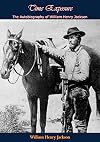
Time Exposure: The Autobiography of William Henry Jackson
by William Henry Jackson
On This Page
Description
The unmatchable autobiography of the pre-eminent American photographer of the 19th century William Henry Jackson. Jackson, who was also a renowned painter, lived a long and adventure filled life from boyhood in New York through the Civil War, the Westward expansion, the Mexican-American War to the outbreak of WWII. This book is an exciting and captivating reading.Tags
Recommendations






















Member Recommendations
rakerman Olmstead lived from 1822-1903, William Henry Jackson from 1843-1942. They both lived extraordinary, varied lives in the 19th Century, when today's United States was still very much a frontier in the west, and for a time at war with itself. Their paths intersect at Yosemite, whose protection owes much to the understanding of nature and political connections of Olmstead, and the amazing photographs of Jackson.
Member Reviews
Truly an excellent read. Jackson's autobiography doubles as an exploration of 18th century western history, which the author was heavily involved in.
My favorite part, though, was in the early chapters, where the author discusses the approaching Civil War from the viewpoint of a representative civilian. It seems he expected the army to quickly extinguish the rebellion. Of course, that's not the way things turned out. What caught my eye was the similarity of those sentiments to civilian expectations of most the American wars during my lifetime.
Anyway, I wish I'd been aware of this book back when I was studying American history in college. My history courses that covered that time period discussed the war mostly from the perspective of the show more country's political leadership--or from the perspective of the military leadership. This third perspective would have been helpful. show less
My favorite part, though, was in the early chapters, where the author discusses the approaching Civil War from the viewpoint of a representative civilian. It seems he expected the army to quickly extinguish the rebellion. Of course, that's not the way things turned out. What caught my eye was the similarity of those sentiments to civilian expectations of most the American wars during my lifetime.
Anyway, I wish I'd been aware of this book back when I was studying American history in college. My history courses that covered that time period discussed the war mostly from the perspective of the show more country's political leadership--or from the perspective of the military leadership. This third perspective would have been helpful. show less
William Henry Jackson was a remarkable man, with a life so full of activity that he only got around to writing his autobiography Time Exposure in 1940, when he was 97 years old.
After quite a lot of detail describing his early home life, his adventures get underway as he enlists in the army, ending up in Company K of the Twelfth Vermont Volunteers.
After the war, he settles into a comfortable life as a photographer's assistant, but following a romantic disappointment lights out for the West. He has an incredible career that ranges all over the Western United States, just one example of which is being the first man to photograph Yellowstone in 1871, images which helped in its being made into a National Park in 1872.
Following that, amongst show more other impressive adventures, he travels around the world with the "World's Transportation Commission", across India, Australia and Korea, ending up crossing Siberia by open sledge. Even after that, his life still holds many more future events.
It is a remarkable work that would qualify as excellent fiction, but is even the more interesting for being an account of a real life from the beginning stages of the settlement of the American West through to the mid-1900s. He records an incredible time of change and relatively speaking, quite a recent moment in history. It's amazing to think that at that time, less than 150 years ago, they had a civil war, and after that the railway was just pushing its way west. Los Angeles was a town of just 5000 people. All in all it's a fascinating first-hand encounter with an enthusiastic, adventurous photographer and painter.
My only wish would have been for more of his photos and paintings -- he selected his favourites I guess, but they are a small sample mostly showing people or locations he was particularly fond of. I suppose with a lifetime of thousands of photographs, it would take dozens of volumes to give his visual work justice. show less
After quite a lot of detail describing his early home life, his adventures get underway as he enlists in the army, ending up in Company K of the Twelfth Vermont Volunteers.
After the war, he settles into a comfortable life as a photographer's assistant, but following a romantic disappointment lights out for the West. He has an incredible career that ranges all over the Western United States, just one example of which is being the first man to photograph Yellowstone in 1871, images which helped in its being made into a National Park in 1872.
Following that, amongst show more other impressive adventures, he travels around the world with the "World's Transportation Commission", across India, Australia and Korea, ending up crossing Siberia by open sledge. Even after that, his life still holds many more future events.
It is a remarkable work that would qualify as excellent fiction, but is even the more interesting for being an account of a real life from the beginning stages of the settlement of the American West through to the mid-1900s. He records an incredible time of change and relatively speaking, quite a recent moment in history. It's amazing to think that at that time, less than 150 years ago, they had a civil war, and after that the railway was just pushing its way west. Los Angeles was a town of just 5000 people. All in all it's a fascinating first-hand encounter with an enthusiastic, adventurous photographer and painter.
My only wish would have been for more of his photos and paintings -- he selected his favourites I guess, but they are a small sample mostly showing people or locations he was particularly fond of. I suppose with a lifetime of thousands of photographs, it would take dozens of volumes to give his visual work justice. show less
Own and read a signed first edition. It is best to view this book in the sense of what he covered. Jackson saw an awful lot of the West ( and the world ) both geographically and chronologically. Really amazing and what we would all like to do I suppose. Finished 19.09.19.
Members
- Recently Added By
Author Information

15 Works 174 Members
Common Knowledge
- People/Characters
- William Henry Jackson
Classifications
Statistics
- Members
- 41
- Popularity
- 713,946
- Reviews
- 3
- Rating
- (4.75)
- Languages
- English
- Media
- Paper, Ebook
- ISBNs
- 6
- ASINs
- 4