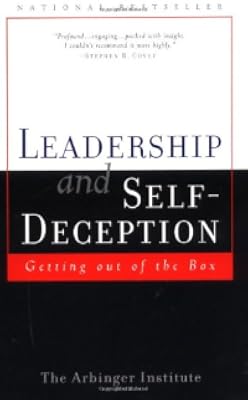
Leadership and Self-Deception: Getting Out of the Box
by The Arbinger Institute
On This Page
Description
This third edition of an international bestseller-over 2 million copies sold worldwide and translated into 33 languages-details how its powerful insights on motivation, conflict, and collaboration can benefit organizations as well as individuals. Since its original publication in 2000, Leadership and Self-Deception has become an international word-of-mouth phenomenon. Rather than tapering off, it sells more copies every year. The book's central insight--that the key to leadership lies not in show more what we do but in who we are--has proven to have powerful implications not only for organizational leadership but in readers' personal lives as well. Leadership and Self-Deception uses an entertaining story everyone can relate to about a man facing challenges at work and at home to expose the fascinating ways that we blind ourselves to our true motivations and unwittingly sabotage the effectiveness of our own efforts to achieve happiness and increase happiness. We trap ourselves in a "box" of endless self-justification. Most importantly, the book shows us the way out. Readers will discover what millions already have learned--how to consistently tap into and act on their innate sense of what's right, dramatically improving all of their relationships. show lessTags
Recommendations

























Member Reviews
An engaging presentation in narrative format regarding the difficulties which stem from self-deception and the need for personal justification, blame of others, and the problems these cause. An appeal to find the humanity in others and treat others accordingly.
I will not try to unpack the entire presentation of the book because the reader will have a lot of reasons to want to try to avoid the material. It's not the most comfortable process to explore, but very beneficial to do so.
The book is presented as a narrative involving a few characters and a corporation, and the reader is invited to go with "Tom" on his journey, and, ideally, engaging in the same kind of self-reflection as "Tom" does.
The narrative gets campy at times; the show more self-aggrandization of the book is a bit much; the lack of personality behind the authorship seems at odds with the core message. Nevertheless, a very necessary even if uncomfortable exploration of the self so that one might live more profitably for him or herself and interact better with others. show less
I will not try to unpack the entire presentation of the book because the reader will have a lot of reasons to want to try to avoid the material. It's not the most comfortable process to explore, but very beneficial to do so.
The book is presented as a narrative involving a few characters and a corporation, and the reader is invited to go with "Tom" on his journey, and, ideally, engaging in the same kind of self-reflection as "Tom" does.
The narrative gets campy at times; the show more self-aggrandization of the book is a bit much; the lack of personality behind the authorship seems at odds with the core message. Nevertheless, a very necessary even if uncomfortable exploration of the self so that one might live more profitably for him or herself and interact better with others. show less
Many blindly go into leadership roles to achieve a level of social prestige and power over others. However, that attitude does not last long as the spoils of ego satisfaction fade away quickly. To contrast, the Arbinger Institute offers a better way: service to one’s fellow human beings, centered around getting results for the company. When an organizational catches on to this purpose, its effectiveness can skyrocket. This fictional story illustrates how such a mindset can transform a company and a life towards becoming more effective.
In this fable, a skilled manager is engaged in struggles at a new workplace and with his wife and son at home. A situation of limited burnout transpires. The business’s leader calls him into his office show more one day and teaches him the company’s management techniques, centered around this abstract concept of “the box.” The technique takes root to transform the manager’s life as he realizes his ultimate value is in who he is, not his products. He learns that investing in himself helps him invest in others.
The general approach is not to focus on one’s personal needs, insecurities, and ambitions, but instead to involve oneself in the larger life of an organization. The book admits that this is not a cure-all for every sort of management malfunction. People’s employments may need to be terminated sometimes; we’re all selfish at moments, often multiple times a day; and changing oneself does not always induce others to change themselves. However, the focus on personal self-improvement first is an adage carried throughout centuries of spiritual wisdom.
This book doesn’t dive deeply into what to do when organizational structures go bad. It’s addressed to organizational leaders to implement change from the top down. However, many of today’s organizations are flatter than ever before, and “leadership from behind” is an increasingly common mandate to today’s workers. Sometimes, senior leaders pose more of a hindrance than a solution, and aside from offering senior leaders more inspiration, this book does not offer detailed advice when that quagmire occurs.
This book is generally addressed to those interested in organizational leadership. Its applications are extremely broad to many aspects of modern work life. Its impacts may not extend quite as far as its marketing material suggests, and its framework might not be as novel as it purports. Nonetheless, its message needs to continue to be heard by all of us in the trenches. How we help people – i.e., results – is much more important and lasting than mere self-interest. show less
In this fable, a skilled manager is engaged in struggles at a new workplace and with his wife and son at home. A situation of limited burnout transpires. The business’s leader calls him into his office show more one day and teaches him the company’s management techniques, centered around this abstract concept of “the box.” The technique takes root to transform the manager’s life as he realizes his ultimate value is in who he is, not his products. He learns that investing in himself helps him invest in others.
The general approach is not to focus on one’s personal needs, insecurities, and ambitions, but instead to involve oneself in the larger life of an organization. The book admits that this is not a cure-all for every sort of management malfunction. People’s employments may need to be terminated sometimes; we’re all selfish at moments, often multiple times a day; and changing oneself does not always induce others to change themselves. However, the focus on personal self-improvement first is an adage carried throughout centuries of spiritual wisdom.
This book doesn’t dive deeply into what to do when organizational structures go bad. It’s addressed to organizational leaders to implement change from the top down. However, many of today’s organizations are flatter than ever before, and “leadership from behind” is an increasingly common mandate to today’s workers. Sometimes, senior leaders pose more of a hindrance than a solution, and aside from offering senior leaders more inspiration, this book does not offer detailed advice when that quagmire occurs.
This book is generally addressed to those interested in organizational leadership. Its applications are extremely broad to many aspects of modern work life. Its impacts may not extend quite as far as its marketing material suggests, and its framework might not be as novel as it purports. Nonetheless, its message needs to continue to be heard by all of us in the trenches. How we help people – i.e., results – is much more important and lasting than mere self-interest. show less
If you could improve a relationship, a job, or any other interpersonal interaction simply by changing your own behavior, would you do it? The answer to this seems obvious, but the answer is at the core of this book - self-deception.
The bulk of this book is a fictional telling of a few days in a man's life who is a recently hired executive in a successful company. He is called in by his manager for a discussion, which is to be for two days. He is told that the discussion and training involved will be critical for his continued employment. Over these two days, his world view is changed - a more correct statement might be that his perceptions are changed. He is first presented with ideas. He considers them and then during a break tests show more them with varied results. He is prepared to reject the ideas but is then reinforced with supporting ideas by the CEO of the company, and his manager. He tests the ideas again, this time without really knowing that he is testing the ideas. He goes forth with a new mindset to his family, and treats them in way that shows that he sees them as people, rather than objects. The results are immediate, if not fully developed. He comes back the next day to discuss and discovers what happened, and what he can do to continue the behavior that produced positive results.
I enjoyed reading the story in this way (reading it as a fictional story), because it helped me to picture the direction of ones thoughts. The narrative progresses with ideas being presented, received, digested, and implemented. One of the strongest parts of the book is a section that goes over alternative approaches, and how each one of them fails. These alternatives are carefully considered and analyzed, so that it is clear why they will not work.
The idea of self-betrayal is key to understanding the whole book. We often think that others betray us in business, home, community, and that may be true, but what if we are the ones that are enabling, encouraging, directing this betrayal? Then it is indeed self-betrayal. The book illustrates how we form these kinds of self-betrayal relationships, and then illustrates how we can change from self-betrayal to outward awareness.
I know that this book is useful for multiple applications. I have already seen results in myself and those I interact with at work and at home. I highly recommend it for everyone. show less
The bulk of this book is a fictional telling of a few days in a man's life who is a recently hired executive in a successful company. He is called in by his manager for a discussion, which is to be for two days. He is told that the discussion and training involved will be critical for his continued employment. Over these two days, his world view is changed - a more correct statement might be that his perceptions are changed. He is first presented with ideas. He considers them and then during a break tests show more them with varied results. He is prepared to reject the ideas but is then reinforced with supporting ideas by the CEO of the company, and his manager. He tests the ideas again, this time without really knowing that he is testing the ideas. He goes forth with a new mindset to his family, and treats them in way that shows that he sees them as people, rather than objects. The results are immediate, if not fully developed. He comes back the next day to discuss and discovers what happened, and what he can do to continue the behavior that produced positive results.
I enjoyed reading the story in this way (reading it as a fictional story), because it helped me to picture the direction of ones thoughts. The narrative progresses with ideas being presented, received, digested, and implemented. One of the strongest parts of the book is a section that goes over alternative approaches, and how each one of them fails. These alternatives are carefully considered and analyzed, so that it is clear why they will not work.
The idea of self-betrayal is key to understanding the whole book. We often think that others betray us in business, home, community, and that may be true, but what if we are the ones that are enabling, encouraging, directing this betrayal? Then it is indeed self-betrayal. The book illustrates how we form these kinds of self-betrayal relationships, and then illustrates how we can change from self-betrayal to outward awareness.
I know that this book is useful for multiple applications. I have already seen results in myself and those I interact with at work and at home. I highly recommend it for everyone. show less
I came into work one day, and this book was on my desk with no note attached. I picked it up, flipped it over, and read the first quote on the back: "Fascinating, thought provoking, and insightful! This book is a wake-up call to all those who think they're good with people..."
Wait. What?! Was somebody trying to tell me something? Was this some passive-aggressive attempt at telling me I'm a bear to work with? I could actually feel my heart drop and hit my stomach. I hid the book under my purse and tried to check my email, but I just couldn't concentrate.
I peeked into my neighbor's cube and said in just-barely-above-a-whisper, "Hey, I had some book on my desk when I came in. Do you know what that's about?"
"Oh, yeah. Our boss left them for show more us. She wants us to read them before our group meeting in 2 weeks."
My heart sprung back up to its rightful position in my chest cavity. No secret message from a disgruntled co-worker, hooray!
But...assigned reading for work? I have a spreadsheet of 643 book titles I want to read and a stack of 20-ish books from the library all in various stages of being read and flipped through and referenced, and I'm what—just supposed to work this in?
I eventually relented though, and I'm glad I did.
Don't get me wrong—this is one of those cheesy how-to-be-a-good-leader parables. But the message is a good one, and it's one we could all stand to be reminded of from time to time. Our co-workers deserve our respect and understanding. Self-deception gets in the way of that.
Self-deception is the term they use to describe anytime you have an impulse to help another person, but you ignore the impulse and "deceive" yourself into believing you're justified for not honoring the impulse. For example, let's say it's rush hour and you're driving down the highway. Someone in the next lane has their blinker on and is desperately trying to find an open spot to get over. For a split second, you have an impulse to be nice and let them over. But you don't. We've all done that, right? Have you ever noticed that it's only after you've already decided not to let the person over that you start coming up with reasons for why you're justified in your behavior? You're in a hurry, you're gonna be late, they should have planned ahead if they really needed to get in your lane, etc. That's self-deception. It's just a handy label for something we've all experienced.
Self-deception happens everywhere—even at work. In a workplace, the consequences of rampant self-deception are more than a little twinge of guilt for not letting someone over on the highway. Self-deception can poison how you view your co-workers, and before you know it you're working against each other instead of with each other towards a common goal.
Let me give you an example. When I starting reading this book, I had a meeting at work coming up, which I was going to lead. I had asked all the attendees to send me some information so I could compile it before the meeting. A couple people cut it down to the wire, leaving me only a couple hours to compile their information before the meeting. Because of my part-time work schedule, I almost didn't get it done in time. So you can imagine that I was pretty annoyed.
Fast forward a couple weeks. Now one of the people who had given me their information late needed something from me by the end of the week. I knew that it would be unfair of me to send them the information they needed at the last minute. But I had a lot of big things going on that week, and I kept putting off what that person needed from me. And yet, it was only after I made the decision to put it off each time that I thought of what she had done to me a couple weeks prior. I felt justified in putting off what she now needed from me. Was I enhancing her efficiency at work? No. Was I enhancing my own efficiency? Not really, because I still needed to get the work done—it was just a matter of when I would do it. What about the next time I need something from her, and she remembers my behavior? Will she be compelled to help me out?
This is just a small example, but imagine this happening every day in every cubicle/office in your workplace. Because it does. Every single person is always making little decisions like this that drag down your collective efficiency and productivity. Worse than that, over time we're also letting self-deception color our opinions of our co-workers. We think they're lazy or stupid or irresponsible. I certainly started to think that person was irresponsible when they didn't send me what I needed when I needed it. Sure—sometimes we have to work with some real doozies. But when you're never satisfied with the abilities of the people who surround you at work and you're always complaining about them, is it really your co-workers who are the problem?
If we all began to honor those little impulses to help our co-workers and to work together, not only would we get a lot more done but we'd be a lot happier at work too. I don't know about you, but when I go into work and feel confident in the people who will be working alongside me, I'm in a much better mood than if I feel like I'm surrounded by lazy and/or incompetent people. show less
Wait. What?! Was somebody trying to tell me something? Was this some passive-aggressive attempt at telling me I'm a bear to work with? I could actually feel my heart drop and hit my stomach. I hid the book under my purse and tried to check my email, but I just couldn't concentrate.
I peeked into my neighbor's cube and said in just-barely-above-a-whisper, "Hey, I had some book on my desk when I came in. Do you know what that's about?"
"Oh, yeah. Our boss left them for show more us. She wants us to read them before our group meeting in 2 weeks."
My heart sprung back up to its rightful position in my chest cavity. No secret message from a disgruntled co-worker, hooray!
But...assigned reading for work? I have a spreadsheet of 643 book titles I want to read and a stack of 20-ish books from the library all in various stages of being read and flipped through and referenced, and I'm what—just supposed to work this in?
I eventually relented though, and I'm glad I did.
Don't get me wrong—this is one of those cheesy how-to-be-a-good-leader parables. But the message is a good one, and it's one we could all stand to be reminded of from time to time. Our co-workers deserve our respect and understanding. Self-deception gets in the way of that.
Self-deception is the term they use to describe anytime you have an impulse to help another person, but you ignore the impulse and "deceive" yourself into believing you're justified for not honoring the impulse. For example, let's say it's rush hour and you're driving down the highway. Someone in the next lane has their blinker on and is desperately trying to find an open spot to get over. For a split second, you have an impulse to be nice and let them over. But you don't. We've all done that, right? Have you ever noticed that it's only after you've already decided not to let the person over that you start coming up with reasons for why you're justified in your behavior? You're in a hurry, you're gonna be late, they should have planned ahead if they really needed to get in your lane, etc. That's self-deception. It's just a handy label for something we've all experienced.
Self-deception happens everywhere—even at work. In a workplace, the consequences of rampant self-deception are more than a little twinge of guilt for not letting someone over on the highway. Self-deception can poison how you view your co-workers, and before you know it you're working against each other instead of with each other towards a common goal.
Let me give you an example. When I starting reading this book, I had a meeting at work coming up, which I was going to lead. I had asked all the attendees to send me some information so I could compile it before the meeting. A couple people cut it down to the wire, leaving me only a couple hours to compile their information before the meeting. Because of my part-time work schedule, I almost didn't get it done in time. So you can imagine that I was pretty annoyed.
Fast forward a couple weeks. Now one of the people who had given me their information late needed something from me by the end of the week. I knew that it would be unfair of me to send them the information they needed at the last minute. But I had a lot of big things going on that week, and I kept putting off what that person needed from me. And yet, it was only after I made the decision to put it off each time that I thought of what she had done to me a couple weeks prior. I felt justified in putting off what she now needed from me. Was I enhancing her efficiency at work? No. Was I enhancing my own efficiency? Not really, because I still needed to get the work done—it was just a matter of when I would do it. What about the next time I need something from her, and she remembers my behavior? Will she be compelled to help me out?
This is just a small example, but imagine this happening every day in every cubicle/office in your workplace. Because it does. Every single person is always making little decisions like this that drag down your collective efficiency and productivity. Worse than that, over time we're also letting self-deception color our opinions of our co-workers. We think they're lazy or stupid or irresponsible. I certainly started to think that person was irresponsible when they didn't send me what I needed when I needed it. Sure—sometimes we have to work with some real doozies. But when you're never satisfied with the abilities of the people who surround you at work and you're always complaining about them, is it really your co-workers who are the problem?
If we all began to honor those little impulses to help our co-workers and to work together, not only would we get a lot more done but we'd be a lot happier at work too. I don't know about you, but when I go into work and feel confident in the people who will be working alongside me, I'm in a much better mood than if I feel like I'm surrounded by lazy and/or incompetent people. show less
I'm generally sceptical about leadership books, mainly because of the rare instances that anyone gets its right. This book comes close. In a bit of a misleading way.
The concepts of self-deception, self-justification and confabulation are not new to the world, even outside that of psychology. "Mistakes were made, but not by me", was a book that I recently read on the subject and absolutely loved. This book seemed like an extension of that, albeit with a specific story and scenario in mind.
Leadership is just a small part of the book, which mainly talks about relationships in general and how we need it up due to self-deception.
And from that perspective, the fictional narrative presented here makes its much easier to understand how much show more impact self-deception and accompanying confabulation has on how we do things.
I liked the book. It was short, or rather " not unnecessarily long", funny and ready to read and understand. It's broader implications makes it a good read for everyone and not just those who want to become better leaders. show less
The concepts of self-deception, self-justification and confabulation are not new to the world, even outside that of psychology. "Mistakes were made, but not by me", was a book that I recently read on the subject and absolutely loved. This book seemed like an extension of that, albeit with a specific story and scenario in mind.
Leadership is just a small part of the book, which mainly talks about relationships in general and how we need it up due to self-deception.
And from that perspective, the fictional narrative presented here makes its much easier to understand how much show more impact self-deception and accompanying confabulation has on how we do things.
I liked the book. It was short, or rather " not unnecessarily long", funny and ready to read and understand. It's broader implications makes it a good read for everyone and not just those who want to become better leaders. show less
This one is infuriatingly patronizing, and I felt like I was reading a very very long-form variant of the old Goofus and Gallant cartoons at times, but the main idea of the book seems sound. As with so many of these business books I'm reading, I feel like it would have made a great article but a whole book devoted to it tends to overwork the material.
I find myself wondering all the time, "How can [that person] possibly see the world that way/reach that conclusion/think that? How are they not more self aware? Why am I getting so frustrated with this person who is clearly having a different experience than I am?" This books gives you the answer. I've learned this lesson in other formats, but this short book presents it in a very accessible way. Even though the business story approach is a little stilted, it's still a quick read. It provides a very simple but profound way to be aware of your internal state-of-mind and how you relate to other people in both professional and personal settings.
Read the other reviews and the blurbs. It's as amazing as everyone says, and I don't really have show more much to add. show less
Read the other reviews and the blurbs. It's as amazing as everyone says, and I don't really have show more much to add. show less
Members
- Recently Added By
Lists

Office Library
41 works; 1 member
Author Information

20 Works 3,472 Members
The Arbinger Institute is a worldwide training, consulting, and coaching organization whose programs and methodologies are based on forty-five years of research in the psychology of human behavior and motivation and more than thirty-five years of experience working with organizations worldwide. Headquartered in the United States, Arbinger has show more operations around the world, including throughout the Americas, Europe, Africa, the Middle East, Oceania, and Asia. show less
Some Editions
Awards and Honors
Awards
Common Knowledge
- Original title
- Leadership and Self-Deception: Getting Out of the Box
- Original publication date
- 2006
- People/Characters*
- Ignaz Semmelweis
- Epigraph
- It is in the darkness of their eyes that men get lost. --Black Elk
- First words
- It was two months ago to the day that I first entered the secluded campus-style headquarters of Zagrum Company to interview for a senior management position.
- Blurbers
- Covey, Stephen R.; Francesconi, Louise; Wheelright, Steven C.; Didonato, Tom A.; Hauth, Doug; Ashworth, Mark (show all 27); Edwards, Robert W.; Christensen, Bruce L.; Whitworth, Laura; Harnish, Verne; Chalk, Rick; Gay, Robert C.; Stapley, Michael; Holt, R. Douglas; Foggin, Peter; Cannon, Mark W.; Steinwedel, Janet; Merchant, Michael J.; Young, Steve; Browne, Dave; Lauritsen, Ed; Denny, Neil; Sanford, David; Kugler, Ed; Ballif, Mark; Beard, Jason; Hamill, Robin
*Some information comes from Common Knowledge in other languages. Click "Edit" for more information.
Classifications
Statistics
- Members
- 2,311
- Popularity
- 8,565
- Reviews
- 35
- Rating
- (3.94)
- Languages
- 8 — Danish, Dutch, English, French, German, Italian, Portuguese, Spanish
- Media
- Paper, Audiobook, Ebook
- ISBNs
- 52
- UPCs
- 2
- ASINs
- 17