
M. C. Escher: The Graphic Work
by M. C. Escher
On This Page
Description
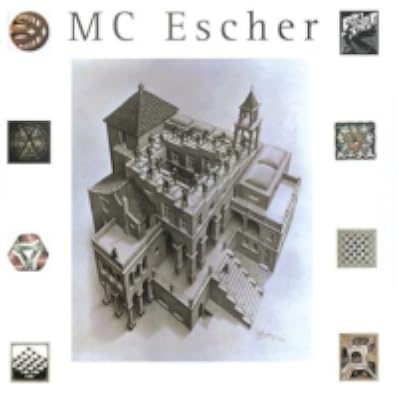
M.C. Escher (1898-1972) was born in Leeuwarden, Netherlands. He received his first drawing lessons during secondary school from F.W. van der Haagen, who also taught him the block printing, thus fostering Escher's innate graphic talents. From 1912 to 1922 he studied at the School of Architecture and Ornamental Design in Haarlem, where he was instructed in graphic techniques by S. Jessurun de Mesquita, who greatly influenced Escher's further artistic development. Between 1922 and 1934 the show more artist lived and worked in Italy. Afterwards Escher spent two years in Switzerland and five in Brussels before finally moving back to Barn in Holland, where he died in 1972. M.C. Escher is not a surrealist drawing us into his dream world, but an architect of perfectly impossible worlds who presents the structurally unthinkable as though it were a law of nature. show lessTags
Recommendations

























Member Reviews
I've been fascinated with and delighted by M.C. Escher's art since I first encountered his famous "Relativity" print as a small child. I love the way he way he plays with perspective, with dimensions, with background and foreground, with visual paradoxes, and recursion, and all kinds of almost mathematical ideas, all while retaining a sense of whimsy.
This particular volume reproduces 76 Escher prints (at least of couple of which, much to my surprise, I don't think I'd seen before), with the author himself providing a short introduction and a paragraph or so of commentary on each piece. These commentaries are often not much more than a simple description of what it is we're looking at, and yet even so I found many of them gave me show more interesting new insights. After all these years, it's rather wonderful to know I can still see new things in Escher's work. show less
This particular volume reproduces 76 Escher prints (at least of couple of which, much to my surprise, I don't think I'd seen before), with the author himself providing a short introduction and a paragraph or so of commentary on each piece. These commentaries are often not much more than a simple description of what it is we're looking at, and yet even so I found many of them gave me show more interesting new insights. After all these years, it's rather wonderful to know I can still see new things in Escher's work. show less
Escher is enlightening, mind-bending and if the essence (not the stories) of the sci-fi genre of other worlds could be painted instead of written, it would look like this.
Very simply, an excellent primer on one of the premier artists of our generation.
Following the brief introduction is the "Classification and Description of the Numbered Productions", 76 prints are listed and each is furnished with a brief description or explanation. Following that are the prints themsleves, each shown full-page in size (or as large as page format will allow), eight of which are shown in colour. In addition to the 72 prints there are a further 10 illustrations included.
This is a well produce book with good quality illustrations.
This is a well produce book with good quality illustrations.
Art critics be damned. I love to look at M.C. Escher's art.
Unique drawings of surreal worlds.
Per Inge Kvindesland liked Escher and bought this book.
Members
- Recently Added By
Author Information

Some Editions
Series
Belongs to Publisher Series
Common Knowledge
- Canonical title
- M. C. Escher: The Graphic Work
- Original title
- Grafiek en tekeningen
- Original publication date
- 1959
- People/Characters
- M. C. Escher
- First words
- Anyone who applies himself, from his early youth, to the practice of graphic techniques may well reach a stage at which he begins to hold as his highest ideal the complete mastery of his craft.
The seven prints in this group, selected from a large number which were made before 1937, display no unity as far as their subject matter is concerned. - Last words
- (Click to show. Warning: May contain spoilers.)In 1934 he left Italy, spent two years in Switzerland and five years in Brussels before settling in Baarn (Holland) in 1941, where he died on 27 March 1972, at the age of 73 years.
- Original language
- Dutch
- Disambiguation notice*
- Verscheen eerder bij Koninklijke Erven J.J. Tijl N.V. in Zwolle
*Some information comes from Common Knowledge in other languages. Click "Edit" for more information.
Classifications
Statistics
- Members
- 2,839
- Popularity
- 6,365
- Reviews
- 15
- Rating
- (4.14)
- Languages
- 19 — Catalan, Czech, Danish, Dutch, English, Finnish, French, German, Greek, Hebrew, Hungarian, Italian, Multiple languages, Norwegian, Polish, Russian, Spanish, Swedish, Portuguese (Portugal)
- Media
- Paper, Ebook
- ISBNs
- 87
- ASINs
- 32