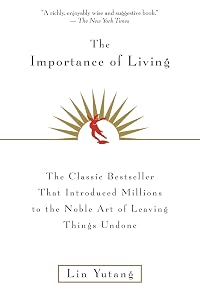
The Importance of Living
by Lin Yutang
On This Page
Description
From the Publisher: The Importance of Living is a wry, witty antidote to the dizzying pace of the modern world. Lin Yutang's prescription is the classic Chinese philosophy of life: Revere inaction as much as action, invoke humor to maintain a healthy attitude, and never forget that there will always be plenty of fools around who are willing-indeed, eager-to be busy, to make themselves useful, and to exercise power while you bask in the simple joy of existence. At a time when we're show more overwhelmed with wake-up calls, here is a refreshing, playful reminder to savor life's simple pleasures. show lessTags
Recommendations















Member Reviews
La importancia de vivir es la obra de referencia en Occidente para conocer, desde una perspectiva moderna, la ancestral y rica cultura oriental. Asuntos como el sentido del ocio, la felicidad, la naturaleza, el viaje, la cultura o la religión son abordados por Lin Yutang con una amena combinación de conocimiento teórico y experiencia personal que lo convierten en un magnífico manual de sabiduría concreta que nos ayuda a conocernos a nosotros mismos y nuestras posibilidades. A partir a menudo de anécdotas en las que todos podemos reconocernos o de actitudes y comportamientos que no nos son ajenos, Lin Yutang invita a dedicarles una mirada crítica y a verlas con nuevos ojos.
Sternness of appearance and correctness of behavior are what we moderns tend to assume when thinking of the Confucian way in pre-modern China. However, Chinese thought and character have a lighter side which is explained in "The Importance of Living" (1937) by Lin Yutang (1895-1976). The book is a collection of essays with titles such as “On Having a Stomach,âÂ? âÂÂThe Cult of the Idle Life,âÂ? âÂÂOn Being Wayward and Incalculable,âÂ? and âÂÂGood Taste in Knowledge.âÂ? It was a best seller in the mid-1930s, as Americans were sympathetic with the Chinese who were suffering at the hand of Japanese invaders (JapanâÂÂs war against China cost about 20 million Chinese lives).
Lin show more mistrusted the arrogance of the intellect and scientism, the belief that the investigative methods of the physical sciences are applicable or justifiable in all fields of inquiry, such as psychology and politics. He writes:
"Philosophy in the Western sense seems to the Chinese eminently idle. ⦠In its preoccupation with logic, which concerns itself with the method of arrival at knowledge, and epistemology, which poses the question of possibility of knowledge, it has forgotten to deal with the knowledge of life itself. . . . The German philosophers are the most frivolous of all; they court truth like ardent lovers, but seldom propose to marry her."
In the Taoist tradition, Lin says the point is not to âÂÂhave a great philosophy or have a few great philosophersâÂ? but rather it is âÂÂto take things philosophically,âÂ? to live in a way that makes life not only bearable but delightful. Reading is key to enjoying life: âÂÂ⦠[I]f one knows the enjoyment of reading, one can study anywhere, even in the best schools.âÂ?
Aside from the sage advice of âÂÂEasy does it,âÂ? the other appeal of this book is that Lin provides translations of Chinese poets and idlers that readers would never find on their own. For instance, his passages from poet and âÂÂgay geniusâÂ? Su Tungpo are wonderful. Su's four maxims for long life are in fact attainable: having leisure equals having power, going to bed early equals having wealth, a leisurely stroll is as enjoyable as a drive, and eating late is as good as eating meat. As Lin was bilingual, the translations are trustworthy and smooth. Anyway, this book is a delight. show less
Lin show more mistrusted the arrogance of the intellect and scientism, the belief that the investigative methods of the physical sciences are applicable or justifiable in all fields of inquiry, such as psychology and politics. He writes:
"Philosophy in the Western sense seems to the Chinese eminently idle. ⦠In its preoccupation with logic, which concerns itself with the method of arrival at knowledge, and epistemology, which poses the question of possibility of knowledge, it has forgotten to deal with the knowledge of life itself. . . . The German philosophers are the most frivolous of all; they court truth like ardent lovers, but seldom propose to marry her."
In the Taoist tradition, Lin says the point is not to âÂÂhave a great philosophy or have a few great philosophersâÂ? but rather it is âÂÂto take things philosophically,âÂ? to live in a way that makes life not only bearable but delightful. Reading is key to enjoying life: âÂÂ⦠[I]f one knows the enjoyment of reading, one can study anywhere, even in the best schools.âÂ?
Aside from the sage advice of âÂÂEasy does it,âÂ? the other appeal of this book is that Lin provides translations of Chinese poets and idlers that readers would never find on their own. For instance, his passages from poet and âÂÂgay geniusâÂ? Su Tungpo are wonderful. Su's four maxims for long life are in fact attainable: having leisure equals having power, going to bed early equals having wealth, a leisurely stroll is as enjoyable as a drive, and eating late is as good as eating meat. As Lin was bilingual, the translations are trustworthy and smooth. Anyway, this book is a delight. show less
The Importance of Living is a number of essays about the importance of enjoying life and ways to do so. In some ways, the author's ideas are kind of silly, but they are presented in such a non-pushy way that they the unpleasant ideas are easy to forget. However, his attitudes towards women are infuriating. At one point the author talks about how it is best for people to be natural... and women require lipstick to be natural. At another point, he makes this statement
This book may have been first published in 1937, but I still find the attitude towards women in this book excessively condescending.
Still, the general message of the book was nice, although not particularly noteworthy or inspiring. I agree that it is good to take things easily and to notice the world around us and appreciate nature and each other. It is good to make sure one's truths are consistent with human nature as well as with logic. show less
Is it merely because woman is more charming and more graceful in a chiffon dress than in a business jacket, or is it merely my imagination? The gist of the matter seems to lie in the fact that women at home are like fish in water. Clothe women in business jackets and men willshow more
regard them as coworkers with the right to criticize, but let them float about in georgette or chiffon one out of the seven office hours in the day and men will give up any idea of competing with them, and will merely sit back and wonder and gasp.
This book may have been first published in 1937, but I still find the attitude towards women in this book excessively condescending.
Still, the general message of the book was nice, although not particularly noteworthy or inspiring. I agree that it is good to take things easily and to notice the world around us and appreciate nature and each other. It is good to make sure one's truths are consistent with human nature as well as with logic. show less
A witty and humane book that ranges in the most relaxed of ways over two millenia of Chinese writing about how we should live. Marred only by a short section containing atavistic views abut women, this is a marvellously refreshing rumination about how to be happy.
So far, Yuntang succeeds in balancing some excesses of European philosophy - and my nemesis, the Beast Critical Pedagogy - by essaying on his experiences with Chinese philosophy. An exception to this: the Confucious-laden musings.
I first read this book in 1962 and it has been the cornerstone of my philosophy ever since. The essence of the philosophy can be summed up in a quote at the beginning of the book, "Only those who take leisurely what the people of the world are busy about can be busy about what the people of the world take leisurely." It also warns about the dangers of too much concern with wealth, fame and accomplishment.
'[T]here are plenty of historical guides that offer sound advice on leading a joyful and fulfilling life in tumultuous times. Take The Pillow Book, for example, a magnificent collection of lists, gossip and life hacks written in around 1,000AD by Sei Shonagon, a lady of the Japanese court. Or Chinese writer Lin Yutang’s wry 1937 guide, The Importance of Living, whose chapters include “The scamp as ideal” and “On tea and friendship”. I’m drawn to texts that traverse the wide landscape of pleasure and humour over those that offer bristling plans of action.' — Nilanjana Roy, in the Financial Times https://www.ft.com/content/586309a1-3939-4936-b3a6-3bba2f2f2328
Members
- Recently Added By
Lists

Publisher's Weekly NON-Fiction list - 1912 - 1975
486 works; 4 members
Author Information

168+ Works 3,330 Members
Though he was never considered to be a serious original thinker or a leading writer in his native China, Lin Yu-t'ang's role as an essayist and popularizer of things Chinese in the West is worthy of attention. He was a native of Changchow in Amoy, son of a Presbyterian minister, and third-generation Christian. He was brought up in a strict show more household and prepared for the ministry, and after middle school he was sent to the Protestant College of Amoy. In 1911 he entered the famous St. John's University in Shanghai, and it was during his time there that he became disillusioned with the choice of a religious career and renounced Christianity. After graduation (with a rather weak academic record), Lin Yu-t'ang became a professor of English at Tsinghua University because his grounding in foreign languages was much stronger than in classical Chinese. In 1919 he decided to pursue further study in the United States, where he spent one year at Harvard University and then went on to France where he worked for the YMCA. He moved to Germany for a term, and at last in 1923 earned a Ph.D. in Leipzig in the field of archaic Chinese phonology. Lin Yu-t'ang then returned home and tried out various teaching posts, and in 1927 became secretary to the Ministry of Foreign Affairs in the Wuhan government. But politics was not to his liking, and he resigned in the following year. In 1932 he founded the Analects Fortnightly, a magazine of wit and satire that proved to be an instant popular success. Two years later he began another periodical, This Human World, which contained short essays. Unfortunately, his satire angered intellectuals on both the Left and the Right, and this was the beginning of his lifelong friction with Chinese literary and academic circles. In 1936, feeling hostility at home but an increased demand for his writings in the West, Lin Yu-t'ang went to New York City and remained there until 1943, when he went back home to lecture briefly and again became embroiled in controversy. However, in the United States, his essays and ideas were greeted with great enthusiasm. Early in 1954 he was appointed chancellor of the new Chinese University in Singapore, but, because of a disagreement with the trustees on policy, he and his staff left early in 1955 before the university opened its doors. Not long after this, in New York, he and his wife publicly announced their reconversion to Christianity. In addition to his many books of essays, Lin Yu-t'ang published a novel, Moment in Peking, a saga about a Chinese family spanning the years 1900--38. He also published a number of translations of classical Chinese works, the best of which is perhaps Shen Fu's Six Chapters of a Floating Life, the moving autobiographical account of a happy marriage marred by parental disapproval and the tragic early death of the wife. Lin Yu-t'ang's writings are marked by an appreciation of both Eastern and Western culture, and their sparkling, idiomatic English style has endeared him to thousands of Western readers. (Bowker Author Biography) show less
All Editions
Some Editions
Awards and Honors
Awards
Distinctions
Series
Belongs to Publisher Series
Zephyr Books (57)
Common Knowledge
- Canonical title
- The Importance of Living
- Original publication date
- 1937
- First words
- In what follows I am presenting the Chinese point of view, because I cannot help myself.
- Last words
- (Click to show. Warning: May contain spoilers.)One has reason to express a reassurance in the capacities of the human mind, to believe that the human mortal mind, limited as it is, is something infinitely higher than the intellect of the reckless drivers of Europe, and that eventually we shall be able to live peaceably because we shall have learned to think reasonably.
Classifications
Statistics
- Members
- 969
- Popularity
- 27,149
- Reviews
- 17
- Rating
- (4.02)
- Languages
- 14 — Chinese, Danish, Dutch, English, Estonian, Finnish, French, German, Hungarian, Italian, Norwegian (Bokmål), Portuguese, Spanish, Swedish
- Media
- Paper, Ebook
- ISBNs
- 56
- ASINs
- 25