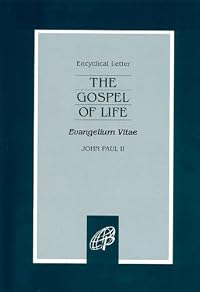
The Gospel of Life: Evangelium Vitae
by John Paul II
Encyclicals of John Paul II (11), Papal Magisterial Documents (Encicliche — 1995)
On This Page
Description
Reaffirming the greatness and inestimable value of human life, Pope John Paul II discusses in this encyclical letter the present-day legal, ethical, and moral threats to life.Tags
Recommendations






Member Recommendations
Member Reviews
Two cultures oppose each other. On one side stands the "culture of death," a culture grounded on the idea that life is an accident of time and space, that life and death are equally devoid of value, and that self-actualization is the highest good — even if that requires the sacrifice of life. On the other side stands the "culture of life," a culture grounded on the belief that life is a gift and duty bestowed by God, that life bears eternal value over death, and that the nurturing of life is the highest good — even if that requires the sacrifice of self.
These are the terms laid out in Pope John Paul II's encyclical "Evangelium Vitae," or "The Gospel of Life." Non-Catholic readers will find themselves filtering out uniquely Catholic show more artifacts, such as the entire conclusion which boils down to an encomium of devotion to Mary. The discerning Protestant reader will often detect the Magisterium's claim to interpret Scripture with full and final authority rather than the other way around.
There are also tough ethical topics which require further thought. For example, John Paul II argues that euthanasia is unacceptable in part because it denies the sanctifying power of suffering, yet he also concedes that palliation is acceptable. If we deny a right to die based on intolerable and terminal suffering, and we deny it on the grounds that suffering is never hopeless but is rather a channel of sanctifying grace, should we not refuse palliative care on the grounds that we're limiting the divine power of that suffering? Similar conundrums could be posed to the Church's opposition to chemical contraception on the one hand and its promotion of "conception avoidance" through natural planning methods on the other, when consistency would seem to dictate that any attempt to "avoid life" is out of bounds.
However, there will always be thorny ethical dilemmas at the shadowy nexus of life and death. All of this is outweighed by the encyclical's powerful promotion of a holistic and all-encompassing love for human life in all its stages, including the middle bits that pro-life advocates sometimes overlook. I doubt there exists a more tightly-written defense of life in our contemporary context, and it should strike the conscience of anyone who finds his or her moral sense dulled by the sheer weight of modernity and the overwhelming power of the "culture of death." I recommend this to any reader who wants to be confronted by and renewed to an appreciation that each human life is beautiful, valuable, and inviolable in dignity — from very beginning to very end, and at every precious stage along the journey. show less
These are the terms laid out in Pope John Paul II's encyclical "Evangelium Vitae," or "The Gospel of Life." Non-Catholic readers will find themselves filtering out uniquely Catholic show more artifacts, such as the entire conclusion which boils down to an encomium of devotion to Mary. The discerning Protestant reader will often detect the Magisterium's claim to interpret Scripture with full and final authority rather than the other way around.
There are also tough ethical topics which require further thought. For example, John Paul II argues that euthanasia is unacceptable in part because it denies the sanctifying power of suffering, yet he also concedes that palliation is acceptable. If we deny a right to die based on intolerable and terminal suffering, and we deny it on the grounds that suffering is never hopeless but is rather a channel of sanctifying grace, should we not refuse palliative care on the grounds that we're limiting the divine power of that suffering? Similar conundrums could be posed to the Church's opposition to chemical contraception on the one hand and its promotion of "conception avoidance" through natural planning methods on the other, when consistency would seem to dictate that any attempt to "avoid life" is out of bounds.
However, there will always be thorny ethical dilemmas at the shadowy nexus of life and death. All of this is outweighed by the encyclical's powerful promotion of a holistic and all-encompassing love for human life in all its stages, including the middle bits that pro-life advocates sometimes overlook. I doubt there exists a more tightly-written defense of life in our contemporary context, and it should strike the conscience of anyone who finds his or her moral sense dulled by the sheer weight of modernity and the overwhelming power of the "culture of death." I recommend this to any reader who wants to be confronted by and renewed to an appreciation that each human life is beautiful, valuable, and inviolable in dignity — from very beginning to very end, and at every precious stage along the journey. show less
The Encyclical Letter on Abortion, Euthanasia, and the Death Penalty in Today's World
Title: Carta enciclica Evangelium vitae del Sumo Pontifice Juan Pablo II :
a los obispos, a los sacerdotes y diaconos, a los religiosos y religiosas, a los fieles laicos, y a todas las personas de buena voluntad sobre el valor y el caracter inviolable de la vida humana.
Uniform Title: Evangelium vitae. Spanish
Author(s): John Paul; II,; Pope,; 1920-2005.
Corp Author(s): Catholic Church. Pope (1978-2005 : John Paul II) ; United States Catholic Conference.
Publication: Washington, D.C. : United States Catholic Conference,
Year: 1995
Description: 192 p. ; 22 cm.
Language: Spanish
Series: Publicación / United States Catholic Conference ;; no. 317-5; Variation: Publication (United States Catholic Conference. Office of Publishing and Promotion show more Services) ;; no. 317-5.
Standard No: ISBN: 1555863175; 9781555863173
SUBJECT(S)
Descriptor: Life -- Religious aspects -- Christianity.
Abortion -- Religious aspects -- Catholic Church.
Euthanasia -- Religious aspects -- Catholic Church.
Capital punishment -- Religious aspects -- Catholic Church.
Right to life.
Named Corp: Catholic Church -- Doctrines.
Note(s): "Texto y formata de Libreria editrice vaticana, Ciudad del Vaticano"--T.p. verso./ Includes bibliographical references.
Class Descriptors: LC: BX873
Other Titles: Evangelio de la vida
Document Type: Book
Entry: 19950608
Update: 20080811
Accession No: OCLC: 32615921
Database: WorldCat show less
a los obispos, a los sacerdotes y diaconos, a los religiosos y religiosas, a los fieles laicos, y a todas las personas de buena voluntad sobre el valor y el caracter inviolable de la vida humana.
Uniform Title: Evangelium vitae. Spanish
Author(s): John Paul; II,; Pope,; 1920-2005.
Corp Author(s): Catholic Church. Pope (1978-2005 : John Paul II) ; United States Catholic Conference.
Publication: Washington, D.C. : United States Catholic Conference,
Year: 1995
Description: 192 p. ; 22 cm.
Language: Spanish
Series: Publicación / United States Catholic Conference ;; no. 317-5; Variation: Publication (United States Catholic Conference. Office of Publishing and Promotion show more Services) ;; no. 317-5.
Standard No: ISBN: 1555863175; 9781555863173
SUBJECT(S)
Descriptor: Life -- Religious aspects -- Christianity.
Abortion -- Religious aspects -- Catholic Church.
Euthanasia -- Religious aspects -- Catholic Church.
Capital punishment -- Religious aspects -- Catholic Church.
Right to life.
Named Corp: Catholic Church -- Doctrines.
Note(s): "Texto y formata de Libreria editrice vaticana, Ciudad del Vaticano"--T.p. verso./ Includes bibliographical references.
Class Descriptors: LC: BX873
Other Titles: Evangelio de la vida
Document Type: Book
Entry: 19950608
Update: 20080811
Accession No: OCLC: 32615921
Database: WorldCat show less
AB-BB-3
Feb 10, 2026Catalan
U-3
Jan 18, 2021Catalan
PB-5
Jan 13, 2021Catalan
Members
- Recently Added By
Author Information

Pope John Paul II was born Karol Wojtyla on May 18, 1920 in Wadowice, Poland. He studied poetry and drama at Jagiellonian University. During World War II, he worked in a stone quarry and chemical factory while preparing for the priesthood. He received a Ph.D. from Rome's Angelicum Institute and a doctorate in theology at the Catholic University of show more Lublin. He was ordained in 1946 and became Auxiliary Bishop of Krakow in 1958. He was a university chaplain and taught ethics at Krakow and Lublin. In 1964, he became Archbishop of Krakow and in 1967, a Cardinal. On October 16, 1978, he was elected as the first non-Italian Pope since 1523. On May 13, 1981, Pope John Paul II was shot in an assassination attempt entering St. Peter's Square in the Vatican, but recovered fully. During the 1980's and 90's, the Pope visited Africa, Asia, the Americas and in 1993, to the Baltic republics, which was the first Papal visit to countries of the former Union of Soviet Socialist Republics (USSR). He greatly influenced the restoring of democracy and religious freedom in Eastern Europe and reaffirmed the Roman Catholic teachings against homosexuality, abortion, "artificial" methods of reproduction, birth control and priest celibacy. He rejected the ordination of women and opposed direct political participation and office holding of priests. His extensive ethical and theological writings included Fruitful and Responsible Love, Sign of Contradiction, Redemptor Hominis (Redeemer of Man), Evangelium Vitae (The Gospel of Life), and Ut Unum Sint (That They May Be One). After developing septic shock, he died on April 2, 2005. He was proclaimed venerable by Pope Benedict XVI on December 19, 2009 and was beatified on May 1, 2011. (Bowker Author Biography) show less
Some Editions
Series


Belongs to Publisher Series
Work Relationships
Is contained in
Lettere encicliche: "Redemptor hominis" 1979, "Dives in misericordia" 1980, "Sollicitudo rei socialis" 1987, "Centesimus annus" 1991, "Evangelium vitae" 1995, "Fides et ratio" 1998, "Ecclesia de Eucharistia" 2003 by Giovanni Paolo II
Inspired
Evangelium vitae : five years of confrontation with the society : proceedings of the sixth assembly of the Pontifical academy for life (Vatican City, 11-14 february 2000) by Juan de Dios Vial Correa
Evangelium vitae e diritto: Acta Symposii internationalis in Civitate Vaticana celebrati 23-25 maii 1996 by Alfonso López Trujillo
Has as a reference guide/companion
Has as a study
Has as a commentary on the text
Common Knowledge
- Canonical title*
- Evangelium vitae
- Original title
- Evangelium vitae
- Original publication date
- 1995
*Some information comes from Common Knowledge in other languages. Click "Edit" for more information.
Classifications
Statistics
- Members
- 1,280
- Popularity
- 19,006
- Reviews
- 7
- Rating
- (4.29)
- Languages
- 12 — Chinese, Dutch, English, Estonian, French, Hungarian, Italian, Latin, Polish, Portuguese, Spanish, Swedish
- Media
- Paper, Ebook
- ISBNs
- 56
- ASINs
- 5