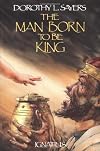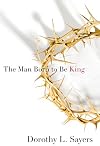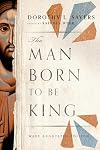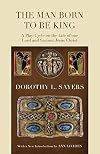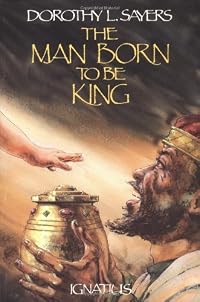
The Man Born to Be King
by Dorothy L. Sayers
On This Page
Description
In 1943 the BBC broadcast a series of radio dramas by Dorothy L. Sayers on the life and ministry of Jesus which would go on to become her most beloved works. In this new annotated edition, scholar Kathryn Wehr brings fresh insights to the plays, their background, Sayers's creative process, and the ongoing significance of the life of Christ today.Tags
Recommendations

















Member Reviews
First sentence: On February 5, 1940, Rev. Dr. James Welch, Director of Religious Broadcasting at the British Broadcasting Corporation (BBC), wrote to Dorothy L. Sayers with a request. "I wonder," he said, "whether you would consider writing a number of dramatic features for children, dealing with the life of our Lord?" The target audience was the "multitude of listeners to whom the Gospel Story is largely unknown and who could not be reached effectively in any other way."
I read the Wade Annotated Edition of The Man Born to Be King. It is a collection of the TWELVE plays on the life (and ministry) of Jesus Christ our Lord. These plays aired on the BBC beginning in December 1941 and finishing in October 1942. Each play--I'll list the show more individual titles below--was meant to fit into the whole, BUT, written to also be able to stand on its own. After all, each play would have its own listeners. There was no guarantee that these listeners would listen to all twelve plays, or would have listened. Each play features marginal notes--annotations--and bibliographical notes. These annotations provide context, fuller explanations, and allow for textual criticism. If a word or phrase was altered in various drafts--it will be noted. Or if someone asked Sayers to change a word, a phrase, etc., then her response may be noted in a marginal note.
The twelve plays are
Kings In Judaea
The King's Herald
A Certain Nobleman
The Heirs to the Kingdom
The Bread of Heaven
The Feast of Tabernacles
The Light and the Life
Royal Progress
The King's Supper
The Princes of this World
King of Sorrows
The King Comes To His Own
The book has a long--and necessary--introduction. It offers MUCH food for thought.
In contemporary times, more often than not, many if not most Christians are supportive--usually--of films and shows depicting the life of Christ. An actor portraying Christ is not usually controversial or scandalous. I used "many" and "most." Those Christian believers who are scandalized and upset by portrayals of Christ are seen more as "odd" or "weird" or "extreme." They can be vocal--on YouTube and other platforms--and they can find supporters for their position. But their "strict" position isn't the "norm." (For better or worse).
Reading this one was SO thought provoking. In that at the time Sayers was writing these plays, it was actually actually ILLEGAL to have Jesus Christ as a character in a play, as a character who appeared on stage. They [the powers that be] got around this law, of course, because this is a RADIO play that would not appear on stage. There was some drama about HEARING an actor's portrayal of Christ over the radio, but, with a little 'supervision' this too was worked out amicably. There was a panel, I believe, of religious experts, who read the plays before they were aired.
Another thing I thought was interesting was the idea of using the plays to "reach" the lost--particularly youth. The supposition was that there were/are generations who are absolutely clueless when it comes to the bare bones basics of the faith. They don't have a foundation. There were/are HUGE gaps in their religious education. This was in the 1940s. The plays were written to bring Christ "to life" to help make the Christian message relatable and interesting. People may not respond to the Bible being read aloud, but maybe having it dramatized--with actors, sound effects, music, etc--will help people respond/react.
I am super curious to seek out a recording of these plays. (I don't know if the original recordings from the 1940s still exist and are available.)
I will say that Sayers sought to HUMANIZE every character--regardless of if they followed Christ or opposed Christ. Even those who were at their core violently opposed to Christ get humanized. It was important to Sayers that every role--no matter how small or how big--be three dimensional.
I didn't love, love, love all her choices. In fact, there were a few times I thought she made some theological mistakes. (Like combining all the Mary's into one character--the sinful woman who anointed Jesus' feet, Mary of Bethany, Mary Magdalene.) But Sayers made some clear literary, artistic choices. She wanted TIGHT plays that dramatically worked. She wasn't looking to have actors read straight from Scripture. In fact, most of the time the dialogue is not straight from the pages of Scripture. Though it is arguably informed by Scripture.) show less
I read the Wade Annotated Edition of The Man Born to Be King. It is a collection of the TWELVE plays on the life (and ministry) of Jesus Christ our Lord. These plays aired on the BBC beginning in December 1941 and finishing in October 1942. Each play--I'll list the show more individual titles below--was meant to fit into the whole, BUT, written to also be able to stand on its own. After all, each play would have its own listeners. There was no guarantee that these listeners would listen to all twelve plays, or would have listened. Each play features marginal notes--annotations--and bibliographical notes. These annotations provide context, fuller explanations, and allow for textual criticism. If a word or phrase was altered in various drafts--it will be noted. Or if someone asked Sayers to change a word, a phrase, etc., then her response may be noted in a marginal note.
The twelve plays are
Kings In Judaea
The King's Herald
A Certain Nobleman
The Heirs to the Kingdom
The Bread of Heaven
The Feast of Tabernacles
The Light and the Life
Royal Progress
The King's Supper
The Princes of this World
King of Sorrows
The King Comes To His Own
The book has a long--and necessary--introduction. It offers MUCH food for thought.
In contemporary times, more often than not, many if not most Christians are supportive--usually--of films and shows depicting the life of Christ. An actor portraying Christ is not usually controversial or scandalous. I used "many" and "most." Those Christian believers who are scandalized and upset by portrayals of Christ are seen more as "odd" or "weird" or "extreme." They can be vocal--on YouTube and other platforms--and they can find supporters for their position. But their "strict" position isn't the "norm." (For better or worse).
Reading this one was SO thought provoking. In that at the time Sayers was writing these plays, it was actually actually ILLEGAL to have Jesus Christ as a character in a play, as a character who appeared on stage. They [the powers that be] got around this law, of course, because this is a RADIO play that would not appear on stage. There was some drama about HEARING an actor's portrayal of Christ over the radio, but, with a little 'supervision' this too was worked out amicably. There was a panel, I believe, of religious experts, who read the plays before they were aired.
Another thing I thought was interesting was the idea of using the plays to "reach" the lost--particularly youth. The supposition was that there were/are generations who are absolutely clueless when it comes to the bare bones basics of the faith. They don't have a foundation. There were/are HUGE gaps in their religious education. This was in the 1940s. The plays were written to bring Christ "to life" to help make the Christian message relatable and interesting. People may not respond to the Bible being read aloud, but maybe having it dramatized--with actors, sound effects, music, etc--will help people respond/react.
I am super curious to seek out a recording of these plays. (I don't know if the original recordings from the 1940s still exist and are available.)
I will say that Sayers sought to HUMANIZE every character--regardless of if they followed Christ or opposed Christ. Even those who were at their core violently opposed to Christ get humanized. It was important to Sayers that every role--no matter how small or how big--be three dimensional.
I didn't love, love, love all her choices. In fact, there were a few times I thought she made some theological mistakes. (Like combining all the Mary's into one character--the sinful woman who anointed Jesus' feet, Mary of Bethany, Mary Magdalene.) But Sayers made some clear literary, artistic choices. She wanted TIGHT plays that dramatically worked. She wasn't looking to have actors read straight from Scripture. In fact, most of the time the dialogue is not straight from the pages of Scripture. Though it is arguably informed by Scripture.) show less
This was a neat introduction to Sayers' works! Perhaps an odd choice for my first book of hers, but still enjoyable for sure. I've been reading up on CS Lewis and JRR Tolkien recently, so it was a timely addition.
Annotated editions of anything intrigue me (thanks to my stumbling across _The Annotated Hobbit_ many moons ago); I love having #allthethings at my fingertips should I want to know more, and that's certainly helpful here. (Perhaps I would have benefited from similar in high school while reading Shakespeare! Then again, perhaps not; I didn't really start appreciating literary criticism, philology, etc. until recently.)
Sayers and I may not see eye to eye on all things theological, but this was a refreshing picture/portrayal of show more many a story I knew well. I've been watching _The Chosen_ TV series of late as well (late to the game!), and both this Sayers book and the TV series have helped me approach the familiar stories with fresh eyes--along with plenty of additional resources to peruse as desired.
I received an eARC of the book from the publisher via NetGalley. All opinions are my own. show less
Annotated editions of anything intrigue me (thanks to my stumbling across _The Annotated Hobbit_ many moons ago); I love having #allthethings at my fingertips should I want to know more, and that's certainly helpful here. (Perhaps I would have benefited from similar in high school while reading Shakespeare! Then again, perhaps not; I didn't really start appreciating literary criticism, philology, etc. until recently.)
Sayers and I may not see eye to eye on all things theological, but this was a refreshing picture/portrayal of show more many a story I knew well. I've been watching _The Chosen_ TV series of late as well (late to the game!), and both this Sayers book and the TV series have helped me approach the familiar stories with fresh eyes--along with plenty of additional resources to peruse as desired.
I received an eARC of the book from the publisher via NetGalley. All opinions are my own. show less
Summary: A new annotated edition of Sayers’ cycle of twelve plays on the life of Christ.
Between December 1941 and October 1942, during the depths of Second World War, the BBC broadcast twelve radio dramas written by Dorothy L. Sayers. Through the efforts of Kathryn Wehr these works have been brought to life for a new generation, accompanied by Wehr’s annotations and introduction to the work, offering important background, explanations and discussions of textual emendations during the process of writing for broadcast. This work was supported by a grant from Marion E. Wade Center, the location of a significant archive of material on Dorothy L. Sayers,
The plays center around the idea of Jesus as king, and the contrast between the show more kingdom he inaugurated in his coming and the kingdoms of the day, those of Herod and the Roman Caesars, a contrast resulting in the peril of death over Jesus from his birth to his crucifixion. The first in the cycle is “Kings in Judea” where Herod is visited by the traditional Three Kings (from Europe, Asia, and Africa) seeking the one that the heavens said was born king in Judea.
The king theme is elaborated in Sayers portrayal of Judas Iscariot, who is portrayed as probably the most intelligent of all the disciples, perhaps more far-seeing and idealistic, but also proud in the particular way some of the brightest are, and thus vulnerable to the insinuations of Baruch, a recurring figure who is conspiring with the Zealots to lead an insurgency. Baruch raises questions of Jesus’s intentions and Judas comes to believe Jesus in the end was going to betray his own ideals. He determines to stop him by betraying him first–one of the most probing portrayals of Judas I’ve seen.
The plays are in the vernacular British English of the day, a controversial decision which Wehr discusses in her Introduction (as well as the miraculous consensus that came about on the religious board vetting her material). Despite protests from some religious bodies, the plays enjoyed widespread support from the public. The one thing I notice is that Sayers will sometimes quote verbatim from scripture and then at other times render accounts in the vernacular. Also, some expressions may be anachronistic today, such as Proclus, the centurion’s servant being his “batman.”
Another device Sayers uses is what she calls “tie-rod” characters. Balthazar, one of the Three Kings, reappears at the crucifixion. With him before Herod is Proclus, the Centurion, whose servant is later healed by Jesus, and who also is at the foot of the cross, testifying to Jesus as the Son of God. Baruch also serves in this role, particularly in the development of the Judas plot. Mary the mother of Jesus (Mary Virgin in the plays to distinguish from other Marys) and Mary Magdalene (who she identifies with Mary of Bethany) also recur and critically tie the narrative together.
Sayers weaves the Synoptic accounts and John’s Gospel into a seamless narrative over the twelve plays, contrary to much of the scholarship of her day. Yet she works carefully with biblical texts, other source materials and commentaries. She is also theologically acute, as is evident in this monologue of Mary, the mother of Jesus, as she watches Jesus struggle under the weight of the cross up to Golgotha:
“I know now what he is, and what I am. . . . I, Mary, am the fact; God is the truth; but Jesus is fact and truth–he is reality. You cannot see the immortal truth till it is born in the flesh of the fact. And because all birth is a sundering of the flesh, fact and reality seem to go separate ways, But it is not really so; the feet that must walk this road were made of me. Only one Jesus is to die today–one person whom you know–the truth of God and the fact of Mary. This is reality. From the beginning of time until now, this is the only thing that has ever really happened. When you understand this you will understand all prophecies, and all history. . . .”
In a few sentences, Sayers powerfully summarizes the doctrine of the incarnation and the hypostatic union of the two natures.
Some comments are in order on what is included in this edition. It begins with Kathryn Wehr’s introduction to the plays, describing their inception, Sayers’ conditions, and how the plays illustrate her creative trinity, developed in The Mind of the Maker. Also reproduced are James Welch’s introduction as director of religious broadcasting for the BBC and Sayers own introduction, in which she details her own process in writing the plays.
Each play in the cycle begins with an editor’s introduction offering not only a plot synopsis scene by scene but also background information and discussion of theological issues in each play. This is followed by the cast listing for the original radio broadcast and Sayers notes to actors on the play and the particular characters and how she would have them played–fascinating for her insights particularly into the lives of the disciples, and several other key players, including Caiaphas and Pilate. Also, Wehr provides annotations alongside the text, some explanatory, some providing alternate readings from draft materials, some citing correspondence with James Welch discussing elements of the play. Underlining in the text (as well as introductions and notes) point the reader to annotated material.
This edition was published after Advent and Christmas this past year. The plays are wonderful reading at any time of year but would seem ideal in the time between Advent and Easter. Of course, anyone who follows the works of Dorothy L. Sayers will want this edition of the plays for all the scholarly material included. Above all, the plays help us ask afresh a question that recurs in the gospels and that each of us must resolve for ourselves–who is this Jesus?
________________________________
Disclosure of Material Connection: I received a complimentary review copy of this book from the publisher. show less
Between December 1941 and October 1942, during the depths of Second World War, the BBC broadcast twelve radio dramas written by Dorothy L. Sayers. Through the efforts of Kathryn Wehr these works have been brought to life for a new generation, accompanied by Wehr’s annotations and introduction to the work, offering important background, explanations and discussions of textual emendations during the process of writing for broadcast. This work was supported by a grant from Marion E. Wade Center, the location of a significant archive of material on Dorothy L. Sayers,
The plays center around the idea of Jesus as king, and the contrast between the show more kingdom he inaugurated in his coming and the kingdoms of the day, those of Herod and the Roman Caesars, a contrast resulting in the peril of death over Jesus from his birth to his crucifixion. The first in the cycle is “Kings in Judea” where Herod is visited by the traditional Three Kings (from Europe, Asia, and Africa) seeking the one that the heavens said was born king in Judea.
The king theme is elaborated in Sayers portrayal of Judas Iscariot, who is portrayed as probably the most intelligent of all the disciples, perhaps more far-seeing and idealistic, but also proud in the particular way some of the brightest are, and thus vulnerable to the insinuations of Baruch, a recurring figure who is conspiring with the Zealots to lead an insurgency. Baruch raises questions of Jesus’s intentions and Judas comes to believe Jesus in the end was going to betray his own ideals. He determines to stop him by betraying him first–one of the most probing portrayals of Judas I’ve seen.
The plays are in the vernacular British English of the day, a controversial decision which Wehr discusses in her Introduction (as well as the miraculous consensus that came about on the religious board vetting her material). Despite protests from some religious bodies, the plays enjoyed widespread support from the public. The one thing I notice is that Sayers will sometimes quote verbatim from scripture and then at other times render accounts in the vernacular. Also, some expressions may be anachronistic today, such as Proclus, the centurion’s servant being his “batman.”
Another device Sayers uses is what she calls “tie-rod” characters. Balthazar, one of the Three Kings, reappears at the crucifixion. With him before Herod is Proclus, the Centurion, whose servant is later healed by Jesus, and who also is at the foot of the cross, testifying to Jesus as the Son of God. Baruch also serves in this role, particularly in the development of the Judas plot. Mary the mother of Jesus (Mary Virgin in the plays to distinguish from other Marys) and Mary Magdalene (who she identifies with Mary of Bethany) also recur and critically tie the narrative together.
Sayers weaves the Synoptic accounts and John’s Gospel into a seamless narrative over the twelve plays, contrary to much of the scholarship of her day. Yet she works carefully with biblical texts, other source materials and commentaries. She is also theologically acute, as is evident in this monologue of Mary, the mother of Jesus, as she watches Jesus struggle under the weight of the cross up to Golgotha:
“I know now what he is, and what I am. . . . I, Mary, am the fact; God is the truth; but Jesus is fact and truth–he is reality. You cannot see the immortal truth till it is born in the flesh of the fact. And because all birth is a sundering of the flesh, fact and reality seem to go separate ways, But it is not really so; the feet that must walk this road were made of me. Only one Jesus is to die today–one person whom you know–the truth of God and the fact of Mary. This is reality. From the beginning of time until now, this is the only thing that has ever really happened. When you understand this you will understand all prophecies, and all history. . . .”
In a few sentences, Sayers powerfully summarizes the doctrine of the incarnation and the hypostatic union of the two natures.
Some comments are in order on what is included in this edition. It begins with Kathryn Wehr’s introduction to the plays, describing their inception, Sayers’ conditions, and how the plays illustrate her creative trinity, developed in The Mind of the Maker. Also reproduced are James Welch’s introduction as director of religious broadcasting for the BBC and Sayers own introduction, in which she details her own process in writing the plays.
Each play in the cycle begins with an editor’s introduction offering not only a plot synopsis scene by scene but also background information and discussion of theological issues in each play. This is followed by the cast listing for the original radio broadcast and Sayers notes to actors on the play and the particular characters and how she would have them played–fascinating for her insights particularly into the lives of the disciples, and several other key players, including Caiaphas and Pilate. Also, Wehr provides annotations alongside the text, some explanatory, some providing alternate readings from draft materials, some citing correspondence with James Welch discussing elements of the play. Underlining in the text (as well as introductions and notes) point the reader to annotated material.
This edition was published after Advent and Christmas this past year. The plays are wonderful reading at any time of year but would seem ideal in the time between Advent and Easter. Of course, anyone who follows the works of Dorothy L. Sayers will want this edition of the plays for all the scholarly material included. Above all, the plays help us ask afresh a question that recurs in the gospels and that each of us must resolve for ourselves–who is this Jesus?
________________________________
Disclosure of Material Connection: I received a complimentary review copy of this book from the publisher. show less
This is a cycle of 12 radio dramas depicting the life of Christ. I think I will make reading this a Lenten tradition. The introduction is worth the price of the book. Dorothy Sayers was a scholarly and devout Christian who has a way of really driving home her points that makes her theological writing exciting to read. But in this volume it is the drama and emotion of the plays that draws us into the life and times of Jesus Christ in such a powerful and realistic way that I felt I was actually experiencing these events with the disciples. In all my years I have never experienced so deeply what Jesus must have been like when he walked the earth and lived a human life just as we do. I found this even more moving that the movie “The show more Passion of Christ.” This was a masterful work and I wish every Christian could have the chance to read this. Even better, I wish we could have the chance to hear it as it was intended by Sayers. show less
Superb!
Drama. Adapts the rich yet fragmentary materials of the Gospels into a dramatic retelling of the life of Christ.
12 PLAYS ABOUT JESUS CHRIST
Members
- Recently Added By
Lists

Church Times 100 Best Christian Books
106 works; 26 members
Author Information

277+ Works 70,710 Members
Dorothy Sayers's impressive reputation as a contemporary master of the classic detective story is eclipsed only by Agatha Christie's. Sayers was born in Oxford and attended Somerville College, where she received a B.A. in 1915 and an M.A. in 1920. During that period, Sayers worked as an instructor of modern languages at Hull High School for Girls show more in Yorkshire and as a reader for a publisher in Oxford. Her early literary work was in poetry; she published several volumes and served as an editor for the journal Oxford Poetry from 1917 to 1919. Sayers also worked as a copywriter for a major advertising firm in London. She was president of the Modern Language Association from 1939 to 1945 and of the Detection Club in the 1950s. Around 1920 Sayers developed the idea for her detective hero Lord Peter Wimsey, and she soon published her first mystery, Whose Body? (1923), in which Lord Peter is introduced. For the next dozen or so years, Sayers wrote prolifically about Wimsey, creating in the process what many critics of the genre consider to be the finest detective novels in the English language. Perhaps her most famous Wimsey mystery was The Nine Tailors (1934). Although Sayers essentially followed the classic form in her detective fiction---a formula in which the plot assumes a greater importance than do the characters---Sayers maintained that a detective hero's greatness depended on how effectively the character was portrayed. All but one of Sayers's mysteries feature Lord Peter Wimsey. By the late 1930s, Sayers had apparently tired of writing detective fiction. She stated in 1947 that she would write no more mysteries, that she wrote detective fiction only when she was young and in need of money. Thus saying, Sayers turned her attention to her early loves, medieval and religious literature, spending her remaining years lecturing on and translating Dante (see Vol. 2). (Bowker Author Biography) show less
All Editions
Some Editions
Work Relationships
Is a retelling of
Has the adaptation
Is abridged in
Has as a teacher's guide
Common Knowledge
- Canonical title*
- Zum König geboren
- Original title
- The Man Born to Be King
- Original publication date
- 1943
- People/Characters
- Jesus von Nazareth (Luke 2)
- Publisher's editor
- McNutt, David W.
- Blurbers
- Ward, Michael; Bray, Suzanne; Ahlquist, Dale; Miller, Jeffrey S.; Ford, Seona; Okholm, Dennis (show all 7); Corbett, George
*Some information comes from Common Knowledge in other languages. Click "Edit" for more information.
Classifications
Statistics
- Members
- 784
- Popularity
- 35,419
- Reviews
- 8
- Rating
- (4.11)
- Languages
- 5 — Dutch, English, German, Hungarian, Portuguese (Portugal)
- Media
- Paper, Audiobook, Ebook
- ISBNs
- 17
- UPCs
- 1
- ASINs
- 30