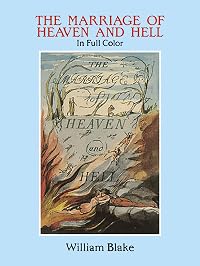
The Marriage of Heaven and Hell
by William Blake
On This Page
Description
William Blake can rightly be described as one of the most important Romantic poets, but he is set apart from the likes of Wordsworth, Coleridge, Byron, Shelley and Keats by his mysticism and radical social and religious beliefs. Following in the tradition of poetic geniuses such as Dante and Milton, Blake's remarkable collection The Marriage of Heaven and Hell describes a descent into the netherworld..
Tags
Recommendations







Member Reviews
This is a beautifully put together book. It is a facsimile edition of William Blake's The Marriage of Heaven and Hell from Oxford's Bodleian Library. It has replica marbled cover/endboards, aged-looking endpapers (complete with old bookplate and penciled in call numbers), and the facsimile of Blake's plates (complete with penciled page numbers). It is a work of art. Included alongside the Bodleian's copy of the full text are other colored copies of several important plates, tacked on at the end. The book has (a) an introduction of several pages, introducing Blake and The Marriage of Heaven and Hell, (b) a transcription of the poem, (c) the facsimile of the Blake original (plus extras), (d) commentary on each plate, (e) a checklist of show more copies of the work, and (f) a bibliography. The bibliography is long and both the intro and commentary have copious references. The commentary describes the physical attributes of each plate, such as an explanation of drawings, etchings, and writings, and it also provides commentary on the text and its meaning, with particular reference to Blake's life and time.
On the physical nature of this book, it is superb beyond compare. This is how facsimile editions should be constructed and published. (Not just of Blake, but any author).
But, then there is Blake. Blake must always be taken with a grain of salt and in small doses, because, well, Blake is weird. And probably nuts too. And Blake's ideas seem, to me, of just being ornery for orneriness's sake. He hates morality and Christianity and any organized group of people, whether church or state. This is why Blake is so beloved today, as he was the forerunner of all leftist art and agitprop that demeans the powers that be. He's a proto-hippie. Thus such crap like "The road of excess leads to the palace of wisdom" and "The wrath of the lion is the wisdom of God" (and un-biblical crap this is) drowns out any witty and philosophical epigrams that Blake might spin (like "One Law for the Lion & Ox is Oppression").
Three stars for Blake's text. Four stars for Blake's art. Five stars for the critical apparatus. Five stars for the physical object of the book. Four-and-a-half stars overall. show less
On the physical nature of this book, it is superb beyond compare. This is how facsimile editions should be constructed and published. (Not just of Blake, but any author).
But, then there is Blake. Blake must always be taken with a grain of salt and in small doses, because, well, Blake is weird. And probably nuts too. And Blake's ideas seem, to me, of just being ornery for orneriness's sake. He hates morality and Christianity and any organized group of people, whether church or state. This is why Blake is so beloved today, as he was the forerunner of all leftist art and agitprop that demeans the powers that be. He's a proto-hippie. Thus such crap like "The road of excess leads to the palace of wisdom" and "The wrath of the lion is the wisdom of God" (and un-biblical crap this is) drowns out any witty and philosophical epigrams that Blake might spin (like "One Law for the Lion & Ox is Oppression").
Three stars for Blake's text. Four stars for Blake's art. Five stars for the critical apparatus. Five stars for the physical object of the book. Four-and-a-half stars overall. show less
Perhaps rightly, this book can be classified among the works that are quoted and referenced more than actually read. Because let's be honest: without a proper preparation this book is a no-go zone. The first time I read it, almost 20 years ago, after just a few pages my head started spinning: what is this actually? What is Blake talking about? And why is this all so strange? I could barely process it. But this time, on the second reading, I was a little better prepared, after reading John Higgs William Blake vs the World. Higgs provides not only (biographical) context but also reading keys to understand Blake (and also explain him). And only then do you notice how original and modern this hyper-stubborn person was and is, also in this show more book. And this not only refers to his attacks against established and less established ways of looking at reality, such as the religion of the churches or that of the esotericists, on the one-sidedness and terror of rationalism, and especially on the dualism that is so ingrained in our culture. No, the merit of Blake doesn’t only lay in the negative, but especially in the very idiosyncratic way of seeing that Blake wants to instill on us: namely through that of the imagination, according to him the source of all reality. It seems as if he anticipated constructivism by almost two centuries, although that is probably too simplistic. Because, let’s be honest, Blake remains very unruly and inimitable at the same time. Even if you read this (relatively short book) two or three times in a row, there still are passages that you just can't fathom. William Blake will continue to challenge us, that's for sure. show less
I first encountered this part visionary / part comic / part poetry / part etching long poem in 1969, in an English class, while an Engineering student at Cornell University. I had grown up a kid scientist, and my hope was that I'd become a NASA engineer. I was also very much in my head and not so much in my body, in the world of logic and not so much the world of emotion. Blake's poem convince me I had to change all that or I'd live out my days a reduced version of myself. This powerful piece reached out to me over many decades and 6000 miles and changed not only my focus (from Engineering to English major) but also set in motion a process of actualizing the more suppressed parts of myself, a lifelong activity that began then and there. show more Thank you, Mr. Blake!
- David show less
- David show less
Pensar en William es pensar en obras con un trasfondo religioso. Este es un poema que la primera vez que lo escuche (mi primer acercamiento a él fue a modo de audio) pensé que era un ensayo,no fue hasta que vi las palabras en papel que note que era un poema, que cada cambio de voz representaba una estrofa, y eso fue una de las cosas que más me gusto respecto a este poema, por que no se limita a representar una metáfora, sino que la desarrolla completamente.
Creo que para este punto de nuestra vida todos hemos escuchado “para que haya bien, debe existir el mal” y cosas similares, pues aquí se aborda esta perspectiva diciendo para que Dios exista, el Diablo debe existir, a este respecto Blake le suma la adopción de una misma show more leyenda para ambos bandos y reconecta alma y cuerpo, en vez de continuar separándolos como lo han hecho todas las religiones del mundo, así mismo defendiendo deseo y trabajo, gozo y sabiduría, prohibición y descarrilamiento, todo como parte de una cosmovisión unificadora bajo la doctrina gnóstica.
Definitivamente Blake no es alguien a quien puedas tomarte a la ligera, a pesar de que escribe de manera bastante entendible los elementos de filosofía y romanticismo que maneja exigen que sea leído más de una vez, no porque sea difícil entenderlo sino que sus palabras piden ser analizadas. show less
Creo que para este punto de nuestra vida todos hemos escuchado “para que haya bien, debe existir el mal” y cosas similares, pues aquí se aborda esta perspectiva diciendo para que Dios exista, el Diablo debe existir, a este respecto Blake le suma la adopción de una misma show more leyenda para ambos bandos y reconecta alma y cuerpo, en vez de continuar separándolos como lo han hecho todas las religiones del mundo, así mismo defendiendo deseo y trabajo, gozo y sabiduría, prohibición y descarrilamiento, todo como parte de una cosmovisión unificadora bajo la doctrina gnóstica.
Definitivamente Blake no es alguien a quien puedas tomarte a la ligera, a pesar de que escribe de manera bastante entendible los elementos de filosofía y romanticismo que maneja exigen que sea leído más de una vez, no porque sea difícil entenderlo sino que sus palabras piden ser analizadas. show less
Without Contraries is no progression. Attraction and Repulsion, Reason and Energy, Love and Hate, are necessary to Human existence. From these contraries spring what the religious call Good & Evil. Good is the passive that obeys Reason. Evil is the active springing from Energy. Good is Heaven. Evil is Hell."
This is a gem of a work I discovered while writing a paper for my class on British Romanticism. More a piece of art than a book, The Marriage of Heaven and Hell is beautiful, confusing, thought-provoking and a bit insane. My favorite part of the book is the Proverbs of Hell. Blake writes that he wanted to explain what hell is like so he brought back its wise sayings, because a people's proverbs tell you what is important to them. The show more list is a mishmash of contradictions. Some of the sayings could have come straight out of the biblical proverbs, while others fly in the face of Christian teachings.
Here are the first few (Read slowly, let each one sink in before you move on to the next):
"In seed time learn, in harvest teach, in winter enjoy.
Drive your cart and your plow over the bones of the dead.
The road of excess leads to the palace of wisdom.
Prudence is a rich ugly old maid courted by Incapacity.
He who desires but acts not, breeds pestilence."
Blake is railing against a religious establishment he doesn't agree with, in a world that has been turned inside out by the French Revolution. If you haven't read this since it was assigned to you in Lit class, pick it up again, but make sure to find an edition with Blake original illustrated pages. I think you will be pleasantly surprised by how refreshingly beautiful Blake's writings and drawings are. show less
This is a gem of a work I discovered while writing a paper for my class on British Romanticism. More a piece of art than a book, The Marriage of Heaven and Hell is beautiful, confusing, thought-provoking and a bit insane. My favorite part of the book is the Proverbs of Hell. Blake writes that he wanted to explain what hell is like so he brought back its wise sayings, because a people's proverbs tell you what is important to them. The show more list is a mishmash of contradictions. Some of the sayings could have come straight out of the biblical proverbs, while others fly in the face of Christian teachings.
Here are the first few (Read slowly, let each one sink in before you move on to the next):
"In seed time learn, in harvest teach, in winter enjoy.
Drive your cart and your plow over the bones of the dead.
The road of excess leads to the palace of wisdom.
Prudence is a rich ugly old maid courted by Incapacity.
He who desires but acts not, breeds pestilence."
Blake is railing against a religious establishment he doesn't agree with, in a world that has been turned inside out by the French Revolution. If you haven't read this since it was assigned to you in Lit class, pick it up again, but make sure to find an edition with Blake original illustrated pages. I think you will be pleasantly surprised by how refreshingly beautiful Blake's writings and drawings are. show less
The Marriage of Heaven and Hell is one of the few works of poetry that I like, along with the (perhaps more famous) Songs of Innocence and Experience. It is a collection of poems and aphorisms, sometimes comical and satirical, other times dark and theological. The book is rather complex in its structure, sometimes it doesn't even look like poetry at all and other times can be rather obscure and open to interpretations.
The obvious main theme are Blake's peculiar religious ideas, explored here more explicitly than in the Songs of Innocence and Experience, and the author really does a good job at stimulating the reader into thinking and reflecting on these topics. It is truly an inspirational piece of art, something that anyone interested show more in theology, even not by a religious point of view, should try and look into.
The Italian edition is published by SE and translated by Giuseppe Ungaretti, one of Italy's most famous poets of the last century, and contains the original English text along with the Italian translation, making it one of the best and most precious translations I've ever seen. show less
The obvious main theme are Blake's peculiar religious ideas, explored here more explicitly than in the Songs of Innocence and Experience, and the author really does a good job at stimulating the reader into thinking and reflecting on these topics. It is truly an inspirational piece of art, something that anyone interested show more in theology, even not by a religious point of view, should try and look into.
The Italian edition is published by SE and translated by Giuseppe Ungaretti, one of Italy's most famous poets of the last century, and contains the original English text along with the Italian translation, making it one of the best and most precious translations I've ever seen. show less
I love Blake. He always manages to touch something in my heart. There's a reason the only poem I know by heart is one of his.
And whether it's with words, or with paint (The Night of Enitharmon's Joy is a personal favourite), or with his etchings (another personal favourite: 'Europe supported'. At first, it looks like a picture with 3 pretty, naked girls, then you realise it is harsh social commentary, that still rings true today), he always manages to make you think.
The Marriage of Heaven and Hell is just brilliant. It's one of those books you can read a thousand times, and still discover something more, something deeper each time.
I thus implore you to read it. ;)
Some quotes to live by (all from the 'Proverbs from Hell. I just selected show more a few that spoke to me today. There not the most well-known, just the ones I liked best today. Ask me tomorrow and I might select some others.)
- He whose face gives no light shall never become a star.
- No bird soars too high if he soars with his own wings.
- The most sublime act is to set another before you.
- Always be ready to speak your mind, and a base man will avoid you.
And the next quote summs up how Blake sees religion. My own view on it has always been similar, even before reading Blake.
"Till a system was formed, which some took advantage of and enslaved the vulgar by attempting to realize or abstract the mental deities from their objects. Thus began Priesthood. Choosing forms of worship from poetic tales. And at length they pronounced that the Gods had ordered such things. Thus men forgot that all deities reside in the human breast." (less) show less
And whether it's with words, or with paint (The Night of Enitharmon's Joy is a personal favourite), or with his etchings (another personal favourite: 'Europe supported'. At first, it looks like a picture with 3 pretty, naked girls, then you realise it is harsh social commentary, that still rings true today), he always manages to make you think.
The Marriage of Heaven and Hell is just brilliant. It's one of those books you can read a thousand times, and still discover something more, something deeper each time.
I thus implore you to read it. ;)
Some quotes to live by (all from the 'Proverbs from Hell. I just selected show more a few that spoke to me today. There not the most well-known, just the ones I liked best today. Ask me tomorrow and I might select some others.)
- He whose face gives no light shall never become a star.
- No bird soars too high if he soars with his own wings.
- The most sublime act is to set another before you.
- Always be ready to speak your mind, and a base man will avoid you.
And the next quote summs up how Blake sees religion. My own view on it has always been similar, even before reading Blake.
"Till a system was formed, which some took advantage of and enslaved the vulgar by attempting to realize or abstract the mental deities from their objects. Thus began Priesthood. Choosing forms of worship from poetic tales. And at length they pronounced that the Gods had ordered such things. Thus men forgot that all deities reside in the human breast." (less) show less
Members
- Recently Added By
Lists

Tonikat reading completed on Librarything journals
329 works; 2 members

Favourite Books
1,819 works; 309 members

18th Century
42 works; 12 members

Favourite Poems
34 works; 1 member

100 Books to Read in a Lifetime (That Are Older Than 200 Years)
415 works; 174 members

Books Read in 2018
4,360 works; 110 members

Greatest Books, allegedly
484 works; 9 members

Books We Love to Reread
688 works; 296 members
Author Information

501+ Works 20,199 Members
William Blake's poems, prophecies, and engravings represent his strong vision and voice for rebellion against orthodoxy and all forms of repression. Born in London in November 1757; his father, a hosier of limited means, could do little for the boy's education. However, when the young Blake's talent for design became apparent, his wise father sent show more him to drawing school at the age of 10. In 1771 Blake was apprenticed to an engraver. Blake went on to develop his own technique, a method he claimed that came to him in a vision of his deceased younger brother. In this, as in so many other areas of his life, Blake was an iconoclast; his blend of printing and engraving gave his works a unique and striking illumination. Blake joined with other young men in support of the Revolutions in France and America. He also lived his own revolt against established rules of conduct, even in his own home. One of his first acts after marrying his lifetime companion, Catherine Boucher, was to teach her to read and write, rare for a woman at that time. Blake's writings were increasingly styled after the Hebrew prophets. His engravings and poetry give form and substance to the conflicts and passions of the elemental human heart, made real as actual characters in his later work. Although he was ignored by the British literary community through most of his life, interest and study of his work has never waned. Blake's creativity and original thinking mark him as one of the earliest Romantic poets, best known for his Songs of Innocence (1789) and Songs of Experience (1794) and The Tiger. Blake died in London in 1827. (Bowker Author Biography) show less
Some Editions
Series
Belongs to Publisher Series
Work Relationships
Is contained in
Le Mariage du Ciel et de l'Enfer précédé de Le Livre de Thel et suivi de L'Evangile Eternel by William Blake
Le Mariage du Ciel et de l'Enfer précédé de Le Livre de Thel et suivi de L'Evangile Eternel by W Blake
Inspired
Has as a commentary on the text
Common Knowledge
- Canonical title
- The Marriage of Heaven and Hell
- Original title
- The Marriage of Heaven and Hell
- Original publication date
- 1790
- Important places
- Heaven; Hell
- First words
- Rintrah roars & shakes his fires in the burden'd air;
Hungry clouds swag on the deep. - Last words
- (Click to show. Warning: May contain spoilers.)For every thing that lives is Holy.
Classifications
Statistics
- Members
- 1,525
- Popularity
- 15,087
- Reviews
- 20
- Rating
- (4.15)
- Languages
- 15 — Catalan, Czech, Dutch, English, Finnish, French, German, Greek, Italian, Multiple languages, Norwegian (Nynorsk), Spanish, Swedish, Turkish, Portuguese (Portugal)
- Media
- Paper, Audiobook, Ebook
- ISBNs
- 68
- UPCs
- 2
- ASINs
- 27