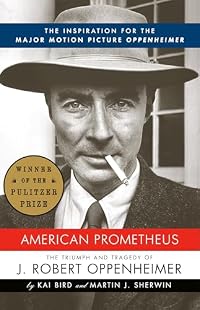
American Prometheus: The Triumph and Tragedy of J. Robert Oppenheimer
by Kai Bird, Martin J. Sherwin
On This Page
Description
The inspiration for the major motion picture Oppenheimer, this is the definitive biography of J. Robert Oppenheimer, a brilliant physicist who led the effort to build the atomic bomb for his country in a time of war and who later found himself confronting the moral consequences of scientific progress.American Prometheus is the first full-scale biography of J. Robert Oppenheimer, "father of the atomic bomb," the brilliant, charismatic physicist who led the effort to capture the awesome fire show more of the sun for his country in time of war.
Immediately after Hiroshima, J. Robert Oppenheimer became the most famous scientist of his generation–one of the iconic figures of the twentieth century, the embodiment of modern man confronting the consequences of scientific progress.
He was the author of a radical proposal to place international controls over atomic materials—an idea that is still relevant today. He opposed the development of the hydrogen bomb and criticized the Air Force's plans to fight an infinitely dangerous nuclear war
In the now almost-forgotten hysteria of the early 1950s, his ideas were anathema to powerful advocates of a massive nuclear buildup, and, in response, Atomic Energy Commission chairman Lewis Strauss, superbomb advocate Edward Teller, and FBI director J. Edgar Hoover worked behind the scenes to have a hearing board find that Oppenheimer could not be trusted with America's nuclear secrets.
American Prometheus sets forth Oppenheimer's life and times in revealing and unprecedented detail. Exhaustively researched, it is based on thousands of records and letters gathered from archives in America and abroad, on massive FBI files, and on close to a hundred interviews with Oppenheimer's friends, relatives, and colleagues.
The book follows him from his earliest education at the turn of the twentieth century at New York City's Ethical Culture School through personal crises at Harvard and Cambridge universities. Then to Germany, where he studied quantum physics with the world's most accomplished theorists; and to Berkeley, California, where he established, during the 1930s, the leading American school of theoretical physics and where he became deeply involved with social justice causes and their advocates, many of whom were communists
Then to Los Alamos, New Mexico, where he transformed a bleak mesa into the world's most potent nuclear weapons laboratory—and where he himself was transformed. And finally, to the Institute for Advanced Study in Princeton, which he directed from 1947 to 1966.
American Prometheus is a rich evocation of America at midcentury, a compelling portrait of a brilliant, ambitious, complex, and flawed man profoundly connected to its major events: the Depression, World War II, and the Cold War. It is at once biography and history and is essential to our understanding of our recent past—and of our choices for the future.
. show less
Tags
Recommendations















Member Reviews
A true work of art. Bird and Sherwin take on the monumental task of understanding the life and times of easily the most important man in his century. Not one character who enters the fray here is overlooked, not in their own personal history or how theirs affected the man's.
The book is not overly scientific and still manages to educate on the topic of quantum theory. It's also quite a history of the lurches in scientific understanding over time, and the men behind them.
But the most wildly interesting component of the narrative is the politics: Oppenheimer's, the country's, and the world's. Not many of us will have our individual ethics challenged so severely as did Oppenheimer. But the cautionary tale still rings loudly for personal show more ethics as a driving force in life, and the consequences for making a stand; or the consequences for not making a stand when necessary. Oppenheimer falls on both ends of that spectrum, as a testament to the complexity of his character.
The book is deeply personal, and doesn't read at all like a cold, dry history. This should be mandatory reading for everyone in school. Sadly, this is a story not everyone wants told. Forget Barbie - case the time to start reading this book.
Highly Recommended!!!!!
5 bones!!!!! show less
The book is not overly scientific and still manages to educate on the topic of quantum theory. It's also quite a history of the lurches in scientific understanding over time, and the men behind them.
But the most wildly interesting component of the narrative is the politics: Oppenheimer's, the country's, and the world's. Not many of us will have our individual ethics challenged so severely as did Oppenheimer. But the cautionary tale still rings loudly for personal show more ethics as a driving force in life, and the consequences for making a stand; or the consequences for not making a stand when necessary. Oppenheimer falls on both ends of that spectrum, as a testament to the complexity of his character.
The book is deeply personal, and doesn't read at all like a cold, dry history. This should be mandatory reading for everyone in school. Sadly, this is a story not everyone wants told. Forget Barbie - case the time to start reading this book.
Highly Recommended!!!!!
5 bones!!!!! show less
https://fromtheheartofeurope.eu/oppenheimer-and-american-prometheus-the-triumph-...
This is an excellent top-to-toe biography, starting with Oppenheimer’s immigrant parents who moved to New York and became rich and finishing with his comfortable exile in Princeton, with refuge in the Caribbean, and the subsequent deaths of his wife and daughter. There were two particular points about his background that helped the whole story make sense for me. The fact that his family was rich meant that Oppenheimer never really had to worry about money, and that perhaps encouraged a lack of responsibility in some ways. But the philosophical foundation that he learned at an early age from his parents’ adherence to the Society for Ethical Culture show more pushed him in the opposite direction, to be aware of the moral consequences of his actions, especially when they affected the lives and even more so the deaths of many.
His fascination with the desert is brought out in the film, but less so his fascination with riding, which seems to have been an obsession from an early age. The ins and outs of his relationship, and Lewis Strauss’s, with the Institute for Advanced Studies in Princeton are also a very important element of the story, taking it beyond the question of national security to in-fighting in the academic world, where Oppenheimer usually defeated the less gifted Strauss – but not always.
The book also gives a much more rounded picture of Kitty Oppenheimer, who had been married three times before ending up with Robert, and was actually German by birth. She claimed to be related to the Belgian royal family, which sent me on a genealogical wild-goose-chase (in short: I don’t think she was). She was also a serious professional botanist in her own right; and an alcoholic. The film hints at some of this but the book reveals much more.
At 900 pages, it has the leisure to examine the accusations levelled against Oppenheimer in detail, and also to look at the motivations of his accusers from a distance of decades. One of the best lines in the book comes from, of all people, Albert Einstein, who when told of Oppenheimer’s security clearance problems said, “The trouble with Oppenheimer is that he loves a woman who doesn’t love him—the United States government.”
It took me quite a while to get through – helped by two overnight flights to and from China last month, and two three-hour internal flights while I was there – but unlike with the film, I felt that my efforts were justified. show less
This is an excellent top-to-toe biography, starting with Oppenheimer’s immigrant parents who moved to New York and became rich and finishing with his comfortable exile in Princeton, with refuge in the Caribbean, and the subsequent deaths of his wife and daughter. There were two particular points about his background that helped the whole story make sense for me. The fact that his family was rich meant that Oppenheimer never really had to worry about money, and that perhaps encouraged a lack of responsibility in some ways. But the philosophical foundation that he learned at an early age from his parents’ adherence to the Society for Ethical Culture show more pushed him in the opposite direction, to be aware of the moral consequences of his actions, especially when they affected the lives and even more so the deaths of many.
His fascination with the desert is brought out in the film, but less so his fascination with riding, which seems to have been an obsession from an early age. The ins and outs of his relationship, and Lewis Strauss’s, with the Institute for Advanced Studies in Princeton are also a very important element of the story, taking it beyond the question of national security to in-fighting in the academic world, where Oppenheimer usually defeated the less gifted Strauss – but not always.
The book also gives a much more rounded picture of Kitty Oppenheimer, who had been married three times before ending up with Robert, and was actually German by birth. She claimed to be related to the Belgian royal family, which sent me on a genealogical wild-goose-chase (in short: I don’t think she was). She was also a serious professional botanist in her own right; and an alcoholic. The film hints at some of this but the book reveals much more.
At 900 pages, it has the leisure to examine the accusations levelled against Oppenheimer in detail, and also to look at the motivations of his accusers from a distance of decades. One of the best lines in the book comes from, of all people, Albert Einstein, who when told of Oppenheimer’s security clearance problems said, “The trouble with Oppenheimer is that he loves a woman who doesn’t love him—the United States government.”
It took me quite a while to get through – helped by two overnight flights to and from China last month, and two three-hour internal flights while I was there – but unlike with the film, I felt that my efforts were justified. show less
Summary: A biography of J. Robert Oppenheimer, focused on his leadership of the atomic bomb program and security clearance trial.
My birth and the dropping of the atom bomb on Hiroshima occurred on the same day (although in different years). I’m in my eighth decade of living under a nuclear cloud. One of the scientists who helped make that possible was J. Robert Oppenheimer. Oppenheimer led the Manhattan Project at Los Alamos, from 1943 to 1945, that built the first bombs, including those dropped over Hiroshima and Nagasaki.
Therefore, Kai Bird and Martin Sherwin’s massive biography of Oppenheimer was one of those books I knew I would read sooner or later (though I will pass on the movie). They trace his early life and educational show more work, and early work in theoretical physics that led to appointments at Caltech, and eventually at Berkeley.
While at Berkeley in the mid-1930’s he expressed his developing social consciousness through associations with and support of organizations with Communist party ties. While likely not a party member, he had close friends who were among the scientists he worked with and others he associated with. One of them, Haakon Chevalier, would later cause him much grief. He also pursued an intimate relationship with psychotherapist and party member Jean Tatlock, who later committed suicide. His wife, Kitty Puening had previously been married to a man killed in the Spanish Civil War fighting for the Communists.
World War Two changed many things. The USSR became an ally. Intelligence, including warnings from Albert Einstein, revealed the Germans were working on an atomic bomb. Oppenheimer’s theoretical work with Ernest Lawrence made him a strong candidate to lead the bomb development program. By this time, he had severed ties to the Communist Party, but his past raised security issues. But investigations cleared him and he became director under Leslie Groves.
His fertile mind and quick grasp of the various challenges facing the teams of scientists made him an ideal director. Meanwhile, he paid assiduous attention to building the Los Alamos community, including cross-team seminars that facilitated teamwork and advances on the science front. But his past associations tripped him up. Haakon Chevalier made an approach, exploring whether Oppenheimer would consider sharing information with Soviet scientists. While he flatly refused Chevalier, his tardy reporting and attempts to cover for his friends, including his brother Frank, made him suspect, though he maintained his clearance and overall director, General Leslie Groves staunchly supported him.
The successful Trinity test of the bomb was significant in raising Oppenheimer’s own fears about using the weapon. He sought unsuccessfully to stop its use. The book raises evidence that the U.S. could have ended the war without using it or invading the mainland. I think that will continue to be debated. But Oppenheimer later had a meeting with Harry Truman “repenting” his own role, something Truman ever after despised.
Leaving Los Alamos, Oppenheimer accepted a position as director of the Institute for Advanced Studies at Princeton, perhaps the happiest situation he enjoyed. He advocated for open sharing of nuclear secrets (though maintaining security himself), hoping for an international order that would oversea and prevent nuclear war. He also opposed the H-bomb, although a member of the Atomic Energy Commission. Chairman Lewis Strauss, who was also on his board at Princeton, became an enemy. Eventually, when he was up for renewal of his security clearance, Strauss orchestrated a star-chamber-like hearing process with the result of denying that clearance. The father of the atomic bomb was excluded from all further nuclear work.
The biography portrays the complexity of Oppenheimer. He is both aloof and condescending and warm and sensitive, He both adored Kitty and yet engaged in several outside relationship. Intelligence mixed with lack of common sense. Most notably, we see how his enemies used the McCarthyism of the early 1950’s to smear him. Yet his character emerges as he comes to terms with his fate. But he was a victim of one of the uglier sides of American character.
Most of all, there is the bomb. Oppenheimer stood apart from many scientists in wrestling with the morality of what he had done. And he spoke out against the fundamental immorality and insanity of a nuclear arms race. His life exemplifies the inherent immorality of war-making. It implicates us in the taking of lives we would never personally choose to take. Bird and Sherwin’s biography serves as a mirror that makes us take a good look at ourselves. show less
My birth and the dropping of the atom bomb on Hiroshima occurred on the same day (although in different years). I’m in my eighth decade of living under a nuclear cloud. One of the scientists who helped make that possible was J. Robert Oppenheimer. Oppenheimer led the Manhattan Project at Los Alamos, from 1943 to 1945, that built the first bombs, including those dropped over Hiroshima and Nagasaki.
Therefore, Kai Bird and Martin Sherwin’s massive biography of Oppenheimer was one of those books I knew I would read sooner or later (though I will pass on the movie). They trace his early life and educational show more work, and early work in theoretical physics that led to appointments at Caltech, and eventually at Berkeley.
While at Berkeley in the mid-1930’s he expressed his developing social consciousness through associations with and support of organizations with Communist party ties. While likely not a party member, he had close friends who were among the scientists he worked with and others he associated with. One of them, Haakon Chevalier, would later cause him much grief. He also pursued an intimate relationship with psychotherapist and party member Jean Tatlock, who later committed suicide. His wife, Kitty Puening had previously been married to a man killed in the Spanish Civil War fighting for the Communists.
World War Two changed many things. The USSR became an ally. Intelligence, including warnings from Albert Einstein, revealed the Germans were working on an atomic bomb. Oppenheimer’s theoretical work with Ernest Lawrence made him a strong candidate to lead the bomb development program. By this time, he had severed ties to the Communist Party, but his past raised security issues. But investigations cleared him and he became director under Leslie Groves.
His fertile mind and quick grasp of the various challenges facing the teams of scientists made him an ideal director. Meanwhile, he paid assiduous attention to building the Los Alamos community, including cross-team seminars that facilitated teamwork and advances on the science front. But his past associations tripped him up. Haakon Chevalier made an approach, exploring whether Oppenheimer would consider sharing information with Soviet scientists. While he flatly refused Chevalier, his tardy reporting and attempts to cover for his friends, including his brother Frank, made him suspect, though he maintained his clearance and overall director, General Leslie Groves staunchly supported him.
The successful Trinity test of the bomb was significant in raising Oppenheimer’s own fears about using the weapon. He sought unsuccessfully to stop its use. The book raises evidence that the U.S. could have ended the war without using it or invading the mainland. I think that will continue to be debated. But Oppenheimer later had a meeting with Harry Truman “repenting” his own role, something Truman ever after despised.
Leaving Los Alamos, Oppenheimer accepted a position as director of the Institute for Advanced Studies at Princeton, perhaps the happiest situation he enjoyed. He advocated for open sharing of nuclear secrets (though maintaining security himself), hoping for an international order that would oversea and prevent nuclear war. He also opposed the H-bomb, although a member of the Atomic Energy Commission. Chairman Lewis Strauss, who was also on his board at Princeton, became an enemy. Eventually, when he was up for renewal of his security clearance, Strauss orchestrated a star-chamber-like hearing process with the result of denying that clearance. The father of the atomic bomb was excluded from all further nuclear work.
The biography portrays the complexity of Oppenheimer. He is both aloof and condescending and warm and sensitive, He both adored Kitty and yet engaged in several outside relationship. Intelligence mixed with lack of common sense. Most notably, we see how his enemies used the McCarthyism of the early 1950’s to smear him. Yet his character emerges as he comes to terms with his fate. But he was a victim of one of the uglier sides of American character.
Most of all, there is the bomb. Oppenheimer stood apart from many scientists in wrestling with the morality of what he had done. And he spoke out against the fundamental immorality and insanity of a nuclear arms race. His life exemplifies the inherent immorality of war-making. It implicates us in the taking of lives we would never personally choose to take. Bird and Sherwin’s biography serves as a mirror that makes us take a good look at ourselves. show less
4.5/5
My interest in this book was spurred by the popularity of the recent Nolan film that was based in large part on this text. I wasn't drawn towards the film, and so have yet to even see it, but it made me curious about getting a better picture of Oppenheimer and the circumstances of his life. This is an expansive and cumulative biography of perhaps the main player in the development of nuclear weapons in the United States. I can't understate just how well documented Oppenheimer's life is, and the amount of time that must have gone into to assembling all of the citations necessary to provide such a pool of knowledge. Bird is an excellent writer, who enhances an already dramatic life with his structure and matter-of-fact style. show more
American Prometheus begins with a brief overview of Robert's parents and the events surrounding his birth, and goes all the way through his entire life. The book has multiple climaxes, coinciding with Robert's life; one being the detonation of the first nuclear bomb at the Trinity test site, and the second during his security clearance trial in 1954. Bird does an excellent job of leading up toward the trial by focusing on points of emphasis as they arise in his life, making sure that we remember that they will be brought against him later. Bird is direct in his opinions (that are obviously substantiated by facts), and makes it clear who he views as responsible for his Roberts public downfall. Robert's life is such an interesting example of McCarthyism in the US, because it's one of the rare examples of an immediate backfiring of the red paranoia of the era. I thought Bird made an interesting point that Roberts trial was the end of scientists being able to have opinions outside of the government's opinion, that afterwards their role when working for the government was more-or-less to shut up and do the work without having any dissenting thoughts of their own. I am left with the opinion that this is yet another failure of the US government, another point among many where we could've gone a different direction and were instead lead in a militaristic, secretive, and insular route by a few government elites behind closed doors. Even though American Prometheus is mostly about Robert, it ends up being about so much more than that, like any good biography should.
What I'm left with is an understanding of who Oppenheimer was as a person. It's amazing how many Nobel prize winners, diplomats, government officials, and influencal figures Robert had in his circles, and how many of them were clearly effected by him in a positive way. Much like his actual life, there is seemingly little space for his personal life, and subsequently most of the time that Bird spends is on his professional connections and his rise to prominence. However, there are still key insights into his life with Kitty, his children, his love affairs, and other such personal notes that both humanize him, and show his failings. He is an undoubtedly morally grey person that is interesting spending so much time getting to know, in large part due to his leadership at Los Alamos and the crisis of conscience afterward. Ultimately, I'm not sure where I stand on my opinion of him after reading this. What I do know is that I'm certainly more knowledgeable about an important American figure, and about a pivotal moment in American history. I'm absolutely better for it. show less
My interest in this book was spurred by the popularity of the recent Nolan film that was based in large part on this text. I wasn't drawn towards the film, and so have yet to even see it, but it made me curious about getting a better picture of Oppenheimer and the circumstances of his life. This is an expansive and cumulative biography of perhaps the main player in the development of nuclear weapons in the United States. I can't understate just how well documented Oppenheimer's life is, and the amount of time that must have gone into to assembling all of the citations necessary to provide such a pool of knowledge. Bird is an excellent writer, who enhances an already dramatic life with his structure and matter-of-fact style. show more
American Prometheus begins with a brief overview of Robert's parents and the events surrounding his birth, and goes all the way through his entire life. The book has multiple climaxes, coinciding with Robert's life; one being the detonation of the first nuclear bomb at the Trinity test site, and the second during his security clearance trial in 1954. Bird does an excellent job of leading up toward the trial by focusing on points of emphasis as they arise in his life, making sure that we remember that they will be brought against him later. Bird is direct in his opinions (that are obviously substantiated by facts), and makes it clear who he views as responsible for his Roberts public downfall. Robert's life is such an interesting example of McCarthyism in the US, because it's one of the rare examples of an immediate backfiring of the red paranoia of the era. I thought Bird made an interesting point that Roberts trial was the end of scientists being able to have opinions outside of the government's opinion, that afterwards their role when working for the government was more-or-less to shut up and do the work without having any dissenting thoughts of their own. I am left with the opinion that this is yet another failure of the US government, another point among many where we could've gone a different direction and were instead lead in a militaristic, secretive, and insular route by a few government elites behind closed doors. Even though American Prometheus is mostly about Robert, it ends up being about so much more than that, like any good biography should.
What I'm left with is an understanding of who Oppenheimer was as a person. It's amazing how many Nobel prize winners, diplomats, government officials, and influencal figures Robert had in his circles, and how many of them were clearly effected by him in a positive way. Much like his actual life, there is seemingly little space for his personal life, and subsequently most of the time that Bird spends is on his professional connections and his rise to prominence. However, there are still key insights into his life with Kitty, his children, his love affairs, and other such personal notes that both humanize him, and show his failings. He is an undoubtedly morally grey person that is interesting spending so much time getting to know, in large part due to his leadership at Los Alamos and the crisis of conscience afterward. Ultimately, I'm not sure where I stand on my opinion of him after reading this. What I do know is that I'm certainly more knowledgeable about an important American figure, and about a pivotal moment in American history. I'm absolutely better for it. show less
Who looks for some scientific popularisation will be disappointed. There is virtually no physics here, except for a historical take of what brought Oppenheimer where he was - at the head of the atomic bomb project - in the early Fourties. The great achievement of this biography lies rather in the exploration of the implications of Oppenheimer's triumphs and defeats for society at large.
'One scientist had been excommunicated, but all scientists were now on notice that there could be serious consequences for those who challenged State policies' (Chapter 37)
Indeed, a lot of pages and effort are spent in the effort to document Bird's stance on what Oppenheimer's farce Security Clearance confirmation hearing meant for the role of the show more scientist in Twentieth Century's American society: are people of knowledge supposed to limit their contribution to technical support of the current State policy, or do they have the right - and responsibility - to help determine what uses of their work are legitimate or not? Also, should a Nation only trust politically orthodox experts, or should they welcome contributions from a wide range of points of view, and respect the right of their citizens to hold - or have held in the past - extreme and discordant views and still take part to the active political and intellectual life of their Country? Finally, is strict security or a politic of "candour" with the public and with foreign powers more effective in avoiding war and destruction? Bird concludes that, whatever the answers to these questions, Oppenheimer's ordeal was the final indictment of Roosevelt's liberal America by McCarthist politics of extreme conservatism, and that it brought with it the fall of the 'messianic scientist' from the pedestal where WWII's had put them, largely through Oppenheimer's team achievements at Los Alamos. I am not sure whether Los Alamos was an achievement at all, or whether it was Oppenheimer who quasi-singlehandedly brought all this to life, but the case is made convinvingly. I will need to read more on the subject, and to hear different opinions.
Interestingly enough, the great shift in the image of the Scientist in 1950s' America, largely due to the publication of the conclusions of Oppenheimer's confirmation board (at least this is what the book states), resonates with good ol' Geddafi's Green Book, where he argues that, as members of a profession don't meddle into the way in which other professions go about their business, so journalists and scientists should not be allowed to meddle into the way politicians and the Government go about THEIR business.
I leave the conclusions to y'all, about this one.
The same approach is to be found in the treatment of the Los Alamos project: the focus is on the political power balance, and on the accurately documented shift between the real reasons for the dropping of the atomic bombs on Japan, and the propaganda. Bird chillingly reminds us of how Japan was actively looking for surrender in the weeks that preceded Hirosima's and Nagasaki's bombings, and of how the new U.S.A. administration was more interested in flexing with the Russians - who were still America's allies - than in pondering the legitimacy of using on Japanese civilians a bomb that had been hurriedly built to stop the Nazis from using it first. The confusion and disarray in which this shift - from stopping the Nazis, to bombing random civilians in a defeated country - threw Los Alamos' scientific community is a sight to behold; not to mention Oppenheimer's ambiguities, contradictions and weaknesses. It is a historical fact that he looked at the bombings with malcelated pride and nostalgia for all the rest of his life, while trying to come to terms with his responsibilities as Father of the Bomb; and we are left wondering how much ambition and vanity, rather than a sense of responsibility and guilt, were involved in shaping Oppenheimer's positions and campaigns for his continued involvement in deciding atomic policy after the war.
Quite transparently, the whole narration of Oppenheimer's life builds up from his very infancy towards the climax of the confirmation hearing, an ominous shadow hanging over a luminous life path. In doing so, Bird manages to highlight at the same time Oppenheimer's personal fragility and strength in both his public and private lives; the way he managed to adapt many of his deep character shortcomings to circumstances, while never really freeing himself of them, or of his deep insecurities and vanity; and his brilliance with its vast reach and similarly vast limits. He paints the portrait of a person who was nearly superhuman and yet endearing, relatable, vaguely deranged and infuriating at the same time - as we all are, when looked at by extremely close. show less
'One scientist had been excommunicated, but all scientists were now on notice that there could be serious consequences for those who challenged State policies' (Chapter 37)
Indeed, a lot of pages and effort are spent in the effort to document Bird's stance on what Oppenheimer's farce Security Clearance confirmation hearing meant for the role of the show more scientist in Twentieth Century's American society: are people of knowledge supposed to limit their contribution to technical support of the current State policy, or do they have the right - and responsibility - to help determine what uses of their work are legitimate or not? Also, should a Nation only trust politically orthodox experts, or should they welcome contributions from a wide range of points of view, and respect the right of their citizens to hold - or have held in the past - extreme and discordant views and still take part to the active political and intellectual life of their Country? Finally, is strict security or a politic of "candour" with the public and with foreign powers more effective in avoiding war and destruction? Bird concludes that, whatever the answers to these questions, Oppenheimer's ordeal was the final indictment of Roosevelt's liberal America by McCarthist politics of extreme conservatism, and that it brought with it the fall of the 'messianic scientist' from the pedestal where WWII's had put them, largely through Oppenheimer's team achievements at Los Alamos. I am not sure whether Los Alamos was an achievement at all, or whether it was Oppenheimer who quasi-singlehandedly brought all this to life, but the case is made convinvingly. I will need to read more on the subject, and to hear different opinions.
Interestingly enough, the great shift in the image of the Scientist in 1950s' America, largely due to the publication of the conclusions of Oppenheimer's confirmation board (at least this is what the book states), resonates with good ol' Geddafi's Green Book, where he argues that, as members of a profession don't meddle into the way in which other professions go about their business, so journalists and scientists should not be allowed to meddle into the way politicians and the Government go about THEIR business.
I leave the conclusions to y'all, about this one.
The same approach is to be found in the treatment of the Los Alamos project: the focus is on the political power balance, and on the accurately documented shift between the real reasons for the dropping of the atomic bombs on Japan, and the propaganda. Bird chillingly reminds us of how Japan was actively looking for surrender in the weeks that preceded Hirosima's and Nagasaki's bombings, and of how the new U.S.A. administration was more interested in flexing with the Russians - who were still America's allies - than in pondering the legitimacy of using on Japanese civilians a bomb that had been hurriedly built to stop the Nazis from using it first. The confusion and disarray in which this shift - from stopping the Nazis, to bombing random civilians in a defeated country - threw Los Alamos' scientific community is a sight to behold; not to mention Oppenheimer's ambiguities, contradictions and weaknesses. It is a historical fact that he looked at the bombings with malcelated pride and nostalgia for all the rest of his life, while trying to come to terms with his responsibilities as Father of the Bomb; and we are left wondering how much ambition and vanity, rather than a sense of responsibility and guilt, were involved in shaping Oppenheimer's positions and campaigns for his continued involvement in deciding atomic policy after the war.
Quite transparently, the whole narration of Oppenheimer's life builds up from his very infancy towards the climax of the confirmation hearing, an ominous shadow hanging over a luminous life path. In doing so, Bird manages to highlight at the same time Oppenheimer's personal fragility and strength in both his public and private lives; the way he managed to adapt many of his deep character shortcomings to circumstances, while never really freeing himself of them, or of his deep insecurities and vanity; and his brilliance with its vast reach and similarly vast limits. He paints the portrait of a person who was nearly superhuman and yet endearing, relatable, vaguely deranged and infuriating at the same time - as we all are, when looked at by extremely close. show less
Fine, complete, and engaging biography of J. Robert Oppenheimer, the physicist who was the midwife (for lack of a better term, but it's really an accurate one) of the atomic bomb. Oppenheimer was a fascinating fellow -- a charismatic polymath who was not only a physicist but a very decent poet (giving new meaning to "Physics for Poets," I guess, or something) as well as being well-versed in just about every other topic. The book is also frank, as a good biography must be, about Oppenheimer's faults, giving the reader a deep sense of Oppenheimer not only as near-mythical figure but also as a human being.
The only problem with this book is that it's so detailed about the deep, deep stupidity of those hounding Oppenheimer in the years after show more the war (i.e., the McCarthyites) that your stomach will probably hurt reading about it. show less
The only problem with this book is that it's so detailed about the deep, deep stupidity of those hounding Oppenheimer in the years after show more the war (i.e., the McCarthyites) that your stomach will probably hurt reading about it. show less
Fascinating revelations about a remarkable man. Oppenheimer was born at the same time as my father. I was born the day after WW II ended. The story is a chronicle of events of my time. It has the great virtue of giving historical perspective. I still remember our fears and worries about Russia and its control over members of the communist party. I recall a TV show called I led three lives about a man who has infiltrated the communist party to spy on it. I remember bomb drills in school - getting under our desks for protection. Russia apparently crippled itself with the social and financial sacrifices it made to become a nuclear power.
The personal aspects of Oppenheimer’s story are what really made this an interesting book. I had no show more idea he was a sailor or that he had spent time in The Virgin Islands. I first sailed in the Virgin Islands. Perhaps his wife was still there then.
I see it as a tragedy that he was a smoker. Tobacco has been responsible for so much premature death and suffering.
He was truly a Renaissance man with amazing recall.
The book enters the debate about whether we should have dropped the bomb. One tangential reason given was to get Japan to surrender before Russia entered the war against Japan. It occurred to me that if Russia had been a party to the surrender then Japan might have been partitioned as Germany was at the wars end. I believe that would have been bad - perhaps causing as much destruction as the bomb. Perhaps it needed to be used once to inhibit future use. I am looking forward to seeing the movie. It’s hard to see how it can explore Oppenheimer’s life the way the book did. show less
The personal aspects of Oppenheimer’s story are what really made this an interesting book. I had no show more idea he was a sailor or that he had spent time in The Virgin Islands. I first sailed in the Virgin Islands. Perhaps his wife was still there then.
I see it as a tragedy that he was a smoker. Tobacco has been responsible for so much premature death and suffering.
He was truly a Renaissance man with amazing recall.
The book enters the debate about whether we should have dropped the bomb. One tangential reason given was to get Japan to surrender before Russia entered the war against Japan. It occurred to me that if Russia had been a party to the surrender then Japan might have been partitioned as Germany was at the wars end. I believe that would have been bad - perhaps causing as much destruction as the bomb. Perhaps it needed to be used once to inhibit future use. I am looking forward to seeing the movie. It’s hard to see how it can explore Oppenheimer’s life the way the book did. show less
Members
- Recently Added By
Lists

100 Biographies & Memoirs to Read in a Lifetime
42 works; 18 members

al.vick-wishlist-history
70 works; 2 members

History
37 works; 1 member

In Our Time books
4,934 works; 2 members

Books Read in 2025
4,090 works; 97 members

Top Five Books of 2024
795 works; 264 members

THE WAR ROOM
813 works; 24 members

Best Films based on novels
10 works; 1 member

Books Read in 2023
5,547 works; 145 members

Blue Pyramid 1,276 Best Books of All Time
1,248 works; 32 members

Mustich's 1000 Books to Read Before You Die: A Life Changing List
1,001 works; 18 members

John Carey's Sunday Best
82 works; 3 members

The Hive Recommends
62 works; 2 members

Penguin Random House
458 works; 4 members

Physics
29 works; 3 members

100 Biographies and Memoirs to Read in a (Single) Lifetime
98 works; 12 members

Books in the Bibliography of The Cold War by John Lewis Gaddis
192 works; 1 member
Author Information

9+ Works 4,610 Members
Kai Bird is the Executive Director of the Leon Levy Center for Biography and an award-winning historian and journalist. His work includes critical writings on the Vietnam War, Hiroshima, nuclear weapons, the Cold War, the Arab-Israeli conflict, and the CIA.

5+ Works 3,792 Members
Martin J. Sherwin is Professor of History at Tufts University, where he founded the Nuclear Age History Center
Some Editions
Awards and Honors
Awards
Distinctions
Notable Lists
Work Relationships
Is contained in
Has the adaptation
Common Knowledge
- Canonical title*
- Robert Oppenheimer, il padre della bomba atomica
- Original title
- American Prometheus: the Triumph and Tragedy of J. Robert Oppenheimer
- Original publication date
- 2005-04-05
- People/Characters
- Robert Oppenheimer; Edward Teller; Hans Bethe; Niels Bohr; Freeman Dyson; Leslie R. Groves (show all 22); Joseph McCarthy; Jean Tatlock; Communist Party of America; Frank Oppenheimer; Haakon Chevalier; Federal Bureau of Investigation; Uranium Committee; Harry Truman; General Advisory Committee of the Atomic Energy Commission; J. Edgar Hoover; HUAC; Lewis Strauss; Dwight D. Eisenhower; Peter Oppenheimer; Katherine Oppenheimer; Kitty Oppenheimer
- Important places
- Berkeley, California, USA; Hiroshima, Japan; Los Alamos, New Mexico, USA; New York, New York, USA; Princeton, New Jersey, USA; Ethical Culture Fieldston School (show all 15); Harvard University, Cambridge, Massachusetts, USA; University of Cambridge, Cambridge, Cambridgeshire, England, UK; University of Göttingen; University of California, Berkeley, California, USA; Nazi Germany; Hiroshima, Japan; Nagasaki, Japan; Institute for Advanced Study, Princeton, New Jersey, USA; New Mexico, USA
- Important events
- World War II (1939 | 1945); Manhattan Project; Atomic Bombings of Hiroshima and Nagasaki (1945); Cold War; McCarthy Era; Great Depression (show all 8); Chevalier Affair; Enrico Fermi Award
- Related movies
- Oppenheimer (2023 | IMDb)
- Epigraph
- Modern Prometheans have raided Mount Olympus again and have brought back for man the very thunderbolts of Zeus.
-- Scientific Monthly
September 1945
Prometheus stole fire and gave it to men. But when Zeus learned of it, he ordered Hephaestus to mail his body to Mount Caucasus. On it Prometheus was nailed and kept bound for many years. Every day an eagle swooped on him ... (show all)and devoured the lobes of his liver, which grew by night.
-- Apollodorus, The Library, book 1:7,
second century B.C. - Dedication
- for Susan Goldmark and Susan Sherwin
and in memory of
Angus Cameron
and
Jean Mayer - First words
- Robert Oppenheimer's life -- his career, his reputation, even his sense of self-worth -- suddenly spun out of control four days before Christmas in 1953.
- Last words
- (Click to show. Warning: May contain spoilers.)The cottage on Hawksnest Bay is now gone, swept away by a hurricane, but in its place is a community house standing on what is now called Oppenheimer Beach.
- Blurbers
- Dallek, Robert; Isaacson, Walter; Else, Jon; Carroll, James; Lifton, Robert J.; Steel, Ronald (show all 10); Bernstein, Barton J.; Foner, Eric; Morrison, Philip; LaFeber, Walter
*Some information comes from Common Knowledge in other languages. Click "Edit" for more information.
Classifications
Statistics
- Members
- 3,554
- Popularity
- 4,587
- Reviews
- 66
- Rating
- (4.30)
- Languages
- 13 — Chinese, Czech, Dutch, English, French, German, Italian, Japanese, Korean, Polish, Portuguese, Spanish, Swedish
- Media
- Paper, Audiobook, Ebook
- ISBNs
- 39
- ASINs
- 17