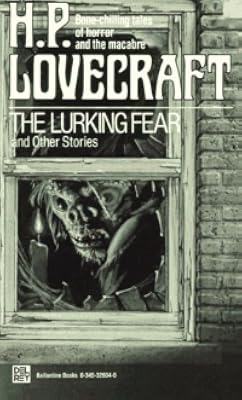
The Lurking Fear and Other Stories
by H. P. Lovecraft
On This Page
Description
H. P. Lovecraft's Cthulhu Mythos is a primary influence of countless iconic authors, and even now, nearly a century after its publication, its themes of cosmic horror and madness remain at the forefront of supernatural literature, as well as being highly influential in the mediums of music, film, and video games. But Lovecraft's expansive imagination didn't stop there. This five-story volume contains some fascinating rarities outside the Cthulhu Mythos. The Lurking Fear includes examples of show more Lovecraft's earliest weird fiction including "Hypnos," "What the Moon Brings," "Imprisoned with the Pharaohs," and "Memory," (inspiration for the 2014 film of the same name) as well as the title story, "The Lurking Fear," a traditional horror study commissioned by George Julian Houtain to be run as a serial in Home Brew magazine in 1923 that has served as the source material for multiple films and been adapted into a comic book. Only H. P. Lovecraft could conceive the delicious and spine-tingling horrors you will find within the pages of this unique five-story collection. show lessTags
Recommendations

















Member Reviews
One other reviewer here states that "everyone" is embarrassed at how influential Lovecraft is as a writer, and that HPL is "not a particularly good writer." None of the professional writers I know are at all embarrassed by Lovecraft's influence, and many have paid tribute to that influence by writing superb original fiction for such books as Ellen Datlow's LOVECRAFT UNBOUND and S. T. Joshi's BLACK WINGS. To say that Lovecraft is not a good writer is to shew an ignorance in regard to that which constitutes good writing. Lovecraft is a GREAT writer, a writer in complete control of his narrative voices, the variety of which is perfectly suited to each of the stories. Lovecraft's excellence and diversity, the stunning brilliance and show more originality of his enormous imagination, is revealed in this wonderful wee collection of his work.
"The Lurking Fear" (written in mid- to late November 1922) was one of the two serials that Lovecraft wrote for what was his first professional sales, to HOME BREW. He was requested to write the story in four episodic chapters, each with its own title. That printing of the tale was illustrated by Clark Ashton Smith, who had a bit of erotic fun by drawing trees and vegetation in the shape of genitalia. (I've posted these illustrations at my blog, A View from Sesqua Valley.) Although Lovecraft desired to write weird fiction that was excellent and an example of Literary Art, sometime he merely wrote an effecting eerie adventure, and "The Lurking Fear" is certainly that. The story has not influenced too many other writers, as has so much of Lovecraft's Mythos fiction; although I confess that I have written my own Sesqua Valley "version" of the story, which will be publish'd next month in the magazine FUNGI.
Completely different in narrative tone is "The White Ship" (written in October 1919), which some have said was inspired by Dunsany's "Idle Days on the Yann." The story was indeed the first that Lovecraft wrote under the influence of his discovery of the Irish fantasist, and its beautiful language is that of the prose-poem. An enchanting tale, superbly told.
Some of Lovecraft's stories (such as "The Music of Erich Zann" and "The Outsider") exist in a realm that may be either reality or dream; but Lovecraft at times insisted that he was a "realist," and "Arthur Jermyn" (written in 1920), although a tale of fantastic legend, is set absolutely in the real world. This is one of Lovecraft's tales of miscegenation--a theme that is perhaps a product of Lovecraft's grotesque and ignorant racism.
"The Hound" and "The Unnamable" are two of my all-time favourite Lovecraft tales--however minor they may be. I was annoy'd that both stories were not included in the majestic Centipede Press edition of Lovecraft in their MASTERS OF THE WEIRD TALE series. Some like to suggest that the overwriting in "The Hound" is evidence that Lovecraft meant the tale as a parody of his purple prose style--but WHY Lovecraft would wish to poke fun at his writing at the time, so early in his career, that he wrote the story (October 1922) mystifies me. The tale was composed during a period when Lovecraft had an intense interest in Literary Decadence. I love how its supernatural manifestations are filled with mystic ambiguity--as such things should be. "The Unnamable" is fascinating in that with it Lovecraft discusses the validity of supernatural fiction as Literature.
"The Shadow Over Innsmouth" is tainted, again, by Lovecraft's xenophobia. I do not mind that Lovecraft was a racist, because it colored his Work in very interesting ways; and today the stupidity of Lovecraft's racist views can lead to vital and important discussions concerning race in America, a dialogue that is ever-important. *spoilers alert* And yet how fascinating, that in this tale of the repugnant Other, the narrator, at the end, not only embraces his alien heritage, but absolutely embraces it, joyously. As a tale of weird horror, this story is a masterpiece, original and brimming over with awesome suggestions, unearthly horror, and adventurous expectancy. The chase scene is one of Lovecraft's completely effective moments of awesome and unrelenting horror.
This is a great wee book, and would serve as a perfect introduction to a friend who is coming to Lovecraft for the first time. show less
"The Lurking Fear" (written in mid- to late November 1922) was one of the two serials that Lovecraft wrote for what was his first professional sales, to HOME BREW. He was requested to write the story in four episodic chapters, each with its own title. That printing of the tale was illustrated by Clark Ashton Smith, who had a bit of erotic fun by drawing trees and vegetation in the shape of genitalia. (I've posted these illustrations at my blog, A View from Sesqua Valley.) Although Lovecraft desired to write weird fiction that was excellent and an example of Literary Art, sometime he merely wrote an effecting eerie adventure, and "The Lurking Fear" is certainly that. The story has not influenced too many other writers, as has so much of Lovecraft's Mythos fiction; although I confess that I have written my own Sesqua Valley "version" of the story, which will be publish'd next month in the magazine FUNGI.
Completely different in narrative tone is "The White Ship" (written in October 1919), which some have said was inspired by Dunsany's "Idle Days on the Yann." The story was indeed the first that Lovecraft wrote under the influence of his discovery of the Irish fantasist, and its beautiful language is that of the prose-poem. An enchanting tale, superbly told.
Some of Lovecraft's stories (such as "The Music of Erich Zann" and "The Outsider") exist in a realm that may be either reality or dream; but Lovecraft at times insisted that he was a "realist," and "Arthur Jermyn" (written in 1920), although a tale of fantastic legend, is set absolutely in the real world. This is one of Lovecraft's tales of miscegenation--a theme that is perhaps a product of Lovecraft's grotesque and ignorant racism.
"The Hound" and "The Unnamable" are two of my all-time favourite Lovecraft tales--however minor they may be. I was annoy'd that both stories were not included in the majestic Centipede Press edition of Lovecraft in their MASTERS OF THE WEIRD TALE series. Some like to suggest that the overwriting in "The Hound" is evidence that Lovecraft meant the tale as a parody of his purple prose style--but WHY Lovecraft would wish to poke fun at his writing at the time, so early in his career, that he wrote the story (October 1922) mystifies me. The tale was composed during a period when Lovecraft had an intense interest in Literary Decadence. I love how its supernatural manifestations are filled with mystic ambiguity--as such things should be. "The Unnamable" is fascinating in that with it Lovecraft discusses the validity of supernatural fiction as Literature.
"The Shadow Over Innsmouth" is tainted, again, by Lovecraft's xenophobia. I do not mind that Lovecraft was a racist, because it colored his Work in very interesting ways; and today the stupidity of Lovecraft's racist views can lead to vital and important discussions concerning race in America, a dialogue that is ever-important. *spoilers alert* And yet how fascinating, that in this tale of the repugnant Other, the narrator, at the end, not only embraces his alien heritage, but absolutely embraces it, joyously. As a tale of weird horror, this story is a masterpiece, original and brimming over with awesome suggestions, unearthly horror, and adventurous expectancy. The chase scene is one of Lovecraft's completely effective moments of awesome and unrelenting horror.
This is a great wee book, and would serve as a perfect introduction to a friend who is coming to Lovecraft for the first time. show less
Another nasty one. In spite of what I said earlier about my appreciation for Lovecraft's corrupt protagonists, it was rather nice to run across one who wasn't himself revolting. Unfortunately, I thought this was going to throw some light on the terrible beyond (when he mentioned that he had finally found one of the horrors we are normally protected from by our limited senses), but then it turned into another encounter with inbred white apes . Lovecraft found the idea of devolution hideous, let me tell you.
(Moved 2016 review to the individual work Sept. 2017 to make room to review the collection under its own entry.)
(Moved 2016 review to the individual work Sept. 2017 to make room to review the collection under its own entry.)
I really love the storytelling here, but holy *censored* that's some racism front and center. Makes Kipling's Empire-centric stuff look like dabbling.
This collection has enough classic Lovecraft to see both why he's so influential, and why everyone is a little embarassed about how influential he is. He's honestly not a particularly good writer, but it's good fun and the atmosphere he's trying for is a worthy target. It's just that he seems to believe that telling you to be frightened and awed at the unknowable grandeur of the universe will make you... well, frightened and awed at the unknowable grandeur of the universe. But you should be, because you know, he was certainly frightened and awed at the unknowable grandeur of the universe. You can tell, because he tells you so. Repeatedly.
The style is wonderfully parody-prone -- I highly recommend Neil Gaimans "Shoggoth's Old Peculiar". show more Original Lovecraft is enjoyable, but it completely fails to produce serious emotions, so you might as well have a giggle instead. show less
The style is wonderfully parody-prone -- I highly recommend Neil Gaimans "Shoggoth's Old Peculiar". show more Original Lovecraft is enjoyable, but it completely fails to produce serious emotions, so you might as well have a giggle instead. show less
The collection contains The Shadow Over Innsmouth. Of the Lovecraft stories I've read, this is one of the best.
Dagon (7.0) - Short and sweet. Lost at sea, protagonist finds a section of the ocean depths that has risen to the surface. Giant monolith and statues and then Dagon. He escapes and the deep ones come to get him.
The Hound (7.0) - Two grave robbers unearth an unholy grave and are hunted by the baying of some unearthly monster.
The Lurking Fear (6.0) - This seemed rather shoddily put together. It was often too over the top with undescribable horror (even for Lovecraft).
The Moon Bog (6.5) - Guy moves in to home of ancestors and decides to empty out the bog. He invites a friend who tells the story of how the creatures come out and then lead humans into the bog to become more twisted creatures. Pretty standard.
The Outsider (7.0) - Not show more sure when I originally read this story but I never forgot it. This is the one where the narrator has lived all his life in a closed off castle and doesn't realize he's a monster until he sees a mirror.
The Temple (6.0) - Seemed like a Lovecraft story written by someone else. German sub in WWI finds amulet on body of victim and then everyone goes crazy and sub ends up on ocean floor in ancient ruins.
The Unnamable (7.0) - Thought this was nonfiction at first because main character was a writer that basically was Lovecraft but named Carter. Different is good. It was a bit scary but more philosophical.
Arthur Jermyn (8.0) - Don't Remember
Beyond the Wall of Sleep (?) - Don't Remember
From Beyond (?) - Don't Remember
The Shadow Over Innsmouth (8.0) - Don't Remember, other than it was great.
The White Ship (?) - Don't Remember show less
The Hound (7.0) - Two grave robbers unearth an unholy grave and are hunted by the baying of some unearthly monster.
The Lurking Fear (6.0) - This seemed rather shoddily put together. It was often too over the top with undescribable horror (even for Lovecraft).
The Moon Bog (6.5) - Guy moves in to home of ancestors and decides to empty out the bog. He invites a friend who tells the story of how the creatures come out and then lead humans into the bog to become more twisted creatures. Pretty standard.
The Outsider (7.0) - Not show more sure when I originally read this story but I never forgot it. This is the one where the narrator has lived all his life in a closed off castle and doesn't realize he's a monster until he sees a mirror.
The Temple (6.0) - Seemed like a Lovecraft story written by someone else. German sub in WWI finds amulet on body of victim and then everyone goes crazy and sub ends up on ocean floor in ancient ruins.
The Unnamable (7.0) - Thought this was nonfiction at first because main character was a writer that basically was Lovecraft but named Carter. Different is good. It was a bit scary but more philosophical.
Arthur Jermyn (8.0) - Don't Remember
Beyond the Wall of Sleep (?) - Don't Remember
From Beyond (?) - Don't Remember
The Shadow Over Innsmouth (8.0) - Don't Remember, other than it was great.
The White Ship (?) - Don't Remember show less
Wow the racism
Members
- Recently Added By
Lists

Weird and Weirder Fiction
270 works; 35 members

Stephen King's Biggest Influences
46 works; 3 members

Jones and Newman's Horror: The 100 Best Books
100 works; 4 members

Best Horror Mega-List
342 works; 6 members

To Read - Horror
137 works; 14 members
Author Information

1,930+ Works 73,952 Members
Howard Phillips Lovecraft, 1890 - 1937 H. P. Lovecraft was born on August 20, 1890 in Providence, Rhode Island. His mother was Sarah Susan Phillips Lovecraft and his father was Winfield Scott Lovecraft, a traveling salesman for Gorham & Co. Silversmtihs. Lovecraft was reciting poetry at the age of two and when he was three years old, his father show more suffered a mental breakdown and was admitted to Butler Hospital. He spent five years there before dying on July 19, 1898 of paresis, a form of neurosyphillis. During those five years, Lovecraft was told that his father was paralyzed and in a coma, which was not the case. His mother, two aunts and grandfather were now bringing up Lovecraft. He suffered from frequent illnesses as a boy, many of which were psychological. He began writing between the ages of six and seven and, at about the age of eight, he discovered science. He began to produce the hectographed journals, "The Scientific Gazette" (1899-1907) and "The Rhode Island Journal of Astronomy" (1903-07). His first appearance in print happened, in 1906, when he wrote a letter on an astronomical matter to The Providence Sunday Journal. A short time later, he began writing a monthly astronomy column for The Pawtuxet Valley Gleaner - a rural paper. He also wrote columns for The Providence Tribune (1906-08), The Providence Evening News (1914-18), The Asheville (N.C.) Gazette-News (1915). In 1904, his grandfather died and the family suffered severe financial difficulties, which forced him and his mother to move out of their Victorian home. Devastated by this, he apparently contemplated suicide. In 1908, before graduating from high school, he suffered a nervous breakdown. He didn't receive a diploma and failed to get into Brown University, both of which caused him great shame. Lovecraft was not heard from for five years, re-emerging because of a letter he wrote in protest to Fred Jackson's love story in The Argosy. His letter was published in 1913 and caused great controversy, which was noted by Edward F. Daas, President of the United Amateur Press Association (UAPA). Daas invited Lovecraft to join the UAPA, which he did in early 1914. He eventually became President and Official Editor of the UAPA and served briefly as President of the rival National Amateur Press Association (NAPA). He published thirteen issues of his own paper, The Conservative (1915-23) and contributed poetry and essays to other journals. He also wrote some fiction which titles include "The Beast in the Cave" (1905), "The Alchemist" (1908), "The Tomb" and "Dagon" (1917). In 1919, Lovecraft's mother was deteriorating, mentally and physically, and was admitted to Butler Hospital. On May 24, 1921, his mother died from a gall bladder operation. While attending an amateur journalism convention in Boston, Lovecraft met his future wife Sonia Haft Greene, a Russian Jew. They were married on March 3, 1924 and Lovecraft moved to her apartment in Brooklyn. Sonia had a shop on Fifth Avenue that went bankrupt. In 1925, Sonia went to Cleveland for a job and Lovecraft moved to a smaller apartment in the Red Hook district of Brooklyn. In 1926, he decided to move back to Providence. Lovecraft had his aunts bar his wife, Sonia, from going to Providence to start a business because he couldn't have the stigma of a tradeswoman wife. They were divorced in 1929. After his return to Providence, he wrote his greatest fiction, which included the titles "The Call of Cthulhu" (1926), "At the Mountains of Madness" (1931), and "The Shadow Out of Time" (1934-35). In 1932, his aunt, Mrs. Clark, died; and he moved in with his other aunt, Mrs. Gamwell, in 1933. Suffering from cancer of the intestine, Lovecraft was admitted to Jane Brown Memorial Hospital and on March 15, 1937 he died. (Bowker Author Biography) show less
Awards and Honors
Notable Lists
Series
Belongs to Publisher Series
Work Relationships
Is contained in
Contains
Common Knowledge
Classifications
Statistics
- Members
- 1,072
- Popularity
- 23,919
- Reviews
- 10
- Rating
- (3.78)
- Languages
- English, French
- Media
- Paper, Audiobook, Ebook
- ISBNs
- 27
- ASINs
- 37