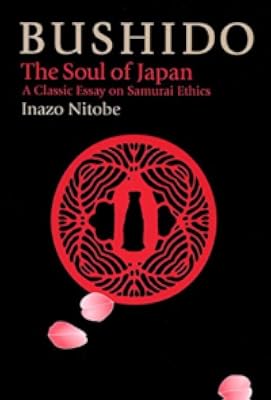
Bushido: The Soul of Japan
by Nitobe Inazō, Akiko Shimojima (Illustrator)
On This Page
Description
Bushido, often translated as Way of the Warrior, came from the Samurai way of life and moral code. It emphasized loyalty, skill, moderation and honor, and became a widespread influence throughout Japan. In Shogakukan Kokugo Daijiten, the Japanese dictionary, "Bushido is defined as a unique philosophy (ronri) that spread through the warrior class from the Muromachi (chusei) period." Nitobe Inazo, in his book Bushido: The Soul of Japan, described it in this way. "...Bushido, then, is the code show more of moral principles which the samurai were required or instructed to observe... More frequently it is a code unuttered and unwritten... It was an organic growth of decades and centuries of military career.". show less
Tags
Recommendations













Member Reviews
This book is short, and accessibly written (provided you view ordinary late nineteenth-century writing as accessible).
When reading this book, it is important to remember two things:
1. It was written in 1900. The approach and the ethics therefore reflect the attitudes and society of the nineteenth century, not the twenty-first.
2. It was written by a Japanese man who had seen the fall of the feudal system, to explain Japanese and, particularly, samurai culture to Westerners. In fact, it was originally written in English and only later translated into Japanese.
Some people have criticised this book for its ethics in general - but I think this is unjust, as it's a book of its time. Although there are parts which do more than merely raise show more eyebrows, it is only fair to the book, and to the author, to acknowledge that our ethics are a century away from Nitobe's. It is unfair to expect a nineteenth-century Japanese man to have exactly the same moral values as twenty-first century Westerners.
Others have criticised the book for its very intent: to explain Japanese culture in terms that Westerners could understand. Again, it's very easy to criticise from our twenty-first century internet-enabled Western point of view. If we want to know about Japan, or any other country, we can look it up on the internet in a few moments. In fact, nowadays, it's very hard not to know at least a little about other cultures unless you deliberately shut yourself off.
It was different at the end of the nineteenth century: Japan had only just emerged from its isolation, and not only was its culture strange to the Western world, but most societies were much less multicultural than they are now, so people were less likely to have encountered a culture other than their own.
Thus, Nitobe discusses Bushido with lots of Western and Christian comparisons and examples, because these are what will make sense to his chosen audience.
The result is a very interesting book.
Nitobe himself was born in 1862, so he was eight years old when feudalism was abolished, and ten when the carrying of swords was forbidden. This not only gives Nitobe a unique perspective, but also means that when the book was written, many Japanese people would have remembered the feudal system. To them, it was not some foreign (or even barbaric) practice - it was their own culture. It was normal.
So with this book, there is a strange mix of explanation and defence. Nowadays, it's shocking to read the story of an eight-year-old samurai boy being order to commit seppuku (ceremonial suicide by disembowelment) and actually doing it. But under bushido - and to Nitobe, who seems to have been of the samurai class himself, or close to it - the story emphasises the strength of devotion to duty, and courage, of even samurai children.
The attitude to women, too, is shocking nowadays. However, it's important to remember that since this was written in 1900, the attitude to women in the West wasn't much different. Admittedly, young girls in the West weren't given daggers in case they needed to commit suicide to protect their honour - but then, neither were boys. If you read much about the life of women in the West during the late 19th century, you do wonder who had the better deal: the samurai girl in feudal Japan, or the middle-class young woman in London.
All in all, this is a very interesting and thought-provoking book - and not the least because it's not written as a scholarly study by an outsider, but by a man trying to explain (and, in some senses, justify) his own culture. It therefore has the result of telling the reader perhaps more about feudal Japanese society and culture than even the author intended. show less
When reading this book, it is important to remember two things:
1. It was written in 1900. The approach and the ethics therefore reflect the attitudes and society of the nineteenth century, not the twenty-first.
2. It was written by a Japanese man who had seen the fall of the feudal system, to explain Japanese and, particularly, samurai culture to Westerners. In fact, it was originally written in English and only later translated into Japanese.
Some people have criticised this book for its ethics in general - but I think this is unjust, as it's a book of its time. Although there are parts which do more than merely raise show more eyebrows, it is only fair to the book, and to the author, to acknowledge that our ethics are a century away from Nitobe's. It is unfair to expect a nineteenth-century Japanese man to have exactly the same moral values as twenty-first century Westerners.
Others have criticised the book for its very intent: to explain Japanese culture in terms that Westerners could understand. Again, it's very easy to criticise from our twenty-first century internet-enabled Western point of view. If we want to know about Japan, or any other country, we can look it up on the internet in a few moments. In fact, nowadays, it's very hard not to know at least a little about other cultures unless you deliberately shut yourself off.
It was different at the end of the nineteenth century: Japan had only just emerged from its isolation, and not only was its culture strange to the Western world, but most societies were much less multicultural than they are now, so people were less likely to have encountered a culture other than their own.
Thus, Nitobe discusses Bushido with lots of Western and Christian comparisons and examples, because these are what will make sense to his chosen audience.
The result is a very interesting book.
Nitobe himself was born in 1862, so he was eight years old when feudalism was abolished, and ten when the carrying of swords was forbidden. This not only gives Nitobe a unique perspective, but also means that when the book was written, many Japanese people would have remembered the feudal system. To them, it was not some foreign (or even barbaric) practice - it was their own culture. It was normal.
So with this book, there is a strange mix of explanation and defence. Nowadays, it's shocking to read the story of an eight-year-old samurai boy being order to commit seppuku (ceremonial suicide by disembowelment) and actually doing it. But under bushido - and to Nitobe, who seems to have been of the samurai class himself, or close to it - the story emphasises the strength of devotion to duty, and courage, of even samurai children.
The attitude to women, too, is shocking nowadays. However, it's important to remember that since this was written in 1900, the attitude to women in the West wasn't much different. Admittedly, young girls in the West weren't given daggers in case they needed to commit suicide to protect their honour - but then, neither were boys. If you read much about the life of women in the West during the late 19th century, you do wonder who had the better deal: the samurai girl in feudal Japan, or the middle-class young woman in London.
All in all, this is a very interesting and thought-provoking book - and not the least because it's not written as a scholarly study by an outsider, but by a man trying to explain (and, in some senses, justify) his own culture. It therefore has the result of telling the reader perhaps more about feudal Japanese society and culture than even the author intended. show less
While the writing style and references to current events date the book academically, I found the book engaging and informative. Especially interesting was to read about the Way of the Bushi from a culture that was directly descended from it, rather than its grandchild. The only bit that soured me was the poo-pooing of the women's rights movement. I would recommend this book for a unique and nearly internal view of Bushido culture.
I have mixed feelings about this book. At the time of this review, this book was written over a century before, and while I do think it's a worthwhile read as a study in Japanese history, it's not too impressive on its own.
One thing should be clear - this is not a how-to guide to Bushido or anything. Rather. it is a long essay (broken into chapters) of various tenets of Bushido (honor, obedience, self-discipline, a woman's position, and yes, seppuku/hara-kiri) as viewed/explained by a Japanese man who has had a Western education.
Fortunately, this book is a relatively quick read, and does actually offer Westerners some points and ways to better understand Bushido and Japanese tradition.
One thing should be clear - this is not a how-to guide to Bushido or anything. Rather. it is a long essay (broken into chapters) of various tenets of Bushido (honor, obedience, self-discipline, a woman's position, and yes, seppuku/hara-kiri) as viewed/explained by a Japanese man who has had a Western education.
Fortunately, this book is a relatively quick read, and does actually offer Westerners some points and ways to better understand Bushido and Japanese tradition.
I've always found Japanese history, particularly that of the Samurai, fascinating. But living on the other side of the world in a completely different time in a completely different culture one can never truly know what these people and the time and place they lived in was really like.
What we can do is simply enjoy these snap shots from the past about a culture long gone that we may still have something to learn from.
Originally published in 1900 the setting for this book is between the end of feudalism and the beginning of modern Japan and is, to my mind at least, a wonderful view of the past and what that can possibly mean for the future.
A very interesting book for anyone who enjoys reading and learning about Japan, especially the show more historical influences of Bushido on modern Japan.
I gave it 4 stars as it does use some very long words and i did find myself using look-up on my Kindle a great deal which does detract from the flow of the book. But it's definitely worth the effort and you do learn a few things along the way. show less
What we can do is simply enjoy these snap shots from the past about a culture long gone that we may still have something to learn from.
Originally published in 1900 the setting for this book is between the end of feudalism and the beginning of modern Japan and is, to my mind at least, a wonderful view of the past and what that can possibly mean for the future.
A very interesting book for anyone who enjoys reading and learning about Japan, especially the show more historical influences of Bushido on modern Japan.
I gave it 4 stars as it does use some very long words and i did find myself using look-up on my Kindle a great deal which does detract from the flow of the book. But it's definitely worth the effort and you do learn a few things along the way. show less
This slim volume talks about the various precepts of Bushido. One chapter easily segues into the next and covers seven essential virtues, along with the history and potential future of Bushido.
I enjoyed it a lot, though I suppose I was expecting it to be longer, in one sense it is good that it wasn't really lengthy. It gets to the point by naming a number of European counterparts for each virtue and how Europe fared under their Feudal System. The author is well read, he is familiar with Cato, Shakespeare, Virgil and others.
I enjoyed it a lot, though I suppose I was expecting it to be longer, in one sense it is good that it wasn't really lengthy. It gets to the point by naming a number of European counterparts for each virtue and how Europe fared under their Feudal System. The author is well read, he is familiar with Cato, Shakespeare, Virgil and others.
Anche questo testo, come "La struttura dell'Iki" rappresenta un tentativo (da parte di un Giapponese colto e esperto di cultura occidentale) di spiegare uno degli elementi fondamentali della cultura (ma anche delle società, storia e identità) del Giappone.
Il libro è del 1899, per cui sul Bushido e sulla tradizione dei Bushi si allunga già l'ombra della modernizzazione e trasformazione del paese. L'autore ne è ben conscio, e dedica il due capitoli finali proprio alla domanda se il Bushido possa soppravvivere man mano che il Giappone si trasforma in qualcosa la cui stessa natura nulla sembra avere a che fare con quella del passato.
Il libro è del 1899, per cui sul Bushido e sulla tradizione dei Bushi si allunga già l'ombra della modernizzazione e trasformazione del paese. L'autore ne è ben conscio, e dedica il due capitoli finali proprio alla domanda se il Bushido possa soppravvivere man mano che il Giappone si trasforma in qualcosa la cui stessa natura nulla sembra avere a che fare con quella del passato.
What I actually got out of the book is what an educated Japanese man at the turn of the century thought of European culture. The parallels he draws between Japanese and European culture are pretty awesome.
Members
- Recently Added By
Lists

Top Five Books of 2014
1,064 works; 398 members

Used books to buy next
565 works; 1 member

Reading LIst
648 works; 1 member
Author Information

44 Works 1,707 Members
Some Editions
Series
Belongs to Publisher Series
Common Knowledge
- Canonical title
- Bushido: The Soul of Japan
- Alternate titles
- Bushidō
- Original publication date
- 1908
- People/Characters
- Nitobe Inazō
- Important places
- Japan
- Important events
- Meiji era
- Epigraph
- --that way
Over the mountain, which who stands upon,
Is apt to doubt if it be indeed a road;
While if he views it from the waste itself,
Up goes the line there, plain from base to brow
Not vague, mistakable! W... (show all)hat's a break or two
Seen from the unbroken desert either side?
And then (to bring in the fresh philosophy)
What if the breaks themselves should prove at last
The most consumate of contrivances
To train a man's eye, teach him what is faith?
--William Browning Spencer, Bishop Blougram's Apology
There are, if I may so say, three powerful spirits, which have from time to time, moved on the face of the waters, and given a predominant impulse to the moral sentiments and energies of mankind. These are the spirits of lib... (show all)erty, of religion, and of honor.
--Hallam, Europe in the Middle Ages
Chivalry is itself the poetry of life.
--Schlegel, Philosophy of History - Dedication
- To my beloved uncle Tokitoshi Ota who taught me to revere the past and to admire the deeds of the samurai I dedicate this little book.
- First words
- (Preface): About ten years ago, while spending a few days under the hospitable roof of the distinguished Belgian jurist, the lamented M. de Laveleye, our conversation turned, during one of our rambles, to the subject of relig... (show all)ion.
Chivalry is a flower no less indigenous to the soil of Japan than its emblem, the cherry blossom; nor is it a dried-up specimen of an antique virtue preserved in the herbarium of our history. - Last words
- (Click to show. Warning: May contain spoilers.)The benediction of the air.
- Blurbers
- Goette, John
- Original language
- English
Classifications
- Genres
- Nonfiction, Philosophy, Sports and Leisure, History, General Nonfiction, Religion & Spirituality
- DDC/MDS
- 170.440952 — Philosophy & psychology Ethics Animals rights, Euthanasia, Pro-life Essays; Special Topics Normativity Asia Japan
- LCC
- BJ971 .B8 .N58 — Philosophy, Psychology and Religion Ethics Ethics History and general works
- BISAC
Statistics
- Members
- 1,342
- Popularity
- 17,896
- Reviews
- 19
- Rating
- (3.69)
- Languages
- 14 — Catalan, Chinese, Czech, English, Estonian, Finnish, French, German, Italian, Japanese, Polish, Portuguese, Romanian, Spanish
- Media
- Paper, Audiobook, Ebook
- ISBNs
- 151
- UPCs
- 1
- ASINs
- 30
