
On This Page
Description
Young and unassuming Rabbi David Small sorts through puzzling pieces of mysteries with logic straight from the Talmud. In Friday the Rabbi Slept Late, a shocking discovery on the temple grounds threatens to ruin both the diligent rabbi and the entire Jewish community at Barnard's Crossing. Unaware that his congregation is grumbling about his rumpled appearance and absent-minded manner, Rabbi Small spends long hours poring over scholarly books. But he is forced to face his congregants' show more discontent when the police discover a young woman's body outside the temple-and her handbag in his car. Suddenly Rabbi Small must study motives and uncover the killer, or lose more than his followers. Best-selling author Harry Kemelman fills his shrewdly plotted mysteries with likeable and cunning characters who could be your next door neighbors. Personally approved for this unabridged recording by the author's estate, veteran narrator George Guidall expertly brings the harried rabbi and his mutinous congregation to life. show lessTags
Recommendations























Member Reviews
I know I sampled these books when I was in my late teens (they were relatively new at that time), but remember very little about them. I think they may have been too "instructive" for me then. This first entry in the series is almost more a primer on Judaism than a mystery novel, and at this point in my life, with a better foundation of knowledge of that subject, I loved it. Rabbi Small, assigned to a Conservative congregation near Boston, finds himself somewhat at odds with many of the members, who seem more interested in the social aspects of the temple than in practicing their religion. With his contract up for discussion by the Board, it isn't helpful when the body of a young woman is found propped against the low wall between the show more temple's parking lot and its grassy lawn, and her purse turns up inside the Rabbi's car which had been parked in the lot overnight. Naturally the Rabbi must be considered a suspect, though even the investigating police chief does not expect him to turn out to be a murderer (or even an adulterer), and the Rabbi himself is barely bothered by the possibility. Board members are divided on whether it would be good or bad to terminate his contract, and keep postponing a vote. Rabbi Small is a sleuth of the cerebral variety, in company with Poirot/Wolfe/Holmes, not the gumshoe variety, so there isn't a lot of action in this novel. His Talmudic training makes him very well suited to methodical exploration of the facts and circumstances, leading to the real culprit and a tidy solution. Also in common with the big three mentioned above, the Rabbi is a man to be admired, not necessarily to be liked. As his wife mentions to Chief Lanigan, "David may change the world, but the world will never change David." Amen to that, is what I say. show less
Rabbi Small becomes the chief suspect when a woman's body is found in the synagogue's parking lot. His car had been parked there late, and the woman's purse was found inside. Meanwhile his contract is up for renewal, and the synagogue's board is divided. While the evidence points to the rabbi, even the local police chief isn't convinced he did it. The rabbi uses his own reasoning skills to solve the mystery. I expected to like it a little more than I did, but I was more distracted than normal so that could have been a factor.
When a young woman’s body is found near the Jewish temple in a small town in Massachusetts, the young rabbi comes under suspicion. After all, the woman’s handbag was found in his car. Rabbi Small uses his Talmudic reasoning skills to deduce the killer’s identity. Meanwhile, Rabbi Small is nearing the end of his first year with his congregation, and the board is divided about extending his contract for another year.
I’ve been aware of this series for as long as I can remember. I’m not sure what took me so long to start it. I love the logical, analytical nature of this book. Readers can use the same logic to arrive at the same conclusion as the rabbi. There are other fictional detectives who use logic and reason to solve crimes, show more such as Christie’s Poirot with his “little grey cells” and Stout’s Nero Wolfe in his arm chair. Rabbi Small isn’t as intimidating as these other fictional detectives. His mind isn’t a black box for the reader. The reader knows exactly what he’s thinking. The audio version is narrated by one of my favorite readers, George Guidall. If the series continues the way it began, I can see it becoming one of my favorites. show less
I’ve been aware of this series for as long as I can remember. I’m not sure what took me so long to start it. I love the logical, analytical nature of this book. Readers can use the same logic to arrive at the same conclusion as the rabbi. There are other fictional detectives who use logic and reason to solve crimes, show more such as Christie’s Poirot with his “little grey cells” and Stout’s Nero Wolfe in his arm chair. Rabbi Small isn’t as intimidating as these other fictional detectives. His mind isn’t a black box for the reader. The reader knows exactly what he’s thinking. The audio version is narrated by one of my favorite readers, George Guidall. If the series continues the way it began, I can see it becoming one of my favorites. show less
I'm writing this review while midway through listening to the third book in the series, so some of the oddities I found in the first book aren't so odd anymore, now that I realize how this series works. Listening to this well-performed audiobook, I kept waiting for the crime, but the book just goes on and on and no crime! Finally, it occurs about midway, which is the case for the second and third books as well. But the crime really isn't the center of the book. The center of the book is Rabbi Small and his struggles to survive in his synagogue against members who want him out for one reason or another. The crime (or I guess it's always a murder?) in each book merely gives the Rabbi an avenue for winning over or at least blunting the show more efforts of his adversaries in the synagogue. Along the way, we get a lot of the Rabbi's philosophy about Judaism and its differences from various type of Christianity, particularly Catholicism, since the small town's police chief, who becomes a friend of the Rabbi is Catholic. It is interesting to read this book after reading Tod Goldberg's Gangsterland trilogy, about someone pretending to be a Rabbi. Kemelman's books are a lot more sedate, and the mystery in the two I have finished is probably something you can figure out if you think hard enough. All the clues appear to be there, but the pleasure in listening here is to see the Rabbi outwit the members of his congregation who are trying to damage his career. More in my second review. show less
After a slow start, the Rabbi came through. A red herring or two, a couple of likable characters, and a not-incompetent police chief made for some interesting stops along the way.
It begins with a group of Jewish men, waiting for the tenth so that they can start morning prayers.
“The rabbi… strolled up and down the center aisle, not impatiently, but like a man who has arrived early at the railroad station. Snatches of conversation reached him: talk about business, about family and children, about vacation plans, about the chances of the Red Sox. It was hardly the proper conversation for men waiting to pray, he thought, and then immediately rebuked himself. Was it not also a sin to be too devout? Was not man expected to enjoy the good show more things of this life? the pleasure of family? of work–and of resting from work? He was still very young, not quite thirty, and introspective, so that he could not help raising questions, and then questioning the questions.”
Interestingly, despite being the titular character, we don’t spend as much time as I expected with the rabbi. Instead, the third person limited narration is shared. We spend a few scenes with Mr. Wasserman, “the elderly president of the congregation,” as he tends to the question of whether or not they will renew the rabbi’s contract for another year. There’s also a couple of chapters from the very-much-alive Elspeth Bleech, who unfortunately will not be alive much longer, as well as a couple centering on the temperamental Al Becker, car dealership owner, and Stanley Doble, chief maintenance man for the temple.
Even more interesting is that it takes so long to get to the actual murder (spoiler: chapter something, for those with bad memories). Definitely a different pace than what I’m accustomed to. Between the viewpoints that act almost like character studies and the pacing, it felt a little be more like an exploration of life in a small town.
What really sets it apart is the focus on Jewish culture, in the ethnic, cultural and religious senses. Though the rabbi is young, he finds he’s often in the role of instructing much older members of his congregation. In fact, early on in the story, there’s a dispute among two members and Wasserman encourages them to bring it to the rabbi. The rabbi suggests a Din Torah, which is a hearing, or judgement, on the case, using the Talmud as a reference for the principles of damage and responsibility. It becomes an interesting little example of the dynamics of how the rabbi works and the dynamics of the members of the synagogue.
Unsurprisingly, issues of ethnical and religious perception by the community at large continue to be raised throughout the story. For a 1965 book, it remains rather sedate, but shows the degree to which communities are often intolerant of the ‘Other,’ particularly when it reminds them of their own failures.
There’s a few easy plot points–I won’t list, for risk of spoilers, but I thought them tolerablethe rabbi was never really under deep suspicion, which was interesting. And the police chief made friends with him practically instantly, which seems problematic during an investigation . I was surprised at the murderer, so good on Kemelman for that.
I remember seeing these books when I was a kid, in the paperback carousel at the library. Since the Rabbi series has been around since1964, I can’t say for certain if I ever read any of the books. But with an e-deal on a four-box set (I don’t even know what that means), I had a feeling it would be worth it. I’m glad that I have three more in store.
Three and a half stars, rounding down so I have somewhere to go for the next. And the pacing. show less
It begins with a group of Jewish men, waiting for the tenth so that they can start morning prayers.
“The rabbi… strolled up and down the center aisle, not impatiently, but like a man who has arrived early at the railroad station. Snatches of conversation reached him: talk about business, about family and children, about vacation plans, about the chances of the Red Sox. It was hardly the proper conversation for men waiting to pray, he thought, and then immediately rebuked himself. Was it not also a sin to be too devout? Was not man expected to enjoy the good show more things of this life? the pleasure of family? of work–and of resting from work? He was still very young, not quite thirty, and introspective, so that he could not help raising questions, and then questioning the questions.”
Interestingly, despite being the titular character, we don’t spend as much time as I expected with the rabbi. Instead, the third person limited narration is shared. We spend a few scenes with Mr. Wasserman, “the elderly president of the congregation,” as he tends to the question of whether or not they will renew the rabbi’s contract for another year. There’s also a couple of chapters from the very-much-alive Elspeth Bleech, who unfortunately will not be alive much longer, as well as a couple centering on the temperamental Al Becker, car dealership owner, and Stanley Doble, chief maintenance man for the temple.
Even more interesting is that it takes so long to get to the actual murder (spoiler: chapter something, for those with bad memories). Definitely a different pace than what I’m accustomed to. Between the viewpoints that act almost like character studies and the pacing, it felt a little be more like an exploration of life in a small town.
What really sets it apart is the focus on Jewish culture, in the ethnic, cultural and religious senses. Though the rabbi is young, he finds he’s often in the role of instructing much older members of his congregation. In fact, early on in the story, there’s a dispute among two members and Wasserman encourages them to bring it to the rabbi. The rabbi suggests a Din Torah, which is a hearing, or judgement, on the case, using the Talmud as a reference for the principles of damage and responsibility. It becomes an interesting little example of the dynamics of how the rabbi works and the dynamics of the members of the synagogue.
Unsurprisingly, issues of ethnical and religious perception by the community at large continue to be raised throughout the story. For a 1965 book, it remains rather sedate, but shows the degree to which communities are often intolerant of the ‘Other,’ particularly when it reminds them of their own failures.
There’s a few easy plot points–I won’t list, for risk of spoilers, but I thought them tolerable
I remember seeing these books when I was a kid, in the paperback carousel at the library. Since the Rabbi series has been around since1964, I can’t say for certain if I ever read any of the books. But with an e-deal on a four-box set (I don’t even know what that means), I had a feeling it would be worth it. I’m glad that I have three more in store.
Three and a half stars, rounding down so I have somewhere to go for the next. And the pacing. show less
The rabbi of the title is David Small, a quiet, rumpled Talmudic scholar who is employed by a congregation of Conservative Jews in a small New England town. When a young woman turns up dead in the temple's parking lot, and her handbag is found in Rabbi Small's car, the congregation faces a crisis. The rabbi is a suspect, as are a Jewish businessman and the temple custodian. The town's latent anti-Semitism is inflamed as well. Fortunately, the rabbi's Talmudic reasoning skills help him solve the crime before the police do.
In a unlikely subplot considering that he is a suspect in a murder case, Rabbi Small strikes up a friendship with the town's Irish Catholic police chief. The two men spend a lot of time talking about the differences show more between their religions. These rather didactic conversations explain the tenets and practices of the Conservative branch of Judaism to the non-Jewish reading audience.
This novel, which was first published over fifty years ago, is dated to say the least, especially in its portrayal of its passive female characters. Nonetheless, this period piece is a mildly entertaining, and even somewhat educational, read. show less
In a unlikely subplot considering that he is a suspect in a murder case, Rabbi Small strikes up a friendship with the town's Irish Catholic police chief. The two men spend a lot of time talking about the differences show more between their religions. These rather didactic conversations explain the tenets and practices of the Conservative branch of Judaism to the non-Jewish reading audience.
This novel, which was first published over fifty years ago, is dated to say the least, especially in its portrayal of its passive female characters. Nonetheless, this period piece is a mildly entertaining, and even somewhat educational, read. show less
Friday the Rabbi Slept Late by Harry Kemelman is the first book in The Rabbi Small Mysteries, a series featuring a Jewish clergyman. Mr. Kemelman is a professor of English, as well as a mystery writer.
A new rabbi for Barard’s Crossing has a bit of an issue. Rabbi David Small might be implicated in a mysterious murder, all this while his contract with the temple is up for renewal.
A young nanny has been found strangled, with her handbag in the rabbi’s car. Using his experience from arguing with his fellow students, the young rabbi comes to several conclusions helping the police pinpoint the murderer
I recently bought Friday the Rabbi Slept Late by Harry Kemelman even though the book was originally published in 1964. Imagining it would show more be interesting to read a murder/mystery with insight into Judaism.
The mystery itself is just an excuse to introduce the characters, as well as, some of the Jewish religious laws and culture. There are hints of affairs, racism, perversions and out-of-marriage pregnancies.
I realize that the book was written almost 60 years ago, the society was different. The book could almost be a time capsule, especially the way husbands and wives talk to one another.
I enjoyed the logic Rabbi Small used to solve this mystery. This, of course, will never fly in real life, but if I wanted that I’d look out my window instead of settling down with a book.
The strength of this novel is the look into the cultural society of Jews in suburbia during the 1960s. Rabbi Small and other characters struggle with ethical, as well as religious issues throughout.
One of my favorite characters was police chief Hugh Lanigan. Here we have an open-minded police officer, who is efficient and capable. I don’t know why I was expecting a bumbling keystone cop but I’m glad I didn’t get it.
The book was enjoyable, even though it was a bit dated. I am not going to judge a 60 year old novel based on today’s standards, it’s simply a period piece for enjoyment. show less
A new rabbi for Barard’s Crossing has a bit of an issue. Rabbi David Small might be implicated in a mysterious murder, all this while his contract with the temple is up for renewal.
A young nanny has been found strangled, with her handbag in the rabbi’s car. Using his experience from arguing with his fellow students, the young rabbi comes to several conclusions helping the police pinpoint the murderer
I recently bought Friday the Rabbi Slept Late by Harry Kemelman even though the book was originally published in 1964. Imagining it would show more be interesting to read a murder/mystery with insight into Judaism.
The mystery itself is just an excuse to introduce the characters, as well as, some of the Jewish religious laws and culture. There are hints of affairs, racism, perversions and out-of-marriage pregnancies.
I realize that the book was written almost 60 years ago, the society was different. The book could almost be a time capsule, especially the way husbands and wives talk to one another.
I enjoyed the logic Rabbi Small used to solve this mystery. This, of course, will never fly in real life, but if I wanted that I’d look out my window instead of settling down with a book.
The strength of this novel is the look into the cultural society of Jews in suburbia during the 1960s. Rabbi Small and other characters struggle with ethical, as well as religious issues throughout.
One of my favorite characters was police chief Hugh Lanigan. Here we have an open-minded police officer, who is efficient and capable. I don’t know why I was expecting a bumbling keystone cop but I’m glad I didn’t get it.
The book was enjoyable, even though it was a bit dated. I am not going to judge a 60 year old novel based on today’s standards, it’s simply a period piece for enjoyment. show less
Members
- Recently Added By
Lists

The Guardian's 1000 Novels Everyone Must Read
1,005 works; 552 members

Favorite Series
238 works; 94 members

Edgar Award
418 works; 15 members

Books Read in 2014
2,344 works; 89 members

Books Read in 2016
4,666 works; 199 members

Books Read in 2017
4,249 works; 130 members

Books Read in 2010
631 works; 11 members

Books by Jewish Authors
68 works; 5 members

Books Read in 2021
5,361 works; 114 members
Author Information

30+ Works 7,624 Members
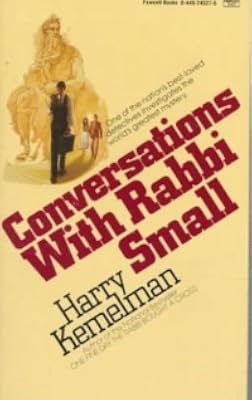
Harry Kemelman was born in Boston, Massachusetts in 1908. After studying English Literature at Boston University and earning an M.A. from Harvard University in 1931, Kemelman worked as a teacher in several Boston high schools, and later became a private businessman. During this time, he also pursued a career as a freelance writer. Kemelman is best show more known for his mystery-based rabbi books about David Small, a rabbi who solves murder cases. His early stories appeared in Ellery Queen's Mystery Magazine. His first rabbi novel, Friday the Rabbi Slept Late, received the Edgar Allan Poe Award from the Mystery Writers of America in 1964. Some of Kemelman's other novels in the rabbi series include Saturday the Rabbi Went Hungry, Sunday the Rabbi Stayed Home, Monday the Rabbi Took Off, and Conversations with Rabbi Small. He died in 1996, at the age of 88. (Bowker Author Biography) show less
Some Editions
Awards and Honors
Awards
Notable Lists
Series

Belongs to Publisher Series
Crimen & Cia. (11)
Work Relationships
Is contained in
Common Knowledge
- Canonical title
- Friday the Rabbi Slept Late
- Original title
- Friday the Rabbi Slept Late
- Original publication date
- 1964
- People/Characters
- Rabbi David Small; Miriam Small
- Important places
- Barnard's Crossing, Massachusetts, USA; Massachusetts, USA
- Related movies
- Lanigan's Rabbi (1976 | IMDb)
- Dedication
- TO MY FATHER AND MOTHER
- First words
- They sat in the chapel and waited.
- Last words
- (Click to show. Warning: May contain spoilers.)Shall we see what the Talmud says?
- Original language*
- English
*Some information comes from Common Knowledge in other languages. Click "Edit" for more information.
Classifications
Statistics
- Members
- 1,052
- Popularity
- 24,631
- Reviews
- 34
- Rating
- (3.70)
- Languages
- 12 — Czech, Danish, Dutch, English, French, German, Hungarian, Polish, Portuguese, Romanian, Spanish, Ukrainian
- Media
- Paper, Audiobook, Ebook
- ISBNs
- 46
- ASINs
- 31