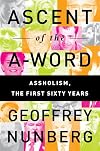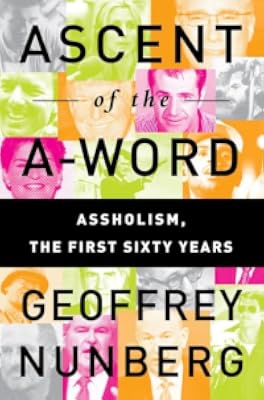
Ascent of the A-Word: Assholism, the First Sixty Years
by Geoffrey Nunberg
On This Page
Description
It first surfaced in the gripes of GIs during World War II and was captured early on by the typewriter of a young Norman Mailer. Within a generation, it had become a basic notion of our everyday moral life, replacing older reproaches like lout and heel with a single inclusive category-a staple of country outlaw songs, Neil Simon plays, and Woody Allen movies. Feminists made it their stock rebuke for male insensitivity, the est. movement used it for those who didn't "get it," and Dirty Harry show more applied it evenhandedly to both his officious superiors and the punks he manhandled. The asshole has become a focus of collective fascination for us, just as the phony was for Holden Caulfield and the cad was for Anthony Trollope. From Donald Trump to Ann Coulter, from Mel Gibson to Anthony Weiner, from the reality TV prima donnas to the internet trolls and flamers, assholism has become the characteristic form of modern incivility, which implicitly expresses our deepest values about class, relationships, authenticity, and fairness. We have conflicting attitudes about the A-word-when a presidential candidate unwittingly uttered it on a live mic in 2000, it confirmed to some that he was a man of the people and to others that he was a bore. But considering how much the word does for us, and to us, it hasn't gotten nearly the attention it deserves-at least until now. show lessTags
Recommendations




Member Reviews
You might not necessarily think that a discussion of the word "asshole" (as applied to people, not anatomy) and the concept behind it would be enough to fill an entire book, even a short-ish one like this. But, if so, you'd be wrong! Nunberg covers a lot of really interesting ground here: The nature of swearing in general and how people think about it versus how we actually use it. The question of what it is that makes someone an asshole, and the difference between how we use that word and how previous generations might have used a word like "scoundrel" or "cad." The changes in social attitudes that seem to have contributed to this particular word becoming part of our vocabulary, used in the way that it is. The attraction the figure of show more the asshole can sometimes have. The question of whether society in general is becoming less civil and more assholic. And, of course, the prominence of assholery in politics and political discussion and the capacity of both the right and the left to behave like assholes, albeit often in different ways. (On that last point, it's worth noting that this book was originally published in 2012, but if anything its social and political commentary feels even more relevant now, and not just because Donald Trump is Nunberg's go-to example of an asshole extraordinaire. Although it does end on a somewhat optimistic political note that I find it a little difficult to sustain these days.)
The book does get a little rambly in places, and sometimes re-covers the same ground a bit, but overall it's engaging, readable, entertaining and interesting. And, in places, surprisingly insightful. If I take nothing else at all from it, I am very much going to keep in my mind Nunberg's description of the "anti-asshole" principle, which describes how, once you've labelled someone as an asshole, you then often feel completely justified in being an asshole back to them, because the asshole has it coming. (Plus, it's so satisfying!) This is a familiar phenomenon, but not one I'd ever spent much time pondering or put a name to, and now that I think about it, I believe it explains a lot about modern American political discourse, and, indeed, modern American politics.
Rating: I'm going to give this one 4.5/5. A little generous, maybe, but I figure the 4 stars are for being interesting and entertaining, and the extra half-star is for actually saying sane and sensible things about politics, which seems rare enough these days that it deserves acknowledgment. show less
The book does get a little rambly in places, and sometimes re-covers the same ground a bit, but overall it's engaging, readable, entertaining and interesting. And, in places, surprisingly insightful. If I take nothing else at all from it, I am very much going to keep in my mind Nunberg's description of the "anti-asshole" principle, which describes how, once you've labelled someone as an asshole, you then often feel completely justified in being an asshole back to them, because the asshole has it coming. (Plus, it's so satisfying!) This is a familiar phenomenon, but not one I'd ever spent much time pondering or put a name to, and now that I think about it, I believe it explains a lot about modern American political discourse, and, indeed, modern American politics.
Rating: I'm going to give this one 4.5/5. A little generous, maybe, but I figure the 4 stars are for being interesting and entertaining, and the extra half-star is for actually saying sane and sensible things about politics, which seems rare enough these days that it deserves acknowledgment. show less
The A word being discussed isn't awesome. To clarify, it isn't the word awesome, though many will agree that it is an awesome word. It's asshole. It definitely is in wide use these days! The author discusses the meaning of the word as well as its history, even including a list of people he considers assholes. I don't see the point of the list because the word is very subjective so inclusion on the list is a personal choice. This book is probably quite interesting to most people, even though it is a scholarly study written by a linguist. I enjoyed the history of its usage more than the definition. I was surprised to learn that this is a fairly new word. It was used by soldiers during WWII, coming into common use in the 60's and 70's. So show more I feel like a pioneer. It is hard to imagine not having it. The alternatives pale by comparison. I suppose, when I'm driving, the other drivers would just be idiots. show less
An interesting and often entertaining cultural/historical/linguistic exploration of "asshole" as word, concept, and idea.
The A word being discussed isn't awesome. To clarify, it isn't the word awesome, though many will agree that it is an awesome word. It's asshole. It definitely is in wide use these days! The author discusses the meaning of the word as well as its history, even including a list of people he considers assholes. I don't see the point of the list because the word is very subjective so inclusion on the list is a personal choice. This book is probably quite interesting to most people, even though it is a scholarly study written by a linguist. I enjoyed the history of its usage more than the definition. I was surprised to learn that this is a fairly new word. It was used by soldiers during WWII, coming into common use in the 60's and 70's. So show more I feel like a pioneer. It is hard to imagine not having it. The alternatives pale by comparison. I suppose, when I'm driving, the other drivers would just be idiots. show less
Somewhat tedious and long winded as befits a linguist discussing the A word. However, the author does have some contributions to make.
Ratings
Members
- Recently Added By
Author Information

11+ Works 1,026 Members
He is a principal scientist at the Xerox Palo Alto Research Center & a consulting professor in the Department of Linguistics at Stanford University. He is also chair of the Usage Panel of The American Heritage Dictionary of the english Language. He lives in San Francisco. (Bowker Author Biography)
Classifications
Statistics
- Members
- 71
- Popularity
- 441,918
- Reviews
- 5
- Rating
- (3.68)
- Languages
- English
- Media
- Paper, Audiobook, Ebook
- ISBNs
- 5
- ASINs
- 1