The Dog Who Loved Too Much: Tales, Treatments and the Psychology of Dogs
by Nicholas Dodman
On This Page
Description
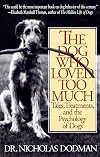
Do you have a problem pooch? What do you do with a dog who attacks the telephone whenever it rings? Or one who chases imaginary rabbits down imaginary holes? Or one who is terrified of microblinds...or turns into Cujo every time company arrives? In this warm, compassionate, entertaining, and very informative book, Dr. Nicholas Dodman, one of the premier veterinary behaviorists in the country, tells real-life stories from his practice that illustrate his unique approach to correcting show more unwanted behaviors. By making key changes in a dog's diet, exercise regime, environment, and training, Dr. Dodman has been able to work wonders with even the most difficult problems. Utilizing revolutionary discoveries in canine behaviorism and pharmacology, Dr. Dodman has given hope and help to owners whose only previous options were obedience schools, or if these failed--euthanasia. Whether you own a problem dog or just want to better understand the complex, intelligent mind of your canine companion, this is a book you won't want to miss. show lessTags
Recommendations
































Member Reviews
This is a fascinating book written by an animal behaviorist and specialist in treating dogs with very serious problems. Combining science and psychology, this guy knows his stuff when it comes to animal personalities and genetic dispositions.
Most of the cases presented were worse case scenarios. However, it was interesting to learn about dogs with issues when their owners are not with them. Our Sheltie Lilly exhibits some of the characteristics noted whenever we go away for a few days. In particular, she misses Will. She refuses to eat and mopes.
The author cites some cases wherein a dog will literally develop anorexia and starve itself because of the love he/she feels toward his/her master and the grief of not seeing that person or show more persons.
I was amazed to learn that Cocker Spaniels and English Springer Spaniels are not necessarily calm dogs and MAY exhibit behavior problems regarding children. Citing cases wherein Terrier bull dogs are inbred for aggression, the author seems to not be a proponent of obtaining puppies from pet stores or puppy mills.
Citing the human brain and dog brain are similar, many dogs develop emotional problems like humans, such as obsessive compulsive disorders. show less
Most of the cases presented were worse case scenarios. However, it was interesting to learn about dogs with issues when their owners are not with them. Our Sheltie Lilly exhibits some of the characteristics noted whenever we go away for a few days. In particular, she misses Will. She refuses to eat and mopes.
The author cites some cases wherein a dog will literally develop anorexia and starve itself because of the love he/she feels toward his/her master and the grief of not seeing that person or show more persons.
I was amazed to learn that Cocker Spaniels and English Springer Spaniels are not necessarily calm dogs and MAY exhibit behavior problems regarding children. Citing cases wherein Terrier bull dogs are inbred for aggression, the author seems to not be a proponent of obtaining puppies from pet stores or puppy mills.
Citing the human brain and dog brain are similar, many dogs develop emotional problems like humans, such as obsessive compulsive disorders. show less
This book was written in 1996 but I think still has a lot of merits to it. The authors ideas on medicating dogs for behavior issues may be valid as a last resort and not something I have read about anywhere else. He covers some topics in behavior that I have not seen specifically addressed as much. At the end of each chapter he gives a summary of signs, situations/diagnosis, and treatment suggestions.
The books gives detailed stories about people and their dog including breed, that I have seen some authors now shy away from doing that to avoid putting any stigma on a breed, and therefore leave out a key piece of information. Some of his theories and suggestions may now have different conclusions but overall a good reference book to show more compare to other books about behavior problems.
Topics include various types of Aggression including seizure related, territorial, dog on dog, and on babies. Other topics include separation anxiety, thunderstorm phobia, late onset separation anxiety, phobias against inanimate things, fear of people and fear related aggression, compulsive behavior, hallucinatory behaviors, lick granuloma, and inappropriate elimination. If you have an issue and a newer book’s solution hasn’t worked, it may be good to look at his possible solution. show less
The books gives detailed stories about people and their dog including breed, that I have seen some authors now shy away from doing that to avoid putting any stigma on a breed, and therefore leave out a key piece of information. Some of his theories and suggestions may now have different conclusions but overall a good reference book to show more compare to other books about behavior problems.
Topics include various types of Aggression including seizure related, territorial, dog on dog, and on babies. Other topics include separation anxiety, thunderstorm phobia, late onset separation anxiety, phobias against inanimate things, fear of people and fear related aggression, compulsive behavior, hallucinatory behaviors, lick granuloma, and inappropriate elimination. If you have an issue and a newer book’s solution hasn’t worked, it may be good to look at his possible solution. show less
This book was written in 1996 but I think still has a lot of merits to it. The authors ideas on medicating dogs for behavior issues may be valid as a last resort and not something I have read about anywhere else. He covers some topics in behavior that I have not seen specifically addressed as much. At the end of each chapter he gives a summary of signs, situations/diagnosis, and treatment suggestions.
The books gives detailed stories about people and their dog including breed, that I have seen some authors now shy away from doing that to avoid putting any stigma on a breed, and therefore leave out a key piece of information. Some of his theories and suggestions may now have different conclusions but overall a good reference book to show more compare to other books about behavior problems.
Topics include various types of Aggression including seizure related, territorial, dog on dog, and on babies. Other topics include separation anxiety, thunderstorm phobia, late onset separation anxiety, phobias against inanimate things, fear of people and fear related aggression, compulsive behavior, hallucinatory behaviors, lick granuloma, and inappropriate elimination. If you have an issue and a newer book’s solution hasn’t worked, it may be good to look at his possible solution. show less
The books gives detailed stories about people and their dog including breed, that I have seen some authors now shy away from doing that to avoid putting any stigma on a breed, and therefore leave out a key piece of information. Some of his theories and suggestions may now have different conclusions but overall a good reference book to show more compare to other books about behavior problems.
Topics include various types of Aggression including seizure related, territorial, dog on dog, and on babies. Other topics include separation anxiety, thunderstorm phobia, late onset separation anxiety, phobias against inanimate things, fear of people and fear related aggression, compulsive behavior, hallucinatory behaviors, lick granuloma, and inappropriate elimination. If you have an issue and a newer book’s solution hasn’t worked, it may be good to look at his possible solution. show less
This book was recommended to me by a dog trainer when my dog showed some signs of aggression. My dog didn't need medication or extensive treatment, but it was a very interesting read. Too often, I think, people give up "problem" pets without really taking the time to see how their own actions have contributed to a pet's behavior and how pets can be rehabilitated by re-training both pet AND owner.
Interesting stories from which you can learn a lot. These are extreme cases. Your dog probably doesn't need medication. -Sidney
Ratings
Members
- Recently Added By
Lists

Books about Animals
86 works; 4 members
Author Information
11 Works 818 Members
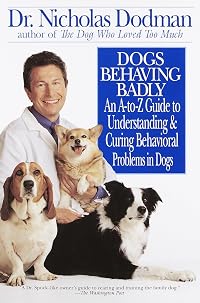
Nicholas H. Dodman is a world-renowned animal behaviorist. He is the author of The Dog Who Loved Too Much, The Cat Who Cried for Help, and Dogs Behaving Badly, and the editor of Puppy's First Steps. Currently Dr. Dodman serves as director of the Animal Behavior Clinic at Tufts University's Cummings School of Veterinary Medicine.
Classifications
Statistics
- Members
- 263
- Popularity
- 123,202
- Reviews
- 5
- Rating
- (4.09)
- Languages
- 5 — Dutch, English, Italian, Japanese, Polish
- Media
- Paper, Audiobook
- ISBNs
- 13
- ASINs
- 3