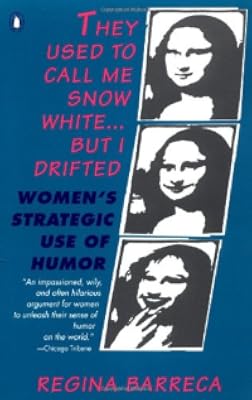
They Used to Call Me Snow White...but I Drifted: Women's Strategic Use of Humor
by Regina Barreca
On This Page
Description
With a comprehensive new introduction by the author, a reissue of the influential text on women's humorTags
Recommendations















Member Reviews
[They Used to Call Me Snow White But I Drifted] was an interesting look at the "gender politics" of humour. The author is a professor of English and of feminist theory in the U.S. She examines how girls and boys are taught about using humour, and about what is appropriately considered funny by each gender. She continues with the use of humour in adults. Some younger readers might not be familiar with all the examples of funny women she uses, but will still get the point that trusting your own sense of humour is empowering.
I read this book a few years ago after seeing Regina when she was a speaker at a conference that I went to. She is very funny and her books hit close to home. A great book for women
From Library Journal
Barreca, editor of Last Laughs: Perspectives on Women and Comedy (Gordon & Breach, 1988), explores the relationship of women and humor. She discusses the differences between men and women in how they use humor, what they think is funny and how they are perceived when telling jokes. Giving the book a strong feminist bent, Barreca theorizes that women are not encouraged to be funny and are even perceived as "bad girls" if they are funny. She quotes extensively from other researchers in the field, as well as from comediennes, authors, and cartoonists. Her coverage is extensive, ranging from Mae West to Sandra Bernhard, Emily Bronte to Erica Jong, "I Love Lucy" to "Designing Women." The added bonus is the wealth of humor show more included as examples in the book. Recommended.-- Kathy Ingels Helmond, Indiana Univ. show less
Barreca, editor of Last Laughs: Perspectives on Women and Comedy (Gordon & Breach, 1988), explores the relationship of women and humor. She discusses the differences between men and women in how they use humor, what they think is funny and how they are perceived when telling jokes. Giving the book a strong feminist bent, Barreca theorizes that women are not encouraged to be funny and are even perceived as "bad girls" if they are funny. She quotes extensively from other researchers in the field, as well as from comediennes, authors, and cartoonists. Her coverage is extensive, ranging from Mae West to Sandra Bernhard, Emily Bronte to Erica Jong, "I Love Lucy" to "Designing Women." The added bonus is the wealth of humor show more included as examples in the book. Recommended.-- Kathy Ingels Helmond, Indiana Univ. show less
Ratings
Members
- Recently Added By
Author Information

25+ Works 765 Members
Gina Barreca, professor of English and feminist theory at the University of Connecticut, is the author or editor of over twenty books including Make Mine a Double: Why Women Like Us Like to Drink (or Not).
Common Knowledge
- Original title
- They used to call me snow white.. but i drifted women's strategic use of humor
- Original publication date
- 1991
- Dedication
- In memory of my father, Hugo, and my mother, Antonine
- First words
- New Introduction: What's changed about the creation and reception of women's comedy since They Used To Call Me Snow White...But I Drifted hit the shelves in 1991?
I grew up watching The Dating Game and The Newlywed Game and soon became aware of the differences between the way men and women deal with humor (I called them boys and girls then, but the theory still holds). - Last words
- (Click to show. Warning: May contain spoilers.)What you've made is a beginning.
Classifications
Statistics
- Members
- 136
- Popularity
- 240,303
- Reviews
- 3
- Rating
- (3.40)
- Languages
- English
- Media
- Paper, Ebook
- ISBNs
- 4
- ASINs
- 3